Army Lists the Crusades
Total Page:16
File Type:pdf, Size:1020Kb
Load more
Recommended publications
-
Was There a Custom of Distributing the Booty in the Crusades of the Thirteenth Century?
Benjámin Borbás WAS THERE A CUSTOM OF DISTRIBUTING THE BOOTY IN THE CRUSADES OF THE THIRTEENTH CENTURY? MA Thesis in Late Antique, Medieval and Early Modern Studies Central European University Budapest May 2019 CEU eTD Collection WAS THERE A CUSTOM OF DISTRIBUTING THE BOOTY IN THE CRUSADES OF THE THIRTEENTH CENTURY? by Benjámin Borbás (Hungary) Thesis submitted to the Department of Medieval Studies, Central European University, Budapest, in partial fulfillment of the requirements of the Master of Arts degree in Late Antique, Medieval and Early Modern Studies. Accepted in conformance with the standards of the CEU. ____________________________________________ Chair, Examination Committee ____________________________________________ Thesis Supervisor ____________________________________________ Examiner ____________________________________________ Examiner CEU eTD Collection Budapest May 2019 WAS THERE A CUSTOM OF DISTRIBUTING THE BOOTY IN THE CRUSADES OF THE THIRTEENTH CENTURY? by Benjámin Borbás (Hungary) Thesis submitted to the Department of Medieval Studies, Central European University, Budapest, in partial fulfillment of the requirements of the Master of Arts degree in Late Antique, Medieval and Early Modern Studies. Accepted in conformance with the standards of the CEU. ____________________________________________ External Reader Budapest May 2019 CEU eTD Collection WAS THERE A CUSTOM OF DISTRIBUTING THE BOOTY IN THE CRUSADES OF THE THIRTEENTH CENTURY? by Benjámin Borbás (Hungary) Thesis submitted to the Department of Medieval Studies, -

Throughout Anglo-Saxon and Norman Times, Many People – Not Just Rich Kings and Bishops
THE CRUSADES: A FIGHT IN THE NAME OF GOD. Timeline: The First Crusade, 1095-1101; The Second Crusade, 1145-47; The Third Crusade, 1188-92; The Fourth Crusade, 1204; The Fifth Crusade, 1217; The Sixth Crusade, 1228-29, 1239; The Seventh Crusade, 1249-52; The Eighth Crusade, 1270. Throughout Anglo-Saxon and Norman times, many people – not just rich kings and bishops - went to the Holy Land on a Pilgrimage, despite the long and dangerous journey – which often took seven or eight years! When the Turks conquered the Middle East this was seen as a major threat to Christians. [a] Motives for the Crusades. 1095, Pope Urban II. An accursed race has violently invaded the lands of the Christians. They have destroyed the churches of God or taken them for their own religion. Jerusalem is now held captive by the enemies of Christ, subject to those who do not know God – the worship of the heathen….. He who makes this holy pilgrimage shall wear the sign of the cross of the Lord on his forehead or on his breast….. If you are killed your sins will be pardoned….let those who have been fighting against their own brothers now fight lawfully against the barbarians…. A French crusader writes to his wife, 1098. My dear wife, I now have twice as much silver, gold and other riches as I had when I set off on this crusade…….. A French crusader writes to his wife, 1190. Alas, my darling! It breaks my heart to leave you, but I must go to the Holy land. -

A Historical Contextual Analysis Study of Persian Silk Fabric: (Pre-Islamic Period- Buyid Dynasty)
Proceedings of SOCIOINT 2017- 4th International Conference on Education, Social Sciences and Humanities 10-12 July 2017- Dubai, UAE A HISTORICAL CONTEXTUAL ANALYSIS STUDY OF PERSIAN SILK FABRIC: (PRE-ISLAMIC PERIOD- BUYID DYNASTY) Nadia Poorabbas Tahvildari1, Farinaz Farbod2, Azadeh Mehrpouyan3* 1Alzahra University, Art Faculty, Tehran, Iran and Research Institute of Cultural Heritage & Tourism, Traditional Art Department, Tehran, IRAN, nadiatahvildari@gmail.com 2Alzahra University, Art Faculty, Tehran, IRAN, farinaz.farbod@gmail.com 3Department of English Literature, Central Tehran Branch, Islamic Azad University, Tehran, IRAN, email: dr.mehrpooyan@gmail.com *Corresponding author Abstract This paper explores the possibility existence of Persian silk fabric (Diba). The study also identifies the locations of Diba weave and its production. Based on the detailed analysis of Dida etymology and discovery locations, this paper present careful classification silk fabrics. Present study investigates the characteristics of Diba and introduces its sub-divisions from Pre-Islamic period to late Buyid dynasty. The paper reports the features of silk fabric of Ancient Persian, silk classification of Sasanian Empire based on discovery location, and silk sub-divisions of Buyaid dynasty. The results confirm the existence of Diba and its various types through a historical contextual analysis. Keywords: Persian Silk, Diba, Silk classification, Historical, context, location, Sasanian Empire 1. INTRODUCTION Diba is one of the machine woven fabrics (Research Institute of Cultural Heritage, Handicrafts and Tourism, 2009) which have been referred continuously as one of the exquisite silk fabrics during the history. History of weaving in Iran dated back to millenniums AD. The process of formation, production and continuity of this art in history of Iran took advantages of several factors such as economic, social, cultural and ecological factors. -
THE CRUSADES Toward the End of the 11Th Century
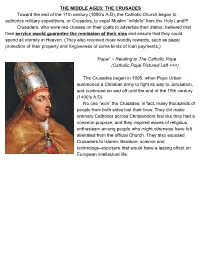
THE MIDDLE AGES: THE CRUSADES Toward the end of the 11th century (1000’s A.D), the Catholic Church began to authorize military expeditions, or Crusades, to expel Muslim “infidels” from the Holy Land!!! Crusaders, who wore red crosses on their coats to advertise their status, believed that their service would guarantee the remission of their sins and ensure that they could spend all eternity in Heaven. (They also received more worldly rewards, such as papal protection of their property and forgiveness of some kinds of loan payments.) ‘Papal’ = Relating to The Catholic Pope (Catholic Pope Pictured Left <<<) The Crusades began in 1095, when Pope Urban summoned a Christian army to fight its way to Jerusalem, and continued on and off until the end of the 15th century (1400’s A.D). No one “won” the Crusades; in fact, many thousands of people from both sides lost their lives. They did make ordinary Catholics across Christendom feel like they had a common purpose, and they inspired waves of religious enthusiasm among people who might otherwise have felt alienated from the official Church. They also exposed Crusaders to Islamic literature, science and technology–exposure that would have a lasting effect on European intellectual life. GET THE INFIDELS (Non-Muslims)!!!! >>>> <<<“GET THE MUSLIMS!!!!” Muslims From The Middle East VS, European Christians WHAT WERE THE CRUSADES? By the end of the 11th century, Western Europe had emerged as a significant power in its own right, though it still lagged behind other Mediterranean civilizations, such as that of the Byzantine Empire (formerly the eastern half of the Roman Empire) and the Islamic Empire of the Middle East and North Africa. -
Louis Ix, King of France
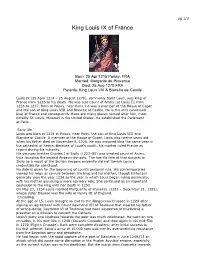
pg 1/3 King Louis IX of France Born: 25 Apr 1215 Poissy, FRA Married: Margarite de Provence Died: 25 Aug 1270 FRA Parents: King Louis VIII & Blanche de Castile Louis IX (25 April 1214 – 25 August 1270), commonly Saint Louis, was King of France from 1226 to his death. He was also Count of Artois (as Louis II) from 1226 to 1237. Born at Poissy, near Paris, he was a member of the House of Capet and the son of King Louis VIII and Blanche of Castile. He is the only canonised king of France and consequently there are many places named after him, most notably St. Louis, Missouri in the United States. He established the Parlement of Paris. Early life Louis was born in 1214 at Poissy, near Paris, the son of King Louis VIII and Blanche of Castile. A member of the House of Capet, Louis was twelve years old when his father died on November 8, 1226. He was crowned king the same year in the cathedral at Reims. Because of Louis's youth, his mother ruled France as regent during his minority. His younger brother Charles I of Sicily (1227–85) was created count of Anjou, thus founding the second Angevin dynasty. The horrific fate of that dynasty in Sicily as a result of the Sicilian Vespers evidently did not tarnish Louis's credentials for sainthood. No date is given for the beginning of Louis's personal rule. His contemporaries viewed his reign as co-rule between the king and his mother, though historians generally view the year 1234 as the year in which Louis began ruling personally, with his mother assuming a more advisory role. -

Dramatis Personae •
Dramatis Personae • Note: all dates are approximate. ALEXANDER THE GREAT (356– 323 bc). Macedonian ruler who, af- ter invading Central Asia in 329 bc, spent three years in the region, establishing or renaming nine cities and leaving behind the Bactrian Greek state, headquartered at Balkh, which eventually ruled territo- ries extending into India. Awhad al- Din ANVARI (1126– 1189). Poet and boon companion of Sultan Sanjar at Merv who, boasting of his vast knowledge, wrote that, “If you don’t believe me, come and test me. I am ready.” Nizami ARUDI. Twelfth- century Samarkand- born poet and courtier of the rulers of Khwarazm and of Ghor, and author of Four Discourses, in which he argued that a good ruler’s intellectual stable should include secretaries, poets, astrologers, and physicians. Abu Mansur Ali ASADI. Eleventh- century poet from Tus and follower of Ferdowsi. Working at a court in Azerbaijan, Asadi versified The Epic of Garshasp (Garshaspnameh), which ranks second only to Ferdowsi’s Shahnameh among Persian epic poems. Farid al- Din ATTAR (1145– 1221). Pharmacist and Sufi poet from Nishapur, who combined mysticism with the magic of the story- teller’s art. His Conference of the Birds is an allegory in which the birds of the world take wing in search of Truth, only to find it within themselves. Yusuf BALASAGUNI (Yusuf of Balasagun). Author in 1069 of the Wisdom of Royal Glory, a guide for rulers and an essay on ethics. Written in a Turkic dialect, Yusuf’s volume for the first time brought a Turkic language into the mainstream of Mediterranean civilization and thought. -

The Seventh Crusade ST
ST. MARY THE VIRGIN Sovereign Military Order of the Temple of Jerusalem The Seventh Crusade ST. MARY THE VIRGIN The Seventh Crusade First Edition 2021 Prepared by Dr. Chev. Peter L. Heineman, GOTJ, CMTJ 2020 Avenue B Council Bluffs, IA 51501 Phone 712.323.3531• www.plheineman.net Table of Contents Introduction ................................................................................................ 1 Historical Context ....................................................................................... 2 The Campaign ........................................................................................... 3 Cyprus ............................................................................................. 4 Damietta .......................................................................................... 4 Cairo ............................................................................................... 5 Battle of Monsourah ........................................................................ 5 Battle of Fariskur ............................................................................. 6 Aftermath ................................................................................................... 7 INTRODUCTION Seventh Crusade he Seventh Crusade (1248-1254) was led by the French king Louis IX (r. 1226-1270) who intended to conquer Egypt and take over Jerusalem; both then controlled by the Muslim Ayyubid Dynasty. Despite the initial success of capturing Damietta on the Nile, Louis' troops were defeated by the T -

Sistem Dan Kelembagaan Pendidikan Islam Bani Saljuk
ISSN : 2088-4095 TARBIYAH ISLAMIYAH, Volume 5, Nomor 2, Juli-Desember 2015 SISTEM DAN KELEMBAGAAN PENDIDIKAN ISLAM BANI SALJUK M. Noor Fuady Program Doktor Pendidikan Agama Islam, Pascasarjana IAIN Antasari Banjarmasin Abstrak Puncak kemajuan pendidikan Islam, yaitu pada masa Malik Syah, wazir Nizham al-Mulk dari bani Saljuk yang membangun Madrasah Nizhamiyah yang nantinya menjadi perguruan tinggi terbesar di zamannya. Madrasah Nizhamiyyah telah berjasa dalam mengembangkan madzhab Sunni Syafi’iyah dan menumbangkan madzhab Syi’ah di daerah itu.materi yang diajarkan pada madrasah ini, adalah fiqih dan tauhid, di samping cabang-cabang ilmu agama yang lain seperti ushul fiqh, ilmu-ilmu al-Quran, hadits Nabi, akhlak, diajarkan di situ. Alasannya adalah bahwa setiap muslim wajib (fard al-’ain) mempelajari ilmu-ilmu tersebut cabang-cabang ilmu agama yang lain, seperti nahwu, sharaf, adab juga disajikan disitu meskipun ilmu-ilmu itu hanya sebagai pelengkap. Madrasah ini betul-betul menyeleksi calon Mahasiswanya dengan sangat ketat, sehingga betul-betul menjadi sekolah favorit sampai saat itu dan wajar jika banyak alumninya menjadi ulama besar.Nizhamiyyah sangat mendukung kemajuan ilmu pengetahun, hal ini terbukti pengelola Nizhamiyyah menyediakan beasiswa/biaya bagi guru yang mau mengadakan penelitian untuk menemukan teori-teori baru. Pendanaan penyelenggaraan pendidikan pada madrasah ini menggunakan wakaf. Kata kunci: Pendidikan, Bani Saljuk, Madrasah Nizhamiyah A. Pendahuluan Dalam catatan sejarah kemunculan dan kemunduran serta kehancuran sebuah Dinasti kerajaan tidak terlepas dari pergolakan politik atau kepentingan-kepentingan politik, baik kepentingan politik perorangan maupun kepentingan politik kelompok.Demikian pula halnya dengan kemunculan Bani Saljuk, yang berawal dari perebutan kekuasaan dalam tubuh dinasti Buwaihi, yang tidak dapat mengatasi persaingan di tubuh militer, yang berasal dari dua suku: Dailam dan Turki Saljuk. -
Remembering the First Crusade
REMEMBERING THE FIRST CRUSADE: LATIN NARRATIVE HISTORIES 1099-c.1300 Barbara Packard Royal Holloway University of London PhD Thesis 1 DECLARATION OF AUTHORSHIP I, Barbara Packard, hereby declare that this thesis and the work presented in it is entirely my own. Where I have consulted the work of others, this is always clearly stated. Signed: ______________________ Date: 04/01/2011 2 ABSTRACT The success of the First Crusade by the Christian armies caught the interest and arrested the imagination of contemporaries, stimulating the production of a large number of historical narratives. Four eyewitness accounts, as well as letters written by the crusaders to the West, were taken up by later authors, re-worked and re-fashioned into new narratives; a process which continued throughout the twelfth century and beyond. This thesis sets out to explore why contemporaries continued to write about the First Crusade in light of medieval attitudes towards the past, how authors constructed their narratives and how the crusade and the crusaders were remembered throughout the twelfth and thirteenth centuries. It will analyse the development in the way the First Crusade was recorded and investigate the social, religious, intellectual and political influences dictating change: How, why and under what circumstances was the story re- told? What changed in the re-telling? What ideas and concepts were the authors trying to communicate and what was their meaning for contemporaries? The thesis will also aim to place these texts not only in their historical but also in their literary contexts, analyse the literary traditions from which authors were writing, and consider the impact the crusade had on medieval literature. -

The Crusades and Islam. Fulbright-Hays Summer Seminars Abroad, 1998 (Israel and Jordan)
DOCUMENT RESUME ED 437 294 SO 030 765 AUTHOR Serota, Laurie TITLE The Crusades and Islam. Fulbright-Hays Summer Seminars Abroad, 1998 (Israel and Jordan). SPONS AGENCY Center for International Education (ED), Washington, DC. PUB DATE 1998-00-00 NOTE 182p. PUB TYPE Guides Classroom Teacher (052) EDRS PRICE MF01/PC08 Plus Postage. DESCRIPTORS Area Studies; Curriculum Development; *Curriculum Enrichment; Foreign Countries; Global Education; Grade 4; Intermediate Grades; *Islam; *Medieval History; *Social Studies; Student Educational Objectives; *World History IDENTIFIERS Core Knowledge Sequence; kCrusades; Europe; Fulbright Hays Seminars Abroad Program; Middle Ages; Middle East ABSTRACT These two mini-units are designed to supplement the areas of study dictated by the Core Knowledge Sequence, a content-rich curriculum used in the educator/curriculum developer's school. The mini-units fall in the middle of a 6-month-long study of the Middle Ages and incorporate the depth of content required to support the larger unit on the Middle Ages. The units include appropriate fourth-grade skills and interdisciplinary connections. The first mini-unit on the Crusades contains five lessons, each of which lists educational objectives for students, study procedures, and evaluation procedures. The unit contains a 21-item bibliography and a list of videos and other resources. Appended are comprehension questions, poems, and informational material. The second mini-unit, Islam, contains the same number of lessons with the same objectives and procedures. This unit contains a 20-item bibliography and a list of videos and resources. Appended are a vocabulary list, comprehension questions, a list of English words of Arabic origin, and informational materials. -

Illinois Masonic Academic Bowl 2017 State Tournament Round 3 1St
Illinois Masonic Academic Bowl Round 3 2017 State Tournament 1st Section Toss-up Questions Question #1: Science – Chemistry 10 points A mixture containing the sulfide of this ion is called sodium ion [or Na1+ or white liquor, and is used at the beginning of the Na+1 or Na+] Kraft process to break down wood. To produce aluminium oxide in the Bayer process, this ion combines with hydroxide [“hide-ROCK-side”], then aluminate [al-OOM-in-“ate”], and then carbonate [“CAR-bun-ate”]. The hypochlorite [“hype-oh”-KLOR-“ite”] of this ion, dissolved in water, forms bleach. This ion is combined with glutamic acid to make a food additive commonly used in Asian food, MSG. This is the cation [“CAT-ion”] in halite [“HAY-light”] and in baking soda. Name this ion that combines with chloride [KLOH-“ride”] to make table salt. Question #2: Miscellaneous – Agriculture 10 points The colpodea [“coal”-POH-dee-uh] subspecies of Kentucky bluegrass [or this organism is primarily found in Arctic regions. Poa pratensis; accept The Adelphi and Midnight varieties of this meadow grass before organism are better for southern climates than “‘meadow’”; prompt on Touchdown and Bristol. This organism’s scientific grass] name comes from the Latin for “meadow” and the Greek for “fodder”. Bentgrass, ryegrass, and this grass are the most popular for lawns in the United States. Name this grass whose colored flowers inspired Kentucky’s nickname. 1 Illinois Masonic Academic Bowl Round 3 2017 State Tournament 1st Section Toss-up Questions Question #3: Social Studies – U.S. Government 10 points This program was renamed in 1980 to honor a U.S. -

Analysis of the Architectural Heritage of El-Mansoura City, Egypt Towards Urban Conservation Approach
View metadata, citation and similar papers at core.ac.uk brought to you by CORE provided by Archivio istituzionale della ricerca - Università di Palermo Analysis of the Architectural heritage of El-Mansoura city, Egypt towards urban conservation approach (Arch. Mohamed A. M. Khalil- arch_m_khalil@yahoo.com), (Dr. Alaa S. El-Eashy- arabeskal_arch@yahoo.com), Department of Architecture- Mansoura university- Egypt. Abstract: Mansoura city is one of the Egyptian intermediate cities in the Nile delta, The city center heritage mostly are in the European Mediterranean style because of the presence of the foreigner comunities in the city during the nineteenth and twentieth centuries. As many other Egyptian intermediate cities, the city heritage suffers from lack of maintenance and absence of organized conservation programs. El-Mansoura architectural heritage are divided into main five zones around the city center, The “private palaces and villas zone” it was the residence of the aristocratic Egyptians, The “Northern city center” it was the administration zone near the port, The “Commercial center” with high concentration of commercial activities, “El-Mokhtalat neighborhood” it was the residence of the foreigners and elite Egyptians, “Torel neighborhood” it was a combination of private villas. Their are some trials to preserve and restore the city heritage but normally they are individual trails, now there is some projects to make urban development of the valuable zones and that will lead to effective conservation projects in the future. El-Mansoura: is an intermediate city in Egypt, Coordinates: 31°03′N 31°23′E with a Population (2008) of 1,045,000. It is the capital of the Dakahlia Governorate.