September 2018 Newsletter
Total Page:16
File Type:pdf, Size:1020Kb
Load more
Recommended publications
-

Vincent Van Gogh, Auvers, 1890 Oil on Jute, 36 X 36 In
Vincent van Gogh, Auvers, 1890 Oil on jute, 36 x 36 in. (91.4 x 91.4 cm.) New York Private Collection Fig. 1 Vincent van Gogh, Auvers, 1890 Oil on jute, 36 x 36 in. (91.4 x 91.4 cm.) Signed on verso, ‘Vincent’ New York Private Collection Auvers,1890, Vincent van Gogh This is the discovery of a full-size van Gogh painting, one of only two in the past 100 years. The work depicts a view of a landscape at Auvers-sur-Oise, the town north of Paris where he spent the last two months of his life. The vista shows a railroad line crossing wheat fields. Auvers, 1890 (Figs. 1-13) is van Gogh’s largest and only square painting. This unique format was chosen to represent a panorama of the wheat fields of the region, of which parts are shown in many of his other paintings of the Auvers landscape. The present painting portrays the entire valley of the Oise as a mosaic of wheat fields, bisected by the right of way of a railway and a telegraph line. The center depicts a small railway station with station houses and a rail shunt, the line disappearing into the distant horizon. The painting is in its original, untouched ondition.c The support is coarse burlap on the original stretcher. The paint surface is a thick impasto that has an overall broad grid pattern of craquelure consistent with a painting of its age. The verso of the painting bears the artist’s signature, Vincent, in black pigment. -

Vincent Van Gogh the Starry Night
Richard Thomson Vincent van Gogh The Starry Night the museum of modern art, new york The Starry Night without doubt, vincent van gogh’s painting the starry night (fig. 1) is an iconic image of modern culture. One of the beacons of The Museum of Modern Art, every day it draws thousands of visitors who want to gaze at it, be instructed about it, or be photographed in front of it. The picture has a far-flung and flexible identity in our collective musée imaginaire, whether in material form decorating a tie or T-shirt, as a visual quotation in a book cover or caricature, or as a ubiquitously understood allusion to anguish in a sentimental popular song. Starry Night belongs in the front rank of the modern cultural vernacular. This is rather a surprising status to have been achieved by a painting that was executed with neither fanfare nor much explanation in Van Gogh’s own correspondence, that on reflection the artist found did not satisfy him, and that displeased his crucial supporter and primary critic, his brother Theo. Starry Night was painted in June 1889, at a period of great complexity in Vincent’s life. Living at the asylum of Saint-Rémy in the south of France, a Dutchman in Provence, he was cut off from his country, family, and fellow artists. His isolation was enhanced by his state of health, psychologically fragile and erratic. Yet for all these taxing disadvantages, Van Gogh was determined to fulfill himself as an artist, the road that he had taken in 1880. -

From Left to Right Don Manuel Osorio Manraque De Zuniga Sunday Afternoon at the Island of La Grande Jatte Young Gi
Some of the art seen on the walls in “Library Mouse, a Museum Adventure” is my interpretation of real paintings, meant to resemble the art as closely as possible so that children can recognize the source material. Other paintings in my book are “parodies” of famous paintings, substituting mouse heads for the humans originally found in the artwork! Below is a list of the original art that inspired me in my illustrations. Where possible, I’ve provided links to websites where you can get more information. FRONT COVER: from left to right Painted Screen by Ogata Korin eighteenth century, in the Don Manuel Osorio Manraque De Zuniga collection of the Metropolitan Museum of Art, by Francisco Goya painted in 1784, in the New York collection of the Metropolitan Museum of Art, New York On the Terrace by Pierre Auguste Renoir painted in 1881, Sunday Afternoon in the collection of the Art Institute of Chicago at the Island of La Grande Jatte by Georges Seurat painted in 1884, in the PAGE 3: clockwise from right collection of the Art Institute of Chicago Palazzo De Mula, Venice Young Girl Reading by Claude Monet painted in 1908, in the collection by Jean-Honore’ Fragonard painted around of the National Gallery, Washington D.C. 1770, in the collection of the National Gallery, Washington D.C. At the Races in the Countryside by Edgar Degas painted in 1869, in the collection BACK COVER: center of the Boston Museum of Fine Art Napoleon Crossing the Alps Eight-Planked Bridge by Jacques-Louis David painted between 1801- by Ogata Korin painted around 1711, -

Landscape Analysis
Post –course Support Course ID: ECP020120030 Event ID: AB Date: 10 – 14 /6/2013 Chan Wai Yin, Doris (Baptist Lui Ming Choi Secondary School) Lesson Plan: Introduction to Landscape Painting Grades: Form 1 Duration: 1 double periods 1. know what a landscape is Learning Objectives: Students will: My suggestion is that you guide the SS to view the paintings by asking certain 1. know what is landscape painting questions. From the answers to those 2. compare foreground, mid-ground and background in landscape painting questions, you will end up with the 3. explore art techniques such as scale and overlapping to create the illusion of distance. definition of a landscape. In Points 2 and 4. observe and discuss types of horizon lines as an important element in landscape painting. 4, you seem to be telling them afterwards, whereas your questions should be guiding them to see it the way Procedures you want them to. So, for example, you 1. Showing students the following images, ask them to look at them carefully. Ask students to describe what is in the artworks. could jointly with the students ask these kinds of questions: “All of these paintings here are the same kind of painting. Tell me what these three have in common - what is the same about them?” They should say that they all show the sky and they all have trees. If they cannot give you any more, then tell them that 2 have people but are the people important in the painting. How do we know they are not important? (size) Then contrast the 3 paintings and ask what one has that the other(s) Vincent Van Gogh; Yellow Wheat Field Vincent Van Gogh; Flower Bed Vincent Van Gogh; Starry Night over the doesn’t/don’t have. -

Vincent Van Gogh, Who Grew up Walking the Dutch Countryside
"Sorrowful yet always rejoicing," Vincent van Gogh, who grew up walking the Dutch countryside, traveled through life seeking the eternal "Light that rises in the darkness"- like these swans readying for flight south of Amsterdam. From the pain and beauty of his journey, he created masterworks of passion, including penetrating self-portraits, such as this one at age 34. Van Gogh likened painting to performing music. "Whether I really sang a lullaby in colors," he wrote, "I leave to the critics." National Geographic, October, 1997 By JOEL L. SWERDLOW, ASSISTANT EDITOR Photographs by LYNN JOHNSON THE LETTERS FROM VINCENT VAN GOGH to his brother Theo are yellowed. Some are torn at the corners or have holes from aging. Acid from ink eats through the cheap paper. I have come to this bombproof vault in the cellar of the Van Gogh Museum in Amsterdam to begin my search for Vincent. Who was this man who said he "sang a lullaby in colors:' and why does he have such a hold on us? His paintings sell for the most money; his exhibitions attract the highest number of visitors; reproductions of his work-on socks, sheets, party napkins, coffee cups-permeate homes and offices; the song "Vincent" has sold more than ten million copies since 1971; movies mythologize his life. No other artist, at any time in any culture, has been more popular. THE 650 LETTERS from Vincent to Theo fill three volumes. Their first surprise is immediate: I knew that Theo financed Vincent's painting and had assumed Theo was the big brother. -
Impressionist Visions
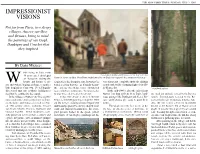
THE NEW YORK TIMES, SUNDAY, JULY 7, 2002 IMPRESSIONIST VISIONS Not far from Paris, two sleepy villages, Auvers-sur-Oise and Ornans, bring to mind the paintings of van Gogh, Daubigny and Courbet that they inspired By Dana Micucci hile living in Paris some 10 years ago, I developed Photographs by Wendy Lamm/Contrasto, for The New York Times an obsession: visiting the Scenes in Auvers-sur-Oise. Notre Dame, made famous by van Gogh, whose grave is in a cemetery not far away homes and haunts of art- respite from the disruptive city. In Auvers he vast wheat and cornfields under the shifting Wists and writers, hoping, perhaps, to spark a found a setting that was “profoundly beauti- clouds and swiftly changing light of the lIe- little inspiration of my own. Soon, I happily ful ... among other things, many old thatched de-France sky. A road lined poplars discovered that my aesthetic indulgences roofs, which are getting rare,” he wrote to his In the mid-1900’s, after the railroad put need not be confined to the capital. brother Theo shortly after his arrival. Auvers less than an hour from Paris, land- the small inn and cafe owned by the Ravoux In the villages of Auvers-sur-Oise and Or- Today, the village of about 6,500 still scape painters like Daubigny and Corot, Pis- family. Painstakingly restored by the Bel- nans, each a day’s train excursion from Paris, brings to mind the paintings it inspired. Here sarro and Cezanne also came to paint from gian entrepreneur Dominique-Charles Jans- are the homes and studios of several celebrat- are the narrow, twisting streets fringed with nature. -
Computers in Astronomy
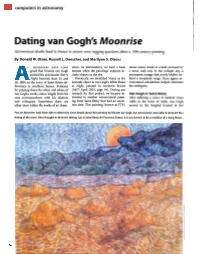
computers in astronomy Dating van Gogh's Moonrise Astronomical sleuths head to France to answer some nagging questions about a 19th-century painting. By Donald Wo Olson, Russell Lo Doescher, and Marilynn So Olson RT HisTORIANS HAVE LONG selves.As astronomers, we have a keen shows wheat stacks in a field enclosed by agreed that Vincent van Gogh interest when the paintings' subjects in- a stone wall and, in the twilight sky, a painted his spectacular Starry clude objects in the sky. prominent orange disk partly hidden be- ~ lVight between June 16 and Previously, we identified Venus as the hind a mountain range. Once again, as- 18, 1889, in the town of Saint-Remy-de- heavenlyobject in van Gogh's White House tronomical calculations helped eliminate Proverice in southern France. Evidence at Night, painted in northern France the ambiguity. for pinning down the when and where of (S&T: April 2001, page 34). During our van Gogh's works comes largely from his research for that project, we became in- Van Gogh in Saint-Remy own correspondence with his relatives terested in another astronomical paint- After suffering a series of medical crises and colleagues. Sometimes there are ing from Saint-Remy that had an uncer- while in the town of Aries, van Gogh other clues within the works of art them- tain date. This painting, known as F735, moved to the hospital housed in the Past art historians have been able to determine some details about this painting by Vincent van Gogh, but astronomers were able to pinpoint the timing of the scene. -

Van Gogh Museum Journal 2002
Van Gogh Museum Journal 2002 bron Van Gogh Museum Journal 2002. Van Gogh Museum, Amsterdam 2002 Zie voor verantwoording: http://www.dbnl.org/tekst/_van012200201_01/colofon.php © 2012 dbnl / Rijksmuseum Vincent Van Gogh 7 Director's foreword In 2003 the Van Gogh Museum will have been in existence for 30 years. Our museum is thus still a relative newcomer on the international scene. Nonetheless, in this fairly short period, the Van Gogh Museum has established itself as one of the liveliest institutions of its kind, with a growing reputation for its collections, exhibitions and research programmes. The past year has been marked by particular success: the Van Gogh and Gauguin exhibition attracted record numbers of visitors to its Amsterdam venue. And in this Journal we publish our latest acquisitions, including Manet's The jetty at Boulogne-sur-mer, the first important work by this artist to enter any Dutch public collection. By a happy coincidence, our 30th anniversary coincides with the 150th of the birth of Vincent van Gogh. As we approach this milestone it seemed to us a good moment to reflect on the current state of Van Gogh studies. For this issue of the Journal we asked a number of experts to look back on the most significant developments in Van Gogh research since the last major anniversary in 1990, the centenary of the artist's death. Our authors were asked to filter a mass of published material in differing areas, from exhibition publications to writings about fakes and forgeries. To complement this, we also invited a number of specialists to write a short piece on one picture from our collection, an exercise that is intended to evoke the variety and resourcefulness of current writing on Van Gogh. -

Van Gogh: Heartfelt Lines
Jane Van Nimmen exhibition review of Van Gogh: Heartfelt Lines Nineteenth-Century Art Worldwide 8, no. 1 (Spring 2009) Citation: Jane Van Nimmen, exhibition review of “Van Gogh: Heartfelt Lines,” Nineteenth- Century Art Worldwide 8, no. 1 (Spring 2009), http://www.19thc-artworldwide.org/ spring09/76-van-gogh-heartfelt-lines. Published by: Association of Historians of Nineteenth-Century Art Notes: This PDF is provided for reference purposes only and may not contain all the functionality or features of the original, online publication. ©2009 Nineteenth-Century Art Worldwide Nimmen: Van Gogh: Heartfelt Lines Nineteenth-Century Art Worldwide 8, no. 1 (Spring 2009) Van Gogh: Heartfelt Lines Albertina, Vienna, 5 September 2008 – 8 January 2009 Catalogue: Van Gogh: Heartfelt Lines Edited by Klaus Albrecht Schröder and Heinz Widauer, Sjraar van Heugten and Marije Vellekoop; with an introduction by Klaus Albrecht Schröder; with essays by Martin Bailey, Sjraar van Heugten, Fred Leeman, Teio Meedendorp, Marije Vellekoop, and Heinz Widauer. Catalogue entries by Stefanie Chaloupek, Fred Leeman, Heinz Widauer, and Denise Willemstein. Cologne: DuMont, 2008. 455 pages; 338 color illustrations, 32 b-w; bibliography Cost: €24,90 ($36, in museum); €49,90 ($73, in bookstores) ISBN: 978-3-8321-9158-0 (museum edition); 978-3-8321-9133-7 (trade edition) Van Gogh: Gezeichnete Bilder ISBN: 978-3-8321-9157-3 (museum edition); 978-3-8321-9157-2 (trade edition) “To bring the art of drawing out of quarantine” became a mission statement of the new Albertina Director Klaus Albrecht Schröder long before he re-opened the meticulously restored museum. Assuming his post at the beginning of the millennium, Schröder accelerated renovations for the palace of Albert, Duke of Saxe-Teschen (1738–1822); the building behind the opera had housed his remarkable collection for two centuries and had closed for urgent repairs in the 1990s. -

Vincent Van Gogh in Arles
VINCENT VAN GOGH IN ARLES “Van Gogh sur la route de Tarascon” Known also as “The painter on his way to work”, July 1888, 48 x 44 cm Formerly in the Kaiser-Friedrich-Museum, Magdeburg, Germany (Destroyed by fire in 1945) https://commons.wikimedia.org/wiki/File:Vincent_Van_Gogh_0013.jpg A Walk-Around of Selected Sites L. M. Boring Membre de l’Association des Artistes Alpicois, Le Pecq 28 February 2019 Vincent Van Gogh arrived in Arles by train on Monday, February 20, 1888, with an idea to found an artist colony in the south “Wishing to see a different light, thinking that looking at nature under a bright sky might give us a better idea of the Japanese way of feeling and drawing. Wishing also to see this stronger sun, because one could not understand Delacroix’s pictures from the point of view of execution and technique without knowing it, and because one feels that the colors of the prism are veiled in the mist of the North.” Oddly and by happenstance, when he arrived, he found the countryside covered in snow, and among his first paintings were soft landscapes of snow covered fields. He found lodging in the Hotel-Restaurant Carrel, but his stay ended badly over a billing dispute after only two months. Vincent signed a lease on May 1st for a small four-room two-story semi-detached house on the Place Lamartine, not far from the train station. Its stucco exterior was bright ochre, and it became known by Van Gogh’s paintings as La Maison Jaune, the Yellow House. -

Chanting Flowers by Zsuzsanna Bacsa Palmer
Palmer Chanting Flowers by Zsuzsanna Bacsa Palmer Ha folyóvíz volnék If I were a river Bánatot nem tudnék No sorrow would I be knowing Hegyek völgyek között Between mountains and valleys Zengedezve járnék I would run forever chanting. Ahol kiterülnék Where I would leave the riverbed Virágot növelnék I would make flowers grow Hegyek völgyek között Between mountains and valleys Virágot növelnék I would make flowers grow. Leányok leszednék The maids would pick the flowers Bokrétába kötnék Tie them into a bunch S az o´´ édesiknek And pin them onto the hats Kalapjára tu´´znék Of their sweethearts. It hasn’t always been like this. Es war nicht immer so. Nem volt mindíg így. In the first half of my life, I was able to think in one language only. I did not have to constantly and unconsciously go through each thought in order to fully understand all the connotations it trilingualism, may have in my three languages. That is the hard part; the thinking, talking to yourself when Dreisprachigkeit there are no listeners. Seeing all the hues of colors that appear with each translation, smelling háromnyelvüség: all the odors, scents, and bouquets. native-like control of I admired people speaking many languages and assumed that they could use them at three languages their liking, but their mother tongue would always prevail as the deepest inner voice. And now that I am in this same situation, I know that songs and prayers stay monolingual. For me, they will always be in Hungarian. However, I also learned that emotions, caresses, and embraces are above any language. -

Van Gogh Museum Enterprises 39 the Works Council 41
Van Gogh Museum Annual Report 2018 Van Gogh Museum Annual Report 2018 Contents Supervisory Board statement 5 1 Report of the Board 7 2018 in short 9 2 Overview of 2018 17 Museum Affairs19 The Mesdag Collection 26 Public Affairs28 Operations 36 Van Gogh Museum Enterprises 39 The Works Council 41 3 Appendices to annual report 43 Overview of the organisation 45 Social Annual Report 46 Acquisitions 48 Gifts 53 Supporters 54 Conserved works 57 Collection information 66 Overview of outgoing loans 67 Long-term loans to the VGM 76 Long-term loans to other museums 78 Research projects 79 Museum publications 81 Additional functions 82 Lectures and other academic activities 84 Publications employees 87 Supervisory Board statement 2018 was once again a resoundingly successful year for the Van Gogh Museum. Vincent van Gogh and his contemporaries continue to inspire millions of people all around the world, as is reflected in the sustained high numbers of visitors to both the museum and its website. In the past year, 2,165,000 art lovers from the Netherlands and abroad visited the museum, and our online fan base grew exponentially. After being officially opened by King Willem-Alexander during a celebratory event, the exhibition Van Gogh & Japan attracted an impressive 430,000 visitors, making it a great success. Van Gogh aspires was published last year, the Strategic Plan 2018-2020 outlining how the museum will work towards realising its Strategic Pillars in the years ahead. In its endeavours to deliver and uphold its mission, vision and core values, the museum focuses on three dimensions: local, global and digital.