Zoologische Mededelingen Uitgegeven Door Het
Total Page:16
File Type:pdf, Size:1020Kb
Load more
Recommended publications
-

Checklist of the Mammals of Indonesia
CHECKLIST OF THE MAMMALS OF INDONESIA Scientific, English, Indonesia Name and Distribution Area Table in Indonesia Including CITES, IUCN and Indonesian Category for Conservation i ii CHECKLIST OF THE MAMMALS OF INDONESIA Scientific, English, Indonesia Name and Distribution Area Table in Indonesia Including CITES, IUCN and Indonesian Category for Conservation By Ibnu Maryanto Maharadatunkamsi Anang Setiawan Achmadi Sigit Wiantoro Eko Sulistyadi Masaaki Yoneda Agustinus Suyanto Jito Sugardjito RESEARCH CENTER FOR BIOLOGY INDONESIAN INSTITUTE OF SCIENCES (LIPI) iii © 2019 RESEARCH CENTER FOR BIOLOGY, INDONESIAN INSTITUTE OF SCIENCES (LIPI) Cataloging in Publication Data. CHECKLIST OF THE MAMMALS OF INDONESIA: Scientific, English, Indonesia Name and Distribution Area Table in Indonesia Including CITES, IUCN and Indonesian Category for Conservation/ Ibnu Maryanto, Maharadatunkamsi, Anang Setiawan Achmadi, Sigit Wiantoro, Eko Sulistyadi, Masaaki Yoneda, Agustinus Suyanto, & Jito Sugardjito. ix+ 66 pp; 21 x 29,7 cm ISBN: 978-979-579-108-9 1. Checklist of mammals 2. Indonesia Cover Desain : Eko Harsono Photo : I. Maryanto Third Edition : December 2019 Published by: RESEARCH CENTER FOR BIOLOGY, INDONESIAN INSTITUTE OF SCIENCES (LIPI). Jl Raya Jakarta-Bogor, Km 46, Cibinong, Bogor, Jawa Barat 16911 Telp: 021-87907604/87907636; Fax: 021-87907612 Email: biologi@mail.lipi.go.id . iv PREFACE TO THIRD EDITION This book is a third edition of checklist of the Mammals of Indonesia. The new edition provides remarkable information in several ways compare to the first and second editions, the remarks column contain the abbreviation of the specific island distributions, synonym and specific location. Thus, in this edition we are also corrected the distribution of some species including some new additional species in accordance with the discovery of new species in Indonesia. -

(GISD) 2021. Species Profile Rattus Rattus. Available From
FULL ACCOUNT FOR: Rattus rattus Rattus rattus System: Terrestrial Kingdom Phylum Class Order Family Animalia Chordata Mammalia Rodentia Muridae Common name Hausratte (German), European house rat (English), bush rat (English), blue rat (English), ship rat (English), roof rat (English), black rat (English) Synonym Mus rattus , Linnaeus, 1758 Mus alexandrinus , Geoffroy, 1803 Musculus frugivorus , Rafinesque, 1814 Mus novaezelandiae , Buller, 1870 Similar species Rattus norvegicus Summary A native of the Indian sub-continent, the ship rat (Rattus rattus) has now spread throughout the world. It is widespread in forest and woodlands as well as being able to live in and around buildings. It will feed on and damage almost any edible thing. The ship rat is most frequently identified with catastrophic declines of birds on islands. It is very agile and often frequents tree tops searching for food and nesting there in bunches of leaves and twigs. view this species on IUCN Red List Species Description A slender rat with large hairless ears, the ship rat (Rattus rattus) may be grey-brown on the back with either a similarly coloured or creamish-white belly, or it may be black all over. The uniformly- coloured tail is always longer than the head and body length combined. Its body weight is usually between 120 and 160 g but it can exceed 200 g. The work of Yosida (1980) and his co-workers has shown that there are two forms of R. rattus that differ in chromosome number. The more widespread Oceanic form has 38 chromosomes and is the ship rat of Europe, the Mediterranean region, America, Australia and New Zealand. -
Quaternary Murid Rodents of Timor Part I: New Material of Coryphomys Buehleri Schaub, 1937, and Description of a Second Species of the Genus
QUATERNARY MURID RODENTS OF TIMOR PART I: NEW MATERIAL OF CORYPHOMYS BUEHLERI SCHAUB, 1937, AND DESCRIPTION OF A SECOND SPECIES OF THE GENUS K. P. APLIN Australian National Wildlife Collection, CSIRO Division of Sustainable Ecosystems, Canberra and Division of Vertebrate Zoology (Mammalogy) American Museum of Natural History (ken.aplin@csiro.au) K. M. HELGEN Department of Vertebrate Zoology National Museum of Natural History Smithsonian Institution, Washington and Division of Vertebrate Zoology (Mammalogy) American Museum of Natural History (HELGENK@si.edu) BULLETIN OF THE AMERICAN MUSEUM OF NATURAL HISTORY Number 341, 80 pp., 21 figures, 4 tables Issued July 21, 2010 Copyright E American Museum of Natural History 2010 ISSN 0003-0090 CONTENTS Abstract.......................................................... 3 Introduction . ...................................................... 3 The environmental context ........................................... 5 Materialsandmethods.............................................. 7 Systematics....................................................... 11 Coryphomys Schaub, 1937 ........................................... 11 Coryphomys buehleri Schaub, 1937 . ................................... 12 Extended description of Coryphomys buehleri............................ 12 Coryphomys musseri, sp.nov.......................................... 25 Description.................................................... 26 Coryphomys, sp.indet.............................................. 34 Discussion . .................................................... -

Report on Biodiversity and Tropical Forests in Indonesia
Report on Biodiversity and Tropical Forests in Indonesia Submitted in accordance with Foreign Assistance Act Sections 118/119 February 20, 2004 Prepared for USAID/Indonesia Jl. Medan Merdeka Selatan No. 3-5 Jakarta 10110 Indonesia Prepared by Steve Rhee, M.E.Sc. Darrell Kitchener, Ph.D. Tim Brown, Ph.D. Reed Merrill, M.Sc. Russ Dilts, Ph.D. Stacey Tighe, Ph.D. Table of Contents Table of Contents............................................................................................................................. i List of Tables .................................................................................................................................. v List of Figures............................................................................................................................... vii Acronyms....................................................................................................................................... ix Executive Summary.................................................................................................................... xvii 1. Introduction............................................................................................................................1- 1 2. Legislative and Institutional Structure Affecting Biological Resources...............................2 - 1 2.1 Government of Indonesia................................................................................................2 - 2 2.1.1 Legislative Basis for Protection and Management of Biodiversity and -

Ba3444 MAMMAL BOOKLET FINAL.Indd
Intot Obliv i The disappearing native mammals of northern Australia Compiled by James Fitzsimons Sarah Legge Barry Traill John Woinarski Into Oblivion? The disappearing native mammals of northern Australia 1 SUMMARY Since European settlement, the deepest loss of Australian biodiversity has been the spate of extinctions of endemic mammals. Historically, these losses occurred mostly in inland and in temperate parts of the country, and largely between 1890 and 1950. A new wave of extinctions is now threatening Australian mammals, this time in northern Australia. Many mammal species are in sharp decline across the north, even in extensive natural areas managed primarily for conservation. The main evidence of this decline comes consistently from two contrasting sources: robust scientifi c monitoring programs and more broad-scale Indigenous knowledge. The main drivers of the mammal decline in northern Australia include inappropriate fi re regimes (too much fi re) and predation by feral cats. Cane Toads are also implicated, particularly to the recent catastrophic decline of the Northern Quoll. Furthermore, some impacts are due to vegetation changes associated with the pastoral industry. Disease could also be a factor, but to date there is little evidence for or against it. Based on current trends, many native mammals will become extinct in northern Australia in the next 10-20 years, and even the largest and most iconic national parks in northern Australia will lose native mammal species. This problem needs to be solved. The fi rst step towards a solution is to recognise the problem, and this publication seeks to alert the Australian community and decision makers to this urgent issue. -

Exploring Material Culture Distributions in the Upper Sepik and Central New Guinea
Gender, mobility and population history: exploring material culture distributions in the Upper Sepik and Central New Guinea by Andrew Fyfe, BA (Hons) Thesis submitted for the Degree of Doctor of Philosophy in The Discipline of Geographical and Environmental Studies The University of Adelaide November 2008 …..These practices, then, and others which I will speak of later, were borrowed by the Greeks from Egypt. This is not the case, however, with the Greek custom of making images of Hermes with the phallus erect; it was the Athenians who took this from the Pelasgians, and from the Athenians the custom spread to the rest of Greece. For just at the time when the Athenians were assuming Hellenic nationality, the Pelasgians joined them, and thus first came to be regarded as Greeks. Anyone will know what I mean if he is familiar with the mysteries of the Cabiri-rites which the men of Samothrace learned from the Pelasgians, who lived in that island before they moved to Attica, and communicated the mysteries to the Athenians. This will show that the Athenians were the first Greeks to make statues of Hermes with the erect phallus, and that they learned the practice from the Pelasgians…… Herodotus c.430 BC ii Table of contents Acknowledgements vii List of figures viii List of tables xi List of Appendices xii Abstract xiv Declaration xvi Section One 1. Introduction 2 1.1 The Upper Sepik-Central New Guinea Project 2 1.2 Lapita and the exploration of relationships between language and culture in Melanesia 3 1.3 The quantification of relationships between material culture and language on New Guinea’s north coast 6 1.4 Thesis objectives 9 2. -
Papua New Guinea Highlands and Mt Wilhelm 1978 Part 1
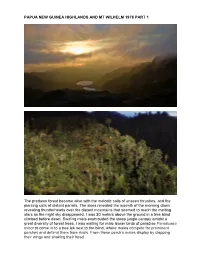
PAPUA NEW GUINEA HIGHLANDS AND MT WILHELM 1978 PART 1 The predawn forest became alive with the melodic calls of unseen thrushes, and the piercing calls of distant parrots. The skies revealed the warmth of the morning dawn revealing thunderheads over the distant mountains that seemed to reach the melting stars as the night sky disappeared. I was 30 meters above the ground in a tree blind climbed before dawn. Swirling mists enshrouded the steep jungle canopy amidst a great diversity of forest trees. I was waiting for male lesser birds of paradise Paradisaea minor to come in to a tree lek next to the blind, where males compete for prominent perches and defend them from rivals. From these perch’s males display by clapping their wings and shaking their head. At sunrise, two male Lesser Birds-of-Paradise arrived, scuffled for the highest perch and called with a series of loud far-carrying cries that increase in intensity. They then displayed and bobbed their yellow-and-iridescent-green heads for attention, spreading their feathers wide and hopped about madly, singing a one-note tune. The birds then lowered their heads, continuing to display their billowing golden white plumage rising above their rust-red wings. A less dazzling female flew in and moved around between the males critically choosing one, mated, then flew off. I was privileged to have used a researcher study blind and see one of the most unique group of birds in the world endemic to Papua New Guinea and its nearby islands. Lesser bird of paradise lek near Mt Kaindi near Wau Ecology Institute Birds of paradise are in the crow family, with intelligent crow behavior, and with amazingly complex sexual mate behavior. -
Diversification of Muroid Rodents Driven by the Late Miocene Global Cooling Nelish Pradhan University of Vermont
University of Vermont ScholarWorks @ UVM Graduate College Dissertations and Theses Dissertations and Theses 2018 Diversification Of Muroid Rodents Driven By The Late Miocene Global Cooling Nelish Pradhan University of Vermont Follow this and additional works at: https://scholarworks.uvm.edu/graddis Part of the Biochemistry, Biophysics, and Structural Biology Commons, Evolution Commons, and the Zoology Commons Recommended Citation Pradhan, Nelish, "Diversification Of Muroid Rodents Driven By The Late Miocene Global Cooling" (2018). Graduate College Dissertations and Theses. 907. https://scholarworks.uvm.edu/graddis/907 This Dissertation is brought to you for free and open access by the Dissertations and Theses at ScholarWorks @ UVM. It has been accepted for inclusion in Graduate College Dissertations and Theses by an authorized administrator of ScholarWorks @ UVM. For more information, please contact donna.omalley@uvm.edu. DIVERSIFICATION OF MUROID RODENTS DRIVEN BY THE LATE MIOCENE GLOBAL COOLING A Dissertation Presented by Nelish Pradhan to The Faculty of the Graduate College of The University of Vermont In Partial Fulfillment of the Requirements for the Degree of Doctor of Philosophy Specializing in Biology May, 2018 Defense Date: January 8, 2018 Dissertation Examination Committee: C. William Kilpatrick, Ph.D., Advisor David S. Barrington, Ph.D., Chairperson Ingi Agnarsson, Ph.D. Lori Stevens, Ph.D. Sara I. Helms Cahan, Ph.D. Cynthia J. Forehand, Ph.D., Dean of the Graduate College ABSTRACT Late Miocene, 8 to 6 million years ago (Ma), climatic changes brought about dramatic floral and faunal changes. Cooler and drier climates that prevailed in the Late Miocene led to expansion of grasslands and retreat of forests at a global scale. -

Download Full Article 492.5KB .Pdf File
https://doi.org/10.24199/j.mmv.1972.33.08 7 February 1972 AMPHIBIANS AND REPTILES FROM SIMBAI, BISMARCK-SCHRADER RANGE, NEW GUINEA By David S. Woodruff The Biological Laboratories, Harvard University, Cambridge, Massachusetts, 02138 Abstract Frogs: Litoria angiana, L. arfakiana, L. micromembrana, Nyctimystes disrupter, N. foricula, N. kubori; skinks: Sphenomorphus flavipes, Emoia pallidiceps, Scincclla stanleyana, S. prehensicauda; and the snake Natrix montana are reported from Simbai (altitude 1770 m) in the Bismarck-Schrader mountains of New Guinea. Taxonomic problems associated with N. disrupta and the lygosomines are discussed but not resolved. N. disrupta is added to the list of montane, riparian anurans known to be host to endoparasitic leeches. Marked sexual dichromatism in S. prehensicauda is described and illustrated. The Simbai anuran fauna appears to be similar to that of the adjacent Kaironk Valley and to that of the Wahgi-Sepik Divide 40 km further S. Finally, Rappaport's study of the regulation of the consumption of small animals by natives, and Bulmer and Tyler's comparison of modern and native classifications of frogs in this area are discussed. Introduction 2540-3810 mm. Originally the bases of the ranges were covered with lowland rainforest, This contribution to the herpetology of New the flanks of the ranges up to about 1825 m Guinea concerns a small collection of six with lower montane rainforest, and the top of species of hylid frogs and five species of reptiles the ridge with montane or cloud forest. Today constituting the first collection reported from the valleys of the Simbai and Kaironk arc the Simbai Valley. -

Convergent Evolution of Olfactory and Thermoregulatory Capacities in Small Amphibious Mammals
Convergent evolution of olfactory and thermoregulatory capacities in small amphibious mammals Quentin Martineza,1, Julien Clavelb,c, Jacob A. Esselstynd,e, Anang S. Achmadif, Camille Grohég,h, Nelly Piroti,j, and Pierre-Henri Fabrea,k aInstitut des Sciences de l’Évolution de Montpellier (ISEM), CNRS, Institut de recherche pour le développement (IRD), Université de Montpellier (UM), UMR 5554, 34095 Montpellier, France; bDepartment of Life Sciences, The Natural History Museum, SW7 5DB London, United Kingdom; cUniv. Lyon Laboratoire d’Ecologie des Hydrosystèmes Naturels et Anthropisés, UMR CNRS 5023, Université Claude Bernard Lyon 1, École Nationale des Travaux Publics de l’État (ENTPE), F‐69622 Villeurbanne, Cedex, France; dMuseum of Natural Science, Louisiana State University, Baton Rouge, LA 70803; eDepartment of Biological Sciences, Louisiana State University, Baton Rouge, LA 70803; fMuseum Zoologicum Bogoriense, Research Center for Biology, Indonesian Institute of Sciences (LIPI), 16911 Cibinong, Indonesia; gDivision of Paleontology, American Museum of Natural History, New York, NY 10024; hLaboratoire Paléontologie Évolution Paléoécosystèmes Paléoprimatologie (PALEVOPRIM, UMR 7262, CNRS-Institut écologie et environnement [INEE]), Université de Poitiers, 86073 Poitiers, Cedex 9, France; iInstitut de Recherche en Cancérologie de Montpellier (IRCM), INSERM, U1194 UM, Institut du Cancer de Montpellier (ICM), F-34298 Montpellier, Cedex 5, France; jRéseau d’Histologie Expérimentale de Montpellier, UMS3426 CNRS-US009 INSERM-UM, 34298 Montpellier, France; and kMammal Section, Department of Life Sciences, The Natural History Museum, SW7 5DB London, United Kingdom Edited by David B. Wake, University of California, Berkeley, CA, and approved February 28, 2020 (received for review October 11, 2019) Olfaction and thermoregulation are key functions for mammals. The partitioning has been documented in histological, airflow dynamic, former is critical to feeding, mating, and predator avoidance behaviors, and performance test studies (9–13). -

Repeated Evolution of Carnivory Among Indo-Australian Rodents
ORIGINAL ARTICLE doi:10.1111/evo.12871 Repeated evolution of carnivory among Indo-Australian rodents Kevin C. Rowe,1,2 Anang S. Achmadi,3 and Jacob A. Esselstyn4,5 1Sciences Department, Museum Victoria, Melbourne, Australia 2E-mail: KRowe@museum.vic.gov.au 3Research Center for Biology, Museum Zoologicum Bogoriense, Cibinong, Jawa Barat, Indonesia 4Museum of Natural Science, 119 Foster Hall, Louisiana State University, Baton Rouge, Louisiana 70803 5Department of Biological Sciences, Louisiana State University, Baton Rouge, Louisiana 70803 Received February 1, 2015 Accepted January 12, 2016 Convergent evolution, often observed in island archipelagos, provides compelling evidence for the importance of natural selection as a generator of species and ecological diversity. The Indo-Australian Archipelago (IAA) is the world’s largest island system and encompasses distinct biogeographic units, including the Asian (Sunda) and Australian (Sahul) continental shelves, which together bracket the oceanic archipelagos of the Philippines and Wallacea. Each of these biogeographic units houses numerous endemic rodents in the family Muridae. Carnivorous murids, that is those that feed on animals, have evolved independently in Sunda, Sulawesi (part of Wallacea), the Philippines, and Sahul, but the number of origins of carnivory among IAA murids is unknown. We conducted a comprehensive phylogenetic analysis of carnivorous murids of the IAA, combined with estimates of ancestral states for broad diet categories (herbivore, omnivore, and carnivore) and geographic ranges. These analyses demonstrate that carnivory evolved independently four times after overwater colonization, including in situ origins on the Philippines, Sulawesi, and Sahul. In each biogeographic unit the origin of carnivory was followed by evolution of more specialized carnivorous ecomorphs such as vermivores, insectivores, and amphibious rats. -

Rodents Bibliography
Calaby’s Rodent Literature Abbott, I.J. (1974). Natural history of Curtis Island, Bass Strait. 5. Birds, with some notes on mammal trapping. Papers and Proceedings of the Royal Society of Tasmania 107: 171–74. General; Rodents Abbott, I. (1978). Seabird islands No. 56 Michaelmas Island, King George Sound, Western Australia. Corella 2: 26–27. (Records rabbit and Rattus fuscipes). General; Rodents; Lagomorphs Abbott, I. (1981). Seabird Islands No. 106 Mondrain Island, Archipelago of the Recherche, Western Australia. Corella 5: 60–61. (Records bush-rat and rock-wallaby). General; Rodents Abbott, I. and Watson, J.R. (1978). The soils, flora, vegetation and vertebrate fauna of Chatham Island, Western Australia. Journal of the Royal Society of Western Australia 60: 65–70. (Only mammal is Rattus fuscipes). General; Rodents Adams, D.B. (1980). Motivational systems of agonistic behaviour in muroid rodents: a comparative review and neural model. Aggressive Behavior 6: 295–346. Rodents Ahern, L.D., Brown, P.R., Robertson, P. and Seebeck, J.H. (1985). Application of a taxon priority system to some Victorian vertebrate fauna. Fisheries and Wildlife Service, Victoria, Arthur Rylah Institute of Environmental Research Technical Report No. 32: 1–48. General; Marsupials; Bats; Rodents; Whales; Land Carnivores Aitken, P. (1968). Observations on Notomys fuscus (Wood Jones) (Muridae-Pseudomyinae) with notes on a new synonym. South Australian Naturalist 43: 37–45. Rodents; Aitken, P.F. (1969). The mammals of the Flinders Ranges. Pp. 255–356 in Corbett, D.W.P. (ed.) The natural history of the Flinders Ranges. Libraries Board of South Australia : Adelaide. (Gives descriptions and notes on the echidna, marsupials, murids, and bats recorded for the Flinders Ranges; also deals with the introduced mammals, including the dingo).