Laodicea Strabo, It Was on a Major Road in Phrygia
Total Page:16
File Type:pdf, Size:1020Kb
Load more
Recommended publications
-
The Menorah and the Cross: Historiographic Reflections on a Recent Discovery from Laodicea on the Lycus
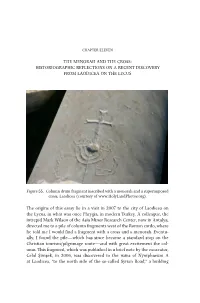
CHAPTER ELEVEN THE MENORAH AND THE CROSS: HISTORIOGRAPHIC REFLECTIONS ON A RECENT DISCOVERY FROM LAODICEA ON THE LYCUS Figure 55. Column drum fragment inscribed with a menorah and a superimposed cross, Laodicea (courtesy of www.HolyLandPhotos.org). The origins of this essay lie in a visit in 2007 to the city of Laodicea on the Lycus, in what was once Phrygia, in modern Turkey. A colleague, the intrepid Mark Wilson of the Asia Minor Research Center, now in Antalya, directed me to a pile of column fragments west of the Roman cardo, where he told me I would find a fragment with a cross and a menorah. Eventu- ally, I found the pile—which has since become a standard stop on the Christian tourism/pilgrimage route—and with great excitement the col- umn. This fragment, which was published in a brief note by the excavator, Celal Şimşek, in 2006, was discovered in the ruins of Nymphaeum A at Laodicea, “to the north side of the so-called Syrian Road,” a building 196 chapter eleven destroyed in an earthquake in 494 CE.1 The presence of a menorah in the nymphaeum compound at the very center of the city did not surprise me. After all, numerous roughly inscribed menorahs were found in the Sebastion of Aphrodisias from late antiquity, a period during which the erstwhile emperor temple compound was subdivided into shops.2 Similar rough menorahs were found in the shops adjacent to the Sardis synagogue (also a building in the city center),3 on a reused marble slab found in the Library of Celsus in Ephesus, and adorning tombs—including some in nearby Hierapolis (Pamukkale)—at numerous other sites.4 Alternatively, perhaps this well-carved column fragment derived from some lost Jewish communal building—perhaps a synagogue. -

The Expansion of Christianity: a Gazetteer of Its First Three Centuries
THE EXPANSION OF CHRISTIANITY SUPPLEMENTS TO VIGILIAE CHRISTIANAE Formerly Philosophia Patrum TEXTS AND STUDIES OF EARLY CHRISTIAN LIFE AND LANGUAGE EDITORS J. DEN BOEFT — J. VAN OORT — W.L. PETERSEN D.T. RUNIA — C. SCHOLTEN — J.C.M. VAN WINDEN VOLUME LXIX THE EXPANSION OF CHRISTIANITY A GAZETTEER OF ITS FIRST THREE CENTURIES BY RODERIC L. MULLEN BRILL LEIDEN • BOSTON 2004 This book is printed on acid-free paper. Library of Congress Cataloging-in-Publication Data Mullen, Roderic L. The expansion of Christianity : a gazetteer of its first three centuries / Roderic L. Mullen. p. cm. — (Supplements to Vigiliae Christianae, ISSN 0920-623X ; v. 69) Includes bibliographical references and index. ISBN 90-04-13135-3 (alk. paper) 1. Church history—Primitive and early church, ca. 30-600. I. Title. II. Series. BR165.M96 2003 270.1—dc22 2003065171 ISSN 0920-623X ISBN 90 04 13135 3 © Copyright 2004 by Koninklijke Brill nv, Leiden, The Netherlands All rights reserved. No part of this publication may be reproduced, translated, stored in a retrieval system, or transmitted in any form or by any means, electronic, mechanical, photocopying, recording or otherwise, without prior written permission from the publisher. Authorization to photocopy items for internal or personal use is granted by Brill provided that the appropriate fees are paid directly to The Copyright Clearance Center, 222 Rosewood Drive, Suite 910 Danvers, MA 01923, USA. Fees are subject to change. printed in the netherlands For Anya This page intentionally left blank CONTENTS Preface ........................................................................................ ix Introduction ................................................................................ 1 PART ONE CHRISTIAN COMMUNITIES IN ASIA BEFORE 325 C.E. Palestine ..................................................................................... -
Christianizing Asia Minor Paul Mckechnie Index More Information
Cambridge University Press 978-1-108-48146-5 — Christianizing Asia Minor Paul McKechnie Index More Information Index 1 John, New Testament epistle, 51, 56, 118 Alexander son of Antonios, 148, 150, 1 Peter, New Testament epistle, 51, 213 165–6, 210, 247 1 Timothy, New Testament epistle, 152 Alexander, bishop of Jerusalem, 214 4 Ezra, 100 Alexander, martyr, 117 Alexandria, 27, 51, 167, 193, 214, 216 ab epistulis, 76, 177 Alexandros aka Artemon, 192 Abdul Hamid, 150, 158 Alexandros son of Domnos, 242 Aberkios stone, 157, 179 Alexandros son of Epigonos, 199 Aberkios, bishop of Hierapolis, 16, 45, 127, Alexandros son of Gaios, 199, 223, 293 131, 137, 139, 147–65, 207, 210, 221, Alexandros son of Menekrates, 220, 290 228, 240, 244, 246–7, 263–87 alimentary schemes, 180 Abgar VIII, 162 Allexandreia, 235 Abraham, bishop of Seleucia-Ctesiphon, 62 Allexandros, 235 Abras, presbyter, 256 aloes, 55 Abris, bishop of Seleucia-Ctesiphon, 62 Alphios, presbyter, 256 Achaean/s, 69 Anaitis, 41 Acts of St Trophimus, 199 Ancyra, 18, 30, 127–8, 146, 188–9, 259, Adana, 72 308 Adıgüzel Dam, 99 angel/s, 4, 20, 25, 31–2, 85, 94, 96–7, 103, Adrianople, 258 111, 130, 153, 155, 161, 173, 184–5, aedicula, 155 227–8, 287 Aegean, 8 Anicetus, bishop of Rome, 79, 82 Aelius Aristides, 86 Aniketos, 257 Aelius Glykon, 65 Anne, Queen, 79 Aelius Publius Julius, 116, 131 anonymous anti-Montanist writer, 100–2, aeons, 70 106, 108, 120, 126, 128, 131, 144, 158 Africa, 97, 101, 129–30, 164, 213, 255 anti-Marcionite prologue, 55 Afyonkarahisar, 166, 215, 234, 291 antimony, 108 Ağa -
The Antigonids and the Ruler Cult. Global and Local Perspectives?
The Antigonids and the Ruler Cult Global and Local Perspectives? 1 Franca Landucci DOI – 10.7358/erga-2016-002-land AbsTRACT – Demetrius Poliorketes is considered by modern scholars the true founder of ruler cult. In particular the Athenians attributed him several divine honors between 307 and 290 BC. The ancient authors in general consider these honors in a negative perspec- tive, while offering words of appreciation about an ideal sovereignty intended as a glorious form of servitude and embodied in Antigonus Gonatas, Demetrius Poliorketes’ son and heir. An analysis of the epigraphic evidences referring to this king leads to the conclusion that Antigonus Gonatas did not officially encourage the worship towards himself. KEYWORDS – Antigonids, Antigonus Gonatas, Demetrius Poliorketes, Hellenism, ruler cult. Antigonidi, Antigono Gonata, culto del sovrano, Demetrio Poliorcete, ellenismo. Modern scholars consider Demetrius Poliorketes the true founder of ruler cult due to the impressively vast literary tradition on the divine honours bestowed upon this historical figure, especially by Athens, between the late fourth and the early third century BC 2. As evidenced also in modern bib- liography, these honours seem to climax in the celebration of Poliorketes as deus praesens in the well-known ithyphallus dedicated to him by the Athenians around 290 3. Documentation is however pervaded by a tone that is strongly hostile to the granting of such honours. Furthermore, despite the fact that it has been handed down to us through Roman Imperial writers like Diodorus, Plutarch and Athenaeus, the tradition reflects a tendency contemporary to the age of the Diadochi, since these same authors refer, often explicitly, to a 1 All dates are BC, unless otherwise stated. -
Calendar of Roman Events
Introduction Steve Worboys and I began this calendar in 1980 or 1981 when we discovered that the exact dates of many events survive from Roman antiquity, the most famous being the ides of March murder of Caesar. Flipping through a few books on Roman history revealed a handful of dates, and we believed that to fill every day of the year would certainly be impossible. From 1981 until 1989 I kept the calendar, adding dates as I ran across them. In 1989 I typed the list into the computer and we began again to plunder books and journals for dates, this time recording sources. Since then I have worked and reworked the Calendar, revising old entries and adding many, many more. The Roman Calendar The calendar was reformed twice, once by Caesar in 46 BC and later by Augustus in 8 BC. Each of these reforms is described in A. K. Michels’ book The Calendar of the Roman Republic. In an ordinary pre-Julian year, the number of days in each month was as follows: 29 January 31 May 29 September 28 February 29 June 31 October 31 March 31 Quintilis (July) 29 November 29 April 29 Sextilis (August) 29 December. The Romans did not number the days of the months consecutively. They reckoned backwards from three fixed points: The kalends, the nones, and the ides. The kalends is the first day of the month. For months with 31 days the nones fall on the 7th and the ides the 15th. For other months the nones fall on the 5th and the ides on the 13th. -

Werner Eck Unter Mitarbeit Von Elisabeth Müller-Luckner
Schriften des Historischen Kollegs Herausgegeben von der Stiftung Historisches Kolleg Kolloquien 42 R. Oldenbourg Verlag München 1999 Lokale Autonomie und römische Ordnungsmacht in den kaiserzeitlichen Provinzen vom 1. bis 3. Jahrhundert Herausgegeben von Werner Eck unter Mitarbeit von Elisabeth Müller-Luckner R. Oldenbourg Verlag München 1999 Schriften cles Historischen Kollegs im Auftrag der Stiftung Historisches Kolleg im Stifterverband für die Deutsche Wissenschaft herausgegeben von Lothar Gail in Verbindung mit Manfred Erhardt, Arnold Esch, Etienne Francois, Klaus Hildebrand, Hilmar Kopper, Jochen Martin, Heinrich Nöth, Winfried Schulze, Michael Stolleis und Ursula Peters Geschäftsführung: Georg Kalmer Redaktion: Elisabeth Müller-Luckncr Organisationsausschuß: Georg Kalmer, Herbert Kießling, Elisabeth Müller-Luckncr, Heinz-Rudi Spiegel Die Stiftung Historisches Kolleg hat sich für den Bereich der historisch orientierten Wissen schaften die Förderung von Gelehrten, die sich durch herausragende Leistungen m For schung und Lehre ausgewiescn haben, zur Aufgabe gesetzt. Sie vergibt zu diesem Zweck jährlich bis zu drei Forschungsstipendien und ein Förderstipendium sowie alle drei Jahre den „Preis des Historischen Kollegs“. Die Forschungsstipendien, deren Verleihung zugleich eine Auszeichnung für die bisherigen Leistungen darstellt, sollen den berufenen Wissenschaftlern während eines Kollegjahres die Möglichkeit bieten, frei von anderen Verpflichtungen eine größere Arbeit abzuschließen. Professor Dr. Werner Eck (Köln) war - zusammen mit Professor Dr. Manfred Hildermeicr (Göttingen), Priv.-Doz. Dr. Wolfram Pyta (Köln) und Professor Dr. Knut Schulz (Berlin) - Stipendiat des Historischen Kollegs im Kollegjahr 1995/96. Den Obliegenheiten der Stipen diaten gemäß hat Werner Eck aus seinem Arbeitsbereich ein Kolloquium zum Thema „Lo kale Autonomie und römische Ordnungsmacht in den kaiserzeitlichen Provinzen vom 1. bis 3. Jahrhundert“ vom 5. bis 7. -

Religioso.Pdf
RELIGIOUS ORIGIN AND LEGENDS OF CASTILLA ACUDECTO - SEGOVIA ORIGIN AND LEGENDS OF CASTILLA BURGOS PALENCIA BURGOS ATAPUERCA PALENCIA COBARRUBIAS SANTO DOMINGO DE SILOS SORIA LERMA VALLADOLID BURGO DE OSMA VALLADOLID AYLLÓN SEGOVIA From $ SEGOVIA 409 3 Days I 2 Nights MADRID MADRID Areas: Castilla y León MONASTERIO SILOS Tour Type: Urban, Religious, Historical Day 01 . Madrid- Ayllon- Burgos De Osma- Monasterio De Silos- Covarrubias- Burgos.- Welcome to your Europamundo Trip Style!!! The information about the meeting place and start time of your circuit can be found on your voucher. We leave to the Northern Mountains of Madrid, and at the beautiful town of AYLLÓN, in the vicinity of the Mountains with the same name, with its red archi- tecture and medieval atmosphere. We continue towards BURGO DE OSMA, an ancient and monumental episco- pal city, located in the province of Soria and known for its history and beautiful Cathedral (entrance included). We visit the SAINT DOMINGO OF SILOS MONASTERY (admission includ- CATEDRAL BURGOS ed), a place of spiritual refuge and one the most beautiful places to admire the Spanish Romanic Art, unique in Europe. Then we arrive at the noble city of CO- VARRUBIAS, with its old walled case, its typical Houses. In the Collegiate Church we can admire the triptych and also visit the tomb of Fernán Gonzalez, first count of Castilla. and its interesting vintage weapons collection. After a brief journey, arrival and accommodation in the city of BURGOS. Day 02 . Burgos- Atapuerca- Lerma- Palencia.- After breakfast time to get to know the city of BURGOS, crossroads; its spectacular Gothic Cathedral stands out, built for more than three centuries, where the tomb of El Cid and his wife Da. -

Jahrbuch Für Antike Und Christentum
Titel_Bd_61_JbAC 23.02.2020 10:49 Seite 1 JAHRBUCH FÜR ANTIKE UND CHRISTENTUM JAHRGANG 61 · 2018 ASCHENDORFF VERLAG MÜNSTER WESTFALEN Titel_Bd_61_JbAC 23.02.2020 10:49 Seite 2 BEGRÜNDET VON THEODOR KLAUSER, EDUARD STOMMEL, ALFRED STUIBER FORTGEFÜHRT VON ERNST DASSMANN, JOSEF ENGEMANN, ALFRED HERMANN, KLAUS THRAEDE HERAUSGEGEBEN VON GEORG SCHÖLLGEN, CHRISTIAN HORNUNG, SIBLE DE BLAAUW, WINRICH LÖHR REDAKTION: SABRINA TATZ ANSCHRIFT DER REDAKTION: F. J. DÖLGER-INSTITUT, OXFORDSTRASSE 15, D-53111 BONN TELEFON 00 49-(0)228-73 61 77 · TELEFAX 73 61 81 · E-MAIL: statz@uni-bonn.de ES WIRD GEBETEN, BESPRECHUNGSEXEMPLARE NUR NACH RÜCKSPRACHE MIT DER SCHRIFTLEITUNG EINZUSENDEN ABKÜRZUNG: J bAC DIESE PUBLIKATION UNTERLIEGT EINEM PEER REVIEW-VERFAHREN. THIS PUBLICATION IS PEER REVIEWED. DIESE PUBLIKATION WIRD VOM VEREIN ZUR FÖRDERUNG DES F. J. DÖLGER-INSTITUTS UND DER RICHARD UND ANNE-LIESE GIELEN-LEYENDECKER-STIFTUNG GEFÖRDERT. © 2020 ASCHENDORFF VERLAG GMBH & CO. KG, MÜNSTER DAS WERK IST URHEBERRECHTLICH GESCHÜTZT. DIE DADURCH BEGRÜNDETEN RECHTE, INSBESONDERE DIE DER ÜBERSETZUNG, DES NACHDRUCKS, DER ENTNAHME VON ABBILDUNGEN, DER FUNKSENDUNG, DER WIEDERGABE AUF FOTOMECHANISCHEM ODER ÄHNLICHEM WEGE UND DER SPEICHERUNG IN DATEN - VERARBEITUNGSANLAGEN BLEIBEN, AUCH BEI NUR AUSZUGSWEISER VERWERTUNG, VORBEHALTEN. DIE VERGÜTUNGSANSPRÜCHE GEMÄSS § 54 ABS. 2 URHG WERDEN DURCH DIE VERWERTUNGSGESELLSCHAFT WORT WAHRGENOMMEN. PRINTED IN GERMANY GEDRUCKT AUF SÄUREFREIEM, ALTERUNGSBESTÄNDIGEM PAPIER ćȍ ISSN 0075-2541 ISBN 978-3-402-10713-3 C:/_mbsl/Werke/JbAC/Bd_61/003-004_Bd_61.3d vom 21.2.2020 Seitenformat: 192,00 x 275,00 mm INHALT Nachruf Rotraut Wisskirchen . ............ 5 Aufsätze Wolfgang Hübner Γνῶσις und ἀγνωσία. Zwei christliche Interpretationen des arateischen Sternhimmels 9 Francesco Lubian Teaching through Images Between claritas and obscuritas. -

The Carthaginians 6Th–2Nd Century BC
The Carthaginians 6th–2nd Century BC ANDREA SALIMBETI ILLUSTRATED BY GIUSEPPE RAVA & RAFFAELE D’AMATO © Osprey Publishing • www.ospreypublishing.com Elite • 201 The Carthaginians 6th–2nd Century BC ANDREA SALIMBETI ILLUSTRATED BY GIUSEPPE RAVA & RAFFAELE D’AMATO Series editor Martin Windrow © Osprey Publishing • www.ospreypublishing.com CONTENTS INTRODUCTION 4 )JTUPSJDBMCBDLHSPVOE HISTORICAL REPUTATION 9 $SVFMFYFDVUJPOT )VNBOTBDSJGJDF CHRONOLOGY 12 ORGANIZATION 16 $PNNBOE $JUJ[FONJMJUJB -JCZP1IPFOJDJBOT .FSDFOBSJFTBMMJFTBEWBOUBHFTBOEEBOHFSTPG SFMJBODFPONFSDFOBSJFTo/PSUI"GSJDBOTo*CFSJBOTo$FMUT /POJOGBOUSZUSPPQT$BWBMSZo$IBSJPUTo&MFQIBOUTo"SUJMMFSZ TACTICS 28 )FBWZBOEMJHIUJOGBOUSZ &WPMVUJPOPGNFSDFOBSZUBDUJDTJO1VOJDTFSWJDF*CFSJBODBWBMSZo$FMUT ARMS & EQUIPMENT 32 $BSUIBHJOJBO-JCZP1IPFOJDJBOJOGBOUSZBOEDBWBMSZ"SNPVS Shields 8FBQPOT /PSUI "GSJDBODBWBMSZBOEJOGBOUSZo*CFSJBOTUIF1P[P.PSPCVSJBMo#BMFBSJDTMJOHFSTo$FMUTo*OTJHOJB standards CLOTHING & PHYSICAL APPEARANCE 46 THE NAVY 48 SELECTED CAMPAIGNS & BATTLES 52 5IFDPORVFTUPG4BSEJOJB oc.#$ 5IFCBUUMFPG)JNFSB #$ 5IFNFSDFOBSZSFWPMU #$ SELECT BIBLIOGRAPHY 61 INDEX 64 © Osprey Publishing • www.ospreypublishing.com THE CARTHAGINIANS 6th–2nd CENTURIES BC INTRODUCTION 5FSSBDPUUBNBMFIFBEGSPN Carthage was the greatest military power in the western Mediterranean $BSUIBHF UIDFOUVSZ#$5IJT world during the centuries of the Greek and Roman expansions, and used its SFBMJTUJDQPSUSBJUJNBHFPGB mighty fleet to build a commercial and territorial empire in North Africa, the $BSUIBHJOJBOOPCMFNBOPS Iberian Peninsula -
Campaign Information Report
BRIEF Contents 1- TOURISM STATISTICS OF TURKEY 2- PRODUCTS OF TURKEY 3- WHAT WE HAVE ACHIEVED SO FAR 4- THE PROBLEMS WE HAVE ENCOUNTERED 5- RIVALS OF TURKEY 6- OUR STRENGHTS AND POTENTIAL OPPORTUNITIES 7- WHY A BRAND-NEW COMMUNICATION CAMPAIGN? 8- TARGET MARKETS OF TURKEY 9- THE VISION OF TURKEY 10- COMMUNICATION STRATEGY 11- TONALITY 12- THE PERCEPTION WE AIM TO CREATE 13- DOS & DON’TS 14- CAMPAIGN GOALS BRIEF 1- TOURISM STATISTICS OF TURKEY While the number of tourists arriving in Turkey in 2014 was 41.6 million, it decreased to 37.9 million in 2017. This figure has increased in 2018, reaching 3,033,145 in the period of January-September. The tourism revenue of Turkey was 34.3 billion US$ in 2014; however, it declined and stood at 26.2 billion USD in 2017. According to the data for January-September 2018, Turkey has generated total tourism revenue worth 22.9 billion USD. In September 2018, the number of tourists visiting Turkey has increased by 17.57% compared to the same period of the previous year which reached 4.792.818. The table below shows the number of tourists arriving in Turkey year on year and the revenues earned starting from 2014 to September 2018. Year Number of Tourist Tourism Revenues* (000 $) 2014 41.627.246 34.305.904 2015 41.114.069 31.464.777 2016 30.906.680 22.107.440 2017 37.969.824 26.283.656 2018** 37.033.145 22.972.492 Source: DG of Investments and Enterprises * Including flight and excursion revenues. -

Adalya 23 2020
ISSN 1301-2746 ADALYA 23 2020 ADALYA ADALYA 23 2020 23 2020 ISSN 1301-2746 ADALYA The Annual of the Koç University Suna & İnan Kıraç Research Center for Mediterranean Civilizations (OFFPRINT) AThe AnnualD of theA Koç UniversityLY Suna A& İnan Kıraç Research Center for Mediterranean Civilizations (AKMED) Adalya, a peer reviewed publication, is indexed in the A&HCI (Arts & Humanities Citation Index) and CC/A&H (Current Contents / Arts & Humanities) Adalya is also indexed in the Social Sciences and Humanities Database of TÜBİTAK/ULAKBİM TR index and EBSCO. Mode of publication Worldwide periodical Publisher certificate number 18318 ISSN 1301-2746 Publisher management Koç University Rumelifeneri Yolu, 34450 Sarıyer / İstanbul Publisher Umran Savaş İnan, President, on behalf of Koç University Editor-in-chief Oğuz Tekin Editors Tarkan Kahya and Arif Yacı English copyediting Mark Wilson Editorial Advisory Board (Members serve for a period of five years) Prof. Dr. Mustafa Adak, Akdeniz University (2018-2022) Prof. Dr. Engin Akyürek, Koç University (2018-2022) Prof. Dr. Nicholas D. Cahill, University of Wisconsin-Madison (2018-2022) Prof. Dr. Edhem Eldem, Boğaziçi University / Collège de France (2018-2022) Prof. Dr. Mehmet Özdoğan, Emeritus, Istanbul University (2016-2020) Prof. Dr. C. Brian Rose, University of Pennsylvania (2018-2022) Prof. Dr. Charlotte Roueché, Emerita, King’s College London (2019-2023) Prof. Dr. Christof Schuler, DAI München (2017-2021) Prof. Dr. R. R. R. Smith, University of Oxford (2016-2020) © Koç University AKMED, 2020 Production Zero Production Ltd. Abdullah Sok. No. 17 Taksim 34433 İstanbul Tel: +90 (212) 244 75 21 • Fax: +90 (212) 244 32 09 info@zerobooksonline.com; www.zerobooksonline.com Printing Fotokitap Fotoğraf Ürünleri Paz. -

The Trade Associations of Ptolemaic Egypt
9 The Trade Associations of Ptolemaic Egypt: Definition, Organization and their Relationship with the State Matt Gibbs THE SCI.DAN.H. i. Introduction ROYAL DANISH This chapter considers the trade associations of Ptolemaic Egypt, O • 9 and will deal specifically with three issues.1 First, the question of A • CA PRIVATE definition: What defined these groups as associations and as pri DEM vate, voluntary collectives? Second, the organization of these Y OF ASSOCIATIONS groups will be examined: Were they imitations of the state or were SCIENCES they based on another model? Finally, the relationship between these collectives and the Ptolemaic administration will be consid AND ered, with particular relevance to their legal status and their posi LETTERS AND tion in part of the economy of Hellenistic Egypt. THE ■ To start, trade associations themselves, in their most simple 2 0 t f PUBLIC form, were collective bodies comprising individuals linked and SPHERE identified by occupation or involvement in a trade, although they likely had a variety of interests that ranged broadly across econom ic, social, and religious spheres. The tradition was certainly long- lived too; the fenomeno assodatwo in Egypt has a significant history, i. The paper that forms the basis of this chapter was presented at the ‘Public Associations and the Public Sphere in the Ancient World’ symposium, held on September 9-11 2010, at the Royal Danish Academy of Sciences and Letters, Copenhagen. For the invitation and hospitality, I thank Vincent Gabrielsen, Christian Ammitzbøll Thomsen, and Sofie Sidor. For their comments, advice, and help, I thank the participants at the symposium, and in particular Colin Adams, Peter Fibiger Bang, Boris Chrubasik, Jennifer Cromwell, Georgy Kantor, Andrew Monson (who was also generous enough to share his research with me), Jonathan S.