Viola × Wittrockiana
Total Page:16
File Type:pdf, Size:1020Kb
Load more
Recommended publications
-

Cockspur Hawthorn Grows from Southern Quebec, and Ontario to Northern Louisiana, Alabama and Northwestern Georgia, and West to Kansas
Plant Guide COCKSPUR Status Please consult the PLANTS Web site and your State HAWTHORN Department of Natural Resources for this plant’s current status, such as, state noxious status, and Crataegus crus-galli L. wetland indicator values. Plant Symbol = CRCR2 Description Contributed By: USDA NRCS National Plant Data General: It is a small tree that grows twenty to thirty Center feet high, twenty to thirty-five feet wide; with wide- spreading, horizontal, thorny branches. Leaves are broadest above or near the middle, thick, leathery, shiny dark green above, usually not lobed, and smooth. Flowers ranging from white to red are produced in clusters. Fruits are broadest above the middle or rounded, dull red or green. Distribution: Cockspur hawthorn grows from southern Quebec, and Ontario to northern Louisiana, Alabama and northwestern Georgia, and west to Kansas. Adaptation Although Cockspur hawthorn generally requires no special soil requirements, it prefers a moist, well- drained, slightly acid soils, and full sunlight. It is adaptable to poor soils; various soil pHs, compacted soils, drought, heat and winter salt spray. Adapted to USDA Hardiness Zone 4. Establishment Propagation from Seed or Grafting: Cockspur hawthorn can be propagated by seeds or by stem Native Trees of Texas Department of Horticulture cuttings grafted onto seedling rootstock. Propagation Texas A&M University using seeds requires acid scarification for two to Uses three hours followed by three months warm Erosion Control: Because it tolerates a wide variety stratification and another three months prechilling. of sites, it can be planted to stabilize banks, for Seeds are planted in drill rows eight to twelve inches shelterbelts, and for erosion control. -

Cyclotides Evolve
Digital Comprehensive Summaries of Uppsala Dissertations from the Faculty of Pharmacy 218 Cyclotides evolve Studies on their natural distribution, structural diversity, and activity SUNGKYU PARK ACTA UNIVERSITATIS UPSALIENSIS ISSN 1651-6192 ISBN 978-91-554-9604-3 UPPSALA urn:nbn:se:uu:diva-292668 2016 Dissertation presented at Uppsala University to be publicly examined in B/C4:301, BMC, Husargatan 3, Uppsala, Friday, 10 June 2016 at 09:00 for the degree of Doctor of Philosophy (Faculty of Pharmacy). The examination will be conducted in English. Faculty examiner: Professor Mohamed Marahiel (Philipps-Universität Marburg). Abstract Park, S. 2016. Cyclotides evolve. Studies on their natural distribution, structural diversity, and activity. Digital Comprehensive Summaries of Uppsala Dissertations from the Faculty of Pharmacy 218. 71 pp. Uppsala: Acta Universitatis Upsaliensis. ISBN 978-91-554-9604-3. The cyclotides are a family of naturally occurring peptides characterized by cyclic cystine knot (CCK) structural motif, which comprises a cyclic head-to-tail backbone featuring six conserved cysteine residues that form three disulfide bonds. This unique structural motif makes cyclotides exceptionally resistant to chemical, thermal and enzymatic degradation. They also exhibit a wide range of biological activities including insecticidal, cytotoxic, anti-HIV and antimicrobial effects. The cyclotides found in plants exhibit considerable sequence and structural diversity, which can be linked to their evolutionary history and that of their host plants. To clarify the evolutionary link between sequence diversity and the distribution of individual cyclotides across the genus Viola, selected known cyclotides were classified using signature sequences within their precursor proteins. By mapping the classified sequences onto the phylogenetic system of Viola, we traced the flow of cyclotide genes over evolutionary history and were able to estimate the prevalence of cyclotides in this genus. -

"National List of Vascular Plant Species That Occur in Wetlands: 1996 National Summary."
Intro 1996 National List of Vascular Plant Species That Occur in Wetlands The Fish and Wildlife Service has prepared a National List of Vascular Plant Species That Occur in Wetlands: 1996 National Summary (1996 National List). The 1996 National List is a draft revision of the National List of Plant Species That Occur in Wetlands: 1988 National Summary (Reed 1988) (1988 National List). The 1996 National List is provided to encourage additional public review and comments on the draft regional wetland indicator assignments. The 1996 National List reflects a significant amount of new information that has become available since 1988 on the wetland affinity of vascular plants. This new information has resulted from the extensive use of the 1988 National List in the field by individuals involved in wetland and other resource inventories, wetland identification and delineation, and wetland research. Interim Regional Interagency Review Panel (Regional Panel) changes in indicator status as well as additions and deletions to the 1988 National List were documented in Regional supplements. The National List was originally developed as an appendix to the Classification of Wetlands and Deepwater Habitats of the United States (Cowardin et al.1979) to aid in the consistent application of this classification system for wetlands in the field.. The 1996 National List also was developed to aid in determining the presence of hydrophytic vegetation in the Clean Water Act Section 404 wetland regulatory program and in the implementation of the swampbuster provisions of the Food Security Act. While not required by law or regulation, the Fish and Wildlife Service is making the 1996 National List available for review and comment. -

Scientific Name Species Common Name Abies Lasiocarpa FIR Subalpine Acacia Macracantha ACACIA Long-Spine
Scientific Name Species Common Name Abies lasiocarpa FIR Subalpine Acacia macracantha ACACIA Long-spine Acacia roemeriana CATCLAW Roemer Acer grandidentatum MAPLE Canyon Acer nigrum MAPLE Black Acer platanoides MAPLE Norway Acer saccharinum MAPLE Silver Aesculus pavia BUCKEYE Red Aesculus sylvatica BUCKEYE Painted Ailanthus altissima AILANTHUS Tree-of-heaven Albizia julibrissin SILKTREE Mimosa Albizia lebbek LEBBEK Lebbek Alnus iridis ssp. sinuata ALDER Sitka Alnus maritima ALDER Seaside Alvaradoa amorphoides ALVARADOA Mexican Amelanchier laevis SERVICEBERRY Allegheny Amyris balsamifera TORCHWOOD Balsam Annona squamosa SUGAR-APPLE NA Araucaria cunninghamii ARAUCARIA Cunningham Arctostaphylos glauca MANZANITA Bigberry Asimina obovata PAWPAW Bigflower Bourreria radula STRONGBACK Rough Brasiliopuntia brasiliensis PRICKLY-PEAR Brazilian Bursera simaruba GUMBO-LIMBO NA Caesalpinia pulcherrima FLOWERFENCE NA Capparis flexuosa CAPERTREE Limber CRUCIFIXION- Castela emoryi THORN NA Casuarina equisetifolia CASUARINA Horsetail Ceanothus arboreus CEANOTHUS Feltleaf Ceanothus spinosus CEANOTHUS Greenbark Celtis lindheimeri HACKBERRY Lindheimer Celtis occidentalis HACKBERRY Common Cephalanthus occidentalis BUTTONBUSH Common Cercis canadensis REDBUD Eastern Cercocarpus traskiae CERCOCARPUS Catalina Chrysophyllum oliviforme SATINLEAF NA Citharexylum berlandieri FIDDLEWOOD Berlandier Citrus aurantifolia LIME NA Citrus sinensis ORANGE Orange Coccoloba uvifera SEAGRAPE NA Colubrina arborescens COLUBRINA Coffee Colubrina cubensis COLUBRINA Cuba Condalia globosa -
Native Trees of Georgia
1 NATIVE TREES OF GEORGIA By G. Norman Bishop Professor of Forestry George Foster Peabody School of Forestry University of Georgia Currently Named Daniel B. Warnell School of Forest Resources University of Georgia GEORGIA FORESTRY COMMISSION Eleventh Printing - 2001 Revised Edition 2 FOREWARD This manual has been prepared in an effort to give to those interested in the trees of Georgia a means by which they may gain a more intimate knowledge of the tree species. Of about 250 species native to the state, only 92 are described here. These were chosen for their commercial importance, distribution over the state or because of some unusual characteristic. Since the manual is intended primarily for the use of the layman, technical terms have been omitted wherever possible; however, the scientific names of the trees and the families to which they belong, have been included. It might be explained that the species are grouped by families, the name of each occurring at the top of the page over the name of the first member of that family. Also, there is included in the text, a subdivision entitled KEY CHARACTERISTICS, the purpose of which is to give the reader, all in one group, the most outstanding features whereby he may more easily recognize the tree. ACKNOWLEDGEMENTS The author wishes to express his appreciation to the Houghton Mifflin Company, publishers of Sargent’s Manual of the Trees of North America, for permission to use the cuts of all trees appearing in this manual; to B. R. Stogsdill for assistance in arranging the material; to W. -
How to Identify New Brunswick Violets
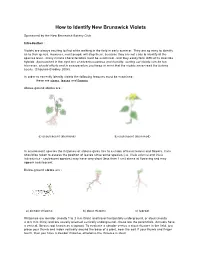
How to Identify New Brunswick Violets Sponsored by the New Brunswick Botany Club Introduction : Violets are always exciting to find while walking in the field in early summer. They are so easy to identify as to their genus. However, most people will stop there, because they are not easy to identify at the species level - many minute characteristics must be examined...and they easily form difficult to describe hybrids. Approached in the right mix of adventurousness and humility, sorting out violets can be fun. However, should efforts end in exasperation, just keep in mind that the violets never read the botany books. (Choukas-Bradley 2004). In order to correctly identify violets the following features must be examined : these are stems, leaves and flowers. Above-ground stems are : a) acaulescent (stemless) b) caulescent (stemmed) In acaulescent species the rhizomes or stolons gives rise to a crown of basal leaves and flowers. Care should be taken to assess the position of leaves since some species (i.e. Viola adunca and Viola labradorica - caulescent species) may have very short (less than 1 cm) stems at flowering and may appear acaulescent. Below-ground stems are : a) slender rhizome b) stout rhizome c) taproot Rhizomes are slender (mostly 1 to 3 mm thick) and travel horizontally underground, or stout (mostly 4 to 6 mm thick) and are usually oriented vertically underground - these are the perennials. Annuals have a vertical, fibrous root known as a taproot. To evaluate a slender versus a stout rhizome in the field, just place your thumb and index vertically around the base of a plant, near the soil. -

State of New York City's Plants 2018
STATE OF NEW YORK CITY’S PLANTS 2018 Daniel Atha & Brian Boom © 2018 The New York Botanical Garden All rights reserved ISBN 978-0-89327-955-4 Center for Conservation Strategy The New York Botanical Garden 2900 Southern Boulevard Bronx, NY 10458 All photos NYBG staff Citation: Atha, D. and B. Boom. 2018. State of New York City’s Plants 2018. Center for Conservation Strategy. The New York Botanical Garden, Bronx, NY. 132 pp. STATE OF NEW YORK CITY’S PLANTS 2018 4 EXECUTIVE SUMMARY 6 INTRODUCTION 10 DOCUMENTING THE CITY’S PLANTS 10 The Flora of New York City 11 Rare Species 14 Focus on Specific Area 16 Botanical Spectacle: Summer Snow 18 CITIZEN SCIENCE 20 THREATS TO THE CITY’S PLANTS 24 NEW YORK STATE PROHIBITED AND REGULATED INVASIVE SPECIES FOUND IN NEW YORK CITY 26 LOOKING AHEAD 27 CONTRIBUTORS AND ACKNOWLEGMENTS 30 LITERATURE CITED 31 APPENDIX Checklist of the Spontaneous Vascular Plants of New York City 32 Ferns and Fern Allies 35 Gymnosperms 36 Nymphaeales and Magnoliids 37 Monocots 67 Dicots 3 EXECUTIVE SUMMARY This report, State of New York City’s Plants 2018, is the first rankings of rare, threatened, endangered, and extinct species of what is envisioned by the Center for Conservation Strategy known from New York City, and based on this compilation of The New York Botanical Garden as annual updates thirteen percent of the City’s flora is imperiled or extinct in New summarizing the status of the spontaneous plant species of the York City. five boroughs of New York City. This year’s report deals with the City’s vascular plants (ferns and fern allies, gymnosperms, We have begun the process of assessing conservation status and flowering plants), but in the future it is planned to phase in at the local level for all species. -
Effect of Crataegus Usage in Cardiovascular Disease Prevention: an Evidence-Based Approach
Hindawi Publishing Corporation Evidence-Based Complementary and Alternative Medicine Volume 2013, Article ID 149363, 16 pages http://dx.doi.org/10.1155/2013/149363 Review Article Effect of Crataegus Usage in Cardiovascular Disease Prevention: An Evidence-Based Approach Jie Wang, Xingjiang Xiong, and Bo Feng Department of Cardiology, Guang’anmen Hospital, China Academy of Chinese Medical Sciences, Beijing 100053, China Correspondence should be addressed to Bo Feng; fengbo263@163.com Received 6 October 2013; Accepted 24 November 2013 Academic Editor: Tabinda Ashfaq Copyright © 2013 Jie Wang et al. This is an open access article distributed under the Creative Commons Attribution License, which permits unrestricted use, distribution, and reproduction in any medium, provided the original work is properly cited. Hawthorn (Crataegus oxyacantha) is a widely used Chinese herb for treatment of gastrointestinal ailments and heart problems and consumed as food. In North America, the role of treatment for heart problems dates back to 1800. Currently, evidence is accumulating from various in vivo and in vitro studies that hawthorn extracts exert a wide range of cardiovascular pharmacological properties, including antioxidant activity, positive inotropic effect, anti-inflammatory effect, anticardiac remodeling effect, antiplatelet aggregation effect, vasodilating effect, endothelial protective effect, reduction of smooth muscle cell migration and proliferation, protective effect against ischemia/reperfusion injury, antiarrhythmic effect, lipid-lowering effect and decrease of arterial blood pressure effect. On the other hand, reviews of placebo-controlled trials have reported both subjective and objective improvement in patients with mild forms of heart failure (NYHA I–III), hypertension, and hyperlipidemia. This paper discussed the underlying pharmacology mechanisms in potential cardioprotective effects and elucidated the clinical applications of Crataegus and its various extracts. -

American Forests National Big Tree Program Species Without Champions
American Forests National Big Tree Program Champion trees are the superstars of their species — and there are more than 700 of them in our national register. Each champion is the result of a lucky combination: growing in a spot protected by the landscape or by people who have cared about and for it, good soil, the right amount of water, and resilience to the elements, surviving storms, disease and pests. American Forests National Big Tree Program was founded to honor these trees. Since 1940, we have kept the only national register of champion trees (http://www.americanforests.org/explore- forests/americas-biggest-trees/champion-trees-national-register/) Champion trees are found by people just like you — school teachers, kids fascinated by science, tree lovers of all ages and even arborists for whom a fun day off is measuring the biggest tree they can find. You, too, can become a big tree hunter and compete to find new champions. Species without Champions (March, 2018) Gold rows indict species that have Idaho State Champions but the nominations are too old to be submitted for National Champion status. Scientific Name Species Common Name Abies lasiocarpa FIR Subalpine Acacia macracantha ACACIA Long-spine Acacia roemeriana CATCLAW Roemer Acer grandidentatum MAPLE Canyon or bigtooth maple Acer nigrum MAPLE Black Acer platanoides MAPLE Norway Acer saccharinum MAPLE Silver Aesculus pavia BUCKEYE Red Aesculus sylvatica BUCKEYE Painted Ailanthus altissima AILANTHUS Tree-of-heaven Albizia julibrissin SILKTREE Mimosa Albizia lebbek LEBBEK Lebbek -

3.2.2.12. Familia Violaceae 3.2.2.12.A
102 3.2.2.12. Familia Violaceae 3.2.2.12.a. Características ¾ Porte: hierbas y arbustos perennes. ¾ Hojas: alternas, rara vez opuesta y enteras o dentadas; simples o divididas, con estípulas. ¾ Flores: solitarias o en racimos, perfectas, actinomorfas o fuertemente zigomorfas, hipóginas. ¾ Perianto: cáliz, 5 sépalos libres; a menudo con apéndices gibosos en su base; corola, 5 pétalos, imbricados o contortos de los cuales el inferior suele prolongarse en un espolón. ¾ Estambres: 5, libres, filamentos muy cortos. ¾ Gineceo: ovario súpero; carpelos, 3 soldados, raro 5; óvulos, 1- ∞, por lóculo, parietales. ¾ Fruto: cápsula loculicida o baya. ¾ Semillas: ariladas o aladas, abundante endosperma oleaginoso, embrión recto. Corte longitudinal de la flor mostrando a la derecha un par Corte longitudinal de la flor de Viola sp. con el de estambres con su prolongación nectarífera. El ovario en espolón abierto al que penetran los apéndices nectaríferos ligados a los dos pares de corte longitudinal mostrando una de sus placentas con sus estambres óvulos y a la izquierda el estambre libre 3.2.2.12.b. Biología floral y/o Fenología Generalmente presentan flores vistosas con guías de néctar que atraen insectos. Además puede presentar flores casmógamas durante la primavera, las cuales son sucedidas en el verano por flores cleistógamas. Presentan nectarios estaminales. En Viola tricolor (pensamiento) hay un espolón formado por el pétalo mediano. El néctar es producido por apéndices del conectivo, dos anteras tienen apéndices y cuatro anteras no tienen apéndices (Vogel, com. pers.). 3.2.2.12.c. Distribución y hábitat Familia cosmopolita, distribuida especialmente en regiones templadas. Diversidad Vegetal Facultad de Ciencias Exactas y Naturales y Agrimensura (UNNE) EUDICOTILEDONEAS ESCENCIALES-Clado Rosides-Eurosides I-Malpighiales: Violaceae 103 (Stevens, 2001) 3.2.2.12.d. -

NJ Native Plants - USDA
NJ Native Plants - USDA Scientific Name Common Name N/I Family Category National Wetland Indicator Status Thermopsis villosa Aaron's rod N Fabaceae Dicot Rubus depavitus Aberdeen dewberry N Rosaceae Dicot Artemisia absinthium absinthium I Asteraceae Dicot Aplectrum hyemale Adam and Eve N Orchidaceae Monocot FAC-, FACW Yucca filamentosa Adam's needle N Agavaceae Monocot Gentianella quinquefolia agueweed N Gentianaceae Dicot FAC, FACW- Rhamnus alnifolia alderleaf buckthorn N Rhamnaceae Dicot FACU, OBL Medicago sativa alfalfa I Fabaceae Dicot Ranunculus cymbalaria alkali buttercup N Ranunculaceae Dicot OBL Rubus allegheniensis Allegheny blackberry N Rosaceae Dicot UPL, FACW Hieracium paniculatum Allegheny hawkweed N Asteraceae Dicot Mimulus ringens Allegheny monkeyflower N Scrophulariaceae Dicot OBL Ranunculus allegheniensis Allegheny Mountain buttercup N Ranunculaceae Dicot FACU, FAC Prunus alleghaniensis Allegheny plum N Rosaceae Dicot UPL, NI Amelanchier laevis Allegheny serviceberry N Rosaceae Dicot Hylotelephium telephioides Allegheny stonecrop N Crassulaceae Dicot Adlumia fungosa allegheny vine N Fumariaceae Dicot Centaurea transalpina alpine knapweed N Asteraceae Dicot Potamogeton alpinus alpine pondweed N Potamogetonaceae Monocot OBL Viola labradorica alpine violet N Violaceae Dicot FAC Trifolium hybridum alsike clover I Fabaceae Dicot FACU-, FAC Cornus alternifolia alternateleaf dogwood N Cornaceae Dicot Strophostyles helvola amberique-bean N Fabaceae Dicot Puccinellia americana American alkaligrass N Poaceae Monocot Heuchera americana -
Floristic Quality Assessment Report
FLORISTIC QUALITY ASSESSMENT IN INDIANA: THE CONCEPT, USE, AND DEVELOPMENT OF COEFFICIENTS OF CONSERVATISM Tulip poplar (Liriodendron tulipifera) the State tree of Indiana June 2004 Final Report for ARN A305-4-53 EPA Wetland Program Development Grant CD975586-01 Prepared by: Paul E. Rothrock, Ph.D. Taylor University Upland, IN 46989-1001 Introduction Since the early nineteenth century the Indiana landscape has undergone a massive transformation (Jackson 1997). In the pre-settlement period, Indiana was an almost unbroken blanket of forests, prairies, and wetlands. Much of the land was cleared, plowed, or drained for lumber, the raising of crops, and a range of urban and industrial activities. Indiana’s native biota is now restricted to relatively small and often isolated tracts across the State. This fragmentation and reduction of the State’s biological diversity has challenged Hoosiers to look carefully at how to monitor further changes within our remnant natural communities and how to effectively conserve and even restore many of these valuable places within our State. To meet this monitoring, conservation, and restoration challenge, one needs to develop a variety of appropriate analytical tools. Ideally these techniques should be simple to learn and apply, give consistent results between different observers, and be repeatable. Floristic Assessment, which includes metrics such as the Floristic Quality Index (FQI) and Mean C values, has gained wide acceptance among environmental scientists and decision-makers, land stewards, and restoration ecologists in Indiana’s neighboring states and regions: Illinois (Taft et al. 1997), Michigan (Herman et al. 1996), Missouri (Ladd 1996), and Wisconsin (Bernthal 2003) as well as northern Ohio (Andreas 1993) and southern Ontario (Oldham et al.