Monarch Butterfly Nectar Plant Lists for Conservation Plantings
Total Page:16
File Type:pdf, Size:1020Kb
Load more
Recommended publications
-

Bwsr Featured Plant Minnesota's Milkweeds
BWSR FEATURED PLANT MINNESOTA’S MILKWEEDS Publication Date: 6‐1‐13 Milkweeds play a key role in wetlands, prairies, savannas and forests in Minnesota. The genus (Asclepias) is particularly important as a nectar and larval food source for a wide range of insect species. The best known example is the monarch butterfly whose larvae appear to feed only on milkweeds. Milkweeds have a unique pollination mechanism where pollen grains are enclosed in waxy sacs called “pollina” that attach to the legs of butterflies, moths, bees, ants and wasps and are then deposited in another milkweed flower if they step into a specialized anther opening. Most milkweeds are toxic to vertebrate herbivores due to cardiac glycosides that are in their plant cells. In addition to supporting insect populations, Butterfly Milkweed milkweeds also provide other landscape benefits due to their extensive root systems (sometimes deep roots, sometimes horizontal) that Photos by Dave Hanson decrease compaction, add organic material to the soil and improve unless otherwise stated water infiltration. Common milkweed is probably the best known milkweed species as it is found in all counties of the state and was included on some county prohibited noxious weed lists. The species was considered a common agricultural weed as its extensive root network made it difficult to remove from agricultural fields with cultivators. Now the species is effectively removed from genetically modified corn and soybean fields that are sprayed with herbicide. This practice has contributed to significant declines in milkweed species, with an estimated 58% decline in the Midwest between 1999 and 2010 and a corresponding 81% decline in monarch butterfly production (Pleasants & Oberhauser, 2013). -

"National List of Vascular Plant Species That Occur in Wetlands: 1996 National Summary."
Intro 1996 National List of Vascular Plant Species That Occur in Wetlands The Fish and Wildlife Service has prepared a National List of Vascular Plant Species That Occur in Wetlands: 1996 National Summary (1996 National List). The 1996 National List is a draft revision of the National List of Plant Species That Occur in Wetlands: 1988 National Summary (Reed 1988) (1988 National List). The 1996 National List is provided to encourage additional public review and comments on the draft regional wetland indicator assignments. The 1996 National List reflects a significant amount of new information that has become available since 1988 on the wetland affinity of vascular plants. This new information has resulted from the extensive use of the 1988 National List in the field by individuals involved in wetland and other resource inventories, wetland identification and delineation, and wetland research. Interim Regional Interagency Review Panel (Regional Panel) changes in indicator status as well as additions and deletions to the 1988 National List were documented in Regional supplements. The National List was originally developed as an appendix to the Classification of Wetlands and Deepwater Habitats of the United States (Cowardin et al.1979) to aid in the consistent application of this classification system for wetlands in the field.. The 1996 National List also was developed to aid in determining the presence of hydrophytic vegetation in the Clean Water Act Section 404 wetland regulatory program and in the implementation of the swampbuster provisions of the Food Security Act. While not required by law or regulation, the Fish and Wildlife Service is making the 1996 National List available for review and comment. -

The Vascular Plants of Massachusetts
The Vascular Plants of Massachusetts: The Vascular Plants of Massachusetts: A County Checklist • First Revision Melissa Dow Cullina, Bryan Connolly, Bruce Sorrie and Paul Somers Somers Bruce Sorrie and Paul Connolly, Bryan Cullina, Melissa Dow Revision • First A County Checklist Plants of Massachusetts: Vascular The A County Checklist First Revision Melissa Dow Cullina, Bryan Connolly, Bruce Sorrie and Paul Somers Massachusetts Natural Heritage & Endangered Species Program Massachusetts Division of Fisheries and Wildlife Natural Heritage & Endangered Species Program The Natural Heritage & Endangered Species Program (NHESP), part of the Massachusetts Division of Fisheries and Wildlife, is one of the programs forming the Natural Heritage network. NHESP is responsible for the conservation and protection of hundreds of species that are not hunted, fished, trapped, or commercially harvested in the state. The Program's highest priority is protecting the 176 species of vertebrate and invertebrate animals and 259 species of native plants that are officially listed as Endangered, Threatened or of Special Concern in Massachusetts. Endangered species conservation in Massachusetts depends on you! A major source of funding for the protection of rare and endangered species comes from voluntary donations on state income tax forms. Contributions go to the Natural Heritage & Endangered Species Fund, which provides a portion of the operating budget for the Natural Heritage & Endangered Species Program. NHESP protects rare species through biological inventory, -

Ipomopsis Sancti-Spiritus in Holy Ghost Canyon with and Without Management Intervention JOYCE MASCHINSKI the Arboretum at Flagstaff
Extinction Risk of Ipomopsis sancti-spiritus in Holy Ghost Canyon With and Without Management Intervention JOYCE MASCHINSKI The Arboretum at Flagstaff Abstract: Small populations are threatened with deterministic and stochastic events that can drive the number of individuals below a critical threshold for survival. Long-term studies allow us to increase our understanding of processes required for their conservation. In the past 7 years, the population of the federally endangered Holy Ghost ipomopsis (Ipomopsis sancti-spiritus) in Holy Ghost Canyon has fluctuated widely from 2047 to 372 plants. Meta- population analysis of average Leslie matrices suggested that I. sancti-spiritus has a high probability of extinction; 60 percent of the demographic transects have negative growth rates. Transects with the greatest likelihood of remaining occupied, the highest h values, and the greatest source of new propagules for maintaining the species in Holy Ghost Canyon are in the sunny lower part of the canyon. In comparison, transects at the top of the canyon have fewer individuals and lower probability of remaining occupied. With management inter- vention to disperse propagules from more fecund to less fecund areas'of the canyon, meta- population modeling indicated decreased (but still a high) risk of extinction within the next 50 years. Thus, although seed augmentation and habitat improvement can improve the chances for I. sancti-spiritus persistence in Holy Ghost Canyon, the species remains at high risk of extinction. Small populations are threatened with determin- rose (Rosa woodsii), poison ivy (Toxicodendron yd- istic and stochastic events that can drive the num- bergii), Indian hemp (Apocynum cannabinum), west- ber of individuals below a critical threshold for ern yarrow (Achilliea millefolium), white ragweed survival (Shaffer 1987, Holsinger 2000). -
Asclepias Incarnata L
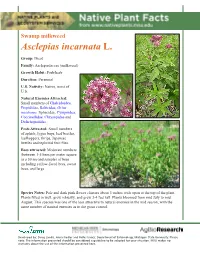
Swamp milkweed Asclepias incarnata L. Group: Dicot Family: Asclepiadaceae (milkweed) Growth Habit: Forb/herb Duration: Perennial U.S. Nativity: Native, most of U.S. Natural Enemies Attracted: Small numbers of Chalcidoidea, Empididae, Salticidae, Orius insidiosus, Sphecidae, Cynipoidea, Coccinellidae, Chrysopidae and Dolichopodidae. Pests Attracted: Small numbers of aphids, lygus bugs, leaf beetles, leafhoppers, thrips, Japanese beetles and tephritid fruit flies. Bees attracted: Moderate numbers (between 1-5 bees per meter square in a 30 second sample) of bees including yellow-faced bees, sweat bees, and large Species Notes: Pale and dark pink flower clusters about 3 inches wide open at the top of the plant. Plants filled in well, grew robustly, and grew 3-4 feet tall. Plants bloomed from mid July to mid August. This species was one of the less attractive to natural enemies in the mid season, with the same number of natural enemies as in the grass control. Developed by: Doug Landis, Anna Fiedler and Rufus Isaacs; Department of Entomology, Michigan State University. Please note: The information presented should be considered a guideline to be adapted for your situation. MSU makes no warranty about the use of the information presented here. About the Plant Species Graph: Plant Species Graph Average number of beneficial insects collected at each plant species the week before, during, and after peak bloom, for plant species blooming from mid-August through early October (+ standard error). Swamp milkweed (Asclepias incarnata) boxed in red. Bars for natural enemies are in green, bars for bees are in yellow. Bars for native plants are solid and nonnative plants are striped. -

Butterfly Plant List
Butterfly Plant List Butterflies and moths (Lepidoptera) go through what is known as a * This list of plants is seperated by host (larval/caterpilar stage) "complete" lifecycle. This means they go through metamorphosis, and nectar (Adult feeding stage) plants. Note that plants under the where there is a period between immature and adult stages where host stage are consumed by the caterpillars as they mature and the insect forms a protective case/cocoon or pupae in order to form their chrysalis. Most caterpilars and mothswill form their transform into its adult/reproductive stage. In butterflies this case cocoon on the host plant. is called a Chrysilas and can come in various shapes, textures, and colors. Host Plants/Larval Stage Perennials/Annuals Vines Common Name Scientific Common Name Scientific Aster Asteracea spp. Dutchman's pipe Aristolochia durior Beard Tongue Penstamon spp. Passion vine Passiflora spp. Bleeding Heart Dicentra spp. Wisteria Wisteria sinensis Butterfly Weed Asclepias tuberosa Dill Anethum graveolens Shrubs Common Fennel Foeniculum vulgare Common Name Scientific Common Foxglove Digitalis purpurea Cape Plumbago Plumbago auriculata Joe-Pye Weed Eupatorium purpureum Hibiscus Hibiscus spp. Garden Nasturtium Tropaeolum majus Mallow Malva spp. Parsley Petroselinum crispum Rose Rosa spp. Snapdragon Antirrhinum majus Senna Cassia spp. Speedwell Veronica spp. Spicebush Lindera benzoin Spider Flower Cleome hasslerana Spirea Spirea spp. Sunflower Helianthus spp. Viburnum Viburnum spp. Swamp Milkweed Asclepias incarnata Trees Trees Common Name Scientific Common Name Scientific Birch Betula spp. Pine Pinus spp. Cherry and Plum Prunus spp. Sassafrass Sassafrass albidum Citrus Citrus spp. Sweet Bay Magnolia virginiana Dogwood Cornus spp. Sycamore Platanus spp. Hawthorn Crataegus spp. -

Identification of Milkweeds (Asclepias, Family Apocynaceae) in Texas
Identification of Milkweeds (Asclepias, Family Apocynaceae) in Texas Texas milkweed (Asclepias texana), courtesy Bill Carr Compiled by Jason Singhurst and Ben Hutchins jason.singhurst@tpwd.texas.gov ben.hutchins@tpwd.texas.gov Texas Parks and Wildlife Department Austin, Texas and Walter C. Holmes walter_holmes@baylor.edu Department of Biology Baylor University Waco, Texas Identification of Milkweeds (Asclepias, Family Apocynaceae) in Texas Created in partnership with the Lady Bird Johnson Wildflower Center Design and layout by Elishea Smith Compiled by Jason Singhurst and Ben Hutchins jason.singhurst@tpwd.texas.gov ben.hutchins@tpwd.texas.gov Texas Parks and Wildlife Department Austin, Texas and Walter C. Holmes walter_holmes@baylor.edu Department of Biology Baylor University Waco, Texas Introduction This document has been produced to serve as a quick guide to the identification of milkweeds (Asclepias spp.) in Texas. For the species listed in Table 1 below, basic information such as range (in this case county distribution), habitat, and key identification characteristics accompany a photograph of each species. This information comes from a variety of sources that includes the Manual of the Vascular Flora of Texas, Biota of North America Project, knowledge of the authors, and various other publications (cited in the text). All photographs are used with permission and are fully credited to the copyright holder and/or originator. Other items, but in particular scientific publications, traditionally do not require permissions, but only citations to the author(s) if used for scientific and/or nonprofit purposes. Names, both common and scientific, follow those in USDA NRCS (2015). When identifying milkweeds in the field, attention should be focused on the distinguishing characteristics listed for each species. -

Phylogenetic Relationships and Historical Biogeography of Tribes and Genera in the Subfamily Nymphalinae (Lepidoptera: Nymphalidae)
Blackwell Science, LtdOxford, UKBIJBiological Journal of the Linnean Society 0024-4066The Linnean Society of London, 2005? 2005 862 227251 Original Article PHYLOGENY OF NYMPHALINAE N. WAHLBERG ET AL Biological Journal of the Linnean Society, 2005, 86, 227–251. With 5 figures . Phylogenetic relationships and historical biogeography of tribes and genera in the subfamily Nymphalinae (Lepidoptera: Nymphalidae) NIKLAS WAHLBERG1*, ANDREW V. Z. BROWER2 and SÖREN NYLIN1 1Department of Zoology, Stockholm University, S-106 91 Stockholm, Sweden 2Department of Zoology, Oregon State University, Corvallis, Oregon 97331–2907, USA Received 10 January 2004; accepted for publication 12 November 2004 We infer for the first time the phylogenetic relationships of genera and tribes in the ecologically and evolutionarily well-studied subfamily Nymphalinae using DNA sequence data from three genes: 1450 bp of cytochrome oxidase subunit I (COI) (in the mitochondrial genome), 1077 bp of elongation factor 1-alpha (EF1-a) and 400–403 bp of wing- less (both in the nuclear genome). We explore the influence of each gene region on the support given to each node of the most parsimonious tree derived from a combined analysis of all three genes using Partitioned Bremer Support. We also explore the influence of assuming equal weights for all characters in the combined analysis by investigating the stability of clades to different transition/transversion weighting schemes. We find many strongly supported and stable clades in the Nymphalinae. We are also able to identify ‘rogue’ -
Descriptions of Two New Chlosyne (Nymphalid~) from Mexico, with a Discussion of Related Forms
148 Vo1.14: no.Z DESCRIPTIONS OF TWO NEW CHLOSYNE (NYMPHALID~) FROM MEXICO, WITH A DISCUSSION OF RELATED FORMS by DAVID L. BAUER Some years ago while examining the series of C hlosyne lacinia Geyer in the collection of F. M. BROWN, I noticed five specimens without marginal or submarginal spots on the wings. These specimens were all from northeastern Mexico and this along with their other peculiarities interested me, so I set them aside and continued to examine the series. Later among the specimens of C hlosyne lacinia quehtala Reakirt, I found five more specimens which also did not have a trace of the marginal or submarginal spots on their wings. These last specimens were from southwestern Mexico. As soon as possible I examined the genitalia of these two insects to see if they were just another variation of the protean C. lacinia, of which I had already checked many forms, or something new. I was both surprised and delighted to find the genitalia w ere definitely not like those of true lacinia. Comparison with the genitalia of other species of Chlosyne showed them to be most like those of C. janais Drury. The next summer, 1954, a trip was taken to Mexico and several colonies of the first insect were found, its habits were observed, and a good series was collected, but only one specimen of the second insect was c3.ptured. However, that same year, and also two years later, KENT H. WILSON was collecting Papilio in Mexico, and knowing of my interest in the Chlosyne he collected as many as he could and sent them to me for study. -

Physiological and Chemical Studies Upon the Milkweed (Asclepias Syriaca L) Fisk Gerhardt Iowa State College
Iowa State University Capstones, Theses and Retrospective Theses and Dissertations Dissertations 1928 Physiological and chemical studies upon the milkweed (Asclepias syriaca L) Fisk Gerhardt Iowa State College Follow this and additional works at: https://lib.dr.iastate.edu/rtd Part of the Agricultural Science Commons, Agriculture Commons, and the Plant Biology Commons Recommended Citation Gerhardt, Fisk, "Physiological and chemical studies upon the milkweed (Asclepias syriaca L)" (1928). Retrospective Theses and Dissertations. 14748. https://lib.dr.iastate.edu/rtd/14748 This Dissertation is brought to you for free and open access by the Iowa State University Capstones, Theses and Dissertations at Iowa State University Digital Repository. It has been accepted for inclusion in Retrospective Theses and Dissertations by an authorized administrator of Iowa State University Digital Repository. For more information, please contact digirep@iastate.edu. INFORMATION TO USERS This manuscript has been reproduced from the microfilm master. UMl films the text directly from the original or copy submitted. Thus, some thesis and dissertation copies are in typewriter face, while others may be from any type of computer printer. The quality of this reproduction is dependent upon the quality of the copy submitted. Broken or indistinct print, colored or poor quality illustrations and photographs, print bleedthrough, substandard margins, and improper alignment can adversely affect reproduction. In the unlikely event that the author did not send UMl a complete manuscript and there are missing pages, these will be noted. Also, if unauthorized copyright material had to be removed, a note will indicate the deletion. Oversize materials (e.g., maps, drawings, charts) are reproduced by sectioning the original, beginning at the upper left-hand comer and continuing from left to right in equal sections with small overiaps. -

Asclepias Incarnata – Swamp-Milkweed
Cultivation Notes No. 56 THE RHODE ISLAND WILD PLANT SOCIETY Fall 2011 Swamp-milkweed – Asclepias incarnata Family: Asclepiadaceae By M.S. Hempstead The milkweeds, genus Asclepias, are a friendly bunch. They look enough alike to be clearly related to each other, but at least our Rhode Island species’ are different enough to be easily distinguishable from each other. Furthermore, they are big, bold and tall, easy on creaking backs. Eight of the 110 species found in North America appear in the Vascular Flora of Rhode Island, although one of them, A. purpurascens, hasn’t been reported in the state since 1906. A. quadrifolia is listed as “State Endangered,” and four of the others are “Of Concern.” That leaves A. syriaca, Common Milkweed, and A. incarnate, Swamp-milkweed, as abundant. A. syriaca can be found in just about any unmowed field. A. incarnata is common in its favorite wet environment, on the shores of many of our rivers and ponds. Swamp- milkweed, with its bright pink flowers, is no less glamorous than its popular but rarer cousin, Butterfly-weed (A. tuberosa). Both would probably prefer that we not mention their reviled cousin, Black Swallowwort (Vincetoxicum nigrum). The milkweeds’ pollination mechanism is so complex that one wonders how the Swamp-milkweed job ever gets done. In the center of the flower is the gynostegium, a stumplike structure, consisting of the stigmatic head with five stamens fused to the outside of it. Each stamen is hidden behind one of the five petal-like hoods that surround the gymnostegium. The pollen-containing anthers, instead of waving in the breeze as in normal flowers, are stuck to the sides of the gynostegium. -
An Overview on Giant Milkweed (Calotropis Procera (Ait.) Ait. F.)
Journal of Plant Sciences 2015; 3(1-1): 19-23 Published online December 26, 2014 (http://www.sciencepublishinggroup.com/j/jps) doi: 10.11648/j.jps.s.2015030101.13 ISSN: 2331-0723 (Print); ISSN: 2331-0731 (Online) An overview on giant milkweed (Calotropis procera (Ait.) Ait. f.) Chandrawat Payal *, Sharma R. A. Medicinal Plant Research Laboratory, Department of Botany, University of Rajasthan, Jaipur-302004 (Rajasthan), India Email address: pchandrawat@gmail.com (C. Payal) To cite this article: Chandrawat Payal, Sharma R. A.. An Overview on Giant Milkweed (Calotropis procera (Ait.) Ait. f.). Journal of Plant Sciences. Special Issue: Medicinal Plants. Vol. 3, No. 1-1, 2015, pp. 19-24. doi: 10.11648/j.jps.s.2015030101.13 Abstract: C. procera in India holds a pride of place largely because of its pharmacological uses and economic values. Arka (C. procera ) an important drug of Ayurveda is known from the earliest time. Traditionally Calotropis is used alone or with other medicines to treat common disease such as fevers, rheumatism, indigestion, cough, cold, eczema, asthma, elephantiasis, nausea, vomiting, and diarrhea. The plant is poisonous can lead to blindness if its juice is put in to the eyes. The silky hairs are using to stuff pillows. The wood is used in impoverished desert areas for a cooking fuel. The stem is useful for making ropes, carpets, fishing nets and sewing thread. The wood is used in making charcoal. C. procera is an ideal plant for monitoring sulphur dioxide emissions in the air. C. procera is a potential plant for bioenergy and biofuel production in semi arid regions of the country.