A Primer on Georgia's American Indian Heritage
Total Page:16
File Type:pdf, Size:1020Kb
Load more
Recommended publications
-
Teacher Asks Board to Fight for Raises JULIA ROBERTS Er Raises
DEFENDING OUR NATURAL BEAUTY. PROTECTING OUR QUALITY OF LIFE. PAID BY BRADLEY M. BEAN FOR CITY COMMISSION | GROUP 1 $1.00 WEDNESDAY, OCTOBER 28, 2020 / 20 PAGES, 2 SECTIONS • fbnewsleader.com Teacher asks board to fight for raises JULIA ROBERTS er raises. He said current offers by the rate in order to bring more money to the decisions.” News-Leader Nassau County School District include district. In light of the financial hard- Glackin suggested the school dis- What do you think? a $5,000 increase for new teachers, but ships brought about by the coronavirus trict “propose a pay scale that makes The Nassau County School Board only $600 for more experienced teach- pandemic, though, board members did sense” even though, he said, the Florida What do you think about heard from a member of the Nassau ers. Glackin noted a “mass exodus of not pursue the matter. Glackin referred Department of Education would reject it. teacher pay in Nassau Teachers’ Association, the union that non-retiring teachers we have been see- to the referendum when he addressed “When they do (reject a pay scale County and Florida? Email represents teachers in Nassau schools, ing recently” and said current contract the board. offer), fight for us. Remind them that who asked the board to support teachers talks are not addressing the issue. “We are currently voting, and (we) you were elected to run Nassau County Letters to the Editor to in current contact negotiations. Last year, the school board con- could be voting on a small tax increase schools and not (the state),” Glackin sjbryan@fbnewsleader.com. -
View / Open Gregory Oregon 0171N 12796.Pdf
CHUNKEY, CAHOKIA, AND INDIGENOUS CONFLICT RESOLUTION by ANNE GREGORY A THESIS Presented to the Conflict and Dispute Resolution Program and the Graduate School of the University of Oregon in partial fulfillment of the requirements for the degree of Master of Science June 2020 THESIS APPROVAL PAGE Student: Anne Gregory Title: Chunkey, Cahokia, and Indigenous Conflict Resolution This thesis has been accepted and approved in partial fulfillment of the requirements for the Master of Science degree in the Conflict and Dispute Resolution Program by: Kirby Brown Chair Eric Girvan Member and Kate Mondloch Interim Vice Provost and Dean of the Graduate School Original approval signatures are on file with the University of Oregon Graduate School. Degree awarded June 2020. ii © 2020 Anne Gregory This work is licensed under a Creative Commons Attribution-NonCommercial-NoDerivs (United States) License. iii THESIS ABSTRACT Anne Gregory Master of Science Conflict and Dispute Resolution June 2020 Title: Chunkey, Cahokia, and Indigenous Conflicts Resolution Chunkey, a traditional Native American sport, was a form of conflict resolution. The popular game was one of several played for millennia throughout Native North America. Indigenous communities played ball games not only for the important culture- making of sport and recreation, but also as an act of peace-building. The densely populated urban center of Cahokia, as well as its agricultural suburbs and distant trade partners, were dedicated to chunkey. Chunkey is associated with the milieu surrounding the Pax Cahokiana (1050 AD-1200 AD), an era of reduced armed conflict during the height of Mississippian civilization (1000-1500 AD). The relational framework utilized in archaeology, combined with dynamics of conflict resolution, provides a basis to explain chunkey’s cultural impact. -

A Study of an Eighteenth-Century Yamasee Mission Community in Colonial St Augustine Andrea Paige White College of William & Mary - Arts & Sciences
W&M ScholarWorks Dissertations, Theses, and Masters Projects Theses, Dissertations, & Master Projects 2002 Living on the Periphery: A Study of an Eighteenth-Century Yamasee Mission Community in Colonial St Augustine andrea Paige White College of William & Mary - Arts & Sciences Follow this and additional works at: https://scholarworks.wm.edu/etd Part of the Indigenous Studies Commons, and the United States History Commons Recommended Citation White, andrea Paige, "Living on the Periphery: A Study of an Eighteenth-Century Yamasee Mission Community in Colonial St Augustine" (2002). Dissertations, Theses, and Masters Projects. Paper 1539626354. https://dx.doi.org/doi:10.21220/s2-whwd-r651 This Thesis is brought to you for free and open access by the Theses, Dissertations, & Master Projects at W&M ScholarWorks. It has been accepted for inclusion in Dissertations, Theses, and Masters Projects by an authorized administrator of W&M ScholarWorks. For more information, please contact scholarworks@wm.edu. LIVING ON THE PERIPHERY: A STUDY OF AN EIGHTEENTH-CENTURY YAMASEE MISSION COMMUNITY IN COLONIAL ST. AUGUSTINE A Thesis Presented to The Faculty of the Department of Anthropology The College of William and Mary in Virginia In Partial Fulfillment Of the Requirements for the Degree of Master of Arts by Andrea P. White 2002 APPROVAL SHEET This thesis is submitted in partial fulfillment of The requirements for the degree of aster of Arts Author Approved, November 2002 n / i i WJ m Norman Barka Carl Halbirt City Archaeologist, St. Augustine, FL Theodore Reinhart TABLE OF CONTENTS Page ACKNOWLEDGEMENTS vi LIST OF TABLES viii LIST OF FIGURES ix ABSTRACT xi CHAPTER 1: INTRODUCTION 2 Creolization Models in Historical Archaeology 4 Previous Archaeological Work on the Yamasee and Significance of La Punta 7 PROJECT METHODS 10 Historical Sources 10 Research Design and The City of St. -

Black-Indian Interaction in Spanish Florida
DOCUMEPT RESUME ED 320 845 SO 030 009 AUTHOR Landers, Jane TITLE Black/Indian Interaction in SpanishFlorida. PUB DATE 24 Mar 90 NOTE 25p.; Paper presented at the AnnualMeeting of the Organization of American Historians(Washington, DC, March 24, 1990). PUB TYPE Speeches/Conference Papers (150) --Historical Materials (060) EDRS PRICE MF01/PC01 Plus Postage. DESCRIPTORS *American Indian History; *Black History; *Colonial History (United States); Higher Education; *Indigenous Populations; Secondary Education; *Slavery; State History IDENTIFIERS *Florida ABSTRACT The history of the lives of non-white peoples in the United States largely has been neglected although the Spanish bureaucrats kept meticulous records of the Spanish Mission period in Florida. These records represent an important source for the cultural history of these groups and offer new perspectives on the tri-racial nature of frontier society. Africans as well as Indians played significant roles in Spain's settlement of the Americas. On arrival in Florida the Africans ran away from the," captors to Indian villages. The Spanish, perceiving an alliance of non-white groups, sought to separate them, and passed special legislation forbidding living or trading between the two groups. There were continuous episodes of violence by the Indians who resisted Spanish labor and tribute demands, efforts to convert them, and changes in their social practices. Villages were reduced to mission sites where they could more readily supply the Spaniards with food and labor. Indian and black surrogates were used to fight the English and helped build the massive stone fort at St. Augustine. The end of the Spanish Mission system came with the war of 1700, English forces from the Carolinas raided mission sites killing thousands of Indians and taking many into slavery. -

1 Oral Pathological Conditions in Early Postcontact Guale, St
Oral Pathological Conditions in Early Postcontact Guale, St. Catherines Island, Georgia Thesis Presented in Partial Fulfillment of the Requirements for the Degree Master of Arts in the Graduate School of The Ohio State University By Kendra Susan Weinrich, B.S. Graduate Program in Anthropology The Ohio State University 2020 Thesis Committee Dr. Clark Spencer Larsen, Advisor Dr. Debra Guatelli-Steinberg Dr. Mark Hubbe 1 Copyrighted by Kendra Susan Weinrich 2020 2 Abstract Situated within the broader context of oral health preceding and proceeding Spanish contact, documentation of oral pathological conditions in Guale individuals from the pre-Spanish mission Fallen Tree site, St. Catherines Island, Georgia, provides a record of oral health during initial Spanish contact. Oral pathological conditions, including dental caries, periodontal disease (PD), antemortem tooth loss (AMTL), and abscesses, reflect the outcome of multifaceted behavioral and biological circumstances and provide insight into individual and community-based oral health trends. This thesis tests the hypotheses that age-at-death, sex, and/or tooth class correlate directly with presence and severity of dental caries, PD, AMTL, and abscesses in Guale individuals (n=56) from Fallen Tree. Situated in the larger context of Guale oral health, this thesis predicts higher rates of oral pathological conditions in the Fallen Tree community and declining oral health during Spanish contact. Results from chi-square analyses revealed significant relationships between: 1) age and all oral pathology; 2) sex and dental caries and PD; and 3) tooth class and dental caries and AMTL. Results from a binomial logit generalized linear model revealed significant relationships between sex and dental caries by tooth (p≤0.05). -
Saturiwa Trail Virtual Ranger Program
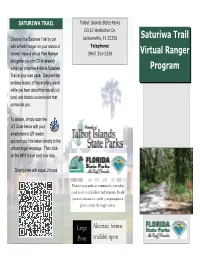
SATURIWA TRAIL Talbot Islands State Parks 12157 Heckscher Dr. Discover the Saturiwa Trail by car Jacksonville, FL 32226 Saturiwa Trail with a Park Ranger on your stereo or Telephone: phone! Have a virtual Park Ranger (904) 251-2320 Virtual Ranger alongside you (on CD or stream) while you drive the 4.4 mile Saturiwa Program Trail at your own pace. Discover the endless history of this exciting island while you hear about the natural, cul- tural, and historic environment that surrounds you. To stream, simply scan the QR Code below with your smartphone’s QR reader app and you’ll be taken directly to the virtual ranger webpage. Then click on the MP3 link at each tour stop. Driving time with stops: 2 hours Florida’s state parks are committed to providing equal access to all facilities and programs. Should you need assistance to enable your participation, please contact the ranger station. Large Alternate format Print available upon Talbot Islands State Parks Virtual Ranger Series, Volume 1 - Saturiwa Trail Note to participants: The term “Saturiwa” is pronounced as [sa-chur-EE-wa]. Welcome to Talbot Islands State Parks and the Virtual Ranger Series. This is a driving tour of the 4.4 mile Saturiwa Trail on Fort George Island, Florida. Each stop is marked on the edge of Fort George Road and Palmetto Avenue with a brown sign. If you are using the audio CD, you will hear the music in between each tour stop, which will signal you to stop your CD player and proceed to the next stop. -

8 Grade Sample Social Studies Learning Plan
th 8 Grade Sample Social Studies Learning Plan Big Idea/ Topic American Indians & Exploration in Georgia Connecting Theme/Enduring Understanding: Location: The student will understand that location affects a society’s economy, culture, and development. Movement/Migration: The student will understand that the movement or migration of people and ideas affects all societies involved. Individuals, Groups, Institutions: The student will understand that the actions of individuals, groups, and/or institutions affect society through intended and unintended consequences. Essential Question: How were the lives of American Indians impacted by European exploration? Standard Alignment SS8H1 Evaluate the impact of European exploration and settlement on American Indians in Georgia. a. Describe the characteristics of American Indians living in Georgia at the time of European contact; to include culture, food, weapons/tools, and shelter. Connection to Literacy Standards for Social Studies and Social Studies Matrices L6-8RHSS5: Describe how a text presents information (e.g., sequentially, comparatively, casually). L6-8RHSS7: Integrate visual information (e.g., in charts, graphs, photographs, videos, or maps) with other information in print and digital texts L6-8WHST7: Conduct short research projects to answer a question (including a self-generated question), drawing on several sources and generating additional related, focused questions that allow for multiple avenues of exploration L6-8WHST4: Produce clear and coherent writing in which the development, organization, and style are appropriate to task, purpose, and audience. L6-8WHST9: Draw evidence from informational texts to support analysis reflection, and research Information Processing Skills– 1 (compare similarities and differences) , 9 (construct charts and tables) Instructional Design *This lesson has a flexible timeline and will cross over several days. -

Frontiers of Contact: Bioarchaeology of Spanish Florida
P1: FMN/FZN/FTK/FJQ/LZX P2: FVK/FLF/FJQ/LZX QC: FTK Journal of World Prehistory [jowo] PP169-340413 June 4, 2001 16:36 Style file version Nov. 19th, 1999 Journal of World Prehistory, Vol. 15, No. 1, 2001 Frontiers of Contact: Bioarchaeology of Spanish Florida Clark Spencer Larsen,1,13 Mark C. Griffin,2 Dale L. Hutchinson,3 Vivian E. Noble,4 Lynette Norr,5 Robert F. Pastor,6 Christopher B. Ruff,7 Katherine F. Russell,8 Margaret J. Schoeninger,9 Michael Schultz,10 Scott W. Simpson,11 and Mark F. Teaford12 The arrival of Europeans in the New World had profound and long-lasting results for the native peoples. The record for the impact of this fundamental change in culture, society, and biology of Native Americans is well docu- mented historically. This paper reviews the biological impact of the arrival of Europeans on native populations via the study of pre- and postcontact skeletal remains in Spanish Florida, the region today represented by coastal Georgia and northern Florida. The postcontact skeletal series, mostly drawn 1Department of Anthropology, The Ohio State University, Columbus, Ohio. 2Department of Anthropology, San Francisco State University, San Francisco, California. 3Department of Anthropology, East Carolina University, Greenville, North Carolina. 4Department of Cell and Molecular Biology, Northwestern University Medical School, Chicago, Illinois. 5Department of Anthropology, University of Florida, Gainesville, Florida. 6Department of Archaeological Sciences, University of Bradford, Richmond Road, Bradford, West Yorkshire BD7 1DP, United Kingdom. 7Department of Cell Biology and Anatomy, Johns Hopkins University School of Medicine, 725 North Wolfe Street, Baltimore, Maryland. 8Department of Biology, University of Massachusetts—Dartmouth, North Dartmouth, Massachusetts. -

The Yamasee War: 1715 - 1717
University of South Carolina Scholar Commons Archaeology and Anthropology, South Carolina Archaeology Month Posters Institute of 10-2015 The aY masee War: 1715 - 1717 South Carolina Institute of Archaeology and Anthropology--University of South Carolina Follow this and additional works at: https://scholarcommons.sc.edu/archmonth_poster Part of the Anthropology Commons Publication Info Published in 2015. South Carolina Institute of Archaeology and Anthropology--University of South Carolina. Archaeology Month Poster - The aY masee War: 1715 - 1717, 2015. Columbia, SC: University of South Carolina, South Carolina Institute of Archaeology and Anthropology, 2015. http://artsandsciences.sc.edu/sciaa/ © 2015 by University of South Carolina, South Carolina Institute of Archaeology and Anthropology This Poster is brought to you by the Archaeology and Anthropology, South Carolina Institute of at Scholar Commons. It has been accepted for inclusion in Archaeology Month Posters by an authorized administrator of Scholar Commons. For more information, please contact dillarda@mailbox.sc.edu. THE YAMASEE WAR: 1715 - 1717 Thomas Nairne, “A map of South Carolina shewing the settlements of the English, French, & Indian nations from Charles Town to the River Missisipi [sic].” 1711. From Edward Crisp, “A compleat description of the province of Carolina in 3 parts.” Photo courtesy of Library of Congress 24th Annual South Carolina Archaeology Month October 2015 USC • South Carolina Institute of Archaeology and Anthropology • 1321 Pendleton Street • Columbia S -
Occupation Polygons
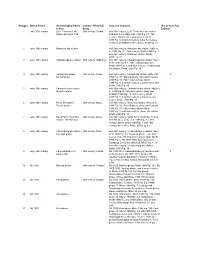
Polygon Date & Period Archaeological Phase Cultural - Historical Source & Comment Hist or Arch Pop & Sites Group Estimate 1 early 16th century Little Tennessee site 16th century Chiaha mid-16th century, Little Tennessee site cluster cluster and sites 7-19 and sites 7-19, Hally et al. 1990:Fig. 9.1; 16th century, Chiaha, three populations, Smith 1989:Fig. 1; mid-16th century, Little Tennessee cluster plus additional sites, Smith, 2000:Fig. 18 2 early 16th century Hiwassee site cluster mid-16th century, Hiwassee site cluster, Hally et al. 1990:Fig. 9.1; 16th century, Smith 1989:Fig. 1; mid-16th century, Hiwassee cluster, Smith, 2000:Fig. 18 3 early 16th century Chattanooga site cluster 16th century Napochies mid-16th century, Chattanooga site cluster, Hally et al. 1990:Fig. 9.1; 16th century Napochies, Smith 1989:Fig. 1; mid-16th century, Chattanooga site cluster, Smith, 2000:Fig. 18 4 early 16th century Carters site cluster; 16th century Coosa mid-16th century, Carters site cluster, Hally et al. X Barnett phase 1990:Fig. 9.1; Barnett phase, Hally and Rudolph 1986:Fig. 15; 16th century Coosa, Smith 1989:Fig. 1; mid-16th century, Carters site cluster, Smith, 2000:Fig. 18 5 early 16th century Cartersville site cluster; mid-16th century, Cartersville site cluster, Hally et Brewster phase al. 1990:Fig. 9.1; Brewster phase, Hally and Rudolph 1986:Fig. 15; 16th century, Smith 1989:Fig. 1; mid-16th century, Cartersville site cluster, Smith, 2000:Fig. 18 6 early 16th century Rome site cluster; 16th century Apica mid-16th century, Rome site cluster, Hally et al. -

Curriculum Vitae
CURRICULUM VITAE Alan Gallay Lyndon B. Johnson Chair of U.S. History Tel. (817) 257-6299 Department of History and Geography Office: Reed Hall 303 Texas Christian University e-mail: a.gallay@tcu.edu Fort Worth, TX 76129 Education Ph.D. Georgetown University, April 1986. Dissertation: “Jonathan Bryan and the Formation of a Planter Elite in South Carolina and Georgia, 1730-1780.” Awarded Distinction M.A. Georgetown University, November 1981 B.A. University of Florida, March 1978, Awarded High Honors Professional Experience Lyndon B. Johnson Chair of U.S. History, Texas Christian University, 2012- Warner R. Woodring Chair of Atlantic World and Early American History, Ohio State University, 2004- 2012 Director, The Center for Historical Research, Ohio State University, 2006-2011 Professor of History, 1995-2004; Associate Professor of History, 1991-1995, Assistant Professor of History, Western Washington University, 1988- 1991 American Heritage Association Professor for London, Fall 1996, Fall 1999 Visiting Lecturer, Department of History, University of Auckland, 1992 Visiting Professor, Departments of Afro-American Studies and History, Harvard University, 1990-1991 Visiting Assistant Professor of History and Southern Studies, University of Mississippi, 1987-1988 Visiting Assistant Professor of History, University of Notre Dame, 1986- 1987 Instructor, Georgetown University, Fall 1983; Summer 1984; Summer 1986 Instructor, Prince George’s Community College, Fall 1983 Teaching Assistant, Georgetown University, 1979-1983 1 Academic Honors Historic -

In Florida Archaeology
Indigenous Florida Panhandle Tomoka Northeastern Florida Shipwreck Trail Archaeology Project 2021 IN FLORIDA ARCHAEOLOGY Saving Angola Community-based Archaeology as Grassroots Activism FLORIDA HISTORICAL SOCIETY ARCHAEOLOGICAL INSTITUTE ON THE COVER EDITORS’ NOTE A barrel well was among the important features uncovered during excavation of the Angola site in Bradenton. Once cleared of soil, water seeped into the well as it had in the past, TABLE OF reflecting the image of a modern archaeologist. Courtesy of Sherry Robinson Svekis CONTENTS BACK COVER NOAA archaeologists record two shipwreck INDIGENOUS sites in the Florida Keys National Marine 02 Sanctuary. Courtesy of Brenda Altmeier (top) NORTHEASTERN FLORIDA and Matt Lawrence (bottom) Searching for a Mocama Indian Community FROM PALEO-INDIAN ANNE V. STOKES, PH.D. KC SMITH 08 TO PROTOHISTORIC FLORIDA HISTORICAL SOCIETY BOARD FLORIDA HISTORICAL SOCIETY St. Vincent Island’s Enduring OF DIRECTORS AND CEO OF SEARCH BOARD OF DIRECTORS Native Occupation As with everything in the past year, the covid pandemic Digital History Project highlighted by KC Smith is a wonderful upended archaeological research. Field schools were resource for researchers. FLORIDA PANHANDLE cancelled or postponed; contract firms worked on fewer 14 infrastructure projects; and research-related travel came Fred Gaske’s article illustrates how a seemingly unimportant SHIPWRECK TRAIL to a halt. However, while archaeologists worldwide groused artifact can tell a rich story and add new interpretation to a A Bridge between the Archaeological about the pandemic’s effects, the pause in field studies site. It also illustrates the importance of context within history and Artificial actually allowed folks to catch up on lab work, think about and archaeology.