Mammalia Für 1895. Paul Matschie
Total Page:16
File Type:pdf, Size:1020Kb
Load more
Recommended publications
-
Redalyc.Mamíferos No Voladores De Guanajuato, México: Revisión
Acta Universitaria ISSN: 0188-6266 actauniversitaria@ugto.mx Universidad de Guanajuato México Sánchez, Óscar; Magaña-Cota, Gloria; Téllez-Girón, Guadalupe; López-Forment, William; Urbano Vidales, Guillermina Mamíferos no voladores de Guanajuato, México: revisión histórica y lista taxonómica actualizada Acta Universitaria, vol. 24, núm. 1, enero-febrero, 2014, pp. 3-37 Universidad de Guanajuato Guanajuato, México Disponible en: http://www.redalyc.org/articulo.oa?id=41630112001 Cómo citar el artículo Número completo Sistema de Información Científica Más información del artículo Red de Revistas Científicas de América Latina, el Caribe, España y Portugal Página de la revista en redalyc.org Proyecto académico sin fines de lucro, desarrollado bajo la iniciativa de acceso abierto Universidad de Guanajuato Mamíferos no voladores de Guanajuato, México: revisión histórica y lista taxonómica actualizada Non-volant mammals of Guanajuato, Mexico: historic review and updated taxonomic list Óscar Sánchez*, Gloria Magaña-Cota**, Guadalupe Téllez-Girón*, William López-Forment***, Guillermina Urbano Vidales**** RESUMEN Se hace una revisión de los mamíferos no voladores del estado de Guanajuato, desarrolla- da principalmente con una perspectiva histórica y de actualización taxonómica, con base en publicaciones especializadas. Se revisó literatura científica desde el siglo XIX hasta el 2012. Asimismo, se consideró información sobre diversos ejemplares de museos, tanto nacionales como del extranjero, lo que permitió una visión de conjunto de las especies. Con la información reunida se elaboró un breve diagnóstico del estado del conocimiento de los mamíferos no voladores de Guanajuato y se identificaron necesidades de estudio adicional. Se provee una lista actualizada de las especies de mamíferos no voladores del estado, que hasta el momento cuenta con 62 especies. -
Agate Fossil Beds National Monument: a Proposal
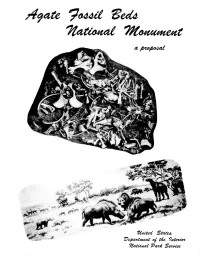
a frMrfxteaC Tincted Sfatei. 'Hattattat 'Pa'16, Service Cover: FOSSIL SLAB FROM THE AGATE QUARRIES Courtesy University of Nebraska State Museum ANCIENT LIFE AT THE AGATE SITE Illustration by Charles R. Knight Courtesy Chicago Natural History Museum PROPOSED AGATE FOSSIL BEDS NATIONAL MONUMENT NEBRASKA August 1963 Department of the Interior National Park Service Midwest Region Omaha, Nebraska Created in I8U9, the Department of the Interior— America's Department of Natural Resources—is concerned with the management, conservation, and development of the Nation's water, wildlife, mineral, forest, and park and recreational resources. It also has major responsibilities for Indian and Territorial affairs. As the Nation's principal conservation agency, the Department works to assure that nonrenewable re sources are developed and used wisely, that park and recreational resources make their full contri bution to the progress, prosperity, and security of the United States—now and in the future. CONTENTS Page Introduction 1 The Setting 3 Geologic History 7 Fossil Collecting History 23 The Cook Family - Early Pioneers of the West 29 Significance 33 Suitability 35 Feasibility 38 Conclusions and Recommendations 39 Proposed Development and Use kl The Proposed Area and Its Administration k6 Acknowledgements k7 Bibliography kQ Fifteen Million Years Ago in Western Nebraska From an illustration by Erwin Christinas Courtesy Natural History Magazine INTRODUCTION The Agate Springs Fossil Quarries site located in Sioux County, Nebraska, is world renowned for its rich concentrations of the fossil remains of mammals that lived fifteen million years ago. A study of this site was made by the Midwest Region, National Park Service in the fall of i960, and a preliminary report prepared. -

Amphibian Alliance for Zero Extinction Sites in Chiapas and Oaxaca
Amphibian Alliance for Zero Extinction Sites in Chiapas and Oaxaca John F. Lamoreux, Meghan W. McKnight, and Rodolfo Cabrera Hernandez Occasional Paper of the IUCN Species Survival Commission No. 53 Amphibian Alliance for Zero Extinction Sites in Chiapas and Oaxaca John F. Lamoreux, Meghan W. McKnight, and Rodolfo Cabrera Hernandez Occasional Paper of the IUCN Species Survival Commission No. 53 The designation of geographical entities in this book, and the presentation of the material, do not imply the expression of any opinion whatsoever on the part of IUCN concerning the legal status of any country, territory, or area, or of its authorities, or concerning the delimitation of its frontiers or boundaries. The views expressed in this publication do not necessarily reflect those of IUCN or other participating organizations. Published by: IUCN, Gland, Switzerland Copyright: © 2015 International Union for Conservation of Nature and Natural Resources Reproduction of this publication for educational or other non-commercial purposes is authorized without prior written permission from the copyright holder provided the source is fully acknowledged. Reproduction of this publication for resale or other commercial purposes is prohibited without prior written permission of the copyright holder. Citation: Lamoreux, J. F., McKnight, M. W., and R. Cabrera Hernandez (2015). Amphibian Alliance for Zero Extinction Sites in Chiapas and Oaxaca. Gland, Switzerland: IUCN. xxiv + 320pp. ISBN: 978-2-8317-1717-3 DOI: 10.2305/IUCN.CH.2015.SSC-OP.53.en Cover photographs: Totontepec landscape; new Plectrohyla species, Ixalotriton niger, Concepción Pápalo, Thorius minutissimus, Craugastor pozo (panels, left to right) Back cover photograph: Collecting in Chamula, Chiapas Photo credits: The cover photographs were taken by the authors under grant agreements with the two main project funders: NGS and CEPF. -
Multi-National Conservation of Alligator Lizards
MULTI-NATIONAL CONSERVATION OF ALLIGATOR LIZARDS: APPLIED SOCIOECOLOGICAL LESSONS FROM A FLAGSHIP GROUP by ADAM G. CLAUSE (Under the Direction of John Maerz) ABSTRACT The Anthropocene is defined by unprecedented human influence on the biosphere. Integrative conservation recognizes this inextricable coupling of human and natural systems, and mobilizes multiple epistemologies to seek equitable, enduring solutions to complex socioecological issues. Although a central motivation of global conservation practice is to protect at-risk species, such organisms may be the subject of competing social perspectives that can impede robust interventions. Furthermore, imperiled species are often chronically understudied, which prevents the immediate application of data-driven quantitative modeling approaches in conservation decision making. Instead, real-world management goals are regularly prioritized on the basis of expert opinion. Here, I explore how an organismal natural history perspective, when grounded in a critique of established human judgements, can help resolve socioecological conflicts and contextualize perceived threats related to threatened species conservation and policy development. To achieve this, I leverage a multi-national system anchored by a diverse, enigmatic, and often endangered New World clade: alligator lizards. Using a threat analysis and status assessment, I show that one recent petition to list a California alligator lizard, Elgaria panamintina, under the US Endangered Species Act often contradicts the best available science. -

A.-The Pondaung Fauna
Article VI.-FOSSIL MAMMALS FROM BURMA IN THE AMERICAN MUSEUM OF NATURAL HISTORY BY EDWIN H. COLBERT FIGuRES 1 TO 64 CONTENTS PAGE INTRODUCTION ........................................................ 259 The American Museum Palaeontological Expedition to Burma............ 259 Previous Publications on Fossil Mammals of Burma..................... 259 Studies on the American Museum Burma Collection..................... 261 Acknowledgments ................................................... 262 THIE CONTINENTAL TERTIARY AND QUATERNARY BEDS OF NORTHERN BURMA. 263 General Observations................................................ 263 Mammal-Bearing Beds of Northern Burma............................. 264 The Pondaung Sandstone........................................... 265 The Freshwater Pegu Beds......................................... 267 The Irrawaddy Series.............................................. 267 Correlation of the Mammal Bearing Horizons of Northern Burma ......... 268 Pondaung Fauna.................................................. 268 Pegu Series....................................................... 275 Lower Irrawaddy Fauna............................................ 276 Upper Irrawaddy Fauna............................................ 277 THE FoSSIL MAMMAL FAUNAS OF BURMA ................................ 280 Pondaung Fauna......................................... 280 Mammals from the Pegu Series........................................ 280 Lower Irrawaddy Fauna......................................... 281 Upper Irrawaddy -
Mammal Faunal Change in the Zone of the Paleogene Hyperthermals ETM2 and H2
Clim. Past, 11, 1223–1237, 2015 www.clim-past.net/11/1223/2015/ doi:10.5194/cp-11-1223-2015 © Author(s) 2015. CC Attribution 3.0 License. Mammal faunal change in the zone of the Paleogene hyperthermals ETM2 and H2 A. E. Chew Department of Anatomy, Western University of Health Sciences, 309 E Second St., Pomona, CA 91767, USA Correspondence to: A. E. Chew (achew@westernu.edu) Received: 13 March 2015 – Published in Clim. Past Discuss.: 16 April 2015 Revised: 4 August 2015 – Accepted: 19 August 2015 – Published: 24 September 2015 Abstract. “Hyperthermals” are past intervals of geologically vulnerability in response to changes already underway in the rapid global warming that provide the opportunity to study lead-up to the EECO. Faunal response at faunal events B-1 the effects of climate change on existing faunas over thou- and B-2 is also distinctive in that it shows high proportions sands of years. A series of hyperthermals is known from of beta richness, suggestive of increased geographic disper- the early Eocene ( ∼ 56–54 million years ago), including sal related to transient increases in habitat (floral) complexity the Paleocene–Eocene Thermal Maximum (PETM) and two and/or precipitation or seasonality of precipitation. subsequent hyperthermals (Eocene Thermal Maximum 2 – ETM2 – and H2). The later hyperthermals occurred during warming that resulted in the Early Eocene Climatic Opti- mum (EECO), the hottest sustained period of the Cenozoic. 1 Introduction The PETM has been comprehensively studied in marine and terrestrial settings, but the terrestrial biotic effects of ETM2 The late Paleocene and early Eocene (ca. -

Perissodactyla, Mammalia) from the Middle Eocene of Myanmar Un Nouveau Tapiromorphe Basal (Perissodactyla, Mammalia) De L’Eocène Moyen Du Myanmar
View metadata, citation and similar papers at core.ac.uk brought to you by CORE provided by RERO DOC Digital Library Geobios 39 (2006) 513–519 http://france.elsevier.com/direct/GEOBIO/ Original article A new basal tapiromorph (Perissodactyla, Mammalia) from the middle Eocene of Myanmar Un nouveau tapiromorphe basal (Perissodactyla, Mammalia) de l’Eocène moyen du Myanmar Grégoire Métais a, Aung Naing Soe b, Stéphane Ducrocq c,* a Carnegie Museum of Natural History, Section of Vertebrate Paleontology, 4400 Forbes Avenue, Pittsburgh, PA 15213, USA b Department of Geology, Yangon University, Yangon 11422, Myanmar c Laboratoire de Géobiologie, Biochronologie et Paléontologie Humaine, UMR 6046 CNRS, Faculté des Sciences de Poitiers, 40, avenue du recteur-Pineau, 86022 Poitiers cedex, France Received 29 September 2004; accepted 10 May 2005 Available online 20 March 2006 Abstract A new genus and species of tapiromorph, Skopaiolophus burmese nov. gen., nov. sp., is described from the middle Eocene Pondaung For- mation in central Myanmar. This small form displays a striking selenolophodont morphology associated with a mixture of primitive “condylar- thran” dental characters and derived tapiromorph features. Skopaiolophus is here tentatively referred to a group of Asian tapiromorphs unknown so far. The occurrence of such a form in Pondaung suggests that primitive tapiromorphs might have persisted in southeast Asia until the late middle Eocene while they became extinct elsewhere in both Eurasia and North America. © 2006 Elsevier SAS. All rights reserved. Résumé Un nouveau genre et une nouvelle espèce de tapiromorphe, Skopaiolophus burmese nov. gen. nov. sp., sont décrits dans la Formation de Pondaung d’âge fini-éocène moyen, au Myanmar. -
Agate Fossil Beds
University of Nebraska - Lincoln DigitalCommons@University of Nebraska - Lincoln U.S. National Park Service Publications and Papers National Park Service 1980 Agate Fossil Beds Follow this and additional works at: http://digitalcommons.unl.edu/natlpark "Agate Fossil Beds" (1980). U.S. National Park Service Publications and Papers. 160. http://digitalcommons.unl.edu/natlpark/160 This Article is brought to you for free and open access by the National Park Service at DigitalCommons@University of Nebraska - Lincoln. It has been accepted for inclusion in U.S. National Park Service Publications and Papers by an authorized administrator of DigitalCommons@University of Nebraska - Lincoln. Agate Fossil Beds cap. tfs*Af Clemson Universit A *?* jfcti *JpRPP* - - - . Agate Fossil Beds Agate Fossil Beds National Monument Nebraska Produced by the Division of Publications National Park Service U.S. Department of the Interior Washington, D.C. 1980 — — The National Park Handbook Series National Park Handbooks, compact introductions to the great natural and historic places adminis- tered by the National Park Service, are designed to promote understanding and enjoyment of the parks. Each is intended to be informative reading and a useful guide before, during, and after a park visit. More than 100 titles are in print. This is Handbook 107. You may purchase the handbooks through the mail by writing to Superintendent of Documents, U.S. Government Printing Office, Washington DC 20402. About This Book What was life like in North America 21 million years ago? Agate Fossil Beds provides a glimpse of that time, long before the arrival of man, when now-extinct creatures roamed the land which we know today as Nebraska. -

Article XXXVIII. -NOTE on SOME WORM (?) BUR- ROWS in ROCKS of the CHEMUNG GROUP of NEW YORK
Article XXXVIII. -NOTE ON SOME WORM (?) BUR- ROWS IN ROCKS OF THE CHEMUNG GROUP OF NEW YORK. By R. P. WHITFIELD. Arenicolites chemungensis, sp. nov. PLATE XIV, FIGS. I AND 2. While working up the fossils of the Potsdam sandstone for the Wisconsin Report, in I876 and I877, there came into my hands a number of specimens representing the so-called Scolithus, which I described as Arenicolites woodi in Volume IV of Prof. T. C. Chamberlain's Report of I882. One block of that series showed the original surface of the mud-covered sandstone with the burrows of the worm (?) which made the perforations, together with the little hillocks surrounding the outlet of the burrows, just as the animal built them up by its castings during life; proving pretty conclusively that it must have been a marine worm-like animal which caused the perforations. Among the geological specimens of the Chemung Group in the Museum, from near Bath, Steuben Co., New York, I find an example so nearly resembling that figured in the Wis- consin Report above referred to, that there can be no ques- tion as to the similarity of its origin. On this Chemung specimen the hillocks are somewhat larger and the funnels more distinct, being generally 5 or 6 mm. in diameter, and the walls surrounding them about 2 mm. thick, while some of the hillocks are much larger and higher and appear to have collapsed from the semifluidity of the sand, closing up the top of the burrow so as to show a mere slit in its place. -

Retallack and Samuels 2020 John
Journal of Vertebrate Paleontology ISSN: (Print) (Online) Journal homepage: https://www.tandfonline.com/loi/ujvp20 Paleosol-based inference of niches for Oligocene and early miocene fossils from the John Day Formation of Oregon Gregory J. Retallack & Joshua X. Samuels To cite this article: Gregory J. Retallack & Joshua X. Samuels (2020): Paleosol-based inference of niches for Oligocene and early miocene fossils from the John Day Formation of Oregon, Journal of Vertebrate Paleontology, DOI: 10.1080/02724634.2019.1761823 To link to this article: https://doi.org/10.1080/02724634.2019.1761823 View supplementary material Published online: 16 Jun 2020. Submit your article to this journal View related articles View Crossmark data Full Terms & Conditions of access and use can be found at https://www.tandfonline.com/action/journalInformation?journalCode=ujvp20 Journal of Vertebrate Paleontology e1761823 (17 pages) © by the Society of Vertebrate Paleontology DOI: 10.1080/02724634.2019.1761823 ARTICLE PALEOSOL-BASED INFERENCE OF NICHES FOR OLIGOCENE AND EARLY MIOCENE FOSSILS FROM THE JOHN DAY FORMATION OF OREGON GREGORY J. RETALLACK*,1 and JOSHUA X. SAMUELS2 1Department of Earth Sciences, University of Oregon, Eugene, Oregon 97403, U.S.A., gregr@uoregon.edu; 2Department of Geosciences, East Tennessee State University, Johnson City, Tennessee 37614, U.S.A., samuelsjx@etsu.edu ABSTRACT—Over the past decade, we recorded exact locations of in situ fossils and measured calcareous nodules in paleosols of the Oligocene and lower Miocene (Whitneyan–Arikareean) John Day Formation of Oregon. These data enable precise biostratigraphy within an astronomical time scale of Milankovitch obliquity cycles and also provide mean annual precipitation and vegetation for each species. -
Synoptic Taxonomy of Major Fossil Groups
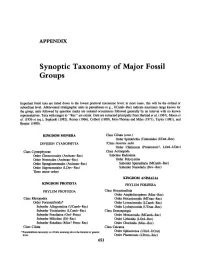
APPENDIX Synoptic Taxonomy of Major Fossil Groups Important fossil taxa are listed down to the lowest practical taxonomic level; in most cases, this will be the ordinal or subordinallevel. Abbreviated stratigraphic units in parentheses (e.g., UCamb-Ree) indicate maximum range known for the group; units followed by question marks are isolated occurrences followed generally by an interval with no known representatives. Taxa with ranges to "Ree" are extant. Data are extracted principally from Harland et al. (1967), Moore et al. (1956 et seq.), Sepkoski (1982), Romer (1966), Colbert (1980), Moy-Thomas and Miles (1971), Taylor (1981), and Brasier (1980). KINGDOM MONERA Class Ciliata (cont.) Order Spirotrichia (Tintinnida) (UOrd-Rec) DIVISION CYANOPHYTA ?Class [mertae sedis Order Chitinozoa (Proterozoic?, LOrd-UDev) Class Cyanophyceae Class Actinopoda Order Chroococcales (Archean-Rec) Subclass Radiolaria Order Nostocales (Archean-Ree) Order Polycystina Order Spongiostromales (Archean-Ree) Suborder Spumellaria (MCamb-Rec) Order Stigonematales (LDev-Rec) Suborder Nasselaria (Dev-Ree) Three minor orders KINGDOM ANIMALIA KINGDOM PROTISTA PHYLUM PORIFERA PHYLUM PROTOZOA Class Hexactinellida Order Amphidiscophora (Miss-Ree) Class Rhizopodea Order Hexactinosida (MTrias-Rec) Order Foraminiferida* Order Lyssacinosida (LCamb-Rec) Suborder Allogromiina (UCamb-Ree) Order Lychniscosida (UTrias-Rec) Suborder Textulariina (LCamb-Ree) Class Demospongia Suborder Fusulinina (Ord-Perm) Order Monaxonida (MCamb-Ree) Suborder Miliolina (Sil-Ree) Order Lithistida -
Agate Fossil Beds National Monument: Geologic Resources Inventory Report John Graham National Park Service
University of Nebraska - Lincoln DigitalCommons@University of Nebraska - Lincoln U.S. National Park Service Publications and Papers National Park Service 2009 Agate Fossil Beds National Monument: Geologic Resources Inventory Report John Graham National Park Service Follow this and additional works at: https://digitalcommons.unl.edu/natlpark Part of the Geology Commons, Paleontology Commons, and the Stratigraphy Commons Graham, John, "Agate Fossil Beds National Monument: Geologic Resources Inventory Report" (2009). U.S. National Park Service Publications and Papers. 151. https://digitalcommons.unl.edu/natlpark/151 This Article is brought to you for free and open access by the National Park Service at DigitalCommons@University of Nebraska - Lincoln. It has been accepted for inclusion in U.S. National Park Service Publications and Papers by an authorized administrator of DigitalCommons@University of Nebraska - Lincoln. National Park Service U.S. Department of the Interior Natural Resource Program Center Agate Fossil Beds National Monument Geologic Resources Inventory Report Natural Resource Report NPS/NRPC/GRD/NRR—2009/080 THIS PAGE: Fossil diorama at Agate Fossil Beds National Monument, an omnivorous entelodont (Daeodon or Dinohyus) stands over a chalicothere (Moropus), Agate Fossil Beds NM. ON THE COVER: University Hill on the left and Carnegie Hill on the right, site of the main fossil excavations, Agate Fossil Beds NM. NPS Photos. Agate Fossil Beds National Monument Geologic Resources Inventory Report Natural Resource Report NPS/NRPC/GRD/NRR—2009/080