Desert Skies Tucson Amateur Astronomy Association
Total Page:16
File Type:pdf, Size:1020Kb
Load more
Recommended publications
-

CENTAURI II Benutzerhandbuch
CENTAURI II Benutzerhandbuch SW-Version ab 3.1.0.73 MAYAH, CENTAURI, FLASHCAST sind eingetragene Warenzeichen. Alle anderen verwendeten Warenzeichen werden hiermit anerkannt. CENTAURI II Benutzerhandbuch ab SW 3.1.0.73 Bestell-Nr. CIIUM001 Stand 11/2005 (c) Copyright by MAYAH Communications GmbH Die Vervielfältigung des vorliegenden Handbuches, sowie der darin besprochenen Dokumentationen aus dem Internet, auch nur auszugsweise, ist nur mit ausdrücklicher schriftlicher Genehmigung der MAYAH Communications GmbH erlaubt. 1 Einführung ........................................................................................................... 1 1.1 Vorwort......................................................................................................... 1 1.2 Einbau / Installation ...................................................................................... 2 1.3 Lieferumfang ................................................................................................ 2 1.4 Umgebungs- / Betriebsbedingung................................................................ 2 1.5 Anschlüsse................................................................................................... 3 2 Verbindungsaufbau ............................................................................................. 4 2.1 ISDN Verbindungen mit dem Centauri II ...................................................... 4 2.1.1 FlashCast Technologie und Audiocodec Kategorien............................. 4 2.1.2 Wie bekomme ich eine synchronisierte Verbindung -

Mathématiques Et Espace
Atelier disciplinaire AD 5 Mathématiques et Espace Anne-Cécile DHERS, Education Nationale (mathématiques) Peggy THILLET, Education Nationale (mathématiques) Yann BARSAMIAN, Education Nationale (mathématiques) Olivier BONNETON, Sciences - U (mathématiques) Cahier d'activités Activité 1 : L'HORIZON TERRESTRE ET SPATIAL Activité 2 : DENOMBREMENT D'ETOILES DANS LE CIEL ET L'UNIVERS Activité 3 : D'HIPPARCOS A BENFORD Activité 4 : OBSERVATION STATISTIQUE DES CRATERES LUNAIRES Activité 5 : DIAMETRE DES CRATERES D'IMPACT Activité 6 : LOI DE TITIUS-BODE Activité 7 : MODELISER UNE CONSTELLATION EN 3D Crédits photo : NASA / CNES L'HORIZON TERRESTRE ET SPATIAL (3 ème / 2 nde ) __________________________________________________ OBJECTIF : Détermination de la ligne d'horizon à une altitude donnée. COMPETENCES : ● Utilisation du théorème de Pythagore ● Utilisation de Google Earth pour évaluer des distances à vol d'oiseau ● Recherche personnelle de données REALISATION : Il s'agit ici de mettre en application le théorème de Pythagore mais avec une vision terrestre dans un premier temps suite à un questionnement de l'élève puis dans un second temps de réutiliser la même démarche dans le cadre spatial de la visibilité d'un satellite. Fiche élève ____________________________________________________________________________ 1. Victor Hugo a écrit dans Les Châtiments : "Les horizons aux horizons succèdent […] : on avance toujours, on n’arrive jamais ". Face à la mer, vous voyez l'horizon à perte de vue. Mais "est-ce loin, l'horizon ?". D'après toi, jusqu'à quelle distance peux-tu voir si le temps est clair ? Réponse 1 : " Sans instrument, je peux voir jusqu'à .................. km " Réponse 2 : " Avec une paire de jumelles, je peux voir jusqu'à ............... km " 2. Nous allons maintenant calculer à l'aide du théorème de Pythagore la ligne d'horizon pour une hauteur H donnée. -
The Surface Operations Framework – Transitioning from Early Analogue Experiments to Future Lunar Missions
THE SURFACE OPERATIONS FRAMEWORK – TRANSITIONING FROM EARLY ANALOGUE EXPERIMENTS TO FUTURE LUNAR MISSIONS Sebastian Martin(1), Toril Bye Rinnan(2), Mehran Sarkarati(3), Kim Nergaard(4) (1) ESA/ESOC, Robert-Bosch-Straße 5, 64293 Darmstadt, Germany, Email: sebastian.martin@esa.int (2) Solenix Deutschland GmbH, Spreestraße 3, 64295 Darmstadt, Germany, Email: toril.bye.rinnan@esa.int (3) ESA/ESOC, Robert-Bosch-Straße 5, 64293 Darmstadt, Germany, Email: mehran.sarkarati@esa.int (4) ESA/ESOC, Robert-Bosch-Straße 5, 64293 Darmstadt, Germany, Email: kim.nergaard@esa.int ABSTRACT to assess the financial and technical feasibility of new mission concepts, technologies and studies before This paper provides an overview of a family of possibly advancing them to the next phases of activities performed within the European Space implementation of a mission. Operations Centre (ESOC) to prepare for future robotic As the result of one such concurrent design study in missions on the lunar surface and beyond. 2009, the METERON concept was created. METERON – the Multi-purpose End-To-End Robotics Operations Over the course of nearly a decade, ESOC has been Network – was initiated to prepare for future human and gradually building up expertise for future surface robotic exploration scenarios. These future scenarios operations activities. foresee robotic assets controlled on the surface of Moon This paper describes or Mars, with humans operating those assets from an - the activities and corresponding systems prepared orbiting vehicle or by Earth ground control. The benefit from the ground up before concrete missions were of near real-time remote asset operations is to reduce defined, human risks and cost by not having to land humans and - how we are now covering a range of activities return them from the surface, while still being able to where we have requirements from missions in the control robotic assets with short transmission delays definition phases while continuing to build on from an orbiter. -
ESA Strategy for Science at the Moon
ESA UNCLASSIFIED - Releasable to the Public ESA Strategy for Science at the Moon ESA UNCLASSIFIED - Releasable to the Public EXECUTIVE SUMMARY A new era of space exploration is beginning, with multiple international and private sector actors engaged and with the Moon as its cornerstone. This renaissance in lunar exploration will offer new opportunities for science across a multitude of disciplines from planetary geology to astronomy and astrobiology whilst preparing the knowledge humanity will need to explore further into the Solar System. Recent missions and new analyses of samples retrieved during Apollo have transformed our understanding of the Moon and the science that can be performed there. We now understand the scientific importance of further exploration of the Moon to understand the origins and evolution of Earth and the cosmic context of life’s emergence on Earth and our future in space. ESA’s priorities for scientific activities at the Moon in the next ten years are: • Analysis of new and diverse samples from the Moon. • Detection and characterisation of polar water ice and other lunar volatiles. • Deployment of geophysical instruments and the build up a global geophysical network. • Identification and characterisation of potential resources for future exploration. • Deployment long wavelength radio astronomy receivers on the lunar far side. • Characterisation of the dynamic dust, charge and plasma environment. • Characterisation of biological sensitivity to the lunar environment. ESA UNCLASSIFIED - Releasable to the Public -
Desert Skies Since 1954 Spring 2015 Volume LXI, Issue 1
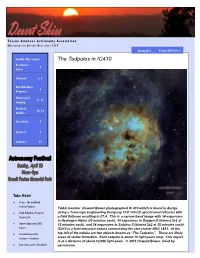
Tucson Amateur Astronomy Association Observing our Desert Skies since 1954 Spring 2015 Volume LXI, Issue 1 Inside this issue: The Tadpoles in IC410 President’s 2 Letter Outreach 3, 5 New RideShare 7 Program Observing & 8 - 11 Imaging Featured 12, 14 Articles Classifieds 7 Sponsors 7 Contacts 15 Take Note! Science Fair and Book Festival Reports TAAA member Howard Bower photographed IC 410 which is found in Auriga TAAA RideShare Program using a Telescope Engineering Company TEC 140 ED apochromat refractor with Announced a field flattener resulting in f/7.4. This is a narrow band image with 34 exposures in Hydrogen Alpha (30 minutes each), 34 exposures in Oxygen III (binned 2x2 at Jupiter Opposition 2015 15 minutes each), and 34 exposures in Sulphur II (binned 2x2 at 15 minutes each). Report IC410 is a faint emission nebula surrounding the star cluster NGC 1893. At the Constellation of the top left of the nebula are two objects known as “The Tadpoles”. These are likely Season—Centaurus areas of stellar formation. Each tadpole is about 10 light years long. This object is at a distance of about 12,000 light years. © 2013 Howard Bower. Used by New Items in the Classifieds permission. Desert Skies Page 2 Volume LXI, Issue 1 From Our President As I reviewed the March Bulletin it was really heartwarming to see all of the activities in which we are involved. It takes a lot of Our mission is to provide opportunities for members dedication and hard work to put this all together and make it and the public to share the joy and excitement of work.. -
Global Exploration Roadmap
The Global Exploration Roadmap January 2018 What is New in The Global Exploration Roadmap? This new edition of the Global Exploration robotic space exploration. Refinements in important role in sustainable human space Roadmap reaffirms the interest of 14 space this edition include: exploration. Initially, it supports human and agencies to expand human presence into the robotic lunar exploration in a manner which Solar System, with the surface of Mars as • A summary of the benefits stemming from creates opportunities for multiple sectors to a common driving goal. It reflects a coordi- space exploration. Numerous benefits will advance key goals. nated international effort to prepare for space come from this exciting endeavour. It is • The recognition of the growing private exploration missions beginning with the Inter- important that mission objectives reflect this sector interest in space exploration. national Space Station (ISS) and continuing priority when planning exploration missions. Interest from the private sector is already to the lunar vicinity, the lunar surface, then • The important role of science and knowl- transforming the future of low Earth orbit, on to Mars. The expanded group of agencies edge gain. Open interaction with the creating new opportunities as space agen- demonstrates the growing interest in space international science community helped cies look to expand human presence into exploration and the importance of coopera- identify specific scientific opportunities the Solar System. Growing capability and tion to realise individual and common goals created by the presence of humans and interest from the private sector indicate and objectives. their infrastructure as they explore the Solar a future for collaboration not only among System. -
A Review on Substellar Objects Below the Deuterium Burning Mass Limit: Planets, Brown Dwarfs Or What?
geosciences Review A Review on Substellar Objects below the Deuterium Burning Mass Limit: Planets, Brown Dwarfs or What? José A. Caballero Centro de Astrobiología (CSIC-INTA), ESAC, Camino Bajo del Castillo s/n, E-28692 Villanueva de la Cañada, Madrid, Spain; caballero@cab.inta-csic.es Received: 23 August 2018; Accepted: 10 September 2018; Published: 28 September 2018 Abstract: “Free-floating, non-deuterium-burning, substellar objects” are isolated bodies of a few Jupiter masses found in very young open clusters and associations, nearby young moving groups, and in the immediate vicinity of the Sun. They are neither brown dwarfs nor planets. In this paper, their nomenclature, history of discovery, sites of detection, formation mechanisms, and future directions of research are reviewed. Most free-floating, non-deuterium-burning, substellar objects share the same formation mechanism as low-mass stars and brown dwarfs, but there are still a few caveats, such as the value of the opacity mass limit, the minimum mass at which an isolated body can form via turbulent fragmentation from a cloud. The least massive free-floating substellar objects found to date have masses of about 0.004 Msol, but current and future surveys should aim at breaking this record. For that, we may need LSST, Euclid and WFIRST. Keywords: planetary systems; stars: brown dwarfs; stars: low mass; galaxy: solar neighborhood; galaxy: open clusters and associations 1. Introduction I can’t answer why (I’m not a gangstar) But I can tell you how (I’m not a flam star) We were born upside-down (I’m a star’s star) Born the wrong way ’round (I’m not a white star) I’m a blackstar, I’m not a gangstar I’m a blackstar, I’m a blackstar I’m not a pornstar, I’m not a wandering star I’m a blackstar, I’m a blackstar Blackstar, F (2016), David Bowie The tenth star of George van Biesbroeck’s catalogue of high, common, proper motion companions, vB 10, was from the end of the Second World War to the early 1980s, and had an entry on the least massive star known [1–3]. -
Observing Exoplanets
Observing Exoplanets Olivier Guyon University of Arizona Astrobiology Center, National Institutes for Natural Sciences (NINS) Subaru Telescope, National Astronomical Observatory of Japan, National Institutes for Natural Sciences (NINS) Nov 29, 2017 My Background Astronomer / Optical scientist at University of Arizona and Subaru Telescope (National Astronomical Observatory of Japan, Telescope located in Hawaii) I develop instrumentation to find and study exoplanet, for ground-based telescopes and space missions My interest is focused on habitable planets and search for life outside our solar system At Subaru Telescope, I lead the Subaru Coronagraphic Extreme Adaptive Optics (SCExAO) instrument. 2 ALL known Planets until 1989 Approximately 10% of stars have a potentially habitable planet 200 billion stars in our galaxy → approximately 20 billion habitable planets Imagine 200 explorers, each spending 20s on each habitable planet, 24hr a day, 7 days a week. It would take >60yr to explore all habitable planets in our galaxy alone. x 100,000,000,000 galaxies in the observable universe Habitable planets Potentially habitable planet : – Planet mass sufficiently large to retain atmosphere, but sufficiently low to avoid becoming gaseous giant – Planet distance to star allows surface temperature suitable for liquid water (habitable zone) Habitable zone = zone within which Earth-like planet could harbor life Location of habitable zone is function of star luminosity L. For constant stellar flux, distance to star scales as L1/2 Examples: Sun → habitable zone is at ~1 AU Rigel (B type star) Proxima Centauri (M type star) Habitable planets Potentially habitable planet : – Planet mass sufficiently large to retain atmosphere, but sufficiently low to avoid becoming gaseous giant – Planet distance to star allows surface temperature suitable for liquid water (habitable zone) Habitable zone = zone within which Earth-like planet could harbor life Location of habitable zone is function of star luminosity L. -

AAS SFMC Manuscript Format Template
(Preprint) AAS 18-344 REFINED MISSION ANALYSIS FOR HERACLES – A ROBOTIC LUNAR SURFACE SAMPLE RETURN MISSION UTILIZING HUMAN INFRASTRUCTURE Dr.-Ing. Florian Renk,* Dr. rer. nat. Markus Landgraf,† and Lorenzo Bucci‡ In the frame of the International Space Exploration Coordination Working Group the European Space Agency is participating in the planning of future ex- ploration architectures. The mission concept for the robotic lander mission (Human Enhanced Robotic Architecture and Capability for Lunar Exploration and Science – HERACLES) has matured meanwhile. The mission aims for a human assisted sample return from the lunar surface, while at the same time providing a qualification opportunity for technologies required for a crewed lu- nar lander. Human spaceflight rating is required for parts of the mission, since the sample return shall not be via a direct return trajectory, but the samples shall be transported via Orion, and thus docking of the robotic lander to the LOP-G will be required. This paper shall provide an update on the current mission de- sign as agreed between the international partners and the associated mission analysis as all the intermediate and final orbits have been selected for the base- line. The implications of the design decision as well as some alternatives that can serve as a backup scenario will be presented as well. The paper will first present the baseline mission sequence and will then focus on aspects of particu- lar interest as e.g. the strong limitation in the launch window design and the ren- dezvous and docking strategy. INTRODUCTION HERACLES is intended as a human-robotic architecture in the frame of preparations for hu- man exploration activities on the lunar surface. -
Messenger-No117.Pdf
ESO WELCOMES FINLANDINLAND AS ELEVENTH MEMBER STAATE CATHERINE CESARSKY, ESO DIRECTOR GENERAL n early July, Finland joined ESO as Education and Science, and exchanged which started in June 2002, and were con- the eleventh member state, following preliminary information. I was then invit- ducted satisfactorily through 2003, mak- II the completion of the formal acces- ed to Helsinki and, with Massimo ing possible a visit to Garching on 9 sion procedure. Before this event, howev- Tarenghi, we presented ESO and its scien- February 2004 by the Finnish Minister of er, Finland and ESO had been in contact tific and technological programmes and Education and Science, Ms. Tuula for a long time. Under an agreement with had a meeting with Finnish authorities, Haatainen, to sign the membership agree- Sweden, Finnish astronomers had for setting up the process towards formal ment together with myself. quite a while enjoyed access to the SEST membership. In March 2000, an interna- Before that, in early November 2003, at La Silla. Finland had also been a very tional evaluation panel, established by the ESO participated in the Helsinki Space active participant in ESO’s educational Academy of Finland, recommended Exhibition at the Kaapelitehdas Cultural activities since they began in 1993. It Finland to join ESO “anticipating further Centre with approx. 24,000 visitors. became clear, that science and technology, increase in the world-standing of ESO warmly welcomes the new mem- as well as education, were priority areas Astronomy in Finland”. In February 2002, ber country and its scientific community for the Finnish government. we were invited to hold an information that is renowned for its expertise in many Meanwhile, the optical astronomers in seminar on ESO in Helsinki as a prelude frontline areas. -

SKA-Athena Synergy White Paper
SKA-Athena Synergy White Paper SKA-Athena Synergy Team July 2018. Edited by: Francisco J. Carrera and Silvia Martínez-Núñez on behalf of the Athena Community Office. Revisions provided by: Judith Croston, Andrew C. Fabian, Robert Laing, Didier Barret, Robert Braun, Kirpal Nandra Authorship Authors Rossella Cassano (INAF-Istituto di Radioastronomia, Italy). • Rob Fender (University of Oxford, United Kingdom). • Chiara Ferrari (Observatoire de la Côte d’Azur, France). • Andrea Merloni (Max-Planck Institute for Extraterrestrial Physics, Germany). • Contributors Takuya Akahori (Kagoshima University, Japan). • Hiroki Akamatsu (SRON Netherlands Institute for Space Research, The Netherlands). • Yago Ascasibar (Universidad Autónoma de Madrid, Spain). • David Ballantyne (Georgia Institute of Technology, United States). • Gianfranco Brunetti (INAF-Istituto di Radioastronomia, Italy) and Maxim Markevitch (NASA-Goddard • Space Flight Center, United States). Judith Croston (The Open University, United Kingdom). • Imma Donnarumma (Agenzia Spaziale Italiana, Italy) and E. M. Rossi (Leiden Observatory, The • Netherlands). Robert Ferdman (University of East Anglia, United Kingdom) on behalf of the SKA Pulsar Science • Working Group. Luigina Feretti (INAF-Istituto di Radioastronomia, Italy) and Federica Govoni (INAF Osservatorio • Astronomico,Italy). Jan Forbrich (University of Hertfordshire, United Kingdom). • Giancarlo Ghirlanda (INAF-Osservatorio Astronomico di Brera and University Milano Bicocca, Italy). • Adriano Ingallinera (INAF-Osservatorio Astrofisico di Catania, Italy). • Andrei Mesinger (Scuola Normale Superiore, Italy). • Vanessa Moss and Elaine Sadler (Sydney Institute for Astronomy/CAASTRO and University of Sydney, • Australia). Fabrizio Nicastro (Osservatorio Astronomico di Roma,Italy), Edvige Corbelli (INAF-Osservatorio As- • trofisico di Arcetri, Italy) and Luigi Piro (INAF, Istituto di Astrofisica e Planetologia Spaziali, Italy). Paolo Padovani (European Southern Observatory, Germany). • Francesca Panessa (INAF/Istituto di Astrofisica e Planetologia Spaziali, Italy). -

The Brightest Stars Seite 1 Von 9
The Brightest Stars Seite 1 von 9 The Brightest Stars This is a list of the 300 brightest stars made using data from the Hipparcos catalogue. The stellar distances are only fairly accurate for stars well within 1000 light years. 1 2 3 4 5 6 7 8 9 10 11 12 13 No. Star Names Equatorial Galactic Spectral Vis Abs Prllx Err Dist Coordinates Coordinates Type Mag Mag ly RA Dec l° b° 1. Alpha Canis Majoris Sirius 06 45 -16.7 227.2 -8.9 A1V -1.44 1.45 379.21 1.58 9 2. Alpha Carinae Canopus 06 24 -52.7 261.2 -25.3 F0Ib -0.62 -5.53 10.43 0.53 310 3. Alpha Centauri Rigil Kentaurus 14 40 -60.8 315.8 -0.7 G2V+K1V -0.27 4.08 742.12 1.40 4 4. Alpha Boötis Arcturus 14 16 +19.2 15.2 +69.0 K2III -0.05 -0.31 88.85 0.74 37 5. Alpha Lyrae Vega 18 37 +38.8 67.5 +19.2 A0V 0.03 0.58 128.93 0.55 25 6. Alpha Aurigae Capella 05 17 +46.0 162.6 +4.6 G5III+G0III 0.08 -0.48 77.29 0.89 42 7. Beta Orionis Rigel 05 15 -8.2 209.3 -25.1 B8Ia 0.18 -6.69 4.22 0.81 770 8. Alpha Canis Minoris Procyon 07 39 +5.2 213.7 +13.0 F5IV-V 0.40 2.68 285.93 0.88 11 9. Alpha Eridani Achernar 01 38 -57.2 290.7 -58.8 B3V 0.45 -2.77 22.68 0.57 144 10.