Old Colony Mennonites in Argentina and Bolivia
Total Page:16
File Type:pdf, Size:1020Kb
Load more
Recommended publications
-

Zwischen Plautdietsch, Hochdeutsch Und Spanisch : Dreisprachigkeit Von in Paraguay Und Bolivien Lebenden Mennoniten Und Ihre
Zwischen Plautdietsch, Hochdeutsch und Spanisch: Dreisprachigkeit von in Paraguay und Bolivien lebenden Mennoniten und ihre Auswirkung auf die spanische Lernersprache Inaugural Dissertation zur Erlangung des Grades eines Doktors der Philosophie in der Fakultät für Philologie der RUHR-UNIVERSITÄT BOCHUM vorgelegt von Kristin Ostendorf Gedruckt mit der Genehmigung der Fakultät für Philologie der Ruhr-Universität Bochum. Referent: ___________________________________________Prof. Dr. Judith Visser Korreferent: ___________________________________________Prof. Dr. Gerald Bernhard Tag der mündlichen Prüfung: _________________________4. Dezember 2017 Meiner Mutter (†2012) Inhaltsverzeichnis 1 Einleitung 9 2 Mennoniten: Glaube, Herkunft, Geschichte und Tradition 13 2.1 DieEntstehungdesmennonitischenGlaubens............ 13 2.2 GlaubensgrundlagenundLebensweisederMennoniten....... 14 3 Sprache und Migration 19 3.1 Sprachgebrauch religi¨oserGruppen.................. 20 3.2 AuswanderungsbewegungenderMennoniten............. 21 3.2.1DeutscheinRussland...................... 23 3.2.2DeutscheinderUkraine.................... 25 3.3 AnabaptisteninAmerikaundKanada................ 28 3.4 Anabaptisten in Sudamerika......................¨ 41 3.5 AußenkontaktederMennoniten.................... 45 4 Mennoniten in Sudamerika:¨ untersuchte Ziell¨ander 49 4.1 Spanisch in Sudamerika........................¨ 49 4.2 Paraguay................................. 50 4.2.1LandesinformationenzuParaguay............... 50 4.2.2MennoniteninParaguay.................... 51 4.2.3SpanischinParaguay..................... -

El Hinterland Sudamericano En Su Trágico Laberinto Fluvial: Reconstrucción Biogeográfica Y Etnopolítica O Su Hilo De Ariadna (*)
1 El hinterland sudamericano en su trágico laberinto fluvial: reconstrucción biogeográfica y etnopolítica o su Hilo de Ariadna (*) Por Eduardo R. Saguier Museo Roca-CONICET http://www.er-saguier.org y la contribución cartográfica y digital del Arquitecto e historiador José Antonio Hoyuela Jayo Director del Seminario (TERYSOS, Valladolid, España) Resumen Palabras claves Agradecimientos Indice I.- Crisis nacional latinoamericana y análisis etnográficos y geológicos II.- Pueblos mesiánico-antropofágicos sin estado III.- Peregrinaciones chamánico-animistas IV.- Etnogénesis de la partición sudamericana y de su trágico hinterland V.- Reconstrucción biogeográfica y etnopolítica V-a.- Descubrimiento de varaderos y territorios amazónicos inexplorados VI.- Tratados que abrogan tratados y conflictividad crónica en las demarcaciones amazónico-chaqueñas VII.- Intentos de romper la dualidad biogeográfica y adquirir una nueva identidad espacial (1919-1980) VIII.- Rivalidad entre opciones integradoras y mutiladoras (1969-1998) IX.- Fatalismo geopolítico en espacios hidrográficos desintegrados (1919-2014) IX-a.- Congresos de ingenieros latinoamericanos y el hinterland fluvial X.- Integración biogeográfica pan-amazónica en oposición al modelo mutilador. X-a.- Obras hidráulicas y comparaciones históricas mundiales XI.- Esterilidad de las pugnas entre potencias regionales, malversaciones del BID- Banco Mundial y caracterización de las hidrovías de América Latina Apéndice-A.- Circuito laberíntico fluvial en el espacio amazónico-platino (Mapa I) A-I.- Primer -

El Hinterland Sudamericano En Su Trágico Laberinto Fluvial: Reconstrucción Biogeográfica Y Etnopolítica O Su Hilo De Ariadna (Segunda Parte)
Artigo original Hegemonia – Revista Eletrônica de Relações Internacionais do Centro Universitário Unieuro ISSN: 1809-1261 UNIEURO, Brasília, número Especial, 2016, pp. 121-174. Recebido em: 2/4/2016 Avaliado em: 1/5/2016 Aprovado em: 9/6/2016 El Hinterland Sudamericano en su Trágico Laberinto Fluvial: Reconstrucción Biogeográfica y Etnopolítica o su Hilo de Ariadna (Segunda Parte) Eduardo R. Saguier1 Resumen: La integración de las cuencas hidrográficas, la globalización del mercado interior, la recuperación de la memoria histórica por parte de los grupos étnicos avasallados, la integración etno-lingüística, la internacionalización de las hidrovías interiores y la construcción de obras hidráulicas en istmos o varaderos --cruciales para la navegación fluvial-- cumpliría entonces los sueños de un mar dulce interior surcado por múltiples, entrelazadas y competitivas hidrovías, que incrementaría el potencial económico, demográfico, lingüístico, y turístico de todo un sub- 1 Doutor em História. Docente e pesquisador do Museo Roca-CONICET. El autor agradece la contribución cartográfica y digital del Arquitecto e historiador José Antonio Hoyuela Jayo Director del Seminario (TERYSOS, Valladolid, España). Cabe consignar que este trabajo no hubiera sido posible sin el apoyo moral e intelectual de mi esposa María Cristina Mendilaharzu, de amigos como Juan Méndez Avellaneda y Mariana Canale Oliver, y de los parroquianos de un popular café palermitano. Asimismo, cabe relatar que este trabajo fue el feliz derivado de una obra colectiva centrada en la construcción de un relato historiográfico para una eventual audiovisual a elaborar, que luego fue deslizándose al estudio de la fiebre cauchera del siglo XIX, y desde este al boom del narcotráfico en el siglo XX, y finalmente, merced al conocimiento de los ríos de la cuenca amazónica recayó en los descubrimientos de Ernesto Baldasarri, Horacio Gallart y Gabriel del Mazo acerca de la frustrada vía hídrica entre Manaos y Buenos Aires. -
Phd Text 2011 Final Unformatted
Chiquitano and the State Negotiating Identities and Indigenous Territories in Bolivia Thesis submitted in accordance with the requirements of the University of Liverpool for the degree of Doctor in Philosophy by Katinka Weber December 2010 Abstract Chiquitano and the State: Negotiating Identities and Indigenous Territories in Bolivia 2010 by Katinka Weber This thesis analyses how Chiquitano people engage with the state and to what effect, based on ethnographic fieldwork carried out between September 2006 and August 2007 in the Bolivian Concepción, San Javier and Lomerío municipalities, in the eastern Bolivian lowlands. It focuses on the most contentious areas of Chiquitano- state relations, namely the emergence of the Chiquitano social movement, the struggle for territory and territorial autonomy and participation in the local state bureaucracy. While Chiquitano interact with the state in order to protect their socio- cultural communal reproduction, this thesis finds that in many ways the Chiquitano organisation acts as part of the state and replicates its neo-liberal multicultural rhetoric. The state remains the main shaper of forms of political engagement and collective identification (such as indigeneity), resonating with Fried’s (1967) and Scott’s (1998) notions that the state implies some sort of process, one of ‘restructuring’ and ‘making legible’. Consequently, this thesis argues that from the Chiquitano perspective, the election of Bolivia’s first indigenous president in 2005 and his radical state reform project through the 2006-2007 Constituent Assembly, has not fundamentally transformed previous patterns of indigenous-state engagement. It posits that the more successful resistance continues to reside, perhaps more subtly, in comunidades ’ socio-cultural relations. -
Newsletter Summer 2006
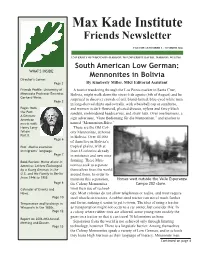
Max Kade Institute Friends Newsletter VOLUME 15 NUMBER 2 • SUMMER 2006 UNIVERSITY OF WISCONSIN–MADISON, 901 UNIVERSITY BAY DR., MADISON, WI 53705 South American Low German: WHAT'S INSIDE: Mennonites in Bolivia Director’s Corner. Page 2 By Kimberly Miller, MKI Editorial Assistant Friends Profile: University of A tourist wandering through the Los Pozos market in Santa Cruz, Minnesota Professor Emeritus Bolivia, might walk down the street 6 de agosto (6th of August) and be Gerhard Weiss. surprised to discover crowds of tall, blond-haired, blue-eyed white men Page 3 in long-sleeved shirts and overalls, with a baseball cap or sombrero, Pages from and women in dark flowered, pleated dresses, nylons and fancy black the Past: sandals, embroidered headscarves, and straw hats. Over one business, a A German- American sign advertises, “Gute Bedienung für die Mennoniten,” and another is meets with named “Mennoniten-Büro.” Henry Long- These are the Old Col- fellow. ony Mennonites, at home Part II. in Bolivia. Over 45,000 Page 6 of them live in Bolivia’s Prof. Macha examines tropical plains, with at immigrants’ language. least 45 colonies already Page 7 in existence and new ones Book Review: Home Alone in forming. These Men- America: Letters Exchanged nonites seek to separate by Collectiona Young German in the themselves from the world U.S.Feature: and His Family in Berlin around them. In order to fromLet's 1946 go toto 1955. maintain this separation, Horses wait outside the Valle Esperanza the World's Page 8 Fair! the Colony Mennonites Campo 202 store. CalendarPage of Events10 and limit their use of technol- News. -

Speaking of “Peter Money” and Poor Abraham: Wealth, Poverty and Consumption Among Old Colony Mennonites in Bolivia
Speaking of “Peter Money” and Poor Abraham: Wealth, Poverty and Consumption among Old Colony Mennonites in Bolivia Anna Sofia Hedberg, University of Dalarna, Sweden In a sense, accumulation of wealth, valuing material goods for anything but their use value, and ridiculing poor people could be perceived as deviations from what we generally think of as Anabaptist and Mennonite ideals.1 Still, life in contemporary Mennonite colonies in Bolivia provides ample evidence that they all occur. This fact hardly surprises anyone, yet from an anthropological perspective, it does constitute an incentive to consider how such deviations harmonise and/ or disharmonise with fundamental community goals. The overall aim of this article is, thus, to illustrate how issues such as wealth and poverty, as well as consumption of material goods – and particularly members’ ways of dealing with these matters – relate to community maintenance in the Mennonite Old Colony of Durango, in Eastern Bolivia. Drawing on three periods of extensive fieldwork,2 this article builds on how people in Durango talk of poverty and wealth, and how they account for their own and others’ economic situations and choices regarding material goods. As will be shown, these accounts illustrate 88 Journal of Mennonite Studies how and why individual members’ economic situations and choices become a crucial concern for all community members. The main argument of this article is that the community members’ culturally constructed image of the past and idea of that which shall come, which is referred to here as the forthcoming,3 influence Old Colonists’ reactions to individual consumption and material goods as well as to wealth and poverty. -

Download Download
Community and Schism among the Old Colony Mennonites of Belize: A Case Study Tanja Plasil, Norwegian University of Science and Technology, Trondheim, Norway Introduction In northern Belize, formerly British Honduras, lies the Altkolonier (Old Colony) Mennonite colony of Shipyard.1 Here the Mennonites form a distinct group within the wider Belizean society because of their appearance, language, religion, and lifestyle. At first glimpse Shipyard may seem like a coherent community, frozen in time, but a closer look reveals that things are quite different from what they appear. The formerly uniform community is showing cracks. A group of people have started to meet to study the Bible, and have begun doubting the old system within which they were living. The old ways do not seem plausible anymore. In order to contain the damage and to keep the rest of the community in line, the preachers have excommunicated members of the Bible Study group, banning them from being a part of community life.2 This 252 Journal of Mennonite Studies means that they, the “outcasts,” face a life of hardship, as they are shunned by even close family members, and do not receive any assistance from former friends or neighbours. To cope with this situation, they have formed a new group within the colony, one that provides mutual support and gives new meaning to their lives. This has worked quite well for some time, but before too long this new group also began splitting into different sub-groups. In this article,3 I focus on the circumstances and social tools that have kept the Altkolonier colony in Belize from becoming part of the wider society for such a long time, and, indeed, how members have kept the community intact. -

Marriage Patterns Among Old Colony Mennonites in Argentina
Marrying the Brother’s Wife’s Sister: Marriage Patterns among Old Colony Mennonites in Argentina Lorenzo Cañás Bottos, Norwegian University of Science and Technology Introduction The objective of this article is to assess the existence and analyse the consequences of a particular type of marriage pattern in a Men- nonite colony. For this, I apply an approach to the study of a complex kinship system that stems from studies of elementary kinship systems. That is, considering the kinship network of a whole population as the unit of study instead of concentrating on households or individual genealogies. I demonstrate the widespread existence of a marriage pattern characterised by two siblings marrying with two siblings (sibling or sister exchange within anthropological parlance), or in other words, marrying one’s sibling’s spouse’s sibling. I would like to clarify from the start that this article does not concern itself with the causes of this pattern, but with its consequences (particularly on effects on land redistribution and the marriage possibilities of the following gen- 76 Journal of Mennonite Studies eration). The main argument is that the marriage pattern in question does not lead toward the consolidation of land, but tends to equalise the distribution of wealth. Furthermore, when taking into account unwritten rules on marriage within the colony, this pattern produces the unintended consequence of opening up marriage opportunities to the following generation. This article is based on fieldwork in La Nueva Esperanza, an Old Colony Mennonite settlement in Argentina (for further details on this colony see Cañás Bottos, 2005, 2008a). The main economic activities in the colony are agriculture and dairy cattle breeding. -

Download Thesis
FAITH PERSPECTIVES OF MIGRANT WORKERS 1 Faith Perspectives of Mexican Migrant Farm Workers in Canada Las perspectivas de fe de los trabajadores agrícolas migrantes mexicanos en Canada Rafael Vallejo Thesis presented in partial fulfillment of the degree of Doctor of Theology (Ph.D.) Supervisor Dr. Charles Van Engen. FAITH PERSPECTIVES OF MIGRANT WORKERS 2 FAITH PERSPECTIVES OF MIGRANT WORKERS DECLARATION I certify that this thesis is the result of my own research and that it has not been partially or totally submitted to another educational institution to obtain an academic degree. Rafael Vallejo January 31, 2018 FAITH PERSPECTIVES OF MIGRANT WORKERS 3 TABLE OF CONTENTS ACKNOWLEDGEMENTS………………………………………………………………..7 ABSTRACT ...................................................................................................... ………….9 ABBREVIATIONS………………………………………………………………………..13 LIST OF TABLES………………………………………………………………………. 15 LIST OF FIGURES…………………………………….………………………………. 18 CHAPTER 1: MIGRANTS AND MIGRATION, RELIGION AND FAITH…………………………. 19 1.1 Introduction 1.1.1 Faith Perspectives of Migrant Workers 1.1.2 Migration and Religion 1.1.3 Global Migration Today 1.1.4 Migration, Globalization and Religion 1.1.5 Migration, Migrants and Christianity 1.2 Background and Significance of The Study 1.3 Objectives of the Study 1.3.1. The Research Question 1.3.2. Specific Objectives 1.3.3. Definition of Terms 1.4 Theoretical Framework 1.4.1. Lived Religion as a Theoretical Framework 1.5 Methodology 1.5.1. Subjects of the Study: Mexican Migrant Farm Workers 1.5.2. Visual Sociology 1.5.3. Post-disciplinary Approaches 1.6 Survey of Related Literature 1.6.1. Migration and Religion 1.6.2. Migration and Globalization 1.6.3. Migration and Religious Identity FAITH PERSPECTIVES OF MIGRANT WORKERS 4 1.6.4. -

FINNISH PARTNERSHIP AGREEMENT SCHEME Country Annexes Scheme
Partnershipcountry annex-kansi 11.8.2008 15:08 Page 1 C M Y CM MY CY CMY K EVALUATION Evaluation FINNISH PARTNERSHIP AGREEMENT SCHEME Country Annexes SCHEME Country AGREEMENT FINNISH PARTNERSHIP Finnish Partnership Agreement Scheme Evaluation report 2008:1 Evaluation report 2008:1 ISBN 978-951-724-672-9 (printed) ISBN 978-951-724-673-6 (pdf) Country Annexes: Bolivia, India, Uganda ISSN 1235-7618 2008:1 Ministry for Foreign Affairs of Finland MINISTRY FOR FOREIGN AFFAIRS OF FINLAND Department for Development Policy DEPARTMENT FOR DEVELOPMENT POLICY Composite REPORT 2008:1 Finnish Partnership Agreement Scheme ISBN: 978-951-724-672-9 (printed), ISBN: 978-951-724-673-6 (pdf), ISSN: 1235-7618 SPECIAL EDITION FAO: Utmaning till förnyelse. Sammanfattning 2008:1 (SWE) ISBN: 978-951-724-670-5 (print), ISBN: 978-951-724-671-2 (pdf), ISSN: 1235-7618 SPECIAL EDITION FAO: Haasteena uudistuminen. Lyhennelmä 2008:1 (FI) ISBN: 978-951-724-655-2 (painettu), ISBN: 978-951-724-659-0 (pdf), ISSN: 1235-7618 SPECIAL EDITION FAO: The Challenge of Renewal. Summary 2008:1 (ENG) ISBN: 978-951-724-657-6 (printed), ISBN: 978-951-724-661-3 (pdf), ISSN: 1235-7618 REPORT 2007:3 Implementation of the Paris Declaration – Finland ISBN: 978-951-724-663-7 (printed), ISBN: 978-951-724-664-4 (pdf), ISSN: 1235-7618 REPORT 2007:2 Meta-Analysis of Development Evaluations in 2006 ISBN: 978-951-724-632-3 (printed), ISBN: 978-951-724-633-1 (pdf), ISSN: 1235-7618 REPORT 2007:1 Finnish Aid to Afghanistan ISBN: 978-951-724-634-7 (printed), ISBN: 978-951-724-635-4 (pdf), ISSN: 1235-7618 -

Memories and Old Colony Mennonite Identity
“Emma jedohne”: Memories and Old Colony Mennonite Identity Karen Warkentin, Winnipeg When Old Colony Mennonites in Bolivia are asked why they do things a certain way, the most common response given is ‘So ha’ wie daut emma jedohne’ (that is how we have always done it). However, while listening to their stories, it quickly becomes evident that certain past events are highlighted, indicating that they were particularly influential in shaping the Old Colony identity. Yet the question can also be turned around, and asked whether these memories are retold precisely because they fit into the cultural Old Colony identity. The Old Colony Mennonites in Bolivia emphasize the needs and identity of the collective over the individual, and as members of the group, individuals recall memories that emphasize their allegiance to the colony. In this article, I suggest a symbiosis between collective memory and cultural identity: individual Mennonites recall events that are part of their collective memory, which in turn influence the formation of the Old Colony Mennonite identity. The Canadian-descendent, Low German-speaking Old Colony Men- nonites of Mexico first settled in isolated, rural colonies in south central Bolivia in 1967. They comprise a continually expanding conservative, anti-modern, ethno-religious group that looks and sounds surprisingly out of place in the Latin American culture of Bolivia. Yet this is their 130 Journal of Mennonite Studies very identity; they are a migratory people out of place in any nation state. Identity, to use the definition from the Encyclopaedia of Social and Cultural Anthropology, refers to the “qualities of sameness, in that persons may associate themselves, or be associated by others, with groups or categories on the basis of some salient common feature, e.g. -

Transforming Education: the Lesson from Argentina
Digital Commons @ Georgia Law Scholarly Works Faculty Scholarship 1-1-2001 Transforming Education: The Lesson from Argentina Anne Dupre University of Georgia School of Law, adupre@uga.edu Repository Citation Anne Dupre, Transforming Education: The Lesson from Argentina (2001), Available at: https://digitalcommons.law.uga.edu/fac_artchop/792 This Article is brought to you for free and open access by the Faculty Scholarship at Digital Commons @ Georgia Law. It has been accepted for inclusion in Scholarly Works by an authorized administrator of Digital Commons @ Georgia Law. Please share how you have benefited from this access For more information, please contact tstriepe@uga.edu. VANDERBILT JOURNAL of TRANSNATIONAL LAW VOLUME 34 JANUARY 2001 NUMBER I Transforming Education: The Lesson from Argentina Anne Proffitt Dupre* ABSTRACT This Article traces education reforms in Argentina from the colonialperiod to the present. Specifically, the Article focuses on La Ley Federal de Educaci6n, passed in 1993, which sought to reform primary and secondaryeducation throughout Argentina by promoting educational equity through a just distribution of educationalservices and opportunity. The Article begins with a descriptionof the current Argentine federal republic and the relationshipof the federal government and the provinces. Next, Article describes the development of the Argentine education system. It continues by explaining the backdrop of the adoption of Ley Federal. The Author describes the act's twenty-three rights and principlesand outlines the reforms envisioned under the law. The Article then turns to an evaluation of the effects and the effectiveness of Ley Federal. The Author specifically addresses the pervasiveproblems with dropout rates,funding, special education, and teacher salaries.