About Kazi Nazrul Islam (1899-1976)
Total Page:16
File Type:pdf, Size:1020Kb
Load more
Recommended publications
-

Poetry and History: Bengali Maṅgal-Kābya and Social Change in Precolonial Bengal David L
Western Washington University Western CEDAR A Collection of Open Access Books and Books and Monographs Monographs 2008 Poetry and History: Bengali Maṅgal-kābya and Social Change in Precolonial Bengal David L. Curley Western Washington University, david.curley@wwu.edu Follow this and additional works at: https://cedar.wwu.edu/cedarbooks Part of the Near Eastern Languages and Societies Commons Recommended Citation Curley, David L., "Poetry and History: Bengali Maṅgal-kābya and Social Change in Precolonial Bengal" (2008). A Collection of Open Access Books and Monographs. 5. https://cedar.wwu.edu/cedarbooks/5 This Book is brought to you for free and open access by the Books and Monographs at Western CEDAR. It has been accepted for inclusion in A Collection of Open Access Books and Monographs by an authorized administrator of Western CEDAR. For more information, please contact westerncedar@wwu.edu. Table of Contents Acknowledgements. 1. A Historian’s Introduction to Reading Mangal-Kabya. 2. Kings and Commerce on an Agrarian Frontier: Kalketu’s Story in Mukunda’s Candimangal. 3. Marriage, Honor, Agency, and Trials by Ordeal: Women’s Gender Roles in Candimangal. 4. ‘Tribute Exchange’ and the Liminality of Foreign Merchants in Mukunda’s Candimangal. 5. ‘Voluntary’ Relationships and Royal Gifts of Pan in Mughal Bengal. 6. Maharaja Krsnacandra, Hinduism and Kingship in the Contact Zone of Bengal. 7. Lost Meanings and New Stories: Candimangal after British Dominance. Index. Acknowledgements This collection of essays was made possible by the wonderful, multidisciplinary education in history and literature which I received at the University of Chicago. It is a pleasure to thank my living teachers, Herman Sinaiko, Ronald B. -

Chapter- II Kazi Nazrul Islam's Works Having Less Or No Perso-Arabic Words
52 Chapter- II Kazi Nazrul Islam's works having less or no Perso-Arabic words "Nazrul Islam used comparatively less Perso-Arabic words in the love and nature related poems and did not use abundant of Perso-Arabic words in the poems which were written in "Payer Chhanda"— remarks of the Authority on Nazrul Islam's work's Dr. Rafiqul Islam, Department of Bengali of Dhaka University. In sorting out titles of this chapter, the mile stone is fixed upto 150 Perso-Arabic words or less used in a title. Bengali race being predomi nantly consisted of Hindus and Muslims, Nazrul Islam did use traditional words of both the socities together for analogy and traditional words can not display themselves side by side in a nicely manner and meaningful bearings. There are so many words in usage in Hindu society to create Hindu environment where as there are words used in Muslim societyto indicate Muslim environment. Nazrul created appropriate environment for his situation using appropriate words which go easy to the depth of the situation and got the acceptance of the mass people of both the socities to differentiate and high light this inequlity of using less Perso-Arabic words, the following titles were sorted out. The figure on the right side in the bracket or at the end of each word indicate number of time the word used in the book (poeti'y) 53 Titk'S Arabic words Persian words Total l^erso-Arabic Words l.Chittanama(1925) 15 09 24 2. Gitishatadal(1934) 14 23 37 3.Chakrabak(1929) 20 20 40 4.ProlayShikha(1930) 19 25 44 5. -
IBEF Presentataion
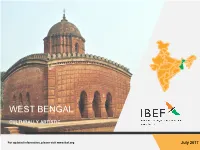
WEST BENGAL CULTURALLY ARTISTIC For updated information, please visit www.ibef.org July 2017 Table of Content Executive Summary .…………….….……...3 Advantage State ...………………………….4 Vision 2022 …………..……..…………..…..5 West Bengal – An Introduction …….……....6 Annual Budget 2015-16 ……………………18 Infrastructure Status ..................................19 Business Opportunities ……..…………......42 Doing Business in West Bengal …...……...63 State Acts & Policies ….….………..............68 EXECUTIVE SUMMARY One of the largest state . West Bengal, India’s 6th largest economy, had a gross state domestic product (GSDP) of US$ 140.56 billion economies in 2016-17. The state’s GSDP grew at a CAGR of 10.42% during 2005-16. Kolkata as the next IT . By 2015-16, 8 IT parks located at Barjora, Rajarhat, Asansol, Durgapur Phase II, Bolpur, Siliguri Phase II, Puralia & Kharagpur started operating. Establishment of 7 new IT parks at Haldia, Krishnanagar, Kalyani, hub Bantala, Taratala, Howrah, Malda is expected to start soon in next 5 years. Major producer of . In 2016-17, West Bengal was the 2nd largest producer of potato in India, accounting for about 25.06% of the potato country’s potato output. The state’s potato production stood at 11 million tonnes in 2016-17. West Bengal is the largest producer of rice in India. In 2016-17, rice production in West Bengal totalled to Largest rice producer 16.2 million tonnes, which is expected to cross 17 million tonnes by 2017. West Bengal is the 3rd largest state in India in term of mineral production, accounting for about one-fifth of Coal rich state total mineral production. Coal accounts for 99% of extracted minerals. Source: Statistics of West Bengal, Government of West Bengal 3 WEST BENGAL For updated information, please visit www.ibef.org ADVANTAGE: WEST BENGAL 2014-15 Geographic and cost advantage Rich labour pool 2022-23 T . -
Introduction to Bengali, Part I
R E F O R T R E S U M E S ED 012 811 48 AA 000 171 INTRODUCTION TO BENGALI, PART I. BY- DIMOCK, EDWARD, JR. AND OTHERS CHICAGO UNIV., ILL., SOUTH ASIALANG. AND AREA CTR REPORT NUMBER NDEA.--VI--153 PUB DATE 64 EDRS PRICE MF -$1.50 HC$16.04 401P. DESCRIPTORS-- *BENGALI, GRAMMAR, PHONOLOGY, *LANGUAGE INSTRUCTION, FHONOTAPE RECORDINGS, *PATTERN DRILLS (LANGUAGE), *LANGUAGE AIDS, *SPEECHINSTRUCTION, THE MATERIALS FOR A BASIC COURSE IN SPOKENBENGALI PRESENTED IN THIS BOOK WERE PREPARED BYREVISION OF AN EARLIER WORK DATED 1959. THE REVISIONWAS BASED ON EXPERIENCE GAINED FROM 2 YEARS OF CLASSROOMWORK WITH THE INITIAL COURSE MATERIALS AND ON ADVICE AND COMMENTS RECEIVEDFROM THOSE TO WHOM THE FIRST DRAFT WAS SENT FOR CRITICISM.THE AUTHORS OF THIS COURSE ACKNOWLEDGE THE BENEFITS THIS REVISIONHAS GAINED FROM ANOTHER COURSE, "SPOKEN BENGALI,"ALSO WRITTEN IN 1959, BY FERGUSON AND SATTERWAITE, BUT THEY POINTOUT THAT THE EMPHASIS OF THE OTHER COURSE IS DIFFERENTFROM THAT OF THE "INTRODUCTION TO BENGALI." FOR THIS COURSE, CONVERSATIONAND DRILLS ARE ORIENTED MORE TOWARDCULTURAL CONCEPTS THAN TOWARD PRACTICAL SITUATIONS. THIS APPROACHAIMS AT A COMPROMISE BETWEEN PURELY STRUCTURAL AND PURELYCULTURAL ORIENTATION. TAPE RECORDINGS HAVE BEEN PREPAREDOF THE MATERIALS IN THIS BOOK WITH THE EXCEPTION OF THEEXPLANATORY SECTIONS AND TRANSLATION DRILLS. THIS BOOK HAS BEEN PLANNEDTO BE USED IN CONJUNCTION WITH THOSE RECORDINGS.EARLY LESSONS PLACE MUCH STRESS ON INTONATION WHIM: MUST BEHEARD TO BE UNDERSTOOD. PATTERN DRILLS OF ENGLISH TO BENGALIARE GIVEN IN THE TEXT, BUT BENGALI TO ENGLISH DRILLS WERE LEFTTO THE CLASSROOM INSTRUCTOR TO PREPARE. SUCH DRILLS WERE INCLUDED,HOWEVER, ON THE TAPES. -

Sharmila Roy, Internationally Acclaimed Tagore Scholar & Singer
Sharmila Roy, internationally acclaimed Tagore scholar & singer. Sharmila Roy grew up on the idyllic campus of Vishva Bharati University, Shantiniketan, which was founded by Nobel Laureate poet Rabindranath Tagore (1913, in literature). This resulted in her experiencing Tagore’s music, poetry, dance dramas, and his world embracing philosophy as part of everyday life at the Ashram-like setting of this school. Besides receiving her formal degrees from Calcutta University (English) and from Shantiniketan (Graphic Arts), she studied Tagore songs and classical Indian music in Shantiniketan and in Kolkata. She came to Paris in 1975 on a French government scholarship to study art after which she did her Doctoral studies at the Sorbonne, Paris. Her beautifully evocative voice has enriched the works of world class directors like Satyajit Ray (JanaAranya/Middleman), Nacer Khemir (in Bab'Aziz), Peter Brook (in The Mahabharata) and others. She has adapted and directed several dance dramas of Tagore in French, besides translating into French works by Kazi Nazrul Islam, Lalon Fakir and the wandering Baul musicians/minstrels of Bengal. She has done French subtitles for Satyajit Ray's films, participated in several documentary films and has written on the music in Satyajit Ray's films for such publications as "Positif", a French cinema journal. She has a wide discography, starting with Grammophone Company of India and RPG, Virgin, Real World, ALM Kojima, EMI, Erato Warner, Prime Records, Long Distance, Disques Meys, Adarsh Media, etc. She has represented India in many international festivals and collaborated with contemporary dancers and composers of different traditions and cultures such as the Battery Dance Company, NY; Kudsi Ergunar of Turkey; Annemarie Porras of France, etc. -

A Hermeneutic Study of Bengali Modernism
Modern Intellectual History http://journals.cambridge.org/MIH Additional services for Modern Intellectual History: Email alerts: Click here Subscriptions: Click here Commercial reprints: Click here Terms of use : Click here FROM IMPERIAL TO INTERNATIONAL HORIZONS: A HERMENEUTIC STUDY OF BENGALI MODERNISM KRIS MANJAPRA Modern Intellectual History / Volume 8 / Issue 02 / August 2011, pp 327 359 DOI: 10.1017/S1479244311000217, Published online: 28 July 2011 Link to this article: http://journals.cambridge.org/abstract_S1479244311000217 How to cite this article: KRIS MANJAPRA (2011). FROM IMPERIAL TO INTERNATIONAL HORIZONS: A HERMENEUTIC STUDY OF BENGALI MODERNISM. Modern Intellectual History, 8, pp 327359 doi:10.1017/S1479244311000217 Request Permissions : Click here Downloaded from http://journals.cambridge.org/MIH, IP address: 130.64.2.235 on 25 Oct 2012 Modern Intellectual History, 8, 2 (2011), pp. 327–359 C Cambridge University Press 2011 doi:10.1017/S1479244311000217 from imperial to international horizons: a hermeneutic study of bengali modernism∗ kris manjapra Department of History, Tufts University Email: kris.manjapra@tufts.edu This essay provides a close study of the international horizons of Kallol, a Bengali literary journal, published in post-World War I Calcutta. It uncovers a historical pattern of Bengali intellectual life that marked the period from the 1870stothe1920s, whereby an imperial imagination was transformed into an international one, as a generation of intellectuals born between 1885 and 1905 reinvented the political category of “youth”. Hermeneutics, as a philosophically informed study of how meaning is created through conversation, and grounded in this essay in the thought of Hans Georg Gadamer, helps to reveal this pattern. -
KRAKAUER-DISSERTATION-2014.Pdf (10.23Mb)
Copyright by Benjamin Samuel Krakauer 2014 The Dissertation Committee for Benjamin Samuel Krakauer Certifies that this is the approved version of the following dissertation: Negotiations of Modernity, Spirituality, and Bengali Identity in Contemporary Bāul-Fakir Music Committee: Stephen Slawek, Supervisor Charles Capwell Kaushik Ghosh Kathryn Hansen Robin Moore Sonia Seeman Negotiations of Modernity, Spirituality, and Bengali Identity in Contemporary Bāul-Fakir Music by Benjamin Samuel Krakauer, B.A.Music; M.A. Dissertation Presented to the Faculty of the Graduate School of The University of Texas at Austin in Partial Fulfillment of the Requirements for the Degree of Doctor of Philosophy The University of Texas at Austin May 2014 Dedication This work is dedicated to all of the Bāul-Fakir musicians who were so kind, hospitable, and encouraging to me during my time in West Bengal. Without their friendship and generosity this work would not have been possible. জয় 巁쇁! Acknowledgements I am grateful to many friends, family members, and colleagues for their support, encouragement, and valuable input. Thanks to my parents, Henry and Sarah Krakauer for proofreading my chapter drafts, and for encouraging me to pursue my academic and artistic interests; to Laura Ogburn for her help and suggestions on innumerable proposals, abstracts, and drafts, and for cheering me up during difficult times; to Mark and Ilana Krakauer for being such supportive siblings; to Stephen Slawek for his valuable input and advice throughout my time at UT; to Kathryn Hansen -

Impact of Women: a Brief Sketch in Kazi Nazrul Islam's Life and Poetry
International Journal of Humanities & Social Science Studies (IJHSSS) A Peer-Reviewed Bi-monthly Bi-lingual Research Journal ISSN: 2349-6959 (Online), ISSN: 2349-6711 (Print) ISJN: A4372-3142 (Online) ISJN: A4372-3143 (Print) Volume-VI, Issue-VI, November 2020, Page No. 60-65 Published by Scholar Publications, Karimganj, Assam, India, 788711 Website: http://www.ijhsss.com DOI: 10.29032/ijhsss.v6.i4.2020.1-8 Impact of Women: A Brief Sketch in Kazi Nazrul Islam’s Life and Poetry Dr. Sanjay Bhattacharjee Department of Bengali, Gauhati University, Assam, India Abstract Kazi Nazrul Islam, known as a rebel poet in Bengali literature, is the next generation poet of Rabindranath Tagore from the time and spirit. Nazrul's poems have declared an extraordinary rebellion on traditional social order, superstition, the pains of subjugation, inequality and neglect of women. His poem 'Bidrohi' is a shining example of this. In clear terms, no one has ever written about it before. Especially when talking about women, Nazrul is always outspoken and fearless. Many women had came to his personal life and his poetry. In his literary works , women have been transformed into many forms. While Nargis and Pramila are portrayed as lovers in his poetry, he has banished women like Birajasundari Devi as a symbol of mother. In his poems, Nazrul has declared that women have the equal rights of men in first half of twentieth century . It is repeated in Nazrul's poem that women are not less than men, but are entitled to sit in one seat with men. We will try to capture the nature of the influence of women in the life and poetry of Nazrul Islam in our proposed research paper Key words: Woman, Poetry, Rebellion, Mother, Love. -

Religion in History: Conflict, Conversion and Co-Existence the Bengal Renaissance
Religion in history: conflict, conversion and co-existence The Bengal Renaissance John Wolffe In the following discussion we’re going to consider Ram Mohan Roy and Vivekananda not in Britain but in Bengal and the city of Calcutta where both lived for different parts of their lives. There they created movements for which they are remembered during a period in which it has been claimed India experienced a renaissance. I shall be talking with William Radice, Senior Lecturer in Bengali at the School of Oriental African Studies, University of London. In the following section, Dr Radice uses Bengali pronunciation. John Wolffe How do you think a British administrator or missionary travelling to Calcutta in the 19th century might have anticipated what they would find when they got there? William Radice You mean in the early period? Well, of course great wealth was built up in the 18th century because of the activities of the East India company and there were Bengalis who were able to build up great wealth too because of all the trading activity which led to the growth of Calcutta as a great city, but I think administrators going out to work, say for the East India company, they would have been aware that this was an environment with extraordinary social contrasts and they would have been aware that amidst all this wealth in the city of Palaces, as so called, there would be great squalor and great poverty and particularly if they had progressive ideals or if they had evangelical religious convictions, they would’ve been aware that there would be a lot of social iniquities and abuses, religious practices, that they would regard it as barbaric and so on. -

Searching for the Greatest Bengali: the BBC and Shifting Identity
National Identities Vol. 10, No. 2, June 2008, 149Á165 Searching for the greatest Bengali: The BBC and shifting identity categories in South Asia Reece Jones* University of Wisconsin-Madison, USA Drawing on debates generated by the BBC Bengali Language Service’s naming of the greatest Bengali of all time, this article investigates the shifting boundaries between group identity categories in our ‘globalising’ world. First, the con- troversy over the meaning of the term ‘Bengali’, which emerged in contemporary Bangladesh and India in response to the BBC’s list, is investigated. Then writings and speeches of several of the individuals who were honoured as the greatest Bengalis are analysed in order to draw out the multiple ways they approached their own Bengali identities. In the conclusion, it is argued that rather than imagining the end of place-based identity categories through the process of globalisation, it is more useful to conceptualise shifting categories that continue Downloaded By: [Jones, Reece] At: 15:14 29 April 2008 to incorporate a place-based aspect, but in hybrid and contradictory ways. Keywords: categories; ethnicity; nations; globalisation; South Asia In Spring 2004, following the British Broadcasting Company’s naming of Winston Churchill as the greatest Briton of all time, the BBC Bengali Language Service conducted a survey of its twelve million listeners to determine the greatest Bengali of all time (BBC, 2004).1 Respondents were asked to rank their top five choices and in the end more than 100 individuals received votes. The top twenty were announced one per day beginning on 26 March, Bangladesh’s Independence Day, and ending on 15 April, the Bengali New Year’s Day, with the naming of Sheikh Mujibur Rahman as the greatest Bengali of all time. -
'Aradhona' a University of Visual & Performing Arts By
‘ARADHONA’ A UNIVERSITY OF VISUAL & PERFORMING ARTS BY IFREET RAHIMA 09108004 SEMINAR II Submitted in partial fulfillment of the requirements for the degree of Bachelors of Architecture Department of Architecture BRAC University SUMMER 2013 DISSERTATION THE DESIGN OF ‘ARADHONA’ A UNIVERSITY OF VISUAL & PERFORMING ARTS This dissertation is submitted to the Department of Architecture in partial gratification of the exigency for the degree of Bachelor of Architecture (B.Arch.) at BRAC University, Dhaka, Bangladesh IFREET RAHIMA 09108004 5TH YEAR, DEPARTMENT OF ARCHITECTURE BRAC UNIVERSITY, DHAKA FALL 2013 DECLARATION The work contained in this study has not been submitted elsewhere for any other degree or qualification and unless otherwise referenced it is the author’s own work. STATEMENT OF COPYRIGHT The copyright of this dissertation rests with the Architecture Discipline. No quotation from it should be published without their consent. RAHIMA | i ‘ARADHONA’ A UNIVERSITY OF VISUAL & PERFORMING ARTS A Design Dissertation submitted to the Department of Architecture in partial fulfillment of the requirement for the Degree of Bachelor of Architecture (B.Arch) under the Faculty of BRAC University, Dhaka. The textual and visual contents of the Design Dissertation are the intellectual output of the student mentioned below unless otherwise mentioned. Information given within this Design Dissertation is true to the best knowledge of the student mentioned below. All possible efforts have been made by the author to acknowledge the secondary sources information. Right to further modification and /or publication of this Design Dissertation in any form belongs to its author. Contents within this Design Dissertation can be reproduced with due acknowledgement for academic purposes only without written consent from the author. -

The Bengalis: a Thousand Years
Bengalis Thousand Years 8670/ 021116 The BengAlis: A ThousAnd YeArs Jawhar Sircar The last few days of a century that also happen to be at the end of a whole millennium, are bound to stir a strange excitement in even the most placid person. The two most expected feelings that hold their sway can perhaps be summarized as: introspection and expectation — drawing a balance sheet of the past as also trying to gauge what the future holds. Such an exercise can cover not only a single person or his immediate concerns; it may as well cover his locality, his state or nation and may be stretched to entire humanity. The constraints of my acquaintance and knowledge hardly qualify me to scan any group higher or bigger than my own people: the Bengalis. Even in this, my limitations now plague me more than my enthusiasm to try out such a review — but these notwithstanding; the sheer thrill of initiating an animated adda on the subject overpowers me. At the beginning, let me make it clear that I do not have the audacity to try to cover a thousand years in just a few pages: hence I will concentrate only on certain significant periods or issues, for the sake of presenting a viewpoint. So let us begin: are the Bengalis a thousand years old? Or even more? Historians tell us about our history during the Pala- Sena period, which would give us about 1250 years to be proud of, but if we include the great Sasanka, we could be share-holders in a great concern that goes back fourteen centuries.