PBS Winter 2017 TCA Press Tour
Total Page:16
File Type:pdf, Size:1020Kb
Load more
Recommended publications
-
A Dangerous Summer
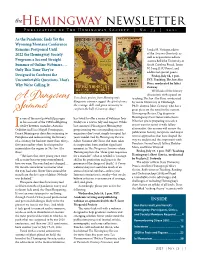
theHemingway newsletter Publication of The Hemingway Society | No. 73 | 2021 As the Pandemic Ends Yet the Wyoming/Montana Conference Remains Postponed Until Lynda M. Zwinger, editor 2022 the Hemingway Society of the Arizona Quarterly, as well as acquisitions editors Programs a Second Straight Aurora Bell (the University of Summer of Online Webinars.… South Carolina Press), James Only This Time They’re W. Long (LSU Press), and additional special guests. Designed to Confront the Friday, July 16, 1 p.m. Uncomfortable Questions. That’s EST: Teaching The Sun Also Rises, moderated by Juliet Why We’re Calling It: Conway We’ll kick off the literary discussions with a panel on Two classic posters from Hemingway’s teaching The Sun Also Rises, moderated dangerous summer suggest the spirit of ours: by recent University of Edinburgh A Dangerous the courage, skill, and grace necessary to Ph.D. alumna Juliet Conway, who has a confront the bull. (Courtesy: eBay) great piece on the novel in the current Summer Hemingway Review. Dig deep into n one of the most powerful passages has voted to offer a series of webinars four Hemingway’s Lost Generation classic. in his account of the 1959 bullfighting Fridays in a row in July and August. While Whether you’re preparing to teach it rivalry between matadors Antonio last summer’s Houseguest Hemingway or just want to revisit it with fellow IOrdóñez and Luis Miguel Dominguín, programming was a resounding success, aficionados, this session will review the Ernest Hemingway describes returning to organizers don’t want simply to repeat last publication history, reception, and major Pamplona and rediscovering the bravery year’s model. -

Prohibition Premieres October 2, 3 & 4
Pl a nnerMichiana’s bi-monthly Guide to WNIT Public Television Issue No. 5 September — October 2011 A FILM BY KEN BURNS AND LYNN NOVICK PROHIBITION PREMIERES OCTOBER 2, 3 & 4 BrainGames continues September 29 and October 20 Board of Directors Mary’s Message Mary Pruess Chairman President and GM, WNIT Public Television Glenn E. Killoren Vice Chairmen David M. Findlay Rodney F. Ganey President Mary Pruess Treasurer Craig D. Sullivan Secretary Ida Reynolds Watson Directors Roger Benko Janet M. Botz WNIT Public Television is at the heart of the Michiana community. We work hard every Kathryn Demarais day to stay connected with the people of our area. One way we do this is to actively engage in Robert G. Douglass Irene E. Eskridge partnerships with businesses, clubs and organizations throughout our region. These groups, David D. Gibson in addition to the hundreds of Michiana businesses that help underwrite our programs, William A. Gitlin provide WNIT with constant and immediate contact to our viewers and to the general Tracy D. Graham Michiana community. Kreg Gruber Larry D. Harding WNIT maintains strong partnerships and active working relationship with, among others, James W. Hillman groups representing the performing arts – Arts Everywhere, Art Beat, the Fischoff National Najeeb A. Khan Chamber Music Association, the Notre Dame Shakespeare Festival, the Krasl Art Center in Evelyn Kirkwood Kevin J. Morrison St. Joseph, the Lubeznik Center for the Arts in Michigan City and the Southwest Michigan John T. Phair Symphony; civic and cultural organizations like the Center for History, Fernwood Botanical Richard J. Rice Garden and Nature Center and the Historic Preservation Commission; educational, social Jill Richardson and healthcare organizations such as WVPE National Public Radio, the St. -

American Masters 200 List Finaljan2014
Premiere Date # American Masters Program Title (Month-YY) Subject Name 1 ARTHUR MILLER: PRIVATE CONVERSATIONS On the Set of "Death of a Salesman" June-86 Arthur Miller 2 PHILIP JOHNSON: A SELF PORTRAIT June-86 Philip Johnson 3 KATHERINE ANNE PORTER: THE EYE OF MEMORY July-86 Katherine Anne Porter 4 UNKNOWN CHAPLIN (Part 1) July-86 Charlie Chaplin 5 UNKNOWN CHAPLIN (Part 2) July-86 Charlie Chaplin 6 UNKNOWN CHAPLIN (Part 3) July-86 Charlie Chaplin 7 BILLIE HOLIDAY: THE LONG NIGHT OF LADY DAY August-86 Billie Holiday 8 JAMES LEVINE: THE LIFE IN MUSIC August-86 James Levine 9 AARON COPLAND: A SELF PORTRAIT August-86 Aaron Copland 10 THOMAS EAKINS: A MOTION PORTRAIT August-86 Thomas Eakins 11 GEORGIA O'KEEFFE September-86 Georgia O'Keeffe 12 EUGENE O'NEILL: A GLORY OF GHOSTS September-86 Eugene O'Neill 13 ISAAC IN AMERICA: A JOURNEY WITH ISAAC BASHEVIS SINGER July-87 Isaac Bashevis Singer 14 DIRECTED BY WILLIAM WYLER July-87 William Wyler 15 ARTHUR RUBENSTEIN: RUBENSTEIN REMEMBERED July-87 Arthur Rubinstein 16 ALWIN NIKOLAIS AND MURRAY LOUIS: NIK AND MURRAY July-87 Alwin Nikolais/Murray Louis 17 GEORGE GERSHWIN REMEMBERED August-87 George Gershwin 18 MAURICE SENDAK: MON CHER PAPA August-87 Maurice Sendak 19 THE NEGRO ENSEMBLE COMPANY September-87 Negro Ensemble Co. 20 UNANSWERED PRAYERS: THE LIFE AND TIMES OF TRUMAN CAPOTE September-87 Truman Capote 21 THE TEN YEAR LUNCH: THE WIT AND LEGEND OF THE ALGONQUIN ROUND TABLE September-87 Algonquin Round Table 22 BUSTER KEATON: A HARD ACT TO FOLLOW (Part 1) November-87 Buster Keaton 23 BUSTER KEATON: -

Vorwort Was Uns Bewegt Aminatta Forna Amber Heard Safia Shah
Vorwort Aminatta Forna Kanchan Sins;h Was uns bewegt Amber Heard Linda Sarsour Safia Shah Linda Biehl Fereshtch Forough Molly Biehl Dana Donofree Renee Montaigne Nokwanele Mbewu Rokhaya Diallo Ellen Bryant Voigt Louise Nicholas Cleo Wade Helene Grimaucl Ronni Kahn Chimamanda Nj'.o/i Adichie Jodi Peterson Josefine Co> Pushpa Basnet Imany Allison Havey Deana Purcio Jan Owen NomvLIIa Sikhnk.hrinc Inge Haselsteiner Eva Oiuer Sabila Khalun Gillian Caldwell Ruth Reichl Jessica Graro Stnith Lara Bergthold Marama Fox Tabitha St. Bernard Jacobs Nicole Turn: Marilyn Waring Rosemary Jones Camille Crosnier Ynssmin Abdel-iVun'.ied Katarina Pira< Sikku Embeth Davidt/ Esther Duflo Zamaswa/i Dlamirn-iv'iandc Sasha Marianna Salzmann Laurence 1 lennot- Hei :"ien* Zoleka Mandela Gillian blovo Collette Dinnigan Loii-Ji S.ilcs Karen Walker Roxane G;iy Dominique Attias ElisatxMh M.isc Kristcn Visbai Sliiimi Ch<iki,il)aiti Sarah Outen Alicia Gai/a Danielle Brooks Cl(;mentine Ra[i|iapor; Isabel Allende S(i|)bie M.ithisrii Kaylin Whittmgham Claudi«1 I laii'.nrir Stephanie Alexander K.ithy Lldmi Justina Machado Amy I Idon luilclt.Mib Florence Aubenas Vidya ['[il.in Sharon Brous (]!<]( <i M.K hei Jutta Speide Ale'-'.iiufM f'au Inna Modja Ivy Ro'A Julia Leeb KJ m b f, i Karen Maltison C (' I 111, ] ( M 1,1! 1;' Inhalt Gillian Anderson 118 Deborah Santana 16? ; Maria Shriver 216 Alexandra Zavis 120 Jane Caro 169 : Christine Parker 217 Pauline Nguyen 120 Winnie Madikizela-Mandela 170 i Jude Kelly 217 Nadya Tolokonnikova 121 Mithu Ghosh 172 i Elif Shafak 218 Hodan Isse -

Review Essay Ken Burns and Lynn Novick's the Vietnam
Review Essay Ken Burns and Lynn Novick’s The Vietnam War MARK PHILIP BRADLEY True confessions: I did not go into the eighteen hours of Ken Burns and Lynn Novick’s The Vietnam War with a totally open mind.1 Burns’s 1990 documentary series The Civil War, which made his career, had evoked a storm of controversy, with such leading his- torians as Leon Litwack and Eric Foner offering scathing critiques of how the film depicted African Americans as passive victims and entirely ignored the ways in which the postwar era of Reconstruction became an exercise in white supremacy. As Foner wrote, “Faced with a choice between historical illumination or nostalgia, Burns consis- tently opts for nostalgia.”2 Subsequent documentaries on jazz and World War II always struck me, and in fact many critics, as deliberately skirting potentially subversive counter-narratives in a kind of burnishing of the past.3 And to be quite honest, all of them seemed too long. In the case of Burns and Novick’s earlier series The War (2007) and its fifteen-hour embrace of the greatest generation narrative, Burns’s insular docu- mentary painted World War II as an entirely American affair, with non-white and non- American voices largely to the side. The much-heralded “Ken Burns effect” had never worked its magic on me. When I began to hear the tagline for The Vietnam War in the drumbeat of publicity before it was first aired on PBS last September (you will have to conjure up the melan- choly Peter Coyote voiceover as you read)—“It was begun in good faith by decent peo- ple out of fateful misunderstandings, American overconfidence, and Cold War mis- calculations”—I anticipated a painful eighteen hours. -

The Legacy of American Photojournalism in Ken Burns's
Interfaces Image Texte Language 41 | 2019 Images / Memories The Legacy of American Photojournalism in Ken Burns’s Vietnam War Documentary Series Camille Rouquet Electronic version URL: http://journals.openedition.org/interfaces/647 DOI: 10.4000/interfaces.647 ISSN: 2647-6754 Publisher: Université de Bourgogne, Université de Paris, College of the Holy Cross Printed version Date of publication: 21 June 2019 Number of pages: 65-83 ISSN: 1164-6225 Electronic reference Camille Rouquet, “The Legacy of American Photojournalism in Ken Burns’s Vietnam War Documentary Series”, Interfaces [Online], 41 | 2019, Online since 21 June 2019, connection on 07 January 2021. URL: http://journals.openedition.org/interfaces/647 ; DOI: https://doi.org/10.4000/interfaces.647 Les contenus de la revue Interfaces sont mis à disposition selon les termes de la Licence Creative Commons Attribution 4.0 International. THE LEGACY OF AMERICAN PHOTOJOURNALISM IN KEN BURNS’S VIETNAM WAR DOCUMENTARY SERIES Camille Rouquet LARCA/Paris Sciences et Lettres In his review of The Vietnam War, the 18-hour-long documentary series directed by Ken Burns and Lynn Novick released in September 2017, New York Times television critic James Poniewozik wrote: “The Vietnam War” is not Mr. Burns’s most innovative film. Since the war was waged in the TV era, the filmmakers rely less exclusively on the trademark “Ken Burns effect” pans over still images. Since Vietnam was the “living-room war,” played out on the nightly news, this documentary doesn’t show us the fighting with new eyes, the way “The War” did with its unearthed archival World War II footage. -

Vietnam Revisited
OCTOBER 2017 VIETNAM REVISITED elebrated filmmaker Ken Burns — heralded as “America’s storyteller” for such films as Jazz, Baseball, The Roosevelts, and Brooklyn Bridge — makes television history again this month with the premiere of The Vietnam War, a new 10-part, 18-hour documentary series co-directed by Lynn Novick. CTen years in the making, The Vietnam War tells the epic story of one of the most divisive and controversial events in American history as it has never before been told on film. The immersive narrative reveals the human dimensions of the war through testimony from nearly 80 witnesses, including Americans who fought in the war and others who opposed it, as well as Vietnamese combatants and civilians from both sides of the conflict. Digitally re-mastered archival footage, photographs taken by legendary 20th century photojournalists, historic television broadcasts, evocative home movies, and revelatory audio recordings from inside the Kennedy, Johnson, and Nixon administrations bring the war and the chaotic era it encompassed to life. More than 120 popular songs that defined the era by The Beatles, The Rolling Stones, Bob Dylan, Jimi Hendrix, Simon and Garfunkel, Janis Joplin, Joni Mitchell, Pete Seeger, and other iconic artists further enhance the storytelling. “The Vietnam War was a decade of agony that took the lives of more than 58,000 Americans,” Burns said. “Not since the Civil War have we as a country been so torn apart. More than 40 years after it ended, we can’t forget Vietnam, and we are still arguing about why it went wrong, who was to blame and whether it was all worth it.” Burns hopes The Vietnam War will inspire national conversations about our country’s history and who we are as Americans. -

What's Cooking at the White House
What's cooking at the White House First lady Michelle Obama shops with Sam Kass, assistant chef at the White House, in September at a farmers market two blocks from the White House. The Obamas recruited Kass from Chicago, where he had worked with such chefs as Paul Kahan and had cooked for the family in their Kenwood home. (Win McNamee, Getty Images / September 17, 2009) By Katherine Skiba Tribune reporter December 6, 2009 WASHINGTON -- Not long after arriving at the White House, first lady Michelle Obama led reporters and culinary students through its cramped, stainless steel kitchen, enthusing, "This is where the magic happens." The food at 1600 Pennsylvania Ave. is fresh, seasonal and gathered from across America, as far away as the rivers of Alaska and as close as the first lady's garden. There's a Chicago influence too, not only because of the first couple's deep roots. They brought with them Sam Kass, who had cooked for them in the Windy City and is now an assistant chef at the White House. Ten months into the Obama presidency, it's plainer than a scoop of vanilla ice cream that Barack and Michelle Obama are food enthusiasts. Call them the "first foodies." The Obamas possess sophisticated palates, according to chefs who know them. Still, there's a dichotomy to their dining. They're omnivores who enjoy "adventurous" eating, but confess a hankering for humble foods, like burgers and sweet potato french fries. All of this translates to a White House where food, and who is cooking it, matters. -
2018 BAM Next Wave Festival #Bamnextwave
2018 BAM Next Wave Festival #BAMNextWave Brooklyn Academy of Music Adam E. Max, Katy Clark, Chairman of the Board President William I. Campbell, Joseph V. Melillo, Vice Chairman of the Board Executive Producer Place BAM Harvey Theater Oct 11—13 at 7:30pm; Oct 13 at 2pm Running time: approx. one hour 15 minutes, no intermission Created by Ted Hearne, Patricia McGregor, and Saul Williams Music by Ted Hearne Libretto by Saul Williams and Ted Hearne Directed by Patricia McGregor Conducted by Ted Hearne Scenic design by Tim Brown and Sanford Biggers Video design by Tim Brown Lighting design by Pablo Santiago Costume design by Rachel Myers and E.B. Brooks Sound design by Jody Elff Assistant director Jennifer Newman Co-produced by Beth Morrison Projects and LA Phil Season Sponsor: Leadership support for music programs at BAM provided by the Baisley Powell Elebash Fund Major support for Place provided by Agnes Gund Place FEATURING Steven Bradshaw Sophia Byrd Josephine Lee Isaiah Robinson Sol Ruiz Ayanna Woods INSTRUMENTAL ENSEMBLE Rachel Drehmann French Horn Diana Wade Viola Jacob Garchik Trombone Nathan Schram Viola Matt Wright Trombone Erin Wight Viola Clara Warnaar Percussion Ashley Bathgate Cello Ron Wiltrout Drum Set Melody Giron Cello Taylor Levine Electric Guitar John Popham Cello Braylon Lacy Electric Bass Eileen Mack Bass Clarinet/Clarinet RC Williams Keyboard Christa Van Alstine Bass Clarinet/Contrabass Philip White Electronics Clarinet James Johnston Rehearsal pianist Gareth Flowers Trumpet ADDITIONAL PRODUCTION CREDITS Carolina Ortiz Herrera Lighting Associate Lindsey Turteltaub Stage Manager Shayna Penn Assistant Stage Manager Co-commissioned by the Los Angeles Phil, Beth Morrison Projects, Barbican Centre, Lynn Loacker and Elizabeth & Justus Schlichting with additional commissioning support from Sue Bienkowski, Nancy & Barry Sanders, and the Francis Goelet Charitable Lead Trusts. -

Vietnam and PTSD
EDITORIAL An Anniversary Postponed and a Diagnosis Delayed: Vietnam and PTSD More than 40 years after it ended, we can’t forget Vietnam and we are still arguing about why it went wrong, who was to blame and whether it was all worth it. Ken Burns1 any events both personal and public have this year of so much loss and heroism, I encour- been deferred during the 15 plus months age you to find a way to thank Vietnam veterans M of the pandemic. Almost everyone has who may have received the opposite of gratitude an example of a friend or family member who when they initially returned home. would have been sitting at what President Biden, As my small contribution to the commemora- Cynthia Geppert is during his memorial speech for the 500,000 vic- tion, this editorial will focus on the psychiatric Editor-in-Chief; tims of the virus referred to as the “empty chair” disorder of memory: posttraumatic stress disorder Chief, Consultation at a holiday gathering sans COVID-19.2 For (PTSD) and how the Vietnam War brought defi- Psychiatry and Ethics, New Mexico VA Health many in our country, part of the agonizing ef- nition—albeit delayed—to the agonizing diagno- Care System; and fort to awaken from the long nightmare of the sis that too many veterans experience. Professor and pandemic is to resume the rhythm of rituals na- The known clinical entity of PTSD is ancient. Director of Ethics Education at the tional, local, and personal that mark the year Narrative descriptions of the disorder are written University of New with meaning and offer rest and rejuvenation in the Mesopotamian Epic of Gilgamesh and in Mexico School of from the daily toil of duty. -
The Law of Black Mirror - Syllabus
City University of New York (CUNY) CUNY Academic Works Open Educational Resources Baruch College 2020 The Law of Black Mirror - Syllabus Yafit Lev-Aretz CUNY Bernard M Baruch College Nizan Packin CUNY Bernard M Baruch College How does access to this work benefit ou?y Let us know! More information about this work at: https://academicworks.cuny.edu/bb_oers/27 Discover additional works at: https://academicworks.cuny.edu This work is made publicly available by the City University of New York (CUNY). Contact: AcademicWorks@cuny.edu The Law of Black Mirror: Privacy, Online Social Profiling and the Law Spring 2020 Zicklin School of Business Baruch College Professor Nizan Geslevich Packin Department: Law Email: Nizan.Packin@baruch.cuny.edu Phone: 646-312-3593 Office: Room B9-208, Vertical Campus Professor Yafit Lev-Aretz Department: Law Email: Yafit.lev-aretz@baruch.cuny.edu Phone: 646-312-3606 Office: Room B9-219, Vertical Campus Course Description: Using episodes from the show Black Mirror as a study tool - a show that features tales that explore techno-paranoia - the course analyzes legal and policy considerations of futuristic or hypothetical case studies. The case studies tap into the collective unease about the modern world and bring up a variety of fascinating key philosophical, legal, and economic- based questions. Learning goals for the course include: ł Students will use primary sources to analyze contemporary legal and policy issues arising from emerging technologies. ł Students will engage critically and constructively in key policy debates that shape the future of the technology, through in-class discussions, presentations, and colloquia. -

Celebrating Women's History Month
March 2021 - Celebrating Women’s History Month It all started with a single day in 1908 in New York City when thousands of women marched for better labor laws, conditions, and the right to vote. A year later on February 28, in a gathering organized by members of the Socialist Party, suffragists and socialists gathered again in Manhattan for what they called the first International Woman’s Day. The idea quickly spread worldwide from Germany to Russia. In 1911, 17 European countries formally honored the day as International Women’s day. By 1917 with strong influences and the beginnings of the Russian Revolution communist leader Vladimir Lenin made Women’s Day a soviet holiday. But due to its connections to socialism and the Soviet Union, the holiday wasn’t largely celebrated in the United States until 1975. That’s when the United Nations officially began sponsoring International Woman’s day. In 1978 Woman’s Day grew from a day to a week as the National Women’s History Alliance became frustrated with the lack of information about women’s history available to public school curriculums. Branching off of the initial celebration, they initiated the creation of Women’s History week. And by 1980 President Jimmy Carter declared in a presidential proclamation that March 8 was officially National Women’s History Week. As a result of its country wide recognition and continued growth in state schools, government, and organizations by 1986, 14 states had gone ahead and dubbed March Women’s History Month. A year later, this sparked congress to declare the holiday in perpetuity.