African Commission on Human and Peoples' Rights Communications
Total Page:16
File Type:pdf, Size:1020Kb
Load more
Recommended publications
-

Sudan 2020 Human Rights Report
SUDAN 2020 HUMAN RIGHTS REPORT EXECUTIVE SUMMARY Sudan’s civilian-led transitional government, installed in August 2019, is led by Prime Minister Abdalla Hamdok, who heads the Council of Ministers. There is also a Sovereign Council led by Abdel Fatah al-Burhan, who is one of the five military members, as well as six civilians. The Transitional Legislative Council had not been formed as of year’s end. Under the constitutional declaration signed in August 2019, general elections were scheduled for 2022, but following the signing of the Juba Peace Agreement on October 3, they were postponed to 2024. Under the civilian-led transitional government, responsibility for internal security resides with the Ministry of Interior, which oversees police agencies as well as the Ministry of Defense and the General Intelligence Service. Ministry of Interior police agencies include the security police, special forces police, traffic police, and the combat-trained Central Reserve Police. There is a police presence throughout the country. The General Intelligence Service’s mandate changed from protecting national security and during the year was limited to gathering, analyzing, and submitting information to other security services. The Ministry of Defense has a mandate to oversee all elements of the Sudanese Armed Forces, including the Rapid Support Forces, Border Guards, and defense and military intelligence units. During the year the police infrastructure was largely moved under executive authority to assure it would adhere to its mandate to protect individuals and enforce the laws. Civilian authorities’ control of security forces continued to improve. Nevertheless, members of the security forces committed some abuses. -

Cultural Heritage Is the Physical Manifestation of a People's History
Witnessing Heritage Destruction in Syria and Iraq Cultural heritage is the physical manifestation of a people’s history and forms a significant part of their identity. Unfortunately, the destruction of that heritage has become an ongoing part of the conflict in Syria and Iraq. With the rise of ISIS and the increase of political instability, important cultural sites and irreplaceable collections are now at risk in these countries and across the region. Mass murder, systematic terror, and forced resettlement have always been tools of ethnic and sectarian cleansing. But events in Syria and Iraq remind us that the erasure of cultural heritage, Map of Syria and Iraq which removes all traces of a people from the landscape, is part of the same violent process. Understanding this loss and responding to it remain a challenge for us all. Exhibit credits: Smithsonian Institution University of Pennsylvania Museum of Archaeology and Anthropology American Association for the Advancement of Science U.S. Committee of the Blue Shield A Syrian inspects a damaged mosque following bomb attacks by Assad regime forces in the opposition-controlled al-Shaar neighborhood of Aleppo, Syria, on September 21, 2015. Conflict in Syria and Iraq (Photo by Ibrahim Ebu Leys/Anadolu Agency/ Getty Images) Recent violence in Syria and Iraq has shattered daily life, leaving over 250,000 people dead and over 12 million displaced. Beginning in 2011, civil protests in Damascus and Daraa against the Assad government were met with a severe crackdown, leading to a civil war and creating a power vacuum within which terror groups like ISIS have flourished. -

Sudan Law Reform Advocacy Briefing
Sudan Law Reform Advocacy Briefing January 2014 Welcome to the fourth issue of the Sudan Law Reform Advocacy Briefing.1 This Briefing is published quarterly to highlight and reflect on law reform developments and issues critical to the promotion and protection of human rights in Sudan. Its aim is to inform and engage those working on, and interested in, law reform and human rights in Sudan. The present issue contains an annotated compilation of key recommendations made by regional and international human rights bodies, as well as states during the Universal Periodic Review process, and, in so far as available, responses by Sudan thereto. It focuses on legislative reforms, particularly in relation to serious human rights violations. This issue seeks to provide a useful reference document for all actors concerned and to identify priority areas for engagement, particularly in the context of the pending review of Sudan’s state party report by the UN Human Rights Committee. Yours, Lutz Oette For further information, please visit our dedicated project website at www.pclrs.org/ Please contact Lutz Oette (REDRESS) at lutz@redress.org (Tel +44 20 77931777) if you wish to share information or submit your comments for consideration, or if you do not wish to receive any further issues of the advocacy briefing. 1 The Advocacy Briefings are available online at: http://www.pclrs.org/english/updates. 1 I. The implementation of international human rights treaty obligations, legislative reforms and effective protection of rights in Sudan: International perspectives and Sudan’s responses in context 1. Introduction The question of human rights in Sudan has engaged a large number of regional and international bodies. -

Displaced Loyalties: the Effects of Indiscriminate Violence on Attitudes Among Syrian Refugees in Turkey
Displaced Loyalties: The Effects of Indiscriminate Violence on Attitudes Among Syrian Refugees in Turkey Kristin Fabbe Chad Hazlett Tolga Sinmazdemir Working Paper 18-024 Displaced Loyalties: The Effects of Indiscriminate Violence on Attitudes Among Syrian Refugees in Turkey Kristin Fabbe Harvard Business School Chad Hazlett UCLA Tolga Sinmazdemir Bogazici University Working Paper 18-024 Copyright © 2017 by Kristin Fabbe, Chad Hazlett, and Tolga Sinmazdemir Working papers are in draft form. This working paper is distributed for purposes of comment and discussion only. It may not be reproduced without permission of the copyright holder. Copies of working papers are available from the author. Displaced Loyalties: The Effects of Indiscriminate Violence on Attitudes Among Syrian Refugees in Turkey Kristin Fabbe,∗ Chad Hazlett,y & Tolga Sınmazdemirz December 8, 2017 Abstract How does violence during conflict affect the political attitudes of civilians who leave the conflict zone? Using a survey of 1,384 Syrian refugees in Turkey, we employ a natural experiment owing to the inaccuracy of barrel bombs to examine the effect of having one's home destroyed on political and community loyalties. We find that refugees who lose a home to barrel bombing, while more likely to feel threatened by the Assad regime, are less supportive of the opposition, and instead more likely to say no armed group in the conflict represents them { opposite to what is expected when civilians are captive in the conflict zone and must choose sides for their protection. Respondents also show heightened volunteership towards fellow refugees. Altogether, this suggests that when civilians flee the conflict zone, they withdraw support from all armed groups rather than choosing sides, instead showing solidarity with their civilian community. -
The Reverberating Effects of Explosive Weapon Use in Syria Contents
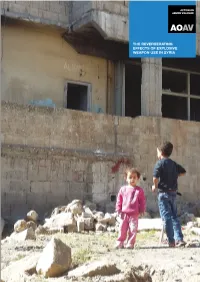
THE REVERBERATING EFFECTS OF EXPLOSIVE WEAPON USE IN SYRIA CONTENTS Introduction 4 1.1 Timeline 6 1.2 Worst locations 8 1.3 Weapon types 11 1.4 Actors 12 Health 14 Economy 19 Environment 24 Society and Culture 30 Conclusion 36 Recommendations 37 Report by Jennifer Dathan Notes 38 Additional research by Silvia Ffiore, Leo San Laureano, Juliana Suess and George Yaolong Editor Iain Overton Copyright © Action on Armed Violence (January 2019) Cover illustration Syrian children play outside their home in Gaziantep, Turkey by Jennifer Dathan Design and printing Tutaev Design Clarifications or corrections from interested parties are welcome Research and publication funded by the Government of Norway, Ministry of Foreign Affairs 4 | ACTION ON ARMED VIOLENCE REVERBERATING EFFECTS OF EXPLOSIVE WEAPONS IN SYRIA | 5 INTRODUCTION The use of explosive weapons, particularly in populated noticed the following year that, whilst total civilian families from both returning to their homes and using areas, causes wide-spread and long-term harm to casualties (deaths and injuries) were just below that their land. Such impact has devastating and lingering civilians. Action on Armed Violence (AOAV) has been of the previous year, civilian deaths had increased by consequences for communities and cultures. monitoring casualties from the use of explosive 50% (from 5,639 in 2016 to 8,463 in 2017). As the war weapons around the globe since 2010. So extreme continued, injuries were increasingly less likely to be In this report, AOAV seeks to better understand the has such harm been in Syria in recent years that, recorded - particularly in incidents where there were reverberating harms from the explosive violence in by the end of 2017, Syria had overtaken Iraq as the high levels of civilian deaths. -

Political Repression in Sudan
Sudan Page 1 of 243 BEHIND THE RED LINE Political Repression in Sudan Human Rights Watch/Africa Human Rights Watch Copyright © May 1996 by Human Rights Watch. All rights reserved. Printed in the United States of America. Library of Congress Catalog Card Number: 96-75962 ISBN 1-56432-164-9 ACKNOWLEDGMENTS This report was researched and written by Human Rights Watch Counsel Jemera Rone. Human Rights Watch Leonard H. Sandler Fellow Brian Owsley also conducted research with Ms. Rone during a mission to Khartoum, Sudan, from May 1-June 13, 1995, at the invitation of the Sudanese government. Interviews in Khartoum with nongovernment people and agencies were conducted in private, as agreed with the government before the mission began. Private individuals and groups requested anonymity because of fear of government reprisals. Interviews in Juba, the largest town in the south, were not private and were controlled by Sudan Security, which terminated the visit prematurely. Other interviews were conducted in the United States, Cairo, London and elsewhere after the end of the mission. Ms. Rone conducted further research in Kenya and southern Sudan from March 5-20, 1995. The report was edited by Deputy Program Director Michael McClintock and Human Rights Watch/Africa Executive Director Peter Takirambudde. Acting Counsel Dinah PoKempner reviewed sections of the manuscript and Associate Kerry McArthur provided production assistance. This report could not have been written without the assistance of many Sudanese whose names cannot be disclosed. CONTENTS -

1 Chairperson, Committee on Economic, Social And
Chairperson, Committee on Economic, Social and Cultural Rights Office of the High Commissioner for Human Rights UNOG-OHCHR CH 1211 Geneva 10 Switzerland 1 October 2014 Dear Mr. Kedzia, 56th Session of the Committee on Economic, Social and Cultural Rights – Pre-Sessional Working Group on Sudan We are writing with a view to the pre-sessional meeting of the working group on Sudan during the 54th Session from 1-5 December 2014. Please find below a brief update of developments pertaining to the main concerns of REDRESS and the African Centre for Justice and Peace Studies (ACJPS) in relation to the state party’s implementation of the International Covenant on Economic, Social and Cultural Rights (ICESCR). 1 I. Renewed conflict, ongoing human rights violations and impunity The situation in Sudan since 2000, when the Committee on Economic, Social and Cultural Rights last considered a report by the State party,1 has been marked by considerable developments and changes, including the adoption of the Comprehensive Peace Agreement in 2005, the Interim National Constitution in 2005 and the independence of South Sudan in 2011. Nonetheless, most of the concerns identified in the Committee’s concluding observations of 2000 have not been adequately addressed, and several new issues of concern have arisen since. The situation in Sudan continues to be characterised by ongoing human rights violations, armed conflict, impunity and a weak rule of law. Lack of democracy, marginalisation (of the periphery and of groups within Sudan, particularly women) and weak governance are among the key factors that have contributed to this systemic crisis. -

Darfur Destroyed Ethnic Cleansing by Government and Militia Forces in Western Sudan Summary
Human Rights Watch May 2004 Vol. 16, No. 6(A) DARFUR DESTROYED ETHNIC CLEANSING BY GOVERNMENT AND MILITIA FORCES IN WESTERN SUDAN SUMMARY.................................................................................................................................... 1 SUMMARY RECOMMENDATIONS.................................................................................... 3 BACKGROUND ......................................................................................................................... 5 ABUSES BY THE GOVERNMENT-JANJAWEED IN WEST DARFUR.................... 7 Mass Killings By the Government and Janjaweed............................................................... 8 Attacks and massacres in Dar Masalit ............................................................................... 8 Mass Executions of captured Fur men in Wadi Salih: 145 killed................................ 21 Other Mass Killings of Fur civilians in Wadi Salih........................................................ 23 Aerial bombardment of civilians ..........................................................................................24 Systematic Targeting of Marsali and Fur, Burnings of Marsalit Villages and Destruction of Food Stocks and Other Essential Items ..................................................26 Destruction of Mosques and Islamic Religious Articles............................................... 27 Killings and assault accompanying looting of property....................................................28 Rape and other forms -

Evolution in Military Affairs in the Battlespace of Syria and Iraq
P. MARTON DOI: 10.14267/cojourn.2017v2n2a3 COJOURN 2:2-3 (2017) Evolution in military affairs in the battlespace of Syria and Iraq Péter Marton1 Abstract This paper will consider developments in the Syrian and Iraqi battlespaces that may be conceptualised as relevant to the broader evolution in military affairs. A brief discussion of different notions of „revolution" and „evolution” (in Military Affairs) will be offered, followed by an overview of the combatant actors involved in engagements in the battlespace concerned. The analysis distinguishes at the start between two different evolutionary processes: one specific to the local theatre of war in which local combatants, heavily constrained by their circumstances and limitations, show innovation with limited resources and means, and with very high (existential) stakes. This actually existential evolutionary process is complicated by the effects of the only quasi-evolutionary process of major powers’ interactions (with each other and with local combatants). The latter process is quasi-evolutionary in the sense that it does not carry direct existential stakes for the central players involved in it. The stakes are in a sense virtual: being a function of the prospects of imagined peer-competitor military conflict. Key cases studied in the course of the discussion include (inter alia) the evolution of the Syrian Arab Air Force's use of so-called barrel bombs as well as the use of land-attack cruise missiles and other high-end weaponry by major intervening powers. Keywords: RMA, warfare, militaries, tactics, strategy, Syria, Iraq Introduction: Evolution in military affairs Evolution, in the case of more complex organisms, is the combined effect of genetic re- combination and natural selection that results in the adaptation of different species to their 1 Péter Marton is Associate Professor at Corvinus University’s Institute of International Studies, and Editor- in-Chief of COJOURN. -
Agents of Fear
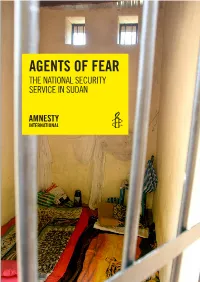
AGENTS OF FEAR THE NATIONAL SECURITY SERVICE IN SUDAN Amnesty International is a global movement of 2.8 million supporters, members and activists in more than 150 countries and territories who campaign to end grave abuses of human rights. Our vision is for every person to enjoy all the rights enshrined in the Universal Declaration of Human Rights and other international human rights standards. We are independent of any government, political ideology, economic interest or religion and are funded mainly by our membership and public donations. Amnesty International Publications First published in 2010 by Amnesty International Publications International Secretariat Peter Benenson House 1 Easton Street London WC1X 0DW United Kingdom www.amnesty.org © Amnesty International Publications 2010 Index: AFR 54/010/2010 Original language: English Printed by Amnesty International, International Secretariat, United Kingdom All rights reserved. This publication is copyright, but may be reproduced by any method without fee for advocacy, campaigning and teaching purposes, but not for resale. The copyright holders request that all such use be registered with them for impact assessment purposes. For copying in any other circumstances, or for re-use in other publications, or for translation or adaptation, prior written permission must be obtained from the publishers, and a fee may be payable. Cover photo : A cell where detainees were held by the National Intelligence and Security Service in Nyala, Sudan. This photograph was taken in 2004 during a visit of -
The Sudan Consortium the Impact of Sudanese Military Operations On
The Sudan Consortium African and International Civil Society Action for Sudan The impact of Sudanese military operations on the civilian population of Southern Kordofan1 April 2014 The Sudan Consortium works with a trusted group of local Sudanese partners who have been working on the ground in Southern Kordofan since the current conflict began in late 2011. All the attacks referred to in this report were launched against areas where there was no military presence and which were clearly identifiable as civilian in character. We believe that this information provides strong circumstantial evidence that civilians are being directly and deliberately targeted by the Sudanese armed forces in Southern Kordofan. In the last week of April, large numbers of civilians were reported to have been displaced from their homes in Delami County, South Kordofan as a result of a major new military offensive launched in Southern Kordofan by the Sudanese Armed Forces (SAF). Although exact numbers are difficult to establish, partners have cited estimates between 45,000 and 70,000. The government offensive in Southern Kordofan appears to have been concentrated on Rashad, Al Abisseya and Delami counties in the north-east of Southern Kordofan. The situation on the ground remains fluid and information from Rashad and Al Abisseya counties has been difficult to obtain. However the Sudan Consortium’s partners on the ground have been able to report firsthand on the situation in Delami County and have interviewed internally displaced persons (IDPs) fleeing from the fighting further north. From 12 April onwards, several locations in Delami County, notably Aberi, Mardis and Sarafyi, were subject to heavy bombardment on a daily basis by artillery and multiple launch rocket systems (MLRS) deployed by the Sudanese Armed Forces. -

About Syrians for Truth and Justice/STJ
About Syrians for Truth and Justice/STJ Syrians for Truth and Justice /STJ is a nonprofit, nongovernmental, independent Syrian organization. STJ includes many defenders and human rights defenders from Syria and from different backgrounds and affiliations, including academics of other nationalities. The organization works for Syria, where all Syrians, without discrimination, should be accorded dignity, justice and equal human rights. 1 Repeated Attacks with Incendiary Weapons, Cluster Munitions and Chemicals on Eastern Ghouta A Flash Report Documenting the events of 7 March 2018 in Hamoryah and those of 10 and 11 March 2018 in Irbin 2 Introduction Syrian regular forces and their allies continued their heaviest military campaign1 on Eastern Ghouta cities and towns, using various types of weapons, such as rocket launchers “Smerch type”, barrel bombs, guided missiles and incendiary weapons. As on March 7, 2018, the city of Hamoryah2 witnessed a bloody day (following adoption of Security Council Resolution No. 2401), where it was shelled with weapons loaded with incendiary substances, similar to phosphorous, and napalm-like substances. This was accompanied with targeting Hamoryah with a barrel bomb, loaded with toxic gas, dropped by a helicopter on the road between Saqba town and Hamoryah, as confirmed by the field researcher of Syrians for Truth and Justice/STJ. As well as targeting the city with a rocket loaded with cluster munitions the same day. This intensive shelling killed at least 29 civilians, two of whom were burnt to death with incendiary substances, and caused suffocation to scores of civilians as a result of using toxic gas besides the outbreak of fires in residential buildings The hysterical shelling hasn’t spared the city of Irbin3, which was targeted by chemical weapons loaded with incendiary substances similar to phosphorus and others loaded with napalm-like substances, on 10 and 11 March 2018.