English Version
Total Page:16
File Type:pdf, Size:1020Kb
Load more
Recommended publications
-
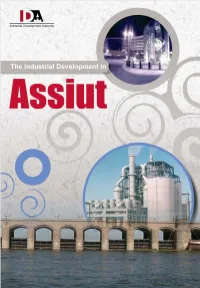
Preface -The Industrial Development in Assiut
Chapter 1 Preface ‐The Industrial Development in Assiut ‐The Industrial Map ‐The Industrial Zone Contents Subject Page No. Chapter 1 Preface- 1 The Industrial Development in Assiut - 2‐5 The Industrial Map of Assuit - The Industrial Zones in Assuit- Total Number of establishments - registered in IDA at Assuit Prospective Plan of Assuit Industrial - Zones Chapter 2 About Assiut - 6 Information about the Governorate - 7‐10 Population- 11 Education- 11‐15 Health- 16 Chapter 3 First: Agricultural Resources- 17 SdSecond: WWtater Resources- 18 Third: Fishery Wealth- 18 Forth: Mineral Wealth- 18 Fifth: Infrastructure- 19‐22 Chapter 4 Investment Advantages in Assuit- 24 Investment Opportunities in Assuit- 25 Proposed Projects in Assuit- 26 Preface TheEgyptianGovernmenthasstarteditsplantodeveloptheUpper Egypt region that includes many promising governorates in the investment field, such as Assuit governorate in which new industrial zones were established due to the natural resources the governorate has, such as (clay‐sand‐ cobblestone‐ alabaster‐ limestone ).This come within the framework of the State's aim to establish industrial zones in all governorates to achieve the industrial development in Egypt. Assuit governorate contributes to enhancing the industrial activity through many industries, the most important of which are petroleum, food and beverage industry, in addition to engineering, electronic and electric industries. Assuit governorate includes 584 existed establishments registered in IDA with investment costs of about L.E8 Billion and provide labor opportunities of 13818. There are six industrial zones in Assuit (Al Awamer Abnoub industrial zone‐ Al Zarabi industrial zone in Abu Tig‐ Al Safa industrial zone (Beni Ghaleb)‐ Sahel Selim industrial zone‐ Dairout industrial zone and Badari industrial zone. -

Newsletter Egyptian Ministry of Antiquities No. 12
Ministry of Antiquities Newsletter of the Egyptian Ministry of Antiquities * Issue 12 * May 2017 ARCHAEOLOGICAL DISCOVERIES • The Egyptian archaeological mission in Dahshur uncovered a burial chamber of a thirteenth-dynasty royal pyramid found last month by the mission. The chamber contained a canopic box, made of wood and covered with a layer of plaster. The box was inscribed with three lines of hieroglyphic text to protect the deceased, and included the name of the deceased, Hatshepsut?, who was possibly the daughter of King Imeny Qemaw. An anthropoid coffin lid, golden foils, a stone lamp and remains of human bones were also found. Excavations during the month of May were supported by AT Land Production and Lion Television. • The Faculty of Archaeology of Cairo University working in Tuna al-Gebel in Minya discovered an underground necropolis, accessible through an eight metre shaft. The shaft end has a number of corridors, with numerous burials and mummies, several of which had gilded plaster masks. Uninscribed stone coffins and pottery coffins were also found. The mission also found two papyri written in Demotic script. Elsewhere on the west side of the tomb of Petosiris and east of the Roman water wheel, a number of Roman funerary houses made of clay were discovered, including a number of chambers and stores with vaulted ceilings. The Minister of Antiquities announced the discovery during an international press conference attended by the Governor of Minya, the President of Cairo University, members of the Parliament, the deans of the Faculties of Archaeology and Science at Cairo University, a number of ambassadors of foreign countries, and MoA officials. -

Country Advice Egypt Egypt – EGY37024 – Treatment of Anglican Christians in Al Minya 2 August 2010
Country Advice Egypt Egypt – EGY37024 – Treatment of Anglican Christians in Al Minya 2 August 2010 1. Please provide detailed information on Al Minya, including its location, its history and its religious background. Please focus on the Christian population of Al Minya and provide information on what Christian denominations are in Al Minya, including the Anglican Church and the United Coptic Church; the main places of Christian worship in Al Minya; and any conflict in Al Minya between Christians and the authorities. 1 Al Minya (also known as El Minya or El Menya) is known as the „Bride of Upper Egypt‟ due to its location on at the border of Upper and Lower Egypt. It is the capital city of the Minya governorate in the Nile River valley of Upper Egypt and is located about 225km south of Cairo to which it is linked by rail. The city has a television station and a university and is a centre for the manufacture of soap, perfume and sugar processing. There is also an ancient town named Menat Khufu in the area which was the ancestral home of the pharaohs of the 4th dynasty. 2 1 „Cities in Egypt‟ (undated), travelguide2egypt.com website http://www.travelguide2egypt.com/c1_cities.php – Accessed 28 July 2010 – Attachment 1. 2 „Travel & Geography: Al-Minya‟ 2010, Encyclopædia Britannica, Encyclopædia Britannica Online, 2 August http://www.britannica.com/EBchecked/topic/384682/al-Minya – Accessed 28 July 2010 – Attachment 2; „El Minya‟ (undated), touregypt.net website http://www.touregypt.net/elminyatop.htm – Accessed 26 July 2010 – Page 1 of 18 According to several websites, the Minya governorate is one of the most highly populated governorates of Upper Egypt. -

Mints – MISR NATIONAL TRANSPORT STUDY
No. TRANSPORT PLANNING AUTHORITY MINISTRY OF TRANSPORT THE ARAB REPUBLIC OF EGYPT MiNTS – MISR NATIONAL TRANSPORT STUDY THE COMPREHENSIVE STUDY ON THE MASTER PLAN FOR NATIONWIDE TRANSPORT SYSTEM IN THE ARAB REPUBLIC OF EGYPT FINAL REPORT TECHNICAL REPORT 11 TRANSPORT SURVEY FINDINGS March 2012 JAPAN INTERNATIONAL COOPERATION AGENCY ORIENTAL CONSULTANTS CO., LTD. ALMEC CORPORATION EID KATAHIRA & ENGINEERS INTERNATIONAL JR - 12 039 No. TRANSPORT PLANNING AUTHORITY MINISTRY OF TRANSPORT THE ARAB REPUBLIC OF EGYPT MiNTS – MISR NATIONAL TRANSPORT STUDY THE COMPREHENSIVE STUDY ON THE MASTER PLAN FOR NATIONWIDE TRANSPORT SYSTEM IN THE ARAB REPUBLIC OF EGYPT FINAL REPORT TECHNICAL REPORT 11 TRANSPORT SURVEY FINDINGS March 2012 JAPAN INTERNATIONAL COOPERATION AGENCY ORIENTAL CONSULTANTS CO., LTD. ALMEC CORPORATION EID KATAHIRA & ENGINEERS INTERNATIONAL JR - 12 039 USD1.00 = EGP5.96 USD1.00 = JPY77.91 (Exchange rate of January 2012) MiNTS: Misr National Transport Study Technical Report 11 TABLE OF CONTENTS Item Page CHAPTER 1: INTRODUCTION..........................................................................................................................1-1 1.1 BACKGROUND...................................................................................................................................1-1 1.2 THE MINTS FRAMEWORK ................................................................................................................1-1 1.2.1 Study Scope and Objectives .........................................................................................................1-1 -

1 Egypt Nov 18 to Dec 7 2019 Nov 18 to 19 a Long Flight from Chicago To
Egypt Nov 18 to Dec 7 2019 Nov 18 to 19 A long flight from Chicago to Amman, then a short flight to Cairo. We were met inside security by the Egitalloyd representative who, with the driver, took us to the Ramses Hilton on the Nile. Our minibus had to pass the soccer stadium, where a big game was about to start, so the roads were jammed. The representative had been with us briefly in 2018, and seemed really happy to see us. At the hotel, we were given a refurbished room with a Nile view, which we love, and non-smoking, but with a shower instead of a tub. Nov. 20 After a short night (from jetlag) and a nice breakfast, we walked the few blocks to the old Egyptian Museum and spent several hours there. A large number of artifacts had been moved out to the new Grand Egyptian Museum, in Giza, for conservation and eventual display, and they were painting and refurbishing the old Egyptian Museum so a lot of sculpture was wrapped and covered in drop cloths. They had done a good job of introducing new areas, in particular the exhibit of artifacts from Yuya and Thuyu’s tomb (which was already set up when we were there in 2018). A special exhibition space had a good exhibit of the El-Gusus Cachette, a tomb of 153 elites, mostly priests and priestesses of Amun, discovered in 1891. We managed to spend time in the protodynastic exhibit, as well. Not surprisingly, we ran into someone we know who was not on our group tour...Tom Hardwick, the curator of Ancient Egyptian art at the Houston Museum of Natural History. -
Egyptian National Action Program to Combat Desertification
Arab Republic of Egypt UNCCD Desert Research Center Ministry of Agriculture & Land Reclamation Egyptian National Action Program To Combat Desertification June, 2005 UNCCD Egypt Office: Mail Address: 1 Mathaf El Mataria – P.O.Box: 11753 El Mataria, Cairo, Egypt Tel: (+202) 6332352 Fax: (+202) 6332352 e-mail : Egypt_unccd_focalpoint@hotmail.com Prof. Dr. Abdel Moneim Hegazi +202 0123701410 Dr. Ahmed Abdel Ati Ahmed +202 0105146438 ARAB REPUBLIC OF EGYPT Ministry of Agriculture and Land Reclamation Desert Research Center (DRC) Egyptian National Action Program To Combat Desertification Editorial Board Dr. A.M.Hegazi Dr. M.Y.Afifi Dr. M.A.EL Shorbagy Dr. A.A. Elwan Dr. S. El- Demerdashe June, 2005 Contents Subject Page Introduction ………………………………………………………………….. 1 PART I 1- Physiographic Setting …………………………………………………….. 4 1.1. Location ……………………………………………………………. 4 1.2. Climate ……...………………………………………….................... 5 1.2.1. Climatic regions…………………………………….................... 5 1.2.2. Basic climatic elements …………………………….................... 5 1.2.3. Agro-ecological zones………………………………………….. 7 1.3. Water resources ……………………………………………………... 9 1.4. Soil resources ……...……………………………………………….. 11 1.5. Flora , natural vegetation and rangeland resources…………………. 14 1.6 Wildlife ……………………………………………………………... 28 1.7. Aquatic wealth ……………………………………………………... 30 1.8. Renewable energy ………………………………………………….. 30 1.8. Human resources ……………………………………………………. 32 2.2. Agriculture ……………………………………………………………… 34 2.1. Land use pattern …………………………………………………….. 34 2.2. Agriculture production ………...……………………………………. 34 2.3. Livestock, Poultry and Fishing production …………………………. 39 2.3.1. Livestock production …………………………………………… 39 2.3.2. Poultry production ……………………………………………… 40 2.3.3. Fish production………………………………………………….. 41 PART II 3. Causes, Processes and Impact of Desertification…………………………. 43 3.1. Causes of desertification ……………………………………………….. 43 Subject Page 3.2. Desertification processes ………………………………………………… 44 3.2.1. Urbanization ……………………………………………………….. 44 3.2.2. Salinization…………………………………………………………. -

Ministry of Antiquities Ibis Bird Mallawi Museum Newsletter of the Egyptian Ministry of Antiquities * Issue 4 * September 2016
Ministry of Antiquities Ibis bird Mallawi Museum Newsletter of the Egyptian Ministry of Antiquities * Issue 4 * September 2016 Reopening of Mallawi Museum in Minya H.E. Minister of Antiquities reopened Mallawi Museum in Minya. The ceremony was attended by the governor of Minya, MoA representatives, ambassadors, cultural attaches and representatives of foreign archaeological institutions, and missions in Egypt (22 September 2016). The museum was first inaugurated on 23rd July, 1963. It is situated in a region rich in archaeological sites. Two of the most important archaeological sites in the vicinity are Tuna al-Gebel and el-Ashmunein. In August 2013, looters vandalised the museum. Of 1089 objects originally on display, 1043 were smashed, burnt or looted. Authorities have since managed to recover 656 of the missing items, which have been restored. Today, the new display houses 944 items, of which 503 are new additions brought in from an antiquities storehouse at al-Ashmunein, or were part of the collections of the old Mallawi Museum that were stored elsewhere. All the new additions are from local excavations. An additional five objects were brought in from the Coptic Museum. Ministry of Antiquities Newsletter-Issue 4 -September 2016 1 Several field projects have started their work in September: Durham University and Egypt Exploration Society joint mission, U.K., at Sais (Sa el-Hagar); MoA-University of Leipzig (Germany) at Heliopolis/Matariyyah - Field University of Milan (Italy) and IFAO at Umm-el-Breigat in Fayoum - University of Birmingham (U.K.) at Qubbet al-Hawa – University of Warsaw (Poland) at Deir al-Naqlun – Museum of Soissons (France) at San El-Hagar (Tell Debqo); Work University of Geneva (Switzerland) at the Cemetery of Pepi I in Saqqara - University of Yale (USA) and University of Bologna (Italy) joint mission in Kom Ombo, Aswan; German Archaeological Institute at Kom El-Gier in Buto; Ancient Egypt Research Associates at Memphis. -

National Feasibility Study & Roadmap for Riverbank
SUPPORTING INNOVATION IN WATER & WASTEWATER IN EGYPT NATIONAL FEASIBILITY STUDY & ROADMAP FOR RIVERBANK FILTRATION IN EGYPT CAIRO 2018 (REVISED) 2020 RBF Unit, Sohag, Egypt - ©2021 COPYRIGHT AND DISCLAIMER Copyright © United Nations Human Settlements Programme (UN-Habitat) 2020 All rights reserved United Nations Human Settlements Programme (UN-Habitat) P.O. Box 30030 00100 Nairobi GPO KENYA Tel: 254-020-7623120 (Central Office) www.ar.unhabitat.org DISCLAIMER The designations employed and the presentation of material in this publication do not imply the expression of any opinion whatsoever on the part of the secretariat of the United Nations concerning the legal status of any county, territory, city or area or its authorities, or concerning the delimitation of its frontiers or boundaries regarding its economic system or degree of development. Excerpts may be reproduced without authorization, on condition that the source is indicated. Views expressed in this publication do not necessarily reflect those of the United Nations Human Settlements Programme, the United Nations and its member states. i National Feasibility Study and roadmap for River Bank Filtration in Egypt NATIONAL FEASIBILITY STUDY AND ROADMAP FOR RIVER BANK FILTRATION IN EGYPT FEASIBILITY STUDY REPORT PARTNERS COORDINATORS The initial version of this report was produced under Hyat Inclusive and Sustainable Local Economic Development Project in partnership with the Egyptian Ministry for Local Development, the Egyptian Ministry for Housing, Utilities and Urban Communities, the Egyptian Holding Company for Water and Wastewater and the United Nations Human Settlement’s Programme (UN Habitat). Funded by the United Nations Trust Fund for Human Security and UN Habitat. CONTACT DETAILS Holding Company for Water and Wastewater (HCWW) Prof. -

Crushing Humanity the Abuse of Solitary Confinement in Egypt’S Prisons
CRUSHING HUMANITY THE ABUSE OF SOLITARY CONFINEMENT IN EGYPT’S PRISONS Amnesty International is a global movement of more than 7 million people who campaign for a world where human rights are enjoyed by all. Our vision is for every person to enjoy all the rights enshrined in the Universal Declaration of Human Rights and other international human rights standards. We are independent of any government, political ideology, economic interest or religion and are funded mainly by our membership and public donations. © Amnesty International 2018 Except where otherwise noted, content in this document is licensed under a Creative Commons Cover photo: (attribution, non-commercial, no derivatives, international 4.0) licence. © Designed by Kjpargeter / Freepik https://creativecommons.org/licenses/by-nc-nd/4.0/legalcode For more information please visit the permissions page on our website: www.amnesty.org Where material is attributed to a copyright owner other than Amnesty International this material is not subject to the Creative Commons licence. First published in 2018 by Amnesty International Ltd Peter Benenson House, 1 Easton Street London WC1X 0DW, UK Index: MDE 12/8257/2018 Original language: English amnesty.org CONTENTS EXECUTIVE SUMMARY 6 METHODOLOGY 10 BACKGROUND 12 ILLEGITIMATE USE OF SOLITARY CONFINEMENT 14 OVERLY BROAD SCOPE 14 ARBITRARY USE 15 DETAINEES WITH A POLITICAL PROFILE 15 PRISONERS ON DEATH ROW 20 ACTS NOT CONSTITUTING DISCIPLINARY OFFENCES 22 LACK OF DUE PROCESS 24 LACK OF INDEPENDENT REVIEW 24 LACK OF AUTHORIZATION BY A COMPETENT -

Food Safety Inspection in Egypt Institutional, Operational, and Strategy Report
FOOD SAFETY INSPECTION IN EGYPT INSTITUTIONAL, OPERATIONAL, AND STRATEGY REPORT April 28, 2008 This publication was produced for review by the United States Agency for International Development. It was prepared by Cameron Smoak and Rachid Benjelloun in collaboration with the Inspection Working Group. FOOD SAFETY INSPECTION IN EGYPT INSTITUTIONAL, OPERATIONAL, AND STRATEGY REPORT TECHNICAL ASSISTANCE FOR POLICY REFORM II CONTRACT NUMBER: 263-C-00-05-00063-00 BEARINGPOINT, INC. USAID/EGYPT POLICY AND PRIVATE SECTOR OFFICE APRIL 28, 2008 AUTHORS: CAMERON SMOAK RACHID BENJELLOUN INSPECTION WORKING GROUP ABDEL AZIM ABDEL-RAZEK IBRAHIM ROUSHDY RAGHEB HOZAIN HASSAN SHAFIK KAMEL DARWISH AFKAR HUSSAIN DISCLAIMER: The author’s views expressed in this publication do not necessarily reflect the views of the United States Agency for International Development or the United States Government. CONTENTS EXECUTIVE SUMMARY...................................................................................... 1 INSTITUTIONAL FRAMEWORK ......................................................................... 3 Vision 3 Mission ................................................................................................................... 3 Objectives .............................................................................................................. 3 Legal framework..................................................................................................... 3 Functions............................................................................................................... -

She-Feeds-The-World-Sftw-Egypt-Baseline-1.Pdf
Table of Contents Acronyms 5 List of Tables 6 List of Figures 7 Executive Summary 8 Introduction 14 Women and Agriculture in Egypt 14 She Feeds the World 15 Purpose of the Study 15 Methodology and Study Design 16 Data Collection 16 Quantitative tool 17 Structured Interviews with Potential Beneficiaries 17 Sample 17 Enumerators 18 Data Management 18 Data Analysis 19 Limitations 19 Findings and Discussions 19 Household and Respondents Characteristics 19 SFtW Outcome Area: Women Empowerment and Gender Roles and Attitudes 22 Women Roles and Responsibilities 22 Gender Equitable Attitude 23 Women Status and Community Engagement 28 SFtW Outcome Area: Improving Nutrition in Communities and Households 29 Household Dietary Diversity 29 Production for Household Consumption 34 Women Nutrition during Pregnancy 36 Women Nutrition during Breastfeeding 37 Breastfeeding 39 Complementary Feeding 39 Dietary Diversity 41 SFtW Outcome Area: Improving Access to Healthcare Services for Households 46 She Feeds the World Egypt Baseline Report 2020 2 Women Health at Reproductive Age 47 Women’s Work Load 48 Decision Making in Women Health 48 Child Health 49 Decision Making in Child Health 50 SFtW Outcome Area: Improving Access to Markets 51 Marketing Practices 51 SFtW Outcome Area: Improving Access to Finance 53 Household Income Generation 53 Household Savings 55 Household Expenditures 57 Loans 61 Decision Making on Finance and Access to Credit 68 SFtW Outcome Areas: Improving Productivity and Technical Resources 69 Agricultural or Livestock 69 Productivity 71 -

World Bank Document
PROCUREMENT PLAN (Textual Part) Project information: Egypt Transforming Egypt's Healthcare System Project P167000 Project Implementation agency: Ministry of Health and Population Public Disclosure Authorized Date of the Procurement Plan: October 23, 2018 Period covered by this Procurement Plan: 18 months Preamble In accordance with paragraph 5.9 of the “World Bank Procurement Regulations for IPF Borrowers” (July 2016) (“Procurement Regulations”) the Bank’s Systematic Tracking and Exchanges in Procurement (STEP) system will be used to prepare, clear and update Procurement Plans and conduct all procurement transactions for the Project. Public Disclosure Authorized This textual part along with the Procurement Plan tables in STEP constitute the Procurement Plan for the Project. The following conditions apply to all procurement activities in the Procurement Plan. The other elements of the Procurement Plan as required under paragraph 4.4 of the Procurement Regulations are set forth in STEP. The Bank’s Standard Procurement Documents: shall be used for all contracts subject to international competitive procurement and those contracts as specified in the Procurement Plan tables in STEP. Public Disclosure Authorized National Procurement Arrangements: In accordance with paragraph 5.3 of the Procurement Regulations, when approaching the national market (as specified in the Procurement Plan tables in STEP), the country’s own procurement procedures may be used. Leased Assets: “Not Applicable” Procurement of Second Hand Goods: “Not Applicable” Domestic