!01Novi Zvuk 43 FINAL 3 Nov.Indd
Total Page:16
File Type:pdf, Size:1020Kb
Load more
Recommended publications
-
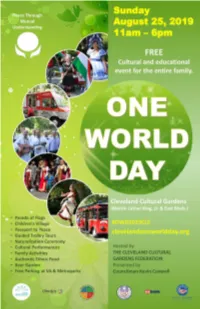
Program Booklet
The Irish Garden Club Ladies Ancient Order of Hibernians Murphy Irish Arts Association Proud Sponsors of the Irish Cultural Garden Celebrate One World Day 2019 Italian Cultural Garden CUYAHOGA COMMUNITY COLLEGE (TRI-C®) SALUTES CLEVELAND CULTURAL GARDENS FEDERATION’S ONE WORLD DAY 2019 PEACE THROUGH MUTUAL UNDERSTANDING THANK YOU for 74 years celebrating Cleveland’s history and ethnic diversity The Italian Cultural Garden was dedicated in 1930 “as tri-c.edu a symbol of Italian culture to American democracy.” 216-987-6000 Love of Beauty is Taste - The Creation of Beauty is Art 19-0830 216-916-7780 • 990 East Blvd. Cleveland, OH 44108 The Ukrainian Cultural Garden with the support of Cleveland Selfreliance Federal Credit Union celebrates 28 years of Ukrainian independence and One World Day 2019 CZECH CULTURAL GARDEN 880 East Blvd. - south of St. Clair The Czech Garden is now sponsored by The Garden features many statues including composers Dvorak and Smetana, bishop and Sokol Greater educator Komensky – known as the “father of Cleveland modern education”, and statue of T.G. Masaryk founder and first president of Czechoslovakia. The More information at statues were made by Frank Jirouch, a Cleveland czechculturalgarden born sculptor of Czech descent. Many thanks to the Victor Ptak family for financial support! .webs.com DANK—Cleveland & The German Garden Cultural Foundation of Cleveland Welcome all of the One World Day visitors to the German Garden of the Cleveland Cultural Gardens The German American National congress, also known as DANK (Deutsch Amerikan- ischer National Kongress), is the largest organization of Americans of Germanic descent. -

At the Margins of the Habsburg Civilizing Mission 25
i CEU Press Studies in the History of Medicine Volume XIII Series Editor:5 Marius Turda Published in the series: Svetla Baloutzova Demography and Nation Social Legislation and Population Policy in Bulgaria, 1918–1944 C Christian Promitzer · Sevasti Trubeta · Marius Turda, eds. Health, Hygiene and Eugenics in Southeastern Europe to 1945 C Francesco Cassata Building the New Man Eugenics, Racial Science and Genetics in Twentieth-Century Italy C Rachel E. Boaz In Search of “Aryan Blood” Serology in Interwar and National Socialist Germany C Richard Cleminson Catholicism, Race and Empire Eugenics in Portugal, 1900–1950 C Maria Zarimis Darwin’s Footprint Cultural Perspectives on Evolution in Greece (1880–1930s) C Tudor Georgescu The Eugenic Fortress The Transylvanian Saxon Experiment in Interwar Romania C Katherina Gardikas Landscapes of Disease Malaria in Modern Greece C Heike Karge · Friederike Kind-Kovács · Sara Bernasconi From the Midwife’s Bag to the Patient’s File Public Health in Eastern Europe C Gregory Sullivan Regenerating Japan Organicism, Modernism and National Destiny in Oka Asajirō’s Evolution and Human Life C Constantin Bărbulescu Physicians, Peasants, and Modern Medicine Imagining Rurality in Romania, 1860–1910 C Vassiliki Theodorou · Despina Karakatsani Strengthening Young Bodies, Building the Nation A Social History of Child Health and Welfare in Greece (1890–1940) C Making Muslim Women European Voluntary Associations, Gender and Islam in Post-Ottoman Bosnia and Yugoslavia (1878–1941) Fabio Giomi Central European University Press Budapest—New York iii © 2021 Fabio Giomi Published in 2021 by Central European University Press Nádor utca 9, H-1051 Budapest, Hungary Tel: +36-1-327-3138 or 327-3000 E-mail: ceupress@press.ceu.edu Website: www.ceupress.com An electronic version of this book is freely available, thanks to the support of libraries working with Knowledge Unlatched (KU). -

1 Lenki I Relji, Mojim Unucima
Lenki i Relji, mojim unucima 1 2 Feliks Pašić MUCI Ljubomir Draškić ili živeti u pozorištu 3 4 Ulaz u vilu »Nada« u Omišlju na ostrvu Krku 5 6 Mladom Svetozaru Cvetkoviću, tek pristiglom u Atelje 212, činio se kao ka- kav veliki lutan, očiju dubokih i crnih, sa podočnjacima koji su s godinama posta- jali sve tamniji i dublji. Mira Stupica pamti jedno štrkljasto i visoko dete, krakato, okato, nosato i pomalo dremljivo, koje je kapke imalo uvek napola spuštene, kao roletne. I u sećanju Aleksandra–Luja Todorovića javlja se u istoj slici: visok, štrkljast, šiljat, neopisivo mršav. Vojislavu Kostiću je, tako visok i mršav, sa šišanom bradom, ličio na Don Kihota. Ivana Dimić je imala dvanaest godina kad ga je prvi put videla, na slavi na koju je došla s roditeljima. Među gostima se izdvajao visok, mršav, duhovit čovek koji je psovao. Ogroman, tamnog lica i brade, izgledao joj je kao neki Azijat. Aleksandar–Saša Gruden seća ga se kao klinca koji je s majkom došao kod očeve rodbine u Užice. Prilog opštem utisku: štkljast, nosat, s ogromnim kolenima. Kad su ga upitali kako je, odgovorio je: »Zaštopal mi se nosek.« Posle je objašnjavao da je imao jezički problem: »Govorio sam hrvatski.« Dolasku u Užice 1941. godine prethodi prva velika životna avantura. Od ranih dana naučio je da svet i ljude vidi u slikama. U slikama Zadra, u koji se porodica 1939. seli iz Zagreba, kada je otac Sreten postavljen za vicekonzula Kraljevskog konzulata, prelamaju se, između ostalih, prizori ogromnog stana u kome, po jednom dugačkom hodniku, vozi bicikl. -

Biljana Milanović ▪︎ Opera Productions of the Belgrade
UR. JERNEJ WEISS VLOGA NACIONALNIH OPERNIH GLEDALIŠČ V 20. IN 21. STOLETJU THE ROLE OF NATIONAL OPERA HOUSES IN THE 20TH AND 21ST CENTURIES 3 studia musicologica labacensia issn 2536-2445 studia musicologica labacensia Izid monografije so podprli vloga nacionalnih opernih gledališč v 20. in 21. stoletju the role of national opera houses in the 20th and 21st centuries ur. Jernej Weiss 2019 Znanstvena monografija z mednarodno udeležbo Vloga nacionalnih opernih gledališč v 20. in 21. stoletju – The Role of National Opera Houses in the 20th and 21st Centuries Uredil Jernej Weiss Studia musicologica Labacensia, 3 (ISSN 2536-2445) Glavni urednik ■ Jernej Weiss (Ljubljana/Maribor) Odgovorni urednik ■ Jonatan Vinkler (Koper) Tehnična urednica ■ Tjaša Ribizel (Ljubljana) Uredniški odbor ■ Matjaž Barbo (Ljubljana), Primož Kuret (Ljubljana), Helmut Loos (Leipzig), Lubomír Spurný (Brno), John Tyrrell († Cardiff), Michael Walter (Graz), Jernej Weiss (Ljubljana/Maribor) Recenzenti ■ Lubomír Spurný, Ivan Florjanc, Igor Grdina Oblikovanje in prelom ■ Jonatan Vinkler Prevod ■ Amidas d. o. o. Jezikovni pregled (slovensko besedilo) ■ Jernej Weiss Izdali in založili Založba Univerze na Primorskem (zanjo: prof. dr. Dragan Marušič, rektor) Titov trg 4, SI-6000 Koper Glavni urednik ■ Jonatan Vinkler Vodja založbe ■ Alen Ježovnik Festival Ljubljana (zanj: Darko Brlek, direktor) Trg francoske revolucije 1, SI-1000 Ljubljana Koper, Ljubljana 2019 ISBN 978-961-7055-50-4 (spletna izdaja: pdf) http://www.hippocampus.si/ISBN/978-961-7055-50-4.pdf ISBN 978-961-7055-51-1 -
From the Tito-Stalin Split to Yugoslavia's Finnish Connection: Neutralism Before Non-Alignment, 1948-1958
ABSTRACT Title of Document: FROM THE TITO-STALIN SPLIT TO YUGOSLAVIA'S FINNISH CONNECTION: NEUTRALISM BEFORE NON-ALIGNMENT, 1948-1958. Rinna Elina Kullaa, Doctor of Philosophy 2008 Directed By: Professor John R. Lampe Department of History After the Second World War the European continent stood divided between two clearly defined and competing systems of government, economic and social progress. Historians have repeatedly analyzed the formation of the Soviet bloc in the east, the subsequent superpower confrontation, and the resulting rise of Euro-Atlantic interconnection in the west. This dissertation provides a new view of how two borderlands steered clear of absorption into the Soviet bloc. It addresses the foreign relations of Yugoslavia and Finland with the Soviet Union and with each other between 1948 and 1958. Narrated here are their separate yet comparable and, to some extent, coordinated contests with the Soviet Union. Ending the presumed partnership with the Soviet Union, the Tito-Stalin split of 1948 launched Yugoslavia on a search for an alternative foreign policy, one that previously began before the split and helped to provoke it. After the split that search turned to avoiding violent conflict with the Soviet Union while creating alternative international partnerships to help the Communist state to survive in difficult postwar conditions. Finnish-Soviet relations between 1944 and 1948 showed the Yugoslav Foreign Ministry that in order to avoid invasion, it would have to demonstrate a commitment to minimizing security risks to the Soviet Union along its European political border and to not interfering in the Soviet domination of domestic politics elsewhere in Eastern Europe. -
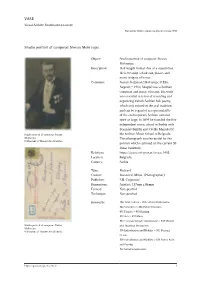
VASE Studio Portrait of Composer Stevan Mokranjac
VASE Visual Archive Southeastern Europe Permalink: https://gams.uni-graz.at/o:vase.1492 Studio portrait of composer Stevan Mokranjac Object: Studio portrait of composer Stevan Mokranjac Description: Half-length frontal shot of a seated man. He is wearing a dark suit, glasses and many insignia of honor. Comment: Stevan Stojanović Mokranjac (1856, Negotin – 1914, Skopje) was a Serbian composer and music educator. His work was essential in terms of recording and organizing Valach Serbian folk poetry, which only existed in the oral tradition and can be regarded as representative of the contemporary Serbian national spirit at large. In 1899 he founded the first independent music school in Serbia with Stanislav Binički and Cvetko Manojlović: Studio portrait of composer Stevan the Serbian Music School in Belgrade. Mokranjac This photograph was the model for the © Museum of Theater Art of Serbia portrait which is printed on the current 50 Dinar banknote. Relations: https://gams.uni-graz.at/o:vase.1495 Location: Belgrade Country: Serbia Type: Postcard Creator: Jovanović, Milan, (Photographer) Publisher: S.B. Cvijanović Dimensions: Artefact: 137mm x 86mm Format: Not specified Technique: Not specified Keywords: 180 Total Culture > 184 Cultural Participation 340 Structures > 344 Public Structures 450 Finance > 453 Banking 530 Arts > 533 Music 540 Commercialized Entertainment > 545 Musical Studio portrait of composer Stevan and Theatrical Productions Mokranjac 550 Individuation and Mobility > 551 Personal © Museum of Theater Art of Serbia Names 550 Individuation and Mobility > 554 Status, Role, and Prestige 560 Social Stratification https://gams.uni-graz.at/vase 1 VASE Visual Archive Southeastern Europe Permalink: https://gams.uni-graz.at/o:vase.1492 Copyright: Muzej Pozorišne Umetnosti Srbije Archive: Museum of Theater Art of Serbia, Inv. -

Memorinmotion
english memorInmotion pedagogical tool on culture of remembrance manual dvd second supplemented edition MemorInmotion Pedagogical Tool on Culture of Remembrance Second supplemented edition Manual DVD Sarajevo, 2016 Publication Title: Consultants: MemorInmotion - Pedagogical Tool on Culture of Suad Alić Remembrance Andrea Baotić Second supplemented edition Judith Brand Elma Hašimbegović Authors: Adis Hukanović Laura Boerhout Alma Mašić Ana Čigon Nerkez Opačin Bojana Dujković-Blagojević Christian Pfeifer Melisa Forić Soraja Zagić Senada Jusić Muhamed Kafedžić Muha Editor-in-chief: Larisa Kasumagić-Kafedžić Michele Parente Vjollca Krasniqi Nita Luci Project Coordinators: Nicolas Moll Michele Parente, forumZFD Michele Parente Melisa Forić, EUROCLIO HIP BiH Wouter Reitsema Laura Boerhout, Anne Frank House (Netherlands) Students of the PI Gymnasium Obala, Sarajevo CIP - Katalogizacija u publikaciji Nacionalna i univerzitetska biblioteka Bosne i Hercegovine, Sarajevo 791.5:725.94(497) MEMORLNMOTION : pedagogical tool on culture of remembrance : manual / [authors Melisa Forić ... [et al.] ; translators Lejla Efendić, Gordana Lonco]. - 2nd supplemented ed. - Sarajevo : Forum Ziviler Friedensdienste e.V. (forumZFD), 2016. - 101 str. : ilustr. ; 20 x 20 cm + [1] DVD Prijevod djela: Sjećanje u pokretu. - The authors: str. 93-96. - Bibliografija: str. 97-100 ISBN 978-9958-0399-6-6 1. Forić, Melisa COBISS.BH-ID 23297286 contents I. Manual 1.0. Introduction 1.1. Memorlnmotion - Pedagogical Tool on Culture of Remembrance 7 2.0. Essay: how to create an active culture of remembrance in our societies? 2.1. Challenging young people to reflect on monuments and their meaning 11 3.0. The pedagogical modules with lesson plans 3.1. Module I: Start-up 3.1.1. Lesson Plan 1: Who am I? 17 3.2. -

Iz Istorije Kulture I Arhitekture
Vladimir Mitrović Iz istorije kulture i arhitekture Zapisi jednog istraživača (1994−2014) Vladimir Mitrović • Iz istorije kulture i arhitekture MUZEJ SAVREMENE UMETNOSTI VOJVODINE Vladimir mitroViĆ IZ ISTORIJE KULTURE I ARHITEKTURE Zapisi jednog istražiVača (1994−2014) Aleksandar Kelemen Sadržaj: Uvodne napomene Iz istorije arhitekture XX veka Konkurs za gradnju pozorišta u Novom Sadu iz 1928/29. godine………………………….....…13 Primeri industrijske arhitekture novosadskih modernista………………………………........……21 Građevinarstvo i ekonomija između dva svetska rata……………………………………........……23 Arhitekta Juraj Najdhart i Novi Sad…………………………………………………………….........……….27 Prilog istoriji arhitekture socijalističkog šopinga: Samoposluga, robna kuća, buvljak, megamarket.….........................................................29 Staklo u novoj arhitekturi Bulevara oslobođenja u Novom Sadu: Zid i antizid………………….33 Novosadska arhitektura devedesetih godina: Kroz granje nebo……………………………………37 Efekat kanjona: O stambenoj izgradnji u Novom Sadu prvih godina nakon 2000……….45 Arhitektura u Vojvodini na početku XXI veka: Zaobilazne strategije………………………………47 Nova arhitektura porodičnih vila u Srbiji………………………………………………………….........….58 Kuća kao živa skulptura………………………………………………………………………...................………62 Arhitekta je (i) umetnik……………………………………………………………………..................………….65 Soliteri Srbije Prilozi za istoriju srpskih solitera (I): Život i smrt srpskih solitera - Potkivanje žabe….....73 Prilozi za istoriju srpskih solitera (II): Soliteri u ravnici…………………………………………….....78 -

Womens Side of War.Pdf
Publisher Women in Black - Belgrade, December 2008 Original title Ženska strana rata, Women in Black - Belgrade, 2007 Edited by Lina Vušković and Zorica Trifunović In association with Tamara Belenzada, Helena Rill, Staša Zajović, Lino Veljak, Indira Topčagić, Sanja Cesar and Luljeta Vuniqi Translation Mirka Janković, Stanislava Lazarević, Dubravka Radanov, et al. Proof reading and editing Jennifer Michelle Williams, Janet Fiona Rabin, Tamara Belenzada Layout Marija Vidić Artistic design Bojana Ban Printing Artprint Circulation 1,000 The publication of this book was made possible by Kvinna til Kvinna, Sweden and Quaker Peace & Social Witness, London The translation and printing of the English edition was made possible by The Balkan Trust for Democracy Acknowledgements First and foremost, our thanks go to all those women, both the undersigned and those who have remained anonymous, who related and wrote accounts of their experiences during the wars in the area of the for- mer Yugoslavia and whose testimonies have been included in this compila- tion. We also thank the women who recorded these testimonies and made possible their publication. We thank the authors with whose consent we have published parts of their works free of charge: Alenka Mirković (91,6 MHZ – Voice Against Cannons), Svetlana Djordjević (Testimony on Kosovo), Miroslava Malešević (Didara – Life Story of a Woman from Prizren), Jusuf Kadrić (Brčko: Genocide and Testimonies), Radmila Sesar (radio drama: Mother Meira – In Search of the Truth) and Brendan MacQuillan (Voices of -
Introduction
Introduction Speaking in Ljubljana in 1913, the Slovene poet Ivan Cankar called for a political union of the South Slavs, lamenting the historical circumstances that had brought about the cultural estrangement of the “Yugoslav tribe”: “By blood we are brothers, by language cousins, by culture -- which is the fruit of centuries of separate upbringing -- we are less familiar with one another than the Upper Carniolan peasant is with the Tyrolean, or the Gorizian vintner with the Friulian” (Cankar 2009). The postulate of cultural separation, or “separate upbringing” as Cankar eloquently expressed it, is built on the premise that ethnic and national features are forged over the longue durée, through centuries of constant and unwavering exposure to one cultural model or civilization. The national predispositions and inclinations thus acquired are believed to supersede evident commonalities such as language and local custom -- as in the case of the Serbs and Croats, who are bound by language but separated by confessional and perceived historical allegiances. This premise is central to the narratives of the Balkan nationalisms. Thus, according to Croatian nationalists and historians such as Ivo Banac, Franjo Tuđman, and Branimir Anzulović, the Orthodox Serbs, whose medieval principalities bordered the Byzantine Empire until their destruction by the Ottomans in the fifteenth century, had over the centuries developed different habits and worldviews from the Catholic Croats. Their cultural origins, these authors claimed, lie in the Byzantine civilization (Banac 1984: 65 et passim; Tuđman, cit. in Bellamy 2003: 68; Anzulović 1999: 17 et passim). Many nationalists in Serbia would agree with the assessment that the Byzantine civilization left a deep imprint on the formation of their culture and identity (Perica 2002: 6-9). -
Searchable PDF Format
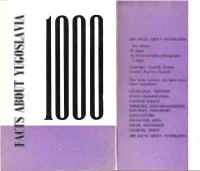
- !-l t(xt0 trA(i'l's Atr()U'I' YUGOSLAVIA (t) 4tlr eclitiorr a-\ l2tl pagcs rl -30 lrltck.unrl-wlriIc photographs - 3 rrraps - Lurrgrr:tgt's: tinglish, French, -) (icrrnitn, I\rssian, Spanish 'l'lris b<xrk c:ontuins the basic facts E- llrorrt Yrrgttslavia GT]o(;I{APIIY, I{ISTORY, r-\ w-) S ATF, OR.GANIZATION, AA IIOREIGN POLICY, WORKTJRS' SELF-MANAGEMENT, -t INDT]STRY, TRANSPORT, ACRICULTURE, a EDUCATION, ARTS, E- SOCIAL INSURANCE, (J TOURISM, SPORT IOOO FACTS ABOUT YUGOST.AVIA r= O waRszAwA .^*-h-;; c_-?6 =i PUBLISHER IZDAVACKI ZAVOD "IUGOSLAVI.I A. Beograd, Nemamjiaa 34 FACTS ABOUT YI]GOSIAYIA COUNTRY AND POPULATION GEOGRAPHIC AREA POSITION The Social srt Federral Rerpub,lic of y,urgoslavia lies, u,ith its greater part (g0 percent) in the Balkan peninsula, Southeast Europe, and, with a smaller part (20 percent) in Central Europe. Since its southwestern ,regions occupy a long length of the Adriati,c coastal be1t, it is b,oth a continental and a maritime country. The country,s extreme points extend from 40o 57' to 460 53, N. lat. and from 13" 23' to 23o 02' E. l"ong. It is consequently pole, closer to the Equator than to the North and and Italy. it has the Central European Standard time. POPULATION AND BOUNDARIES ITS NATIONAL STRUCTURE Yugoslavia is bounded by several states and the sea. On the land side, it borders on seven states: Austria and Hungary on the north, Rumania on the northeast, Bulgaria on the east, Greece on the south, Albania on the southwest and Italy on the northwest. -

1945 – PRELOM S PRETEKLOSTJO Zgodovina Srednjeevropskih Držav Ob Koncu Druge Svetovne Vojne
1945 – A BREAK WITH THE PAST A History of Central European Countries at the End of World War Two 1945 – PRELOM S PRETEKLOSTJO Zgodovina srednjeevropskih držav ob koncu druge svetovne vojne Edited by ZDENKO ČEPIČ Book Editor Zdenko Čepič Editorial board Zdenko Čepič, Slavomir Michalek, Christian Promitzer, Zdenko Radelić, Jerca Vodušek Starič Published by Inštitut za novejšo zgodovino/ Institute for Contemporary History, Ljubljana, Republika Slovenija/Republic of Slovenia Represented by Jerca Vodušek Starič Layout and typesetting Franc Čuden, Medit d.o.o. Printed by Grafika-M s.p. Print run 400 CIP – Kataložni zapis o publikaciji Narodna in univerzitetna knjižnica, Ljubljana 94(4-191.2)"1945"(082) NINETEEN hundred and forty-five 1945 - a break with the past : a history of central European countries at the end of World War II = 1945 - prelom s preteklostjo: zgodovina srednjeevropskih držav ob koncu druge svetovne vojne / edited by Zdenko Čepič. - Ljubljana : Inštitut za novejšo zgodovino = Institute for Contemporary History, 2008 ISBN 978-961-6386-14-2 1. Vzp. stv. nasl. 2. Čepič, Zdenko 239512832 1945 – A Break with the Past / 1945 – Prelom s preteklostjo CONTENTS Zdenko Čepič, The War is Over. What Now? A Reflection on the End of World War Two ..................................................... 5 Dušan Nećak, From Monopolar to Bipolar World. Key Issues of the Classic Cold War ................................................................. 23 Slavomír Michálek, Czechoslovak Foreign Policy after World War Two. New Winds or Mere Dreams?