The Pr Contact
Total Page:16
File Type:pdf, Size:1020Kb
Load more
Recommended publications
-
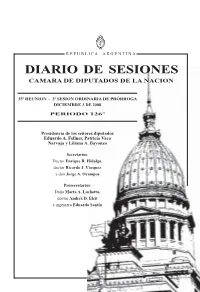
D I a R I O D E S E S I O N
R E P U B L I C A A R G E N T I N A D I A R I O D E S E S I O N E S CAMARA DE DIPUTADOS DE LA NACION 35ª REUNION – 2ª SESION ORDINARIA DE PRÓRROGA DICIEMBRE 3 DE 2008 PERIODO 126º Presidencia de los señores diputados Eduardo A. Fellner, Patricia Vaca Narvaja y Liliana A. Bayonzo Secretarios: Doctor Enrique R. Hidalgo, doctor Ricardo J. Vázquez y don Jorge A. Ocampos Prosecretarios: Doña Marta A. Luchetta, doctor Andrés D. Eleit e ingeniero Eduardo Santín 2 CAMARA DE DIPUTADOS DE LA NACION Reunión 35ª DIPUTADOS PRESENTES: DELICH, Francisco José LUSQUIÑOS, Luis Bernardo ACOSTA, María Julia DEPETRI, Edgardo Fernando MACALUSE, Eduardo Gabriel ACUÑA, Hugo Rodolfo DI TULLIO, Juliana MARCONATO, Gustavo Ángel AGUAD, Oscar Raúl DÍAZ BANCALARI, José María MARINO, Adriana del Carmen AGUIRRE de SORIA, Hilda Clelia DÍAZ ROIG, Juan Carlos MARTIARENA, Mario Humberto ALBARRACÍN, Jorge Luis DIEZ, María Inés MARTÍN, María Elena ALBRISI, César Alfredo DONDA PÉREZ, Victoria Analía MARTÍNEZ GARBINO, Emilio Raúl ALCUAZ, Horacio Alberto DOVENA, Miguel Dante MARTÍNEZ ODDONE, Heriberto Agustín ALFARO, Germán Enrique ERRO, Norberto Pedro M ASSEI, Oscar Ermelindo ÁLVAREZ, Juan José FABRIS, Luciano Rafael MERCHÁN, Paula Cecilia ALVARO, Héctor Jorge FADEL, Patricia Susana MERLO, Mario Raúl AMENTA, Marcelo Eduardo FEIN, Mónica Haydé MONTERO, Laura Gisela ARBO, José Ameghino FELLNER, Eduardo Alfredo MORÁN, Juan Carlos ARDID, Mario Rolando FERNÁNDEZ BASUALDO, Luis María MORANDINI, Norma Elena ARETA, María Josefa FERNÁNDEZ, Marcelo Omar MORANTE, Antonio Orlando María -

THE PHILOSOPHY of STEVEN SODERBERGH the Philosophy of Popular Culture
THE PHILOSOPHY OF STEVEN SODERBERGH The Philosophy of Popular Culture Th e books published in the Philosophy of Popular Culture series will illuminate and explore philosophical themes and ideas that occur in popular culture. Th e goal of this series is to demonstrate how philosophical inquiry has been reinvigorated by increased scholarly interest in the intersection of popular culture and philosophy, as well as to explore through philosophical analysis beloved modes of entertainment, such as movies, TV shows, and music. Philosophical concepts will be made accessible to the general reader through examples in popular culture. Th is series seeks to publish both established and emerging scholars who will engage a major area of popular culture for philosophical interpretation and examine the philosophical underpinnings of its themes. Eschewing ephemeral trends of philosophical and cultural theory, authors will establish and elaborate on connections between traditional philosophical ideas from important thinkers and the ever-expanding world of popular culture. Series Editor Mark T. Conard, Marymount Manhattan College, NY Books in the Series Th e Philosophy of Stanley Kubrick, edited by Jerold J. Abrams Football and Philosophy, edited by Michael W. Austin Tennis and Philosophy, edited by David Baggett Th e Philosophy of the Coen Brothers, edited by Mark T. Conard Th e Philosophy of Film Noir, edited by Mark T. Conard Th e Philosophy of Martin Scorsese, edited by Mark T. Conard Th e Philosophy of Neo-Noir, edited by Mark T. Conard Th e Philosophy of Horror, edited by Th omas Fahy Th e Philosophy of Th e X-Files, edited by Dean A. -

Univerzita Karlova V Praze
Univerzita Karlova v Praze Filozofická fakulta Katedra filmových studií Bakalářská práce Luděk Čertík ŘEKA, KTERÁ NIKDY NEVYSYCHÁ: PŘÍRODA VE FILMECH TERRENCE MALICKA RIVER THAT NEVER RUNS DRY: NATURE IN FILMS OF TERRENCE MALICK Praha 2014 Vedoucí práce: Doc. PhDr. Stanislava Přádná Poděkování Srdečně děkuji vedoucí práce Doc. PhDr. Stanislavě Přádné za četné podnětné rady a především bohorovnou trpělivost. Děkuji rovněž radě svých blízkých přátel za neustálé povzbuzování a nezlomnou důvěru. Všem "zamilovaným ven". Všichni, kteří dosáhli skutečné dokonalosti v nějakém umění, mají jednu věc společnou; totiž, mysl schopnou naslouchat přírodě, být s přírodou zajedno po všechna roční období. Cokoli taková mysl vidí, je květina, a cokoli, o čem sní, je měsíc. ~ Terrence Malick Prohlášení: Prohlašuji, že jsem tuto bakalářskou práci vypracoval samostatně a výhradně s použitím citovaných pramenů, literatury a dalších odborných zdrojů a že práce nebyla využita v rámci jiného vysokoškolského studia či k získání jiného nebo stejného titulu. V Českých Budějovicích dne 20. srpna 2014 .................................. podpis Abstrakt: Tato bakalárská práce pojednává o přírodě ve filmech významného amerického režiséra, scenáristy a producenta Terrence Malicka. Práce analyzuje Malickovy filmy s ohledem na režisérův vlastní vztah k přírodě, čímž se zásadně odlišuje od jiných prací s podobným zaměřením. Práce je rozdělena do dvou vzájemně provázaných částí. První, biografická část se detailně zaobírá Malickovým životem se zvláštním akcentem na události a díla, které se výrazněji dotýkají tématu práce. Druhá část pak pojednává o vztahu Malickových postav k přírodě a zároveň podává ucelený obraz toho, jakým způsobem Malick ve svých filmech přírodu pojímá. Abstract: The following bachelor's thesis discusses nature in the films of the renowned American director, screenwriter and producer Terrence Malick. -

Marx & Philosophy Review of Books » 2015 » Gaido: Che Wants to See You Ciro Roberto Bustos Che Wants to See You: the Untol
Marx & Philosophy Review of Books » 2015 » Gaido: Che Wants to See You Ciro Roberto Bustos Che Wants to See You: The Untold Story of Che in Bolivia Verso, London, 2013. 468pp., £25 hb ISBN 9781781680964 Reviewed by Daniel Gaido Comment on this review About the reviewer Daniel Gaido Daniel Gaido is a researcher at the National Research Council (Conicet), Argentina. He is author of The Formative Period of American Capitalism (Routledge, 2006) and co-editor, with Richard Day, of Witnesses to Permanent Revolution (Brill, 2009), Discovering Imperialism (Brill, 2009) and Responses to Marx's 'Capital' (Brill, forthcoming). More... Review The publication of these memoirs by one of Ernesto “Che” Guevara’s key men in Argentina and Bolivia is a major political and literary achievement. Politically, not because it shows the superiority of Che’s rural armed foco strategy and his peasant way to socialism over Marx’s strategy of building a revolutionary working-class political party, but because it provides a truthful account of Che’s guerrillas exploits, and in that sense it is the best homage that could have been paid to his memory. Artistically, because Bustos’ unique experiences are rendered in a lively and captivating style, which makes the reading of these at times brutal and traumatizing reminiscences an enjoyable experience. Ciro Bustos was born in Mendoza, Argentina, in 1932. A painter by profession, he studied at the School of Fine Arts of the National University of Cuyo, Mendoza. Attracted by the Cuban Revolution, in 1961 he travelled to Havana, where he met Che, who included him in the group he chose to carry out his revolutionary project in Argentina – part of Che’s wider “continental plan” to set up a guerrilla base in Northern Argentina and Southern Bolivia and Peru. -

El Período Histórico 1955 / 1976, Su Influencia En La Juventud De
Cuando se planteó la posibilidad de crear una página Web de homenaje a los compañeros Marplatenses desaparecidos del PST y la JSA, se concluyó que todas sus trayectorias era en cierto modo convergentes, a la vez que todos nosotros habíamos sido influenciados por el mismo entorno, que no era otro que aquel en el que vivimos. Pero si hay algo sobre lo que no hubo ninguna duda, fue que el punto de partida de nuestra historia y la de la mayoría de los 30.000 desaparecidos, era el último gobierno de Perón. El objetivo no es otro que sintetizar el período que va de mediados de los 50 hasta el golpe militar de 1976, utilizando como fuente fundamental de información la enciclopedia Wikipedia con sus enlaces. Al final de este resumen también se realiza una pequeña exposición de los acontecimientos acaecidos en la ciudad de Mar del Plata, a partir del asesinato de Silvia Filler, hecho este que propició “El Marplatazo”. Utilizando como fuente el libro de Carlos Bozzi “Luna Roja” se resume la espiral de violencia que se produjo en “La Ciudad Feliz” por el accionar de elementos de extrema derecha y paramilitares cuyo objetivo era anular la influencia, en el movimiento estudiantil y obrero, de las organizaciones de izquierda, contestando a su vez a las acciones, en su mayoría testimoniales, de los grupos guerrilleros, que alcanzaron su punto álgido con el asesinato del abogado Ernesto Piantoni, dirigente de la CNU. Un repaso a esa parte de la “Historia de Argentina”, que está a final del libro. Fuente mayoritaria: Wikipedia. -

Envío Incluido En Exploración
OSVALDO por otras voces BAYER Segunda edición, corregida y ampliada OSVALDO por otras voces BAYER Segunga edición, corregida y ampliada Julio Ferrer (coordinador) Ferrer, Julio Osvaldo Bayer por otras voces / Julio Ferrer; compilado por Julio Ferrer. - 2.º ed. - La Plata: Universidad Nacional de La Plata, 2011. 220 p. ; 21x16 cm. ISBN 978-950-34-0710-3 1. Entrevistas. 2. Osvaldo Bayer. I. Ferrer, Julio, comp. II. Título. CDD 070.4 OSVALDO BAYER por otras voces Segunda edición, corregida y ampliada Julio Ferrer (coordinador) Coordinación Editorial: Anabel Manasanch Corrección: María Eugenia López, María Virginia Fuente, Magdalena Sanguinetti y Marisa Schieda. Diseño y diagramación: Andrea López Osornio Imagen de tapa: REP Editorial de la Universidad de La Plata (Edulp) Calle 47 Nº 380 / La Plata B1900AJP / Buenos Aires, Argentina +54 221 427 3992 / 427 4898 editorial@editorial.unlp.edu.ar www.editorial.unlp.edu.ar Edulp integra la Red de Editoriales Universitarias (REUN) Segunda edición, 2011 ISBN N.º 978-950-34-0710-3 Queda hecho el depósito que marca la Ley 11.723 © 2011 - Edulp Impreso en Argentina A mi querida y bella hija Micaela Agradecimientos Agradezco profundamente a todos los hombres y mujeres de la cultura por su valioso y desinteresado aporte, que ha permitido el nacimiento de este libro. A la gente de la Editorial de la Universidad de La Plata: Julito, Mónica, Sebas- tián, María Inés, Ulises, por los buenos momentos. A su director, Leonardo González, por creer que este libro merecía volver a editarse. A Miguel Rep, por la generosa -

Un Film Di Nicholas Jarecki Con Richard Gere Susan Sarandon Tim Roth Laetitia Casta Brit Marling Uscita
1 CAST TECNICO Regia e sceneggiatura Nicholas Jarecki Direzione della fotografia Yorick Le Saux Montaggio Douglas Crise Scenografie Beth Mickle Costumi Joe Aulisi Musiche Cliff Martinez Produzione Laura Bickford, Kevin Turen, Justin Nappi e Robert Salerno Produzione esecutiva Brian Young, Mohammed Al Turki, Lisa Wilson, Stanislaw Tyczynski, Lauren Versel, Maria Teresa Areda e Ron Curtis Durata 107’ Distribuzione M2 Pictures Ufficio Stampa REGGI & SPIZZICHINO Communication CAST ARTISTICO Richard Gere Robert Miller Susan Sarandon Ellen Miller Brit Marling Brooke Tim Roth ispettore Michael Bryer Laetitia Casta Julie Côte Nate Parker Jimmy Grant Graydon Carter James Mayfield 2 SINOSSI Il magnate Robert Miller (Richard Gere), alla vigilia del suo 60esimo compleanno, sembra il ritratto del successo sia negli affari che nella vita familiare. Ma dietro la facciata dorata, Miller sta in realtà cercando disperatamente di vendere il suo impero finanziario a una grande banca prima che le frodi da lui perpetrate per anni vengano scoperte. Abile nel nascondere la sua reale situazione finanziaria alla moglie Ellen (Susan Sarandon) e alla brillante figlia ed erede Brooke (Brit Marling), Miller riesce anche a bilanciare la vita familiare con una relazione extraconiugale con la giovane e bellissima Julie (Laetitia Casta). Ma proprio mentre è a un passo dal chiudere la trattativa, un errore sanguinoso cattura l’attenzione del detective Michael Bryer (Tim Roth) della NYPD. In una disperata corsa contro il tempo, Miller dovrà cercare un modo per non perdere tutta la sua vita. 3 LA PRODUZIONE LA FRODE è il film di debutto alla regia nel lungometraggio dello scrittore Nicholas Jarecki: un seducente thriller di grande tensione e ricco di suspense, che parla di amore, lealtà e alta finanza. -

1958 04 Entrevista De Jorge Masetti Con El Che En Sierra Maestra
Entrevista de Jorge Masetti con el Che en Sierra Maestra (Abril / mayo 1958) Jorge Ricardo Masetti fue el primer periodista argentino que ascendió a la Sierra Maestra, en Cuba, para lograr entrevistarse con Fidel Castro y el Che Guevara. En los meses de abril y mayo de 1958, Masetti vive toda una odisea humana y profesional para lograr su cometido. Entre los peligros que suponía andar por la Cuba de Batista en busca de los Rebeldes que combatían la tiranía y las dificultades naturales que ofrecían las montaсas cubanas, este periodista argentino tuvo que subir dos veces a encontrarse con los jefes revolucionarios porque la primera transmisión de las entrevistas no había llegado a destino. El contacto directo con los hechos, la cercanía directa con los combatientes revolucionarios y con los campesinos cubanos que sufrían en carne propia la represión batistiana, forjaron en Masetti una visión más subjetiva del proceso de lucha que se estaba llevando a cabo en la Isla. Su primer encuentro con el Che ocurre tras agotadoras jornadas de ascenso, matizadas con lluvias torrenciales, mulas empacadas y espinos por doquier. Al llegar al campamento del comandante guerrillero argentino-cubano, Masetti se entera que Che había salido con un grupo de hombres a intentar emboscar al temible Sánchez Mosquera. Cuando Guevara regresa se encuentra con el periodista argentino que lo estaba esperando. Luego de oír las explicaciones del motivo que traía para hacer las entrevistas, la intención de mostrar al mundo qué se encontraba detrás de la guerra que mantenían, el Che escuchó la primer pregunta de quien años después serнa parte de un proyecto de liberación continental más abarcador y concreto: - ”?Por qué estás aquí? - Estoy aquí, sencillamente, porque considero que la ъnica forma de liberar a Amйrica de dictadores es derribбndolos. -
University of Southampton Research Repository Eprints Soton
University of Southampton Research Repository ePrints Soton Copyright © and Moral Rights for this thesis are retained by the author and/or other copyright owners. A copy can be downloaded for personal non-commercial research or study, without prior permission or charge. This thesis cannot be reproduced or quoted extensively from without first obtaining permission in writing from the copyright holder/s. The content must not be changed in any way or sold commercially in any format or medium without the formal permission of the copyright holders. When referring to this work, full bibliographic details including the author, title, awarding institution and date of the thesis must be given e.g. AUTHOR (year of submission) "Full thesis title", University of Southampton, name of the University School or Department, PhD Thesis, pagination http://eprints.soton.ac.uk UNIVERSITY OF SOUTHAMPTON FACULTY OF HUMANITIES Film Studies The Representation of Hispanic masculinity in US cinema 1998-2008: Genre, Stardom and Machismo by Victoria Lynn Kearley Thesis for the degree of Doctor of Philosophy May 2014 UNIVERSITY OF SOUTHAMPTON FACULTY OF HUMANITIES Film Studies Thesis for the degree of Doctor of Philosophy ABSTRACT The Representation of Hispanic masculinity in US cinema 1998-2008: Genre, Stardom and Machismo Victoria Lynn Kearley This thesis examines how the conventions of four distinct genres, the star personas of two key Hispanic male stars and conceptions of Hispanic men as 'macho' intersected in constructing images of Hispanic masculinity in Hollywood between the years 1998 and 2008. The work makes an original contribution to knowledge as the first extensive study of Hispanic masculinity in contemporary Hollywood and affording new insights into the way in which genre conventions and star personas contributed to these representations. -

Urban Guerilla Warfa
Chronology 1964 March 31-April 2 Revolution of March 31; military coup over throws populist regime of Joao Goulart. April 9 Institutional Act I institutes "revolutionary gov ernment." April-July Wholesale purges throughout military, unions, Congress, judiciary, civil service, state and local governments. April 16 General Castelo Branco elected president by Congress. May 9 Carlos Marighella injured in shootout with po lice. July Purges decline as regime consolidates; Carlos Lacerda, one of the initiators of the coup, goes into opposition. J O c t o b e r Leadership of Brazilian Communist Party ar rested; purge reinstituted. W^ N o v e m b e r 2 6 Coias Governor Borges ousted for subversion. N o v e m b e r 2 7 Two hundred jailed in Rio Grande do Sul for allegedly plotting leftist insurrection in conjunc tion with Borges and ex-deputy Leonel Brizola. 1965 March 17 New York Times reports 2,000 people in jail without charges. March 27 Guerrilla raid on barracks in Rio Grande do Sul. May 18 Bomb found in United States Embassy. O c t o b e r 2 7 Institutional Act II; Castelo Branco dissolves political parties, increases executive powers, decrees appointment of judges and indirect election of future presidents. ) I 1966 February 5 Bombing of home of United States consul in Porto Alegre. June 24 U.S.I.S. building in Brasilia bombed. July Bomb at Recife airport kills 3; assassination at tempt on General Costa e Silva; hundreds ar rested. September 15-23 Students demonstrate and clash with police in Rio. -

Salvador Allende- Notes on His Security Team: the Group of Personal Friends (Gap-Grupo De Amigos Personales)
STUDY SALVADOR ALLENDE- NOTES ON HIS SECURITY TEAM: THE GROUP OF PERSONAL FRIENDS (GAP-GRUPO DE AMIGOS PERSONALES) Cristián Pérez This article describes the formation and development of the first strictly revolutionary institution of the Socialist President Salvador Allende: his security team, known as the Group of Personal Friends or GAP, from its origins in 1970 to the fight at the Presidential Palace (La Moneda). In it I intend to trace the different phases of the organisation, the diversity of its functions and its intimate rela- tionships with, on the one hand, the parties and movements of the Chilean Left and, on the other, with Cuba. CRISTIÁN PÉREZ is studying for his Master´s degree at the University of Santia- go in Chile. Estudios Públicos, 79 (winter 2000). 2 ESTUDIOS PÚBLICOS “Salvador always goes everywhere with his personal bodyguards” (Laura Allende)1 INTRODUCTION2 A t one o´clock in the morning of Tuesday September 11th, the 20 young men who were on guard at the President´s rest house, known as El Cañaveral, in the upper class area of Santiago, were finishing their traditio- nal game of pool when they heard the voice of “Bruno”, the head of the President´s security team, who ordering them to go to their dormitories. The news that he brought about the national situation did not cause any undue anxiety, because over the past few months rumours of a coup against the Government had become almost routine, especially after June 29th, the day of the tanks or el tancazo as it was known.3 At the same time, some kilome- tres towards the centre of the capital, in the house at Tomas Moro No. -

Peru: Two Strategies
Nahuel Moreno Peru: Two Strategies The peasant rebellion headed by Hugo Blanco and the polemic with putschism (1961-1963) Ediciones Nahuel Moreno Nahuel Moreno: Peru Two Strategies First Spanish Edition: Estrategia, Buenos Aires, 1964 Second Spanish Edition: Ediciones Cehus, Buenos Aires, 2015 First English (Internet) Edition: Ediciones El Socialista, Buenos Aires, 2015 Other Papers: Fragments from Workers’ and Internationalist Trotskyism in Argentina, Ernesto Gonzalez (Coordinator), Editorial Antidoto, Part 3, Vol. 1, 1999. Annex: Hugo Blanco and the peasant uprising in the Cusco region (1961-1963), Hernan Camarero, Periphery; Social Science Journal No. 8, second half of 2000. English Translation: Daniel Iglesias Cover Design: Marcela Aguilar / Daniel Iglesias Interior Design: Daniel Iglesias www.nahuelmoreno.org www.uit-ci.org www.izquierdasocialista.org.ar Ediciones Index Foreword Miguel Sorans Nahuel Moreno and his fight against putschism in Trotskyism ........................................................................ 2 Peru: Two Strategies Nahuel Moreno Chapter I The peasant mobilisation is the engine of the Peruvian Revolution ................................................................ 9 Chapter ii Putsch or development of dual power? .................................................................................................................12 Chapter III Developing and centralising the agrarian revolution ........................................................................................23 Chapter IV The revolutionary