Celts in the Americas / Edited by Michael Newton
Total Page:16
File Type:pdf, Size:1020Kb
Load more
Recommended publications
-

Celts and Celticists in Howard Brenton's the Romans in Britain
Spring 1998 69 Celts and Celticists in Howard Brenton's The Romans in Britain Meenakshi Ponnuswami The Irish Question is really the English Question, and vice- versa. The Irish are accused of never forgetting, but that is because the English never remember. The Irish are accused of endlessly repeating their past, but they are forced to do so precisely because the English have failed to learn from theirs. —Declan Kiberd Much of the controversy generated by Howard Brenton's infamous representation of British colonial history in The Romans in Britain can in retrospect be attributed to familiar political causes. As a result of right-wing indignation, ostensibly prompted by the spectacle of on-stage homosexual rape, the vigorous debate which followed the play's first performances in 1980 concentrated on questions of artistic subsidy and censorship. But it now seems evident that opposition to Brenton's new play had less to do with questions of obscenity or subsidy than with the emerging New Right's need to reshape contemporary political discourse. Brenton, who had challenged the political establishment repeatedly in his earlier plays, had The Romans produced with state subsidy, at nothing less than the National Theatre, shortly after Margaret Thatcher became Prime Minister. As Richard Boon has persuasively argued, "the play became a useful stalking-horse for a number of figures, inside and outside government, who wished both to test and to reinforce the new 'moral climate' of the early eighties."1 Because critical discussion of the play has often been framed by the terms of the initial debate, little attention has been devoted during the last fifteen years to the political and methodological implications of Brenton's reworking of the history of British imperialism. -
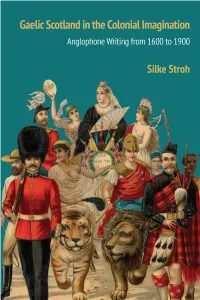
Gaelic Scotland in the Colonial Imagination
Gaelic Scotland in the Colonial Imagination Gaelic Scotland in the Colonial Imagination Anglophone Writing from 1600 to 1900 Silke Stroh northwestern university press evanston, illinois Northwestern University Press www .nupress.northwestern .edu Copyright © 2017 by Northwestern University Press. Published 2017. All rights reserved. Printed in the United States of America 10 9 8 7 6 5 4 3 2 1 Library of Congress Cataloging-in-Publication data are available from the Library of Congress. Except where otherwise noted, this book is licensed under a Creative Commons At- tribution-NonCommercial-NoDerivatives 4.0 International License. To view a copy of this license, visit http://creativecommons.org/licenses/by-nc-nd/4.0/. In all cases attribution should include the following information: Stroh, Silke. Gaelic Scotland in the Colonial Imagination: Anglophone Writing from 1600 to 1900. Evanston, Ill.: Northwestern University Press, 2017. For permissions beyond the scope of this license, visit www.nupress.northwestern.edu An electronic version of this book is freely available, thanks to the support of libraries working with Knowledge Unlatched. KU is a collaborative initiative designed to make high-quality books open access for the public good. More information about the initiative and links to the open-access version can be found at www.knowledgeunlatched.org Contents Acknowledgments vii Introduction 3 Chapter 1 The Modern Nation- State and Its Others: Civilizing Missions at Home and Abroad, ca. 1600 to 1800 33 Chapter 2 Anglophone Literature of Civilization and the Hybridized Gaelic Subject: Martin Martin’s Travel Writings 77 Chapter 3 The Reemergence of the Primitive Other? Noble Savagery and the Romantic Age 113 Chapter 4 From Flirtations with Romantic Otherness to a More Integrated National Synthesis: “Gentleman Savages” in Walter Scott’s Novel Waverley 141 Chapter 5 Of Celts and Teutons: Racial Biology and Anti- Gaelic Discourse, ca. -

Celtic-International-Fund-2019.Pdf
CELTIC INTERNATIONAL FUND BBC ALBA (with funding from MG ALBA), S4C, TG4 and Northern Ireland Screen’s Irish Language Broadcast Fund (ILBF) are delighted to announce the second round of the ‘Celtic International Fund’, a yearly joint-commissioning round between the indigenous Celtic language television broadcasters and funders of Scotland, Wales, Ireland and Northern Ireland The aim of the ‘Celtic International Fund’ is to promote co-development and then co-production through Scottish Gaelic, Welsh and Irish, and to encourage a broader European and worldwide internationalisation of productions which are originally conceived in those Celtic languages. The Celtic International Fund hopes to provide film-makers with an opportunity to co-develop and coproduce distinctive, ambitious works to enrich primetime programme schedules, to have a national impact with audiences in the territories of Scotland, Wales, Ireland and Northern Ireland and seek to reach audiences worldwide. This call-out encompasses three genres, Factual, Formats and Drama. For all projects, we envisage a development phase where funding would be provided to develop ideas but also to develop the co- production framework which must have a production element in Scotland, Wales and either Ireland or Northern Ireland. Feedback from producers regarding genres to be included in ensuing Celtic International Fund call-outs is welcome. The Celtic International Fund will be administered by a joint commissioning team drawn from the Celtic language broadcasters and funders who are partners -

Serbia Turns Blind Eye to Rare Bird Slaughter
Issue No. 211 Friday, July 22 - Thursday, September 08, 2016 ORDER DELIVERY TO Belgrade ‘failing to Political Must-see YOUR DOOR +381 11 4030 303 develop satirists eye music subscription@birn.eu.com - - - - - - - ISSN 1820-8339 1 mid-market Belgrade local festivals BELGRADE INSIGHT IS PUBLISHED BY 0 1 tourism’ elections in August Page 5 Page 9 Page 13 9 7 7 1 8 2 0 8 3 3 0 0 0 Even when the Democrats longas continue to likely is This also are negotiations Drawn-out Surely the situation is urgent Many of us who have experi We feel in-the-know because bia has shown us that (a.) no single no (a.) that us shown has bia party or coalition will ever gain the governa form to required majority negotiations political (b.) and ment, will never be quickly concluded. achieved their surprising result at last month’s general election, quickly itbecame clear that the re sult was actually more-or-less the result election other every as same in Serbia, i.e. inconclusive. as Serbia’s politicians form new political parties every time disagree with they their current party reg 342 currently are (there leader political parties in Serbia). istered the norm. One Ambassador Belgrade-based recently told me he was also alarmed by the distinct lack of urgency among politicians. Serbian “The country is standstill at and a I don’t understand their logic. If they are so eager to progress towards the EU and en theycome how investors, courage go home at 5pm sharp and don’t work weekends?” overtime. -
Historical Background of the Contact Between Celtic Languages and English
Historical background of the contact between Celtic languages and English Dominković, Mario Master's thesis / Diplomski rad 2016 Degree Grantor / Ustanova koja je dodijelila akademski / stručni stupanj: Josip Juraj Strossmayer University of Osijek, Faculty of Humanities and Social Sciences / Sveučilište Josipa Jurja Strossmayera u Osijeku, Filozofski fakultet Permanent link / Trajna poveznica: https://urn.nsk.hr/urn:nbn:hr:142:149845 Rights / Prava: In copyright Download date / Datum preuzimanja: 2021-09-27 Repository / Repozitorij: FFOS-repository - Repository of the Faculty of Humanities and Social Sciences Osijek Sveučilište J. J. Strossmayera u Osijeku Filozofski fakultet Osijek Diplomski studij engleskog jezika i književnosti – nastavnički smjer i mađarskog jezika i književnosti – nastavnički smjer Mario Dominković Povijesna pozadina kontakta između keltskih jezika i engleskog Diplomski rad Mentor: izv. prof. dr. sc. Tanja Gradečak – Erdeljić Osijek, 2016. Sveučilište J. J. Strossmayera u Osijeku Filozofski fakultet Odsjek za engleski jezik i književnost Diplomski studij engleskog jezika i književnosti – nastavnički smjer i mađarskog jezika i književnosti – nastavnički smjer Mario Dominković Povijesna pozadina kontakta između keltskih jezika i engleskog Diplomski rad Znanstveno područje: humanističke znanosti Znanstveno polje: filologija Znanstvena grana: anglistika Mentor: izv. prof. dr. sc. Tanja Gradečak – Erdeljić Osijek, 2016. J.J. Strossmayer University in Osijek Faculty of Humanities and Social Sciences Teaching English as -

E.E. Fournier D'albe's Fin De Siècle: Science, Nationalism and Monistic
Ian B. Stewart E.E. Fournier d’Albe’s Fin de siècle: Science, nationalism and monistic philosophy in Britain and Ireland Article (Accepted version) (Refereed) Original citation: Stewart, Ian B. (2017). E.E. Fournier d’Albe’s Fin de siècle: Science, nationalism and monistic philosophy in Britain and Ireland Cultural and Social History. pp 1-22. ISSN 1478-0038 DOI: 10.1080/14780038.2017.1375721 © 2017 Taylor & Francis This version available at: http://eprints.lse.ac.uk/84274/ Available in LSE Research Online: September 2017 LSE has developed LSE Research Online so that users may access research output of the School. Copyright © and Moral Rights for the papers on this site are retained by the individual authors and/or other copyright owners. Users may download and/or print one copy of any article(s) in LSE Research Online to facilitate their private study or for non-commercial research. You may not engage in further distribution of the material or use it for any profit-making activities or any commercial gain. You may freely distribute the URL (http://eprints.lse.ac.uk) of the LSE Research Online website. This document is the author’s final accepted version of the journal article. There may be differences between this version and the published version. You are advised to consult the publisher’s version if you wish to cite from it. 1 E.E. Fournier d’Albe’s Fin de siècle: Science, Nationalism and Monistic Philosophy in Britain and Ireland* Ian B. Stewart The aim of this article is to reconstruct the intellectual biography of the English physicist Edmund Edward Fournier d’Albe (1868-1933) in order to shed new light on disparate aspects of the British fin de siècle. -

Letnji Retrovizor Ponedeljak,11.Jul 2016
Letnji retrovizor Ponedeljak,11.jul 2016. "Forum mladih lidera Srbije – YES!" Savez ekonomista Srbije i Business Info Group, pod pokroviteljstvom Kopaonik Biznis Foruma, od 7. do 9. oktobra na Srebrnom jezeru organizovaće "Forum mladih lidera Srbije – YES!". Rok za prijavu je 10. avgust. Za učešće na Forumu mogu da se prijave studenti i studentkinje završne godine osnovih studija, kao i master ili doktorskih studija, sa bilo kog fakulteta u Srbiji. Učesnici treba da budu mlađi od 28 godina. Forum ima za cilj da okupi 100 mladih lidera i liderki iz cele Srbije, poveže ih, motiviše za pokretanje inicijativa u društvu, radu na razvoju svojih veština i širenju kruga kontakta. Program će obuhvatiti radionice, panele, motivacione govore i networking koktele, a učesnici i učesnice imaće priliku da čuju zanimljive priče i mišljenja relevantnih stručnjaka iz oblasti obrazovanja, privrede, društvenog aktivizma, biznisa, sporta, kulture i drugo. Za dodatne informacije dostupan je mejl dragisa.djuric@big.co.rs. "Krokodilu" Evropska nagrada za komunikacije Udruženje "Krokodil" dobitnik je Evropske nagrade za komunikacije za 2016. godinu, za festival "Krokodil 2015" i time postalo prva organizacija- dobitnik tog priznanja u kategoriji NVO/udruženja. Za nagradu su se u užem izboru takmičili i projekti "Gradovi žele dobrodošlicu izbeglicama" (Cities welcome refugees) organizacije "Eurocities" te Crveni krst Flandrije (Rode Kruis Vlaanderen) kao treća nominovana organizacija u istoj kategoriji. U kategoriji "Kompanija" Evropsku nagradu za komunikacije osvojio je tim komunikacija iz holandske kompanije DSM, a nagradu za mladog komunikatora godine ispod 30 godina osvojila je Jelena Vasilev iz Erste Bank Srbija za projekat superste.net, saopštio je "Krokodil". Sa više od 2.200 članova iz 42 zemlje Evropska asocijacija direktora komunikacija, koja dodeljuje ovu nagradu, vodeća je evropska mreža predstavnika sektora komunikacija. -

It Just Belongs to Be! Traditional Music and Cornish Identity London Cornish Association Rosyer Lecture 11Th July 2008 Merv Davey “It Just Belongs to Be”
“It Just Belongs To Be” It Just belongs to be! Traditional Music and Cornish identity London Cornish Association Rosyer Lecture 11th July 2008 Merv Davey “It Just Belongs To Be” Abstract This presentation first explores the early roots of Cornish Folk Music, what is the significance the Cornish Carol tradition and who were the musicians and dancers represented on the 16th Century bench ends at Altarnon Church. Following on from this the activities of the late early 20th century British Folk Revivalists in relation to Cornish tradition are considered together with the quite different approach taken by the Celtic revivalists in Cornwall. Lastly we will look at the ongoing traditions of today and how they reflect both the past and modern Cornish identity. “It Just Belongs To Be” Folk A genre of music derived initially from a 19th C folkoric notion of a rural cultural idyll which embraced a broader “peoples music” mindset from the 1950s to include industrial songs and an increasing body of newly composed material in “folk Style”. In the past 40 years it has been increasingly driven by commercial and artistic interests so that it is useful to distinguish the term from “tradition “It Just Belongs To Be” Tradition The active process by which a phenomena such as a tune, song or custom changes and evolves within community usage as it is transmitted from one person to the next and one generation to the next. Although influenced by popular, commercial and art culture, it is ultimately driven by the experiences, perceptions and values of a community or an individual reflecting that community “It Just Belongs To Be” Cornish Identity Identity is a sense of being defined by an individual or groups perceptions and understanding of their relationship with other individuals or groups. -

Disillusioned Serbians Head for China's Promised Land
Serbians now live and work in China, mostly in large cities like Beijing andShanghai(pictured). cities like inlarge inChina,mostly andwork live Serbians now 1,000 thataround andsomeSerbianmedia suggest by manyexpats offered Unofficial numbers +381 11 4030 306 114030 +381 Belgrade in Concern Sparks Boom Estate Real Page 7 Issue No. No. Issue belgradeinsighteditor@birn.eu.com 260 Friday, October 12 - Thursday, October 25,2018 October 12-Thursday, October Friday, Photo: Pixabay/shanghaibowen Photo: Skilled, adventurous young Serbians young adventurous Skilled, China – lured by the attractive wages wages attractive the by –lured China enough money for a decent life? She She life? adecent for money enough earning of incapable she was herself: adds. she reality,” of colour the got BIRN. told Education, Physical and Sports of ulty Fac Belgrade’s a MAfrom holds who Sparovic, didn’t,” they –but world real the change glasses would rose-tinted my thought and inlove Ifell then But out. tryit to abroad going Serbia and emigrate. to plan her about forget her made almost things These two liked. A Ivana Ivana Sparovic soon started questioning questioning soonstarted Sparovic glasses the –but remained “The love leaving about thought long “I had PROMISED LAND PROMISED SERBIANS HEAD HEAD SERBIANS NIKOLIC are increasingly going to work in in towork going increasingly are place apretty just than more Ljubljana: Page 10 offered in Asia’s economic giant. economic Asia’s in offered DISILLUSIONED love and had a job she ajobshe had and love in madly was She thing. every had she vinced con was Ana Sparovic 26-year-old point, t one FOR CHINA’S CHINA’S FOR - - - BELGRADE INSIGHT IS PUBLISHED BY INSIGHTISPUBLISHED BELGRADE for China. -

Revisiting the Achievements of the Ancient Celts
University of Louisville ThinkIR: The University of Louisville's Institutional Repository College of Arts & Sciences Senior Honors Theses College of Arts & Sciences 5-2013 Revisiting the achievements of the Ancient Celts : evidence that the Celtic civilization surpassed contemporary European civilizations in its technical sophistication and social complexity, and continues to influence later cultures. Adam Dahmer University of Louisville Follow this and additional works at: https://ir.library.louisville.edu/honors Part of the Political Science Commons Recommended Citation Dahmer, Adam, "Revisiting the achievements of the Ancient Celts : evidence that the Celtic civilization surpassed contemporary European civilizations in its technical sophistication and social complexity, and continues to influence later cultures." (2013). College of Arts & Sciences Senior Honors Theses. Paper 11. http://doi.org/10.18297/honors/11 This Senior Honors Thesis is brought to you for free and open access by the College of Arts & Sciences at ThinkIR: The University of Louisville's Institutional Repository. It has been accepted for inclusion in College of Arts & Sciences Senior Honors Theses by an authorized administrator of ThinkIR: The University of Louisville's Institutional Repository. This title appears here courtesy of the author, who has retained all other copyrights. For more information, please contact thinkir@louisville.edu. Dahmer 1 A Lost Civilization as Great as Any Scholars traditionally associate the advancement of Western culture from antiquity to the Renaissance with the innovations of the Romans and their Mediterranean cultural predecessors, the Greeks and Etruscans, to the extent that the word "civilization" often seems synonymous with Romanization. In doing so, historians unfairly discount the cultural achievements of other Indo-European peoples who achieved civilization in their own right and contributed much to ancient and modern life. -
SPACE, RELIGION, and the CREATURELINESS of APPALACHIA Dissertation Submitted to the College of Arts and Scie
OF MOUNTAIN FLESH: SPACE, RELIGION, AND THE CREATURELINESS OF APPALACHIA Dissertation Submitted to The College of Arts and Sciences of the UNIVERSITY OF DAYTON In Partial Fulfillment of the Requirements for The Degree of Doctor of Philosophy in Theology By Scott Cooper McDaniel UNIVERSITY OF DAYTON Dayton, Ohio May 2018 OF MOUNTAIN FLESH: SPACE, RELIGION, AND THE CREATURELINESS OF APPALACHIA Name: McDaniel, Scott Cooper APPROVED BY: ____________________________________________ Vincent J. Miller, Ph.D. Faculty Advisor ____________________________________________ Silviu Bunta, Ph.D. Faculty Reader ____________________________________________ Kelly Johnson, Ph.D. Faculty Reader ____________________________________________ Anthony Smith, Ph.D. Faculty Reader _____________________________________________ Norman Wirzba, Ph.D. Outside Faculty Reader _____________________________________________ Daniel S. Thompson, Ph.D. Chairperson ii © Copyright by Scott Cooper McDaniel All rights reserved 2018 iii ABSTRACT OF MOUNTAIN FLESH: SPACE, RELIGION, AND THE CREATURELINESS OF APPALACHIA Name: McDaniel, Scott Cooper University of Dayton Advisor: Dr. Vincent J. Miller The following dissertation articulates a constructive theology of creatureliness that speaks from within the particularities of Appalachia’s spatial topography and religious culture. I analyze the historical development and ecological implications of industrial resource extraction, specifically the practice of mountaintop removal, within the broader framework of urbanization and anthropocentricism. Drawing on the unique religio-cultural traditions of the region, particularly its 19th century expressions of Christianity, I employ a spatial hermeneutic through which I emphasize the region’s environmental and bodily elements and articulate a theological argument for the “creaturely flesh” of Appalachia. iv Dedicated to Jade and Beatrice v ACKNOWLEDGEMENTS There are numerous individuals that have made this dissertation possible. I would first like to thank Dr. -

Celts Ancient and Modern: Recent Controversies in Celtic Studies
Celts Ancient and Modern: Recent Controversies in Celtic Studies John R. Collis As often happens in conferences on Celtic Studies, I was the only contributor at Helsinki who was talking about archaeology and the Ancient Celts. This has been a controversial subject since the 1980s when archaeologists started to apply to the question of the Celts the changes of paradigm, which had impacted on archaeology since the 1960s and 1970s. This caused fundamental changes in the way in which we treat archaeological evidence, both the theoretical basis of what we are doing and the methodologies we use, and even affecting the sorts of sites we dig and what of the finds we consider important. Initially it was a conflict among archaeologists, but it has also spilt over into other aspects of Celtic Studies in what has been termed ‘Celtoscepticism’. In 2015–2016 the British Museum and the National Museum of Scotland put on exhibitions (Farley and Hunter 2015) based largely on these new approaches, raising again the conflicts from the 1990s between traditional Celticists, and those who are advocates of the new approaches (‘New Celticists’), but it also revived, especially in the popular press, misinformation about what the conflicts are all about. Celtoscepticism comes from a Welsh term celtisceptig invented by the poet and novelist Robin Llywelin, and translated into English and applied to Celtic Studies by Patrick Sims-Williams (1998); it is used for people who do not consider that the ancient people of Britain should be called Celts as they had never been so-called in the Ancient World.