Mark W. Elliott Providence Perceived
Total Page:16
File Type:pdf, Size:1020Kb
Load more
Recommended publications
-

Bogomils of Bulgaria and Bosnia
BOGOMILS OF BULGARIA AND BOSNIA The Early Protestants of the East. AN ATTEMPT TO RESTORE SOME LOST LEAVES OF PROTESTANT HISTORY. BY L. P. BROCKETT, M. D. Author of: "The Cross and the Crescent," "History of Religious Denominations," etc. PHILADELPHIA AMERICAN BAPTIST PUBLICATION SOCIETY, 1420 CHESTNUT STREET. Entered to Act of Congress, in the year 1879, by the AMERICAN BAPTIST PUBLICATION SOCIETY, In the Office of the Librarian of Congress, at Washington. CONTENTS _______ SECTION I. Introduction.—The Armenian and other Oriental churches. SECTION II. Dualism and the phantastic theory of our Lord's advent in the Oriental churches —The doctrines they rejected.—They held to baptism. SECTION III. Gradual decline of the dualistic doctrine —The holy and exemplary lives of the Paulicians. SECTION IV. The cruelty and bloodthirstiness of the Empress Theodora —The free state and city of Tephrice. SECTION V. The Sclavonic development of the Catharist or Paulician churches.—Bulgaria, Bosnia, and Servia its principal seats —Euchites, Massalians, and Bogomils SECTION VI. The Bulgarian Empire and its Bogomil czars. SECTION VII. A Bogomil congregation and its worship —Mostar, on the Narenta. SECTION VIII. The Bogomilian doctrines and practices —The Credentes and Perfecti —Were the Credentes baptized? SECTION IX. The orthodoxy of the Greek and Roman churches rather theological than practical —Fall of the Bulgarian Empire. SECTION X. The Emperor Alexius Comnenus and the Bogomil Elder Basil —The Alexiad of the Princess Anna Comnena. SECTION XI. The martyrdom of Basil —The Bogomil churches reinforced by the Armenian Paulicians under the Emperor John Zimisces. SECTION XII. The purity of life of the Bogomils —Their doctrines and practices —Their asceticism. -

Inhaltsverzeichnis
Inhaltsverzeichnis Kirche in unserem Magdeburger Land. Thietmar von Merseburg. E. K 31 Bischof Johannes Braun Dom und Domstiftsbibliothek von Merseburg. E. K 31 Bistum Zeitz. E. K 32 Bischof Julius Pflug - der letzte Bischof von Zeitz-Naum- 1. Kapitel burg. E. K./O. M 32 Vielgestaltige Landschaft Im Jahre 1032. Das Bistum Zeitz wird nach Naumburg ver- legt. Albert Hauck 33 Die Elbe. Elfride Kiel 7 Der Dom zu Naumburg. H. S./E. S./E. K 3; Fruchtbare Magdeburger Börde. Nach Lothar Cumpertl Dunkel und Schatten - Glaubenskämpfe und Reformen. Heinz Glade/Elfride Kiel 8 Weihbischof Friedrich Maria Rintelen 34 192 Ortsnamen mit »leben«. E. K 9 Carl van Eß - ein Benediktiner. Elfride Kiel 34 Wasser aus der Heide. Nach Fritz OelzelHeinz Gladel Neues katholisches Leben 37 Elfride Kiel 9 Magdeburger Katholikentag 1928. Carl Sonnenschein 37 In der Altmark. Elfride Kiel 10 Das Motiv des Katholikentags in Magdeburg 38 Harzvorland und Huy. Elfride Kiel 11 1945 - Zerstörung Magdeburgs und Wiederaufbau 38 Harzland. Elfride Kiel 12 1949 - Magdeburg Sitz eines Weihbischofs. Weihbischof Aus Sumpfland wurde »Goldene Aue«. M. Nick 14 Friedrich Maria Rintelen 38 Der Fläming - »die Fläminge«. Nach Helmar Jungbans/Karl Wie Magdeburg die 1000-Jahr-Feier beging. /• G.IE. K. 38 BischoflElfride Kiel 14 Glauben zwischen gestern und morgen. Elfride Kiel 39 Mansfelder Land. Elfride Kiel 15 Kunst und Geschichte in St. Sebastian in Magdeburg. Bischof Querfurter Platte. Elfride Kiel 16 Johannes Braun 42 Saale und Unstrut. Elfride Kiel 16 Sankt Norbert — Patron des Bischöflichen Amtes Magdeburg. Im Unstruttal. Elfride Kiel 18 Aus der Predigt von Bischof Braun am }./6. -
Proquest Dissertations
Readers, Sanctity, and History in Early Modern Spain Pedro de Ribadeneyra, the Flos sanctorum, and Catholic Community by Jonathan Edward Greenwood A thesis submitted to the Faculty of Graduate and Postdoctoral Affairs in partial fulfillment of the requirements for the degree of Master of Arts in History Carleton University Ottawa, Ontario ©2011 Jonathan Edward Greenwood Library and Archives Bibliotheque et 1*1 Canada Archives Canada Published Heritage Direction du Branch Patrimoine de I'edition 395 Wellington Street 395, rue Wellington OttawaONK1A0N4 OttawaONK1A0N4 Canada Canada Your rile Votre reference ISBN: 978-0-494-83071-0 Our file Notre reference ISBN: 978-0-494-83071-0 NOTICE: AVIS: The author has granted a non L'auteur a accorde une licence non exclusive exclusive license allowing Library and permettant a la Bibliotheque et Archives Archives Canada to reproduce, Canada de reproduire, publier, archiver, publish, archive, preserve, conserve, sauvegarder, conserver, transmettre au public communicate to the public by par telecommunication ou par I'lnternet, preter, telecommunication or on the Internet, distribuer et vendre des theses partout dans le loan, distribute and sell theses monde, a des fins commerciales ou autres, sur worldwide, for commercial or non support microforme, papier, electronique et/ou commercial purposes, in microform, autres formats. paper, electronic and/or any other formats. The author retains copyright L'auteur conserve la propriete du droit d'auteur ownership and moral rights in this et des droits moraux qui protege cette these. Ni thesis. Neither the thesis nor la these ni des extraits substantiels de celle-ci substantial extracts from it may be ne doivent etre imprimes ou autrement printed or otherwise reproduced reproduits sans son autorisation. -
Parte Seconda Bibliotheca Collinsiana, Seu Catalogus Librorum Antonji Collins Armigeri Ordine Alphabetico Digestus
Parte seconda Bibliotheca Collinsiana, seu Catalogus Librorum Antonji Collins Armigeri ordine alphabetico digestus Avvertenza La biblioteca non è solo il luogo della tua memoria, dove conservi quel che hai letto, ma il luogo della memoria universale, dove un giorno, nel momento fata- le, potrai trovare quello che altri hanno letto prima di te. Umberto Eco, La memoria vegetale e altri scritti di bibliografia, Milano, Rovello, 2006 Si propone qui un’edizione del catalogo manoscritto della collezione libra- ria di Anthony Collins,1 la cui prima compilazione egli completò nel 1720.2 Nei nove anni successivi tuttavia Collins ampliò enormemente la sua biblioteca, sin quasi a raddoppiarne il numero delle opere. Annotò i nuovi titoli sulle pagine pari del suo catalogo che aveva accortamente riservato a successive integrazio- ni. Dispose le nuove inserzioni in corrispondenza degli autori già schedati, attento a preservare il più possibile l’ordine alfabetico. Questo tuttavia è talora impreciso e discontinuo.3 Le inesattezze, che ricorrono più frequentemente fra i titoli di inclusione più tarda, devono imputarsi alla difficoltà crescente di annotare nel giusto ordine le ingenti e continue acquisizioni. Sono altresì rico- noscibili abrasioni e cancellature ed in alcuni casi, forse per esigenze di spazio, oppure per sostituire i titoli espunti, i lemmi della prima stesura sono frammez- zati da titoli pubblicati in date successive al 1720.4 In appendice al catalogo, due liste confuse di titoli, per la più parte anonimi, si svolgono l’una nelle pagi- ne dispari e l’altra in quelle pari del volume.5 Agli anonimi seguono sparsi altri 1 Sono molto grato a Francesca Gallori e Barbara Maria Graf per aver contribuito alla revi- sione della mia trascrizione con dedizione e generosità. -

Erinnerungen Pfarrer Zuelicke.Pdf
1 GELEITWORT Bei den Erinnerungen an mein Leben möchte ich mich von dem Stichwort „Anfänge“ leiten lassen. Na- türlich ist jeder Tag ein Anfang, der uns herausfordert, ihn zu gestalten. Da steht oft die Frage: Was fangen wir mit diesem Menschen oder mit diesem Tag an? Es gibt sicher auch Tage, mit denen wir, so scheint es, nichts anfangen können. Wie also gehen wir mit den Gegebenheiten um, die auf uns zukom- men? Manchmal entscheiden wir uns ganz bewusst für einen Neuanfang, vor allem dann, wenn wir hinter eine unangenehme Sache einen Schlussstrich ziehen wollen. Es kann auch sein, dass uns etwas wertvoll erscheint und reizt, etwas Neues auszuprobieren oder zu wagen. Oft genug bedeutet ein An- fang eine Weichenstellung, verbunden mit besonderen Herausforderungen und Entscheidungen. Ein Anfang führt aber auch immer zu einem Ende, dem dann ein Neuanfang folgen kann. Davon habe ich in meinem Leben eine ganze Reihe erfahren und möchte davon schreiben. Der Schwerpunkt meiner Ausführungen wird durch die Orte gesetzt, an denen ich gelebt und gewirkt habe. Zunächst schaue ich aber auf die ersten 25 Jahre bis zu meiner Priesterweihe. Wolmirstedt, im Corona-Sommer 2020 Peter Zülicke Bild 1: In der „Studierstube“ 2020 2 DIE ERSTEN BEIDEN JAHRZEHNTE chon meine Geburt am 13. Februar 1938 im Magdeburger Marienstift war ein prägender Anfang, den ich natürlich noch nicht bewusst wahrgenommen habe. Dieses kleine Wesen, das den bergen- S den Mutterschoß verlassen hatte, musste sich nun als Individuum total in einer anderen Umge- bung zurechtfinden. Ich ahne nur, wie gut mir die bergende und sorgende Liebe meiner Eltern getan hat. -

Manresa and Saint Ignatius of Loyola
JOAN SEGARRA PIJUAN was born in Tárrega, Spain on June 29, 1926. He joined the Society of Jesus in 1942. Seventeen years later he completed his religious and cultural education. On July 29, 1956 – in the Year of Saint Ignatius – he was ordained at the cathedral in Manresa. He has spent much of his life in Veruela, Bar- celona, Sant Cugat del Vallès, Palma (Majorca), Raimat, Rome and Man- resa and has also lived in a number of countries in Central and South Ameri- ca, Africa and Europe. He has always been interested in spi- ritual theology and the study of Saint Ignatius of Loyola. SAINT IGNA- TIUS AND MANRESA describes the Saint’s sojourn here in a simple, rea- dable style. The footnotes and exten- sive bibliography will be of particular interest to scholars wishing the study the life of St. Ignatius in greater de- tail. This book deals only with the months Saint Ignatius spent in Man- resa, which may have been the most interesting part of his life: the months of his pilgrimage and his mystical en- lightenments. Manresa is at the heart of the Pilgrim’s stay in Catalonia because “between Ignatius and Man- resa there is a bond that nothing can break” (Torras y Bages). A copy of this book is in the Library at Stella Maris Generalate North Foreland, Broadstairs, Kent, England CT10 3NR and is reproduced on line with the permission of the author. AJUNTAMENT DE MANRESA Joan Segarra Pijuan, S.J. 1st edition: September 1990 (Catalan) 2nd edition: May 1991 (Spanish) 3rd edition: September 1992 (English) © JOAN SEGARRA i PIJUAN, S.J. -

Antonio Possevino and Jesuits of Jewish Ancestry John Donnelly Marquette University, John.P.Donnelly@Marquette.Edu
Marquette University e-Publications@Marquette History Faculty Research and Publications History, Department of 1-1-1986 Antonio Possevino and Jesuits of Jewish Ancestry John Donnelly Marquette University, john.p.donnelly@marquette.edu Published version. Archivum Historicum Societatis Iesu. Volume LV. (1986): 3-31. Publisher URL: http://www.sjweb.info/curiafrgen/archives.cfm. © 1986 Institutum Historicum Societatis Iesu. Used with permission. COMMENTARII HIS.TORICI ANTONIO POSSEVINO AND JESUITS OF JEWISH ANCESTRY JOHN PATRICK DONNELLY, S.J. - Marquette University, Milwaukee*. I. POSSEVINO'S PROBABLE JEWISH ANCESTRY Contrary to the attitudes of many Spaniards, indeed of many Christians of his time, Ignatius of Loyola was entirely without racial anti-Semitism. His desire to be conformed to Christ in the tiniest details even led him to regret he was not born of Jewish blood. During its formative era, unlike many reli gious orders of the sixteenth century, the Society of Jesus welcomed Chris tians of Jewish descent into its ranks. As is well known, some of Loyola's closest collaborators were of Jewish descent, for instance, Diego Lainez and l Juan Polanco . Many other Jesuits of Jewish descent made notable con 2 tributions, particularly in the foreign missions • It has not been noticed by scholars that Antonio Possevino (1533-1611), a famous figure in the second generation of Jesuit history, was probably born of Jewish Christian ancestry3. His probable Jewish descent seell1S to have affected his later Jesuit career at various stages. His autobiography, which was written for publication but remains in manuscript, says nothing about any Jewish background. He relates that his grandfather and his father mi grated from Piedmont to Milan, then after its capture by the Spaniards * The author wishes to thank Marquette University and the Gladys Krieble Delmas Founda tion for grants that made the archival research on this article possible. -

An Analysis of Pedro De Ribadeneyra's Historia Ecclesiastica Del Scisma De Inglaterra (1588)
View metadata, citation and similar papers at core.ac.uk brought to you by CORE provided by Repositorio Documental de la Universidad de Valladolid FACULTAD de FILOSOFÍA Y LETRAS DEPARTAMENTO de FILOLOGÍA INGLESA Grado en Estudios Ingleses TRABAJO DE FIN DE GRADO An Analysis of Pedro de Ribadeneyra's Historia ecclesiastica del scisma de Inglaterra (1588) Fátima Cid Morgade Tutor: Anunciación Carrera de la Red 2013/2014 ABSTRACT Central to the study of the English-Spanish relations in the 16th century is the Anglican Reformation. It was narrated for first time in Spanish and from a Catholic standpoint in Historia ecclesiastica del scisma de Inglaterra (1558), by the Spanish Jesuit Pedro de Ribadeneyra. Although it was thoroughly appreciated at the time and beyond, current literature on this work is very scarce. This paper will analyze the new structure, the additional sources, shortenings and interpolations through which Ribadeneyra reworked De schismate anglicano the Latin work on which his Historia del scisma is based, as well as those passages of dubious historicity that were retained or included by him. The results confirm the thesis that Ribadeneyra uses and deforms facts with an aim to appeal to a Spanish readership and support his plea for their defense of the Roman Catholic faith. Key words: Pedro de Ribadeneyra (1526-1611) Historia ecclesiastica del scisma de Inglaterra Anglo-Spanish relations Anglican Reformation Counter-Reformation Early Modern Historiography. Un aspecto central en el estudio de las relaciones hipano-inglesas en el siglo XVI es la reforma anglicana. Este hecho se narra por primera vez en español y desde una perspectiva católica en Historia ecclesiastica del scisma de Inglaterra (1558), escrita por el jesuita español Pedro de Ribadeneyra. -

Trinitarian/Christological Heresies Heresy Description Origin Official
Trinitarian/Christological Heresies Official Heresy Description Origin Other Condemnation Adoptionism Belief that Jesus Propounded Theodotus was Alternative was born as a by Theodotus of excommunicated names: Psilanthro mere (non-divine) Byzantium , a by Pope Victor and pism and Dynamic man, was leather merchant, Paul was Monarchianism. [9] supremely in Rome c.190, condemned by the Later criticized as virtuous and that later revived Synod of Antioch presupposing he was adopted by Paul of in 268 Nestorianism (see later as "Son of Samosata below) God" by the descent of the Spirit on him. Apollinarism Belief proposed Declared to be . that Jesus had by Apollinaris of a heresy in 381 by a human body Laodicea (died the First Council of and lower soul 390) Constantinople (the seat of the emotions) but a divine mind. Apollinaris further taught that the souls of men were propagated by other souls, as well as their bodies. Arianism Denial of the true The doctrine is Arius was first All forms denied divinity of Jesus associated pronounced that Jesus Christ Christ taking with Arius (ca. AD a heretic at is "consubstantial various specific 250––336) who the First Council of with the Father" forms, but all lived and taught Nicea , he was but proposed agreed that Jesus in Alexandria, later exonerated either "similar in Christ was Egypt . as a result of substance", or created by the imperial pressure "similar", or Father, that he and finally "dissimilar" as the had a beginning declared a heretic correct alternative. in time, and that after his death. the title "Son of The heresy was God" was a finally resolved in courtesy one. -
The Mir Āt Al Quds in Context
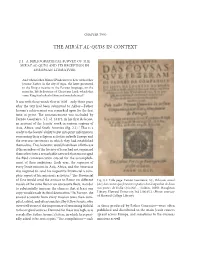
the mirt al-quds in context 19 CHAPTER TWO THE MIRĀT ALQUDS IN CONTEXT 2.1. A BIBLIOGRAPHICAL SURVEY OF THE MIRĀT ALQUDS AND ITS RECEPTION IN EUROPEAN LITERATURE And when father Manoel Pinheiro was here with father Jerome Xavier, in the city of Agra, the latter presented to the King a treatise in the Persian language, on the miracles, life & doctrine of Christ our Lord, which this same King had asked of him and much desired.1 It was with these words that in 1605—only three years after the text had been submitted to Akbar—Father Jerome’s achievement was remarked upon for the first time in print. The announcement was included by Fernão Guerreiro, S.J. (d. 1617), in his first Relaçam, an account of the Jesuits’ work in various regions of Asia, Africa, and South America (fig. 2.1).2 This is a credit to the Jesuits’ ability to put into print information concerning their religious activities in both Europe and the overseas territories in which they had established themselves. This, however, would have been of little use if the members of the Society of Jesus had not organized themselves into a remarkable network that encouraged the fluid communication crucial for the accomplish- ment of their ambitions. Each year, the superior of every Jesuit mission in Asia, Africa, and the Americas was required to send his respective Provincial a com- plete report of his mission’s activities.3 The Provincial of Goa would send the annuae to Rome on different Fig. 2.1. Title page. Fernão Guerreiro, S.J., Relaçam annal vessels of the same fleet or on successive fleets, in order [sic] das cousas que fezeram os padres da Companhia de Iesus to substantially increase the chances that at least one nas partes da India Oriental… (Lisbon, 1605). -

The Issue of Antitrinitarianism in the Fifteenth-Century Novgorod- Moscow Movement: Analysis and Evaluation
Andrews University Digital Commons @ Andrews University Dissertations Graduate Research 2000 The Issue of Antitrinitarianism in the Fifteenth-Century Novgorod- Moscow Movement: Analysis and Evaluation Oleg Zhigankov Andrews University Follow this and additional works at: https://digitalcommons.andrews.edu/dissertations Part of the History of Christianity Commons, Religious Thought, Theology and Philosophy of Religion Commons, and the Slavic Languages and Societies Commons Recommended Citation Zhigankov, Oleg, "The Issue of Antitrinitarianism in the Fifteenth-Century Novgorod-Moscow Movement: Analysis and Evaluation" (2000). Dissertations. 172. https://digitalcommons.andrews.edu/dissertations/172 This Dissertation is brought to you for free and open access by the Graduate Research at Digital Commons @ Andrews University. It has been accepted for inclusion in Dissertations by an authorized administrator of Digital Commons @ Andrews University. For more information, please contact repository@andrews.edu. Thank you for your interest in the Andrews University Digital Library of Dissertations and Theses. Please honor the copyright of this document by not duplicating or distributing additional copies in any form without the author’s express written permission. Thanks for your cooperation. INFORMATION TO USERS This manuscript has been reproduced from the microfilm master. UMi films the text directly from the original or copy submitted. Thus, some thesis and dissertation copies are in typewriter face, while others may be from any type of computer printer. The quality of this reproduction is dependent upon the quality of the copy submitted. Broken or indistinct print, colored or poor quality illustrations and photographs, print bieedthrough, substandard margins, and improper alignment can adversely affect reproduction. In the unlikely event that the author did not send UMI a complete manuscript and there are missing pages, these will be noted. -

The Maronites Cistercian Studies Series: Number Two Hundred Forty-Three
The Maronites CISTERCIAN STUDIES SERIES: NUMBER TWO HUNDRED FORTY-THREE The Maronites The Origins of an Antiochene Church A Historical and Geographical Study of the Fifth to Seventh Centuries Abbot Paul Naaman Translated by The Department of Interpretation and Translation (DIT), Holy Spirit University Kaslik, Lebanon 2009 Cistercian Publications www.cistercianpublications.org LITURGICAL PRESS Collegeville, Minnesota www.litpress.org Maps adapted from G. Tchalenko, Villages antiques de la syrie du Nord (1953), T. II Pl. XXIII, Pl. XXIV, Pl. XXV. Used with permission. A Cistercian Publications title published by Liturgical Press Cistercian Publications Editorial Offices Abbey of Gethsemani 3642 Monks Road Trappist, Kentucky 40051 www.cistercianpublications.org © 2011 by Order of Saint Benedict, Collegeville, Minnesota. All rights reserved. No part of this book may be reproduced in any form, by print, microfilm, microfiche, mechanical recording, photocopying, translation, or by any other means, known or yet unknown, for any purpose except brief quotations in reviews, without the previous written permission of Liturgical Press, Saint John’s Abbey, PO Box 7500, Collegeville, Minnesota 56321-7500. Printed in the United States of America. 1 2 3 4 5 6 7 8 9 Library of Congress Cataloging-in-Publication Data Naaman, Paul, 1932– The Maronites : the origins of an Antiochene church : a historical and geographical study of the fifth to seventh centuries / Paul Naaman ; translated by the Department of Interpretation and Translation (DIT), Holy Spirit University, Kaslik, Lebanon. p. cm. — (Cistercian studies series ; no. 243) Includes bibliographical references and index. ISBN 978-0-87907-243-8 (pbk.) — ISBN 978-0-87907-794-5 (e-book) 1.