HB Burma Tour Report
Total Page:16
File Type:pdf, Size:1020Kb
Load more
Recommended publications
-
Disaggregation of Bird Families Listed on Cms Appendix Ii
Convention on the Conservation of Migratory Species of Wild Animals 2nd Meeting of the Sessional Committee of the CMS Scientific Council (ScC-SC2) Bonn, Germany, 10 – 14 July 2017 UNEP/CMS/ScC-SC2/Inf.3 DISAGGREGATION OF BIRD FAMILIES LISTED ON CMS APPENDIX II (Prepared by the Appointed Councillors for Birds) Summary: The first meeting of the Sessional Committee of the Scientific Council identified the adoption of a new standard reference for avian taxonomy as an opportunity to disaggregate the higher-level taxa listed on Appendix II and to identify those that are considered to be migratory species and that have an unfavourable conservation status. The current paper presents an initial analysis of the higher-level disaggregation using the Handbook of the Birds of the World/BirdLife International Illustrated Checklist of the Birds of the World Volumes 1 and 2 taxonomy, and identifies the challenges in completing the analysis to identify all of the migratory species and the corresponding Range States. The document has been prepared by the COP Appointed Scientific Councilors for Birds. This is a supplementary paper to COP document UNEP/CMS/COP12/Doc.25.3 on Taxonomy and Nomenclature UNEP/CMS/ScC-Sc2/Inf.3 DISAGGREGATION OF BIRD FAMILIES LISTED ON CMS APPENDIX II 1. Through Resolution 11.19, the Conference of Parties adopted as the standard reference for bird taxonomy and nomenclature for Non-Passerine species the Handbook of the Birds of the World/BirdLife International Illustrated Checklist of the Birds of the World, Volume 1: Non-Passerines, by Josep del Hoyo and Nigel J. Collar (2014); 2. -

Birds of Gunung Tambora, Sumbawa, Indonesia: Effects of Altitude, the 1815 Cataclysmic Volcanic Eruption and Trade
FORKTAIL 18 (2002): 49–61 Birds of Gunung Tambora, Sumbawa, Indonesia: effects of altitude, the 1815 cataclysmic volcanic eruption and trade COLIN R. TRAINOR In June-July 2000, a 10-day avifaunal survey on Gunung Tambora (2,850 m, site of the greatest volcanic eruption in recorded history), revealed an extraordinary mountain with a rather ordinary Sumbawan avifauna: low in total species number, with all species except two oriental montane specialists (Sunda Bush Warbler Cettia vulcania and Lesser Shortwing Brachypteryx leucophrys) occurring widely elsewhere on Sumbawa. Only 11 of 19 restricted-range bird species known for Sumbawa were recorded, with several exceptional absences speculated to result from the eruption. These included: Flores Green Pigeon Treron floris, Russet-capped Tesia Tesia everetti, Bare-throated Whistler Pachycephala nudigula, Flame-breasted Sunbird Nectarinia solaris, Yellow-browed White- eye Lophozosterops superciliaris and Scaly-crowned Honeyeater Lichmera lombokia. All 11 resticted- range species occurred at 1,200-1,600 m, and ten were found above 1,600 m, highlighting the conservation significance of hill and montane habitat. Populations of the Yellow-crested Cockatoo Cacatua sulphurea, Hill Myna Gracula religiosa, Chestnut-backed Thrush Zoothera dohertyi and Chestnut-capped Thrush Zoothera interpres have been greatly reduced by bird trade and hunting in the Tambora Important Bird Area, as has occurred through much of Nusa Tenggara. ‘in its fury, the eruption spared, of the inhabitants, not a although in other places some vegetation had re- single person, of the fauna, not a worm, of the flora, not a established (Vetter 1820 quoted in de Jong Boers 1995). blade of grass’ Francis (1831) in de Jong Boers (1995), Nine years after the eruption the former kingdoms of referring to the 1815 Tambora eruption. -

BORNEO: Bristleheads, Broadbills, Barbets, Bulbuls, Bee-Eaters, Babblers, and a Whole Lot More
BORNEO: Bristleheads, Broadbills, Barbets, Bulbuls, Bee-eaters, Babblers, and a whole lot more A Tropical Birding Set Departure July 1-16, 2018 Guide: Ken Behrens All photos by Ken Behrens TOUR SUMMARY Borneo lies in one of the biologically richest areas on Earth – the Asian equivalent of Costa Rica or Ecuador. It holds many widespread Asian birds, plus a diverse set of birds that are restricted to the Sunda region (southern Thailand, peninsular Malaysia, Sumatra, Java, and Borneo), and dozens of its own endemic birds and mammals. For family listing birders, the Bornean Bristlehead, which makes up its own family, and is endemic to the island, is the top target. For most other visitors, Orangutan, the only great ape found in Asia, is the creature that they most want to see. But those two species just hint at the wonders held by this mysterious island, which is rich in bulbuls, babblers, treeshrews, squirrels, kingfishers, hornbills, pittas, and much more. Although there has been rampant environmental destruction on Borneo, mainly due to the creation of oil palm plantations, there are still extensive forested areas left, and the Malaysian state of Sabah, at the northern end of the island, seems to be trying hard to preserve its biological heritage. Ecotourism is a big part of this conservation effort, and Sabah has developed an excellent tourist infrastructure, with comfortable lodges, efficient transport companies, many protected areas, and decent roads and airports. So with good infrastructure, and remarkable biological diversity, including many marquee species like Orangutan, several pittas and a whole Borneo: Bristleheads and Broadbills July 1-16, 2018 range of hornbills, Sabah stands out as one of the most attractive destinations on Earth for a travelling birder or naturalist. -

Thailand Highlights 14Th to 26Th November 2019 (13 Days)
Thailand Highlights 14th to 26th November 2019 (13 days) Trip Report Siamese Fireback by Forrest Rowland Trip report compiled by Tour Leader: Forrest Rowland Trip Report – RBL Thailand - Highlights 2019 2 Tour Summary Thailand has been known as a top tourist destination for quite some time. Foreigners and Ex-pats flock there for the beautiful scenery, great infrastructure, and delicious cuisine among other cultural aspects. For birders, it has recently caught up to big names like Borneo and Malaysia, in terms of respect for the avian delights it holds for visitors. Our twelve-day Highlights Tour to Thailand set out to sample a bit of the best of every major habitat type in the country, with a slight focus on the lush montane forests that hold most of the country’s specialty bird species. The tour began in Bangkok, a bustling metropolis of winding narrow roads, flyovers, towering apartment buildings, and seemingly endless people. Despite the density and throng of humanity, many of the participants on the tour were able to enjoy a Crested Goshawk flight by Forrest Rowland lovely day’s visit to the Grand Palace and historic center of Bangkok, including a fun boat ride passing by several temples. A few early arrivals also had time to bird some of the urban park settings, even picking up a species or two we did not see on the Main Tour. For most, the tour began in earnest on November 15th, with our day tour of the salt pans, mudflats, wetlands, and mangroves of the famed Pak Thale Shore bird Project, and Laem Phak Bia mangroves. -

December 2013
December, 2013 TALL TALES It is once again time for everyone to practice a tale about the wild experiences everyone has about our fun pastime birding. Our annual year's end program of TALL TALES will end our club's meetings for 2013. So, be prepared to share your wild birding experience from the Christmas Count or one of your field trips or your backyard feeder, or your trip to Timbuktu. Make it exciting for everyone to help relive your memory. Bring friends and let them share in the excitement and the holiday refreshments. Our meetings are held September through June on the third Monday of each month. They begin at 7 p.m. at the Will Rogers Garden Center, I-44 & NW 36th Street. Visitors are always welcome. REFRESHMENTS Everyone, please bring something savory or sweet to share at our annual Christmas meeting. Drinks will be provided. WELCOME New Member: Calvin Rees, Oklahoma City DUES NOTICE It's time once again to renew your annual membership for 2014. OCAS dues are $15 per household and may be paid at the monthly meetings, online at our website http://www.okc-audubon.org or mailed to Nancy Vicars, Treasurer, 24 SE 57th St., OKC 73129 . MEETING CHANGE Mark your calendar now!!! The January meeting will be held on the 4th Monday, January 27, 2014 due to the Garden Center closure for Martin Luther King Jr. Day. three families are in the superfamily Meliphagoidea in the President’s Perspective basal songbird Australasian grade (BSAG supergroup in By Bill Diffin this series) which consists of all ten of the terminal clades below Passerida and Corvoidea in the ToL Hi, Members. -
ORL 5.1 Hypothetical Spp Final Draft01a.Xlsx
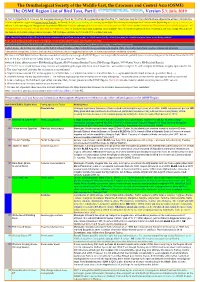
The Ornithological Society of the Middle East, the Caucasus and Central Asia (OSME) The OSME Region List of Bird Taxa, Part E: , Version 5.1: July 2019 In Part E, Hypothetical Taxa, we list non-passerines (prefixed by 'N') first, then passerines (prefixed by 'P'). Such taxa may be from distributions adjacent to or have extended to A fuller explanation is given in Explanation of the ORL, but briefly, Bright green shading of a row (eg Syrian Ostrich) indicates former presence of a taxon in the OSME Region. Light gold shading in column A indicates sequence change from the previous ORL issue. Red font indicates added information since the previous ORL version or the Conservation Threat Status (Critically Endangered = CE, Endangered = E, Vulnerable = V and Data Deficient = DD only). Not all synonyms have been examined. Serial numbers (SN) are merely an administrative convenience and may change. Please do not cite them in any formal correspondence or papers. NB: Compass cardinals (eg N = north, SE = southeast) are used. Rows shaded thus and with yellow text denote summaries of problem taxon groups in which some closely-related taxa may be of indeterminate status or are being studied. Rows shaded thus and with yellow text indicate recent or data-driven major conservation concerns. Rows shaded thus and with white text contain additional explanatory information on problem taxon groups as and when necessary. English names shaded thus are species on BirdLife Tracking Database, http://seabirdtracking.org/mapper/index.php. Only a few individuals from very few colonies are involved. A broad dark orange line, as below, indicates the last taxon in a new or suggested species split, or where sspp are best considered separately. -

BIRDS of HALIMUN-SALAK NATIONAL PARK, WEST JAVA, INDONESIA: Saitou, N
Treubia 43: 31–46, December 2016 Treubia 43: 47–70, December 2016 BIRDS OF HALIMUN-SALAK NATIONAL PARK, WEST JAVA, INDONESIA: Saitou, N. & M. Nei 1987. The neighbor-joining method: a new method for reconstructing phylogenetic trees. Molecular Biology and Evolution, 4: 406-425. ENDEMISM, CONSERVATION AND THREATENED STATUS Simmons, N.B. 2005. Order Chiroptera. In: Wilson, D.E. & D.M. Reeder (eds.). Mammal Species of the Dewi M. Prawiradilaga World: A Taxonomic and Geographic Reference. Baltimore: John Hopkins University Press. pp. 312- Museum Zoologicum Bogoriense, Research Center for Biology, Indonesian Institute of Sciences (LIPI) 529. Jl. Raya Jakarta-Bogor Km 46 Cibinong 16911, Indonesia e-mail: dewi005@lipi.go.id Suyanto, A. 2001. Kelelawar di Indonesia. Bogor: Lembaga Ilmu Pengetahuan Indonesia. 126 pp. Temminck, C.J. 1827 (1824)-1841. Monographies de Mammalogie, ou description de quelques genres de Received: 8 August 2016; Accepted: 5 December 2016 mammiferes, dont les espèces ont été observées dans les différens musées de l’Europe. C.C. Vander Hoek, Leiden, 392 pp. ABSTRACT Thompson, J.D., T.J. Gibson & F. Plewniak 1997. The Clustal X Windows Interface: Flexible Strategies for Multiple Sequence Alignment Aided by the Quality Analysis Tools. Nucleic Acids Research, 24: Bird surveys and long-term bird monitoring in Gunung Halimun-Salak National Park were 4876-4882. conducted between 1998 and 2009 to obtain comprehensive data on the bird species in the area. Compilation of bird data from this study and other studies have recorded a total of 271 species, which is about 53.4% of van Strien, N.J. 1986. Abbreviated checklist of the mammals of the Australian Archipelago. -

Thailand Invitational 2017
Field Guides Tour Report Thailand Invitational 2017 Feb 25, 2017 to Mar 18, 2017 Dave Stejskal & John Rowlett For our tour description, itinerary, past triplists, dates, fees, and more, please VISIT OUR TOUR PAGE. This shimmering Green-tailed Aethopyga is one of the fanciest sunbirds we saw on the tour! Photo by participant Fred Dalbey. It’s been two months now since our Thailand adventure closed and yet I live with persistent reminders of episodes from that trip that arise almost daily! No doubt, in part, because this was my first tour to this extraordinary country for birds, food, culture, and people (and now we know, butterflies!). And in part because I knew that ours was the last tour, after 21 wonderful years, that our heralded Asia guide Dave Stejskal would lead to Siam. Ouch, bite the man! Having the encounters, as we did, with so many legendary birds--Spoon-billed Sandpiper and Nordmann’s Greenshank, Silver Pheasant and Siamese Fireback, Great Hornbill and Silver-breasted Broadbill, Crested Jay and Ratchet-tailed Treepie, Sultan Tit and Giant Nuthatch, and overwhelming numbers of bulbuls, babblers, leaf warblers, and flycatchers--is enough to assure an exceptional birding tour. But to insure an experience of the highest quality, it was necessary to collect a stellar group of participants under the leadership of a first-rate guide and mix in some fabulous Thai food, some Siamese culture, and Dave’s good friend Wat with the best ground crew in the business in order to produce the kind of trip we in fact enjoyed. It was a humdinger. -

Estimations Relative to Birds of Prey in Captivity in the United States of America
ESTIMATIONS RELATIVE TO BIRDS OF PREY IN CAPTIVITY IN THE UNITED STATES OF AMERICA by Roger Thacker Department of Animal Laboratories The Ohio State University Columbus, Ohio 43210 Introduction. Counts relating to birds of prey in captivity have been accomplished in some European countries; how- ever, to the knowledge of this author no such information is available in the United States of America. The following paper consistsof data related to this subject collected during 1969-1970 from surveys carried out in many different direc- tions within this country. Methods. In an attempt to obtain as clear a picture as pos- sible, counts were divided into specific areas: Research, Zoo- logical, Falconry, and Pet Holders. It became obvious as the project advanced that in some casesthere was overlap from one area to another; an example of this being a falconer working with a bird both for falconry and research purposes. In some instances such as this, the author has used his own judgment in placing birds in specific categories; in other in- stances received information has been used for this purpose. It has also become clear during this project that a count of "pets" is very difficult to obtain. Lack of interest, non-coop- eration, or no available information from animal sales firms makes the task very difficult, as unfortunately, to obtain a clear dispersal picture it is from such sourcesthat informa- tion must be gleaned. However, data related to the importa- tion of birds' of prey as recorded by the Bureau of Sport Fisheries and Wildlife is included, and it is felt some observa- tions can be made from these figures. -

Bird Checklists of the World Country Or Region: Myanmar
Avibase Page 1of 30 Col Location Date Start time Duration Distance Avibase - Bird Checklists of the World 1 Country or region: Myanmar 2 Number of species: 1088 3 Number of endemics: 5 4 Number of breeding endemics: 0 5 Number of introduced species: 1 6 7 8 9 10 Recommended citation: Lepage, D. 2021. Checklist of the birds of Myanmar. Avibase, the world bird database. Retrieved from .https://avibase.bsc-eoc.org/checklist.jsp?lang=EN®ion=mm [23/09/2021]. Make your observations count! Submit your data to ebird. -

Mixed-Species Animal Groups 2021 Online Symposium June 14-18, 2021, Beijing Time Zone
Mixed-species animal groups 2021 online symposium June 14-18, 2021, Beijing Time Zone Co-organizers: Eben Goodale, Liping Zhou Monday, June 14, 2021 | Day 1 09:30 pm - 09:35 pm Eben Goodale Symposium introduce 1. 09:35 pm - 09:55 pm Marian Y. L. Wong Behavioural plasticity in a native species may be related to foraging resilience in the presence of an aggressive invader 2. 09:55 pm - 10:15 pm Anne Heloise Theo Response of mixed-species shoaling groups to reef recovery in the Lakshadweep Islands, India 3. 10:15 pm - 10:35 pm Alex Trillo Who is your neighbor? Eavesdropping Parasites and the Influence of Nearby Signalers 4. 10:35 pm - 10:55 pm Nora V Carlson What makes a 'community informant'? Information reliability and anti-predator signal eavesdropping across mixed-species flocks of tits 5. 10:55 pm - 11:15 pm Indrikis Krams Alarm calling behavior of wintering crested tits and willow tits great tits depend on the groups' social structure 1 Mixed-species animal groups symposium | 14-18 June 2021 Mixed-species animal groups 2021 online symposium June 14-18, 2021, Beijing Time Zone Co-organizers: Eben Goodale, Liping Zhou Tuesday, June 15, 2021 | Day 2 1. 09:30 pm - 09:50 pm Scott Robinson Mimicry and patterns of species associations in birds 2. 09:50 pm - 10:10 pm Shuang Xing Convergence in mixed-species flocks: Insights from plumage coloration on bird community assembly 3. 10:10 pm - 10:30 pm Kamal Raj Gosai Evaluating plumage mimicry between the Greater Necklaced and Lesser Necklaced Laughingthrush in mixed-species bird flocks 4. -

Biodiversity Profile of Afghanistan
NEPA Biodiversity Profile of Afghanistan An Output of the National Capacity Needs Self-Assessment for Global Environment Management (NCSA) for Afghanistan June 2008 United Nations Environment Programme Post-Conflict and Disaster Management Branch First published in Kabul in 2008 by the United Nations Environment Programme. Copyright © 2008, United Nations Environment Programme. This publication may be reproduced in whole or in part and in any form for educational or non-profit purposes without special permission from the copyright holder, provided acknowledgement of the source is made. UNEP would appreciate receiving a copy of any publication that uses this publication as a source. No use of this publication may be made for resale or for any other commercial purpose whatsoever without prior permission in writing from the United Nations Environment Programme. United Nations Environment Programme Darulaman Kabul, Afghanistan Tel: +93 (0)799 382 571 E-mail: qadeer.karyab@unep.ch Web: http://www.unep.org DISCLAIMER The contents of this volume do not necessarily reflect the views of UNEP, or contributory organizations. The designations employed and the presentations do not imply the expressions of any opinion whatsoever on the part of UNEP or contributory organizations concerning the legal status of any country, territory, city or area or its authority, or concerning the delimitation of its frontiers or boundaries. Unless otherwise credited, all the photos in this publication have been taken by the UNEP staff. Design and Layout: Rachel Dolores