Public Meeting by Teleconference
Total Page:16
File Type:pdf, Size:1020Kb
Load more
Recommended publications
-
“Where I Lived, What I Lived For”
Henry David Thoreau “Where I Lived, What I Lived For” AT A CERTAIN season of our life we are accustomed to consider every spot as the possible site of a house. I have thus surveyed the country on every side within a dozen miles of where I live. In imagination I have bought all the farms in succession, for all were to be bought, and I knew their price. I walked over each farmer's premises, tasted his wild apples, discoursed on husbandry with him, took his farm at his price, at any price, mortgaging it to him in my mind; even put a higher price on it - took everything but a deed of it - took his word for his deed, for I dearly love to talk - cultivated it, and him too to some extent, I trust, and withdrew when I had enjoyed it long enough, leaving him to carry it on. This experience entitled me to be regarded as a sort of real-estate broker by my friends. Wherever I sat, there I might live, and the landscape radiated from me accordingly. What is a house but a sedes, a seat? - better if a country seat. I discovered many a site for a house not likely to be soon improved, which some might have thought too far from the village, but to my eyes the village was too far from it. Well, there I might live, I said; and there I did live, for an hour, a summer and a winter life; saw how I could let the years run off, buffet the winter through, and see the spring come in. -

Music and Identity Ofthe Cultural Renaissance of Hawai·I A
-022.\ CONNECT BACK TO DIS PIACE: Music and Identity ofthe Cultural Renaissance ofHawai·i A '!HESIS SUBMITTED TO '!HE GRADUATE DIVISION OF '!HE UNIVERSI1Y OF HAWAI·I IN PARTIAL FULFILLMENT OF '!HE REQUIREMENTS FOR '!HE DEGREE OF MASTER OF ARTS IN PACIFIC ISLAND STUDIES MAY 2005 By Andrea A Suzuki Thesis Conunittee: Kater1na Teaiwa. Chairperson George Teny Kanalu Young Jonathan K. 050110 Acknowledgements First and foremost I have to thank my parents. especIally Daddy MIke for the opJX>rtun1ties that they have gtven me and their sUpJX>rt gtven to my endeavors. I have to also thank Daddy Mitch for hIs sUPJX>rt and h1s stortes about "h1s days". I want to especIally thank my mom, an AM.A 1n her own rtght, for all ofher devoted time and sUPJX>rt. Secondly, I would l1ke to gIve my deepest thanks to Mel1nda Caroll wIthout whom th1s jOurney would have been a lot more d1ff1cult. Thankyou for your suggestions, your help, and your encouragement. I would also l1ke to thank my comm11tee, Katertna Tea1Wa, Kanalu Young, and John Osorto for their sUpJX>rt and theIr efforts 1n the completion ofth1s project. I'd l1ke to thank all ofthose that gave their time to me, tell1ng me their stortes. and allowtng me to share those stortes: Jeny Santos, Owana Salazar, Aunty CookIe, Uncle Cyr11. Hemy KapollO, John Demello. Gaylord Holomal1a, Keaum1k1 Akut. Peter Moon, and Joe Atpa. I'd l1ke to gIve my appreciation to the Pac1ftc Island StudIes Program that guIded me every' step ofthe way. F1nallly. I'd 11ke to thank all my frIends for their encouragement and tolerance ofmy 1nsan1ty, espec1ally Kamuela Andrade, for gJ.1nn1ng and beartng It and Kau1 for beIng my personal cheering section. -

Central America and the Bitter Fruit of U.S. Policy by Bill Gentile
CLALS WORKING PAPER SERIES | NO. 23 Central America and the Bitter Fruit of U.S. Policy by Bill Gentile OCTOBER 2019 Pullquote Bill Gentile in Nicaragua in the mid-1980s / Courtesy Bill Gentile Bill Gentile is a Senior Professorial Lecturer and Journalist in Residence at American University’s School of Communication. An independent journalist and documentary filmmaker whose career spans four decades, five continents, and nearly every facet of journalism and mass communication, he is the winner of two national Emmy Awards and was nominated for two others. He is a pioneer of “backpack video journalism” and the director, executive producer, and host of the documentary series FREELANCERS with Bill Gentile. He teaches Photojournalism, Foreign Correspondence, and Backpack Documentary. TheCenter for Latin American & Latino Studies (CLALS) at American University, established in January 2010, is a campus- wide initiative advancing and disseminating state-of-the-art research. The Center’s faculty affiliates and partners are at the forefront of efforts to understand economic development, democratic governance, cultural diversity and change, peace and diplomacy, health, education, and environmental well-being. CLALS generates high-quality, timely analysis on these and other issues in partnership with researchers and practitioners from AU and beyond. A previous version of this piece was published by the Daily Beast as a series, available here. Cover photo: Courtesy Bill Gentile 2 AU CENTER FOR LATIN AMERIcaN & LATINO STUDIES | CHAPTER TITLE HERE Contents -

In Honolulu's Christ Church in Kailua, Which Will Repeat Next Hemenway Theatre, UH Manoa Campus: Wed
5 The Fear Factor 8 Pritchett !ICalendar 13 Book Bonanza l!IStraight Dope Volume 3, Number 45, November 10, 1993 FREE Interview by JOHN WYTHE WHITE State Representative DaveHagino has spent 15 years fighting the system he's a partof- and theparty he belongs to. !JiORDERS BOOKS & MUSIC· BORDERS BOOKS & MUSIC· BORDERS BOOKS & MUSIC· BORDERS BOOKS & MUSIC· BORDERS BOOKS & MUSIC· BORDERS BOOKS & MUSIC· BORDERS BOOKS 8 ,,,, :,..: ;o 0 0 � �L � w ffi 8 Cl 0 ;,<; 0::: w 0 il,1.. � SELECTION: w 2 No Comparison 00 Cl 0::: i0 co co 0 ;o 0 -- -- co�:. 0 0 7' $�··· C nw oco ;o· · 0 m � co 0 0 w7' ::c: :::: C w 0:co 0 ;o 0 m � co 0 0 ci: � $ C w Borders® Books &Music. n ;o8 0 m The whole idea behind Finda book or music store the new Borders Books w;o co .- Borders Books & Music is to &Music. 0 with more titles and 0 w7' create an appealing place with Welcome to the new � $ we'll shop there. C more selection. So we brought Borders Books &Music. w () 100,000 in over book titles, more times the average store. Borders co 0 than 5 times the average bookstore. especially excels in classical and ;o It 0 CD m .r::;"' � OJ ;o What that means is that Borders jazz recordings. 0 E w (.) "' i co .r::; 'l' CD I 0 E 0 offersmore history, more com Borders also carries the area's (!) 0 """' 7' H-1 Fwy. w puters, more cooking. More of broadest selection of videotapes, � Waikele/Waipahu Exit 7 ::::: C everything, not just more copies including classic and foreign films. -
Interview with William Hodding Carter III
Library of Congress Interview with William Hodding Carter III The Association for Diplomatic Studies and Training Foreign Affairs Oral History Project ASSISTANT SECRETARY WILLIAM HODDING CARTER, III Interviewed by: Charles Stuart Kennedy Initial interview date: December 6, 1993 Copyright 1998 ADST [Note: This transcript was not edited by Assistant Secretary Carter] Q: Today is the 6th of December 1993 and this is part of the Foreign Affairs Oral History Program. Do you use William Hodding Carter or Hodding Carter? CARTER: I'd rather just use Hodding Carter. Q: Hodding Carter III. CARTER: The only reason for the III is just because there is a son and my dad who is by far the more famous, has got a lot of “Hodding Carter's” around him, not me. Q: Ah well, let history judge. To begin, for the historian, with could you give a short background before we get to your involvement with the Carter campaign and all that. CARTER: I grew up in a newspaperman, writer family in Mississippi. Born in New Orleans, Louisiana, but basically think of myself as a Mississippian because I lived there from the time I was one on. My father had put out two newspapers, one in Louisiana which was a little tabloid daily. Started it the day after the banks closed which fought Huey Long. And after 1936 in Mississippi, in what was generally regarded to be a very progressive Interview with William Hodding Carter III http://www.loc.gov/item/mfdipbib000187 Library of Congress newspaper, for its place and time, and a courageous editor which he certainly was. -
“I Lived” Onerepublic Close Reading Te a C H E R T I P S
Close ReadingUsing Song Lyrics Analysis of theme and language through evidence based close reading! “I Lived” OneRepublic Close Reading Te a c h e r T i p s How to Use: • Print pages 3 and 6 for students! Page 3 provides a copy of the song lyrics and page 6 is the student recording sheet. • Optional: Project pages 4 and 5 to show the audio video and music video for the song! • Audio Video Link: https://www.youtube.com/watch?v=pKt3o7WPYdo • Music Video Link: https://www.youtube.com/watch?v=z0rxydSolwU • Encourage students to share their feelings about the song and the theme. These songs can spark AMAZING conversations about life! Creative in Costa 2017 I, I did it all I, I did it all I owned every second that this world could 1st give Read I saw so many places, the things that I did With every broken bone, I swear I lived Hope when you take that jump, you don't fear the Oh, Oh, Oh, Oh fall Hope when the water rises, you built a wall With every broken bone, I swear I lived. Hope when the crowd screams out, they're With every broken bone, I swear I... screaming your name Hope if everybody runs, you choose to stay I, I did it all I, I did it all Hope that you fall in love, and it hurts so bad I owned every second that this world could The only way you can know is give it all you have give And I hope that you don't suffer but take the pain I saw so many places, the things that I did Hope when the moment comes, you'll say.. -

Skyline Orchestras
PRESENTS… SKYLINE Thank you for joining us at our showcase this evening. Tonight, you’ll be viewing the band Skyline, led by Ross Kash. Skyline has been performing successfully in the wedding industry for over 10 years. Their experience and professionalism will ensure a great party and a memorable occasion for you and your guests. In addition to the music you’ll be hearing tonight, we’ve supplied a song playlist for your convenience. The list is just a part of what the band has done at prior affairs. If you don’t see your favorite songs listed, please ask. Every concern and detail for your musical tastes will be held in the highest regard. Please inquire regarding the many options available. Skyline Members: • VOCALS AND MASTER OF CEREMONIES…………………………..…….…ROSS KASH • VOCALS……..……………………….……………………………….….BRIDGET SCHLEIER • VOCALS AND KEYBOARDS..………….…………………….……VINCENT FONTANETTA • GUITAR………………………………….………………………………..…….JOHN HERRITT • SAXOPHONE AND FLUTE……………………..…………..………………DAN GIACOMINI • DRUMS, PERCUSSION AND VOCALS……………………………….…JOEY ANDERSON • BASS GUITAR, VOCALS AND UKULELE………………….……….………TOM MCGUIRE • TRUMPET…….………………………………………………………LEE SCHAARSCHMIDT • TROMBONE……………………………………………………………………..TIM CASSERA • ALTO SAX AND CLARINET………………………………………..ANTHONY POMPPNION www.skylineorchestras.com (631) 277 – 7777 DANCE: 24K — BRUNO MARS A LITTLE PARTY NEVER KILLED NOBODY — FERGIE A SKY FULL OF STARS — COLD PLAY LONELY BOY — BLACK KEYS AIN’T IT FUN — PARAMORE LOVE AND MEMORIES — O.A.R. ALL ABOUT THAT BASS — MEGHAN TRAINOR LOVE ON TOP — BEYONCE BAD ROMANCE — LADY GAGA MANGO TREE — ZAC BROWN BAND BANG BANG — JESSIE J, ARIANA GRANDE & NIKKI MARRY YOU — BRUNO MARS MINAJ MOVES LIKE JAGGER — MAROON 5 BE MY FOREVER — CHRISTINA PERRI FT. ED SHEERAN MR. SAXOBEAT — ALEXANDRA STAN BEST DAY OF MY LIFE — AMERICAN AUTHORS NO EXCUSES — MEGHAN TRAINOR BETTER PLACE — RACHEL PLATTEN NOTHING HOLDING ME BACK — SHAWN MENDES BLOW — KE$HA ON THE FLOOR — J. -
Where I Lived, and What I Lived For
33171 97 1317-1322.ps 4/26/06 12:46 PM Page 1317 HENRY DAVID THOREAU [1817–1862] Where I Lived, and What I Lived For Henry David Thoreau was born in 1817 and raised in Concord, Massa- chusetts, living there for most of his life. Along with Ralph Waldo Emerson, Thoreau was one of the most important thinkers of his time in America and is still widely read today. Walden (1854), the work for which he is best known, is drawn from the journal he kept during his two-year-long stay in a cabin on Walden Pond. In Walden, Thoreau ex- plores his interests in naturalism, individualism, and self-sufficiency. He is also remembered for his essay “Civil Disobedience” (1849), an early, influential statement of this tactic of protest later practiced by Mahatma Gandhi and, under the leadership of Martin Luther King Jr., many in the civil rights movement. “Where I Lived, and What I Lived For” is taken from Walden. In it, Thoreau makes the argument for his going to live in the woods. Writing about Walden, scholars have pointed out that Thoreau was not particularly deep in the woods and that he was regularly visited and supplied with, among other things, pies. As you read, consider how this influences your acceptance of what he has to say. I went to the woods because I wished to live deliberately, to front only the essential facts of life, and see if I could not learn what it had to teach, and not, when I came to die, discover that I had not lived. -
1 “U2: There Are Fans and Then There Are Superfans” by Bent Gringer
“U2: There are fans and then there are superfans” by Bent Gringer https://pov.international/u2-superfans-hvad-sker-der 12.06.2019 [Please Note: The following text is a translation from the original Danish to English, supplied by Google translate. It has not been checked for accuracy and completeness. It’s provided here only as a convenience and it not intended to be an equivalent of the original. Please consult the original article at the link above for a complete and accurate text.] MUSIC // LONGREAD - There are maybe 300 international U2 superfans traveling around the band for more or even many of the concerts when U2 is touring. The ones who are at the top of the stage or fence every time, as close to the band as you can get. The so-called 'rail-junkies'. How can this be possible and what on earth are they doing? I first met North Bowman in the lounge café at the Michelberger Hotel in Berlin. It's July 2017, and it's the day after the U2 concert in town. He mocks the text on my T-shirt and recognizes a U2 fan: Unos // dos // tres // catorce // is the introduction to the number Vertigo. Directly translated it means some, two, three, fourteen, and it testifies to Bono's very lenient relationship with the Spanish language or the exact opposite. U2 fans from all over the world are searching for and discussing the deeper meaning with just that counting sequence. Is it a message to the soundman, is it a religious reference, is Bono a mathematical genius, or were the band members just drunk? The band did not run live photos and close-ups of the musicians during the concert on the big screen. -

Warren's the Cave, Country Music, and Vanderbilt F
Robert Penn Warren Studies Volume 8 Robert Penn Warren Studies Article 6 2008 The Box, the Glittering Strings, and the Unbearable Hillbillyness of Being: Warren’s The aC ve, Country Music, and Vanderbilt Fugitive-Agrarianism H.R. Stoneback Follow this and additional works at: https://digitalcommons.wku.edu/rpwstudies Part of the American Literature Commons, and the English Language and Literature Commons Recommended Citation Stoneback, H.R. (2008) "The Box, the Glittering Strings, and the Unbearable Hillbillyness of Being: Warren’s The aC ve, Country Music, and Vanderbilt Fugitive-Agrarianism," Robert Penn Warren Studies: Vol. 8 , Article 6. Available at: https://digitalcommons.wku.edu/rpwstudies/vol8/iss1/6 This Article is brought to you for free and open access by TopSCHOLAR®. It has been accepted for inclusion in Robert Penn Warren Studies by an authorized administrator of TopSCHOLAR®. For more information, please contact topscholar@wku.edu. H. R. STONEBACK 9 The Box, the Glittering Strings, and the Unbearable Hillbillyness of Being: Warren’s The Cave, Country Music, and Vanderbilt Fugitive-Agrarianism H. R. STONEBACK I For shame of his own hillbillyness? No—for shame of something else, something more deeply himself? Robert Penn Warren, The Cave When I was a graduate student at Vanderbilt University in the 1960s, I was also a country singer and songwriter. I lived with one foot in the elite, somewhat closed-off literary world of Vanderbilt and another foot in the honky-tonk clubs and the sometimes seedy offices of music publishers and recording studios where you had to go if you wanted to sell your songs. -

Live from the Artists Den #1202 "Onerepublic" (TRT 56:46 HDTV, 16:9 Anamorphic Widescreen) Recorded January 22, 2017, Park City Live Park City, UT
Live from the Artists Den #1202 "OneRepublic" (TRT 56:46 HDTV, 16:9 Anamorphic Widescreen) Recorded January 22, 2017, Park City Live Park City, UT Episode Song List 1. Love Runs Out 2. Secrets 3. Wherever I Go 4. All The Right Moves 5. Stop And Stare 6. Apologize 7. Let’s Hurt Tonight 8. Good Life 9. I Lived 10. Kids 11. Counting Stars 12. Lose Myself Photograph by Lucid Images ONEREPUBLIC: LIVE FROM THE ARTISTS DEN OneRepublic created an avalanche of fans in Park City, Utah as they descended on the Artists Den stage for an epic show of their greatest hits, as well as new music from their latest release, Oh My My. Their 70 minute set included fan favorites “Apologize,” “Good Life,” "Counting Stars," and an electric closing with “If I Love Myself.” A taste of their new music included a powerful rendition of “Kids” and “Let’s Hurt Tonight.” OneRepublic’s lead singer Ryan Tedder talked to the audience throughout the set, reflecting on his love of film and the special significance of performing the Artists Den during Sundance. ARTIST BIO OneRepublic released their debut set Dreaming Out Loud in 2007. The album included the smash single "Apologize", which shattered digital sales and airplay records worldwide and received a Grammy nomination. The band’s sophomore album, 2009’s Waking Up, produced three singles: "All the Right Moves", "Secrets" and "Good Life". OneRepublic’s third studio album Native, was released in March 2013 and produced the hit singles "If I Lose Myself", "Feel Again", "Love Runs Out", I Lived and their biggest song to date Counting Stars, which reached #1 in 54 countries and has sold over 10 million downloads. -
Interview with DON MCLEAN Was Conducted by the Library of Congress on April 13, 2017
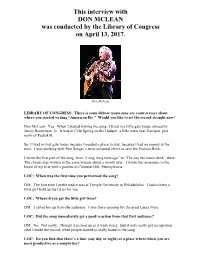
This interview with DON MCLEAN was conducted by the Library of Congress on April 13, 2017. Don McLean LIBRARY OF CONGRESS: There is some debate (some may say controversy) about where you started writing “American Pie.” Would you like to set the record straight now? Don McLean: Yes. When I started writing the song, I lived in a little gate house owned by James Bennenson, Jr. It was in Cold Spring on the Hudson, a little town near Garrison, just north of Peekskill. So, I lived in that gate house because I needed a place to stay, because I had no money at the time. I was working with Pete Seeger’s environmental effort to save the Hudson River. I wrote the first part of the song, from “Long, long time ago” to “The day the music died,” there. The chorus was written in the same houses about a month later. I wrote the remainder in the home of my first wife’s parents in Chestnut Hill, Pennsylvania. LOC: When was the first time you performed the song? DM: The first time I performed it was at Temple University in Philadelphia. I had to have a little girl hold up the lyrics for me. LOC: Where’d you get the little girl from? DM: I called her up from the audience. I was there opening for the great Laura Nyro. LOC: Did the song immediately get a good reaction from that first audience? DM: No. Not really. Though it picked up as it went along. But it only really got recognition after I made the record, when people started to really listen to the song.