The Baldwins, Burne-Jones & Wilden's Pre-Raphaelite Glass
Total Page:16
File Type:pdf, Size:1020Kb
Load more
Recommended publications
-

CASE 6 Shelf 1 #1 Fancy Opaque Glass 1982.65 WATER Challinor Taylor and Paneled Flower Funds Provided PITCHER Co., Pittsburgh, PA, Pattern, No
CASE 6 Shelf 1 #1 Fancy Opaque Glass 1982.65 WATER Challinor Taylor and Paneled Flower Funds provided PITCHER Co., Pittsburgh, PA, pattern, No. 23, by the Fifth patent June 1, 1886 pressed purple slag Annual Benefit opaque soda-lime Antiques Show glass Shelf 1 #2 Fancy Opaque Glass 1990.78 ELECTRIC New Martinsville Peachblow or Gift of Mrs. LIGHT Glass Mfg. Co., New Sunburst line, shaded Betty Woods SHADE Martinsville, WV, pink mold-blown Daniel about 1905-1910 glass with iridescent gold lining 1982.183AB BRIDE’S New Martinsville New Martinsville Gift of Mrs. BOWL ON Glass Mfg. Co., New Peachblow, pink Betty Woods STAND Martinsville, WV, shaded to white Daniel about 1905-1910 mold-blown glass, silver plated stand Shelf 1 #3 Opalescent and Iridescent 1981.138 BERRY Northwood Glass Diamond Funds provided BOWL Company, Indiana, Spearhead pattern, by Mr. Arthur B. PA, about 1900 deep blue shaded to Beaumont opalescent pressed glass 1990.109.1 TWO Dugan Glass Co., Diamond Museum 1990.109.2 MATCHING Indiana, PA, about Spearhead pattern, purchase INDIVIDUAL 1910 deep blue shaded to BERRY opalescent pressed BOWLS glass Shelf 1 #4 Opalescent and Iridescent 1000.164 DISH Dugan Glass Co., Peach opalescent Museum Indiana, PA, about pressed soda-lime purchase 1910-1914 glass with iridescent finish CASE 6 - Page 1 1989.72 BOWL Dugan Glass Co., Petals and Fans Museum Indiana, PA, about pattern on front with purchase 1910-1914 Jeweled Heart pattern on back, amethyst pressed soda-lime glass with deep iridescent finish 1994.39 PLATE Dugan Glass Co., Persian -

Mapping Psychic Spaces in Rudyard Kipling's Fiction Elizabeth Welby
Out of Eden: Mapping Psychic Spaces in Rudyard Kipling's Fiction Elizabeth Welby Thesis submitted for the degree of Doctor of Philosophy School of Literature and Creative Writing University of East Anglia 30 June 2010 © This copy of the thesis has been supplied on condition that anyone who consults it is understood to recognise that its copyright rests with the author and that no quotation from the thesis, nor any information derived therefrom, may be published without the author’s prior, written consent. Part of Chapter 2 has been previously published in The Kipling Journal as ‘The Lords of Misrule and the Pleasant Isle of Aves’, June 2010. A version of part of Chapter 4 has been previously published as ‘Solar Midnight: Traversing the Abject Borderline State in Rudyard Kipling’s “The City of Dreadful Night”’, in The Domination of Fear, ed. by Mikko Canini (Amsterdam: Rodopi Press, 2010), pp. 147-177. Acknowledgements I owe debts of gratitude to many people. First and foremost, I would like to thank my supervisor, Professor John Thieme, whose dedication to my project coupled with his unfailing energy and tireless perseverance would have, I am certain, surprised even Kipling. John took over the project during the latter stages of my PhD and I am sincerely grateful for his unending enthusiasm and willingness to read, consider and constructively comment on my numerous drafts. I would also like to acknowledge The Kipling Society, both for its electronic research tool, ‘The Reader’s Guide’ and its warm human contact. Many thanks are due to, in particular, John Walker, David Page, John Radcliffe and John Lambert who replied to my frequent questions, large and small, about Kipling’s life and art with grace, good humour and speedy efficiency. -

Caroline Kipling
The Rees and Carrington Extracts From the diaries of ` Caroline Kipling 1910 1910 Jan. Engelberg. No entries till John leaves for school with Ellen, 26 Jan. Their first week at Engelberg (they left Bateman’s on 30 December 1909) was not much fun: Carrie had been ill at home – it had been a very wet autumn – and remained ill for at least the first week of their stay at Engelberg. Kipling wrote to his mother-in-law describing their tribulations (PINNEY, Letters, Vol. 3, p. 404-5). Ellen was evidently one of the maids at Bateman’s. LYCETT, (p. 404) lists a maid named Ellen among the Bateman’s staff who attended a parish memorial service for King Edward VII later that summer. It must have been quite an adventure for her to travel out to Switzerland at her employer’s expense, and something of a responsibility to take charge of his 12-year-old son to take back to England, though John was quite a seasoned traveller. Jan. The only entry between December 19h 1909 and February 20th 1910 is on Jan. 26 stating that John left for school with Ellen. Letters, however show that the Ks left home for Engelberg on 30 Dec. `09. 16 Feb. (An allusion to the Baldwins – with them.) There’s a further confirmation of the presence of the Baldwins at Engelberg in the letter to John cited immediately below. 26 Feb. To Geneva. Saw Mr . Feb. 26 Leave Engelberg 10 a.m. Arrive Geneva 7.30 p.m. They were on the first leg of a long cross-country journey from Engelberg to Vernet-les-Bains (see below). -

Indoor Glass Cleaning Brochure
Clean Windows and Glass Faster, Safer and with Less Chemicals Indoor Glass Cleaning A Complete Line For All Glass Cleaning Needs ungerglobal.com Safely and Efficiently Clean All Your Indoor Glass Cleaning professionals face two key challenges when cleaning indoor surfaces such as windows, mirrors and elevators: safety and efficiency. Current window and glass cleaning tools lead to time-consuming and dangerous issues, like re-arranging furniture and reaching high or unusually positioned windows. Unger’s line of indoor window and glass cleaning tools increase productivity and safety by eliminating time spent moving furniture or climbing ladders. Clean Windows The Award Winning Choice 25% Faster and use for Indoor Glass Cleaning The Unger Stingray Ultimate Indoor 39% Less Chemicals Cleaning Tool provides a variety of glass and * window cleaning options, while the multiple than traditional spray and cloth cleaning lightweight extension poles enable you to clean high access areas without the use of ladders! The cleaning solution is powered by 3M Scotchgard™ Protection, which reduces the need to clean glass as often over time and can clean up to 1600 sq. ft. of windows before replacement. SRKT8 Stingray® Indoor Cleaning Kit - Deluxe 10’ shown *Source: Market Research – Professional Window Cleaners. Germany/UK, 2015, SR Strategy Routes Stingray® Indoor glass and window cleaning with Maximum Refillable System The Unger Stingray Flexibility, with new Refillable Refillable System allows ™ you to use your preferred Bottles and QuikPads window cleaning solution while still gaining all the QuikPad™ eliminates the need for laundering safety, speed and cleaning benefits Stingray provides. The QuikPad™ provides even more flexibility, allowing you to clean Adapter Plate used without having to launder with QuikPad™ Refillable bottle allows pads. -
Works in the Kipling Collection "After" : Kipling, Rudyard, 1865-1936. 1924 BOOK PR 4854 R4 1924 "After"
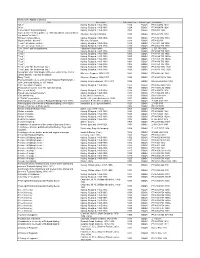
Works in the Kipling Collection Title Main Author Publication Year Material Type Call Number "After" : Kipling, Rudyard, 1865-1936. 1924 BOOK PR 4854 R4 1924 "After" : Kipling, Rudyard, 1865-1936. 1924 BOOK PR 4854 R4 1924 "Collectanea" Rudyard Kipling. Kipling, Rudyard, 1865-1936. 1908 BOOK PR 4851 1908 "Curry & rice," on forty plates ; or, The ingredients of social life at Atkinson, George Francklin. 1859 BOOK DS 428 A76 1859 "our station" in India / : "Echoes" by two writers. Kipling, Rudyard, 1865-1936. 1884 BOOK PR 4854 E42 1884 "Kipling and the doctors" : Bateson, Vaughan. 1929 BOOK PR 4856 B3 "Teem"--a treasure-hunter / Kipling, Rudyard, 1865-1936. 1935 BOOK PR 4854 T26 1935 "Teem"--a treasure-hunter / Kipling, Rudyard, 1865-1936. 1938 BOOK PR 4854 T26 1938 "The Times" and the publishers. Publishers' Association. 1906 BOOK Z 323 T59 1906 "They" / Kipling, Rudyard, 1865-1936. 1905 BOOK PR 4854 T35 1905 "They" / Kipling, Rudyard, 1865-1936. 1905 BOOK PR 4854 T35 1905 "They" / Kipling, Rudyard, 1865-1936. 1905 BOOK PR 4854 T35 1905a "They" / Kipling, Rudyard, 1865-1936. 1905 BOOK PR 4854 T35 1905a "They" / Kipling, Rudyard, 1865-1936. 1906 BOOK PR 4854 T35 1906 "They" / Kipling, Rudyard, 1865-1936. 1905 BOOK PR 4854 T35 1905 "They"; and, The brushwood boy / Kipling, Rudyard, 1865-1936. 1925 BOOK PR 4854 T352 1925 "They"; and, The brushwood boy / Kipling, Rudyard, 1865-1936. 1926 BOOK PR 4854 T352 1926 [Autograph letter from Stephen Wheeler, editor of the Civil & Wheeler, Stephen, 1854-1937. 1882 BOOK PR 4856 A42 1882 military gazette, reporting his deputy [Diary, 1882]. -

Ferro Container Glass Enamel Decoration Systems Overview
Technical Information Container Glass Enamel Decoration Ferro: enhancing life through superior materials performance Headquartered in Mayfeld Heights, Ohio, USA, Ferro Corporation is a world leading producer of Performance Materials, with operations in 20 countries across Europe, Asia and the Americas. We apply core technologies in organic and Meeting the needs of the Color World calls for inorganic chemistry to develop leading market great foresight, fexibility and innovation … positions in a diverse range of industries. • Our global presence is a strong competitive Our mission is “to achieve market leadership advantage. Technical, marketing and management through a customer-focused and highly creative personnel are in continuous contact with customers organisation committed to delivering top quality in every major region. Multinational customers can products and outstanding services to customers be assured of standard products and consistent worldwide”. quality wherever they have operations. Our materials are used to add value to, and to • We co-ordinate our R&D activities globally and improve the performance of products in a variety use our international talent to ensure that product of end markets including building and renova- specifcations and performance are designed tion, home appliances, cookware, giftware and to satisfy the specifc requirements demanded by tableware, transportation, household furnishings, regional markets. leisure, electronics and industrial products. • Ferro views the world-wide concern for the en- We are among the world’s leading suppliers of vironment as an opportunity to develop improved ceramic glazes and colors, glass decoration, products and also to participate in chemical indus- speciality glasses and porcelain enamel coatings. try effor ts to address public concern. -

6-Stained Glass in Lancaster
STAINED GLASS IN LANCASTER Lancaster Civic Society Leaflet 6 St Thomas, in Lancaster Priory by R.F. Ashmead of Abbott & Co (1966} The beauty of stained glass has been recognised since the Middle Ages and it is still popular. Lancaster had three notable stained-glass firms – Seward & Co, Shrigley & Hunt and Abbott & Co – which produced fine work from 1825 to 1996, relying on their artists and craftsmen. Their work The later nineteenth century was a good time for stained glass – new churches, hospitals, town halls, ocean liners, pubs and country houses – the firms’ work can be seen in all these. Shrigley and Hunt initially favoured a Pre-Raphaelite style, lighter in design and colour than its predecessors, strongly decorative, detailed, with realistic scenes and faces telling clear allegories and Biblical stories. Stronger colours were used in the 1880s. Their two main artists, Edward Holme Jewitt and Carl Almquist, had different styles, so widening the firm’s client base. They opened a studio in London to keep Almquist in the firm and to pick up on metropolitan shifts in taste. The firm also made decorative wall tiles. Abbott & Co followed these Late Victorian and Edwardian trends but also developed more modernist styles for interwar houses and in the 1960s. Both firms got contracts in association with the noted Lancaster architectural practice of Paley and Austin. Shrigley and Hunt used their London contacts to get work with Richard Norman Shaw and Alfred Waterhouse. Local magnates such as the Storeys and Williamsons of Lancaster and the brewing families of Boddington (Manchester) and Greenall (Warrington) also patronised them. -

Glass Windows & Doors
GLASS WINDOWS & DOORS Applicant must provide a completed application and the following items: Please indicate items submitted with a checkmark (√) 1. Permit application (check appropriate trade) completed and signed 2. Plans with name and address of designer a. New window or door opening 1. Floor plan with location and sizes of new openings 2. Typical wall section 3. Beam or header sizes over new openings 4. Bedroom emergency egress windows located 5. Emergency egress window size given per FBC 2014 5th Edition, Section 1029; FBC 2014 5th Edition Residential 310 and FBC 2014 5th Edition Existing 604 6. Location of electrical outlets and lights if installing new doors. 7. Elevation view of exterior walls with new doors or windows 8. Product Approvals a. Miami-Dade product approval report with referenced engineered plans. b. State of Florida/DCA product approval with Engineered plans c. Engineer’s signed/sealed plans and calculations for custom design. b. Replacing window or doors with same size material 1. Floor plan with location and sizes to be replaced 2. Bedroom emergency egress windows located 3. Emergency egress window size given per FBC 2014 5th Edition, Section 1029; FBC Residential 310 and FBC 2014 5th Edition Existing 604 4. Product Approvals (one of the following) a. Miami-Dade product approval report with referenced engineered plans b. State of Florida/DCA product approval with . Engineered plans c. Engineer’s signed/sealed plans and calculations for custom design. 3. Signed contract and copy of property appraisers structural valuation or other evidence of structure value 4. All project specific details must be identified on engineered plans including construction details of host structure, type and thickness of glazing, design pressures, anchor details, type of fasteners, etc. -

Press Release Pre-Raphaelites on Paper, Leighton House Museum
PRESS RELEASE Pre-Raphaelites on Paper: Victorian Drawings from the Lanigan Collection An exhibition at Leighton House Museum organised by the National Gallery of Canada, Ottawa 12 Feb 2016 – 29 May 2016 Press Preview 11 Feb 2016 Pre-Raphaelites on Paper: Victorian Drawings from the Lanigan Collection will be the first exhibition opening at Leighton House Museum in 2016, presenting an exceptional, privately- assembled collection to the UK public for the first time. Featuring over 100 drawings and sketches by the Pre- Raphaelites and their contemporaries, the exhibition is organised by the National Gallery of Canada (NGC). It expresses the richness and flair of British draftsmanship during the Victorian era displayed in the unique setting of the opulent home and studio of artist and President of the Royal Academy (PRA) Frederic, Lord Leighton. From preparatory sketches to highly finished drawings intended as works of art in themselves, visitors will discover the diverse ways that Victorian artists used drawing to further their artistic practice, creating, as they did so, images of great beauty and accomplishment. Portraits, landscapes, allegories and scenes from religious and literary works are all represented in the exhibition including studies for some of the most well-known paintings of the era such as Edward Burne- Jones’ The Wheel of Fortune (1883), Holman Hunt’s Eve of St Agnes (1848) and Leighton’s Cymon and Iphigenia (1884). With the exception of Leighton’s painting studio, the permanent collection will be cleared from Leighton House and the drawings hung throughout the historic interiors. This outstanding collection, brought together over a 30-year period by Canadian Dr. -

There's Ink in the Blood of the Macdonalds
Edinburgh Research Explorer “There’s ink in the blood of the Macdonalds” Citation for published version: Wiseman, A 2013, '“There’s ink in the blood of the Macdonalds”' Scottish Islands Explorer. Link: Link to publication record in Edinburgh Research Explorer Document Version: Publisher's PDF, also known as Version of record Published In: Scottish Islands Explorer Publisher Rights Statement: © Wiseman, A. (2013). “There’s ink in the blood of the Macdonalds”. Scottish Islands Explorer General rights Copyright for the publications made accessible via the Edinburgh Research Explorer is retained by the author(s) and / or other copyright owners and it is a condition of accessing these publications that users recognise and abide by the legal requirements associated with these rights. Take down policy The University of Edinburgh has made every reasonable effort to ensure that Edinburgh Research Explorer content complies with UK legislation. If you believe that the public display of this file breaches copyright please contact openaccess@ed.ac.uk providing details, and we will remove access to the work immediately and investigate your claim. Download date: 25. Sep. 2021 July_August.qxd 3/6/13 11:57 Page 44 ‘Ink in the the blood of the Macdonalds’ ‘Ink in the the blood of the Macdonalds’ Andrew Wiseman investigates Rudyard Kipling’s Skye Connection almost all that they wanted to know.’ Kipling deemed that although the speeches were good the Lord Provost’s comments concerning local politics were a trifle parochial. Nevertheless, the Moderator in replying to Kipling’s speech on behalf of the university spoke of Edinburgh having annexed an Englishman! Kipling was not best pleased and would later recall the incident: …said nought but watched him deliver himself deeply into my hands. -

The Carrington Extracts
THE CARRINGTON EXTRACTS CUMULATIVE INDEX – PEOPLE, PLACES AND THINGS – TO 1910 (INCLUSIVE) This index has been compiled straight from the text of the ‘Extracts’. In listing the movements, particularly of Kipling and his family, it is not always clear when who went where and when. Thus, “R. to Academy dinner” clearly refers to Kipling himself going alone to the dinner (as, indeed would have been the case – it was, in the 1890s, a men-only affair). But “Amusing dinner, Mr. Rhodes’s” probably refers to both of them going, and has been included as an entry under both Kipling, Caroline, and Kipling, Rudyard. There are many other similar events. And there are entries recording that, e.g., “Mrs. Kipling leaves”, without any indication of when she had come – but if it’s not in the ‘Extracts’ (though it may well have been in the original diaries) then, of course, it has not been possible to index it. The date given is the date of the diary entry which is not always the date of the event. Another factor is that Carrington quite often mentions a name without further explanation or identification. We assume that he recorded it, with a view to mentioning the subject in the text of the biography, but either changed his mind or edited it out for some reason. In some cases, later biographers have picked up the reference, and explained it. In those cases, we have gratefully recorded their identification. A Abinger Visit to Sir Frederick and Lady Lugard 27 Sept. `03 Academy Dinner (see Royal Academy Dinner) Adams, Henry (American writer) Meets Kiplings on board Teutonic 3 Feb. -

Rudyard Kipling Was Born on December 30, 1865 at Bombay
Rudyard Kipling was born on December 30, 1865 at Bombay, India, where his father, John Lockwood Kipling, himself an artist, was principal of the Jeejeebyhoy Art School. His mother, Alice Macdonald Kipling, had three sisters who married well: among his uncles young Rudyard there were famous painters such as Sir Edward Burne-Jones (one of the most important of the Pre-Raphaelites) and Sir Edward Poynter but also Stanley Baldwin, a future Prime Minister, and these family members were to be of great importance in Kipling's life. The first six years of his life in India were happy ones but in 1871 the Kipling family returned to England. After six months John and Alice Kipling returned to India, leaving six-year old Rudyard and his three-year-old sister with the Holloway family in Southsea. During his five years in this foster home* he was bullied *and physically mistreated* and these years were a psychological shock to him , he also felt his parents had betrayed* him . Between 1878 and 1882 he went to the United Services College in north Devon. The College was a new and very rough* boarding school* where , physically frail, he was once again bullied, but where, nevertheless*, he developed a love of literature. In 1882 Kipling returned to India, where he spent the next seven years working as a journalist and where he began to write about India and the Anglo-Indian society His first volume of poetry, Departmental Ditties, was published in 1886, and between 1887 and 1889 he published six volumes of short stories were the action was set in India , a country he knew well and loved : when he returned to England in 1889 via the United States he found himself already acclaimed as a brilliant young writer.