Exhibit Ah-Jm-12 Phytologia
Total Page:16
File Type:pdf, Size:1020Kb
Load more
Recommended publications
-

Short-Rayed Aster (Symphyotrichum Frondosum) Asteraceae
Status: Red / Endangered Short-rayed Aster (Symphyotrichum frondosum) Best Survey Time: Jul to Sep Asteraceae (Sunflower Family) General Habitat: Foreshore RANGE . Widespread in North America from British Columbia east to Colorado (USA) and south to Baja California (Mexico) . In B.C., found in the south Okanagan Valley at Osoyoos Lake, Vaseux Lake, Skaha Lake and Max Lake ©2014 Josie Symonds Figure 3 Sandy lakeshore habitat along Skaha Lake, B.C. LIFE HISTORY . Annual species that grows each year from seed, germinating following water drawdown in late June or July and flowering from July into September . Achenes (containing seeds) produced from September to October, then released into seed bank . Does not reproduce vegetatively, so population Figure 1 B.C. distribution of S. frondosum (BC CDC 2013) survival depends on seeds and seed bank HABITAT . Seed dispersal by wind, water, waterfowl or small mammals . Open sandy soil along lakeshores in the Bunchgrass . May be subject to annual population fluctuations due Biogeoclimatic Zone, including moist to dry to varying environmental conditions drawdown zones of sandy beaches and saline zones around lakes and ponds that become exposed in summer and early fall . Associates include rayless alkali aster (S. ciliatum), tufted white prairie aster (S. ericoides, spike-rushes (Eleocharis spp.) and rare foreshore plants 2 mm 1 mm overlapping leaf-like bracts 1 mm bristles longer than disk flowers achene topped by bristles 2 cm ©2013 Josie Symonds Figure 2 Open sandy lakeshore habitat along Vaseux Lake, B.C. Figure 4 Illustration of S. frondosum (Douglas et al. 1998) Ministry of Forests, Lands and Natural Resource Operations | Thompson Okanagan Region Version 2.0 Resource Management | Ecosystems Section | Penticton, B.C. -

KEYSTONE XL PIPELINE PROJECT: Rare Plants and Rare Ecological
KEYSTONE XL PIPELINE PROJECT Rare Plants and Rare Ecological Communities (Condition 8) KXL1399-STCE-EN-RP-0002 Rev C January 2019 Prepared for: TransCanada Keystone Pipeline Limited Partnership A Wholly Owned Subsidiary of TransCanada PipeLines Limited Calgary, Alberta Prepared by: Stantec Consulting Ltd. Calgary, Alberta KEYSTONE XL PIPELINE PROJECT RARE PLANTS AND RARE ECOLOGICAL COMMUNITIES (CONDITION 8) Table of Contents EXECUTIVE SUMMARY ............................................................................................................... I ABBREVIATIONS ....................................................................................................................... III 1.0 INTRODUCTION ............................................................................................................ 1.1 2.0 SURVEY METHODS ..................................................................................................... 2.1 2.1 SUMMARY OF PREVIOUS SURVEYS ......................................................................... 2.1 2.1.1 Previous Rare Plants .................................................................................... 2.1 2.1.2 Previous Rare Ecological Communities ....................................................... 2.2 2.1.3 Other Data Sources ...................................................................................... 2.2 2.2 2017 SURVEYS ............................................................................................................. 2.2 2.2.1 Rare Plants .................................................................................................. -

Prairie Lupine (Lupinus Lepidus) Is a Perennial Herb That Grows 20-45 Cm Tall
COSEWIC Assessment and Update Status Report on the Prairie Lupine Lupinus lepidus in Canada ENDANGERED 2009 COSEWIC status reports are working documents used in assigning the status of wildlife species suspected of being at risk. This report may be cited as follows: COSEWIC. 2009. COSEWIC assessment and update status report on the Prairie Lupine Lupinus lepidus in Canada. Committee on the Status of Endangered Wildlife in Canada. Ottawa. vi + 34 pp. (www.sararegistry.gc.ca/status/status_e.cfm). Previous reports: COSEWIC 2000. COSEWIC assessment and status on the Prairie Lupine Lupinus lepidus var. lepidus in Canada. Committee on the Status of Endangered Wildlife in Canada. Ottawa. vi + 18 pp. (www.sararegistry.gc.ca/status/status_e.cfm) Ryan, M., and G.W. Douglas. 1996. COSEWIC status report on the Prairie Lupine Lupinus lepidus var. lepidus in Canada. Committee on the Status of Endangered Wildlife in Canada. Ottawa. 1-18 pp. Production note: COSEWIC acknowledges Carrina Maslovat for writing the update status report on Prairie Lupine, Lupinis lepidus in Canada, prepared under contract with Environment Canada, overseen and edited by Erich Haber, Co-chair, COSEWIC Vascular Plants Specialist Subcommittee For additional copies contact: COSEWIC Secretariat c/o Canadian Wildlife Service Environment Canada Ottawa, ON K1A 0H3 Tel.: 819-953-3215 Fax: 819-994-3684 E-mail: COSEWIC/COSEPAC@ec.gc.ca http://www.cosewic.gc.ca Également disponible en français sous le titre Ếvaluation et Rapport de situation du COSEPAC sur le lupin élégant (Lupinus lepidus) au Canada – Mise à jour. Cover photo: Prairie Lupine — used with permission from H. Roemer. ©Her Majesty the Queen in Right of Canada, 2009. -

Vascular Plants and a Brief History of the Kiowa and Rita Blanca National Grasslands
United States Department of Agriculture Vascular Plants and a Brief Forest Service Rocky Mountain History of the Kiowa and Rita Research Station General Technical Report Blanca National Grasslands RMRS-GTR-233 December 2009 Donald L. Hazlett, Michael H. Schiebout, and Paulette L. Ford Hazlett, Donald L.; Schiebout, Michael H.; and Ford, Paulette L. 2009. Vascular plants and a brief history of the Kiowa and Rita Blanca National Grasslands. Gen. Tech. Rep. RMRS- GTR-233. Fort Collins, CO: U.S. Department of Agriculture, Forest Service, Rocky Mountain Research Station. 44 p. Abstract Administered by the USDA Forest Service, the Kiowa and Rita Blanca National Grasslands occupy 230,000 acres of public land extending from northeastern New Mexico into the panhandles of Oklahoma and Texas. A mosaic of topographic features including canyons, plateaus, rolling grasslands and outcrops supports a diverse flora. Eight hundred twenty six (826) species of vascular plant species representing 81 plant families are known to occur on or near these public lands. This report includes a history of the area; ethnobotanical information; an introductory overview of the area including its climate, geology, vegetation, habitats, fauna, and ecological history; and a plant survey and information about the rare, poisonous, and exotic species from the area. A vascular plant checklist of 816 vascular plant taxa in the appendix includes scientific and common names, habitat types, and general distribution data for each species. This list is based on extensive plant collections and available herbarium collections. Authors Donald L. Hazlett is an ethnobotanist, Director of New World Plants and People consulting, and a research associate at the Denver Botanic Gardens, Denver, CO. -

Short-Rayed Alkali Aster (Symphyotrichum Frondosum) in Canada
Species at Risk Act Recovery Strategy Series Adopted under Section 44 of SARA Recovery Strategy for the Short-rayed Alkali Aster (Symphyotrichum frondosum) in Canada Short-rayed Alkali Aster 2013 Recommended citation: Environment Canada. 2013. Recovery Strategy for the Short-rayed Alkali Aster (Symphyotrichum frondosum) in Canada. Species at Risk Act Recovery Strategy Series. Environment Canada, Ottawa. XIX pp. + Appendix. For copies of the recovery strategy, or for additional information on species at risk, including COSEWIC Status Reports, residence descriptions, action plans, and other related recovery documents, please visit the Species at Risk (SAR) Public Registry (www.sararegistry.gc.ca). Cover illustration: Terry T. McIntosh Également disponible en français sous le titre « Programme de rétablissement de l’aster feuillu (Symphyotrichum frondosum) au Canada » © Her Majesty the Queen in Right of Canada, represented by the Minister of the Environment, 2013. All rights reserved. ISBN 978-1-100-22362-9 Catalogue no. En3-4/163-2013E-PDF Content (excluding the illustrations) may be used without permission, with appropriate credit to the source. RECOVERY STRATEGY FOR THE SHORT-RAYED ALKALI ASTER (Symphyotrichum frondosum) IN CANADA 2013 Under the Accord for the Protection of Species at Risk (1996), the federal, provincial, and territorial governments agreed to work together on legislation, programs, and policies to protect wildlife species at risk throughout Canada. In the spirit of cooperation of the Accord, the Government of British Columbia has given permission to the Government of Canada to adopt the “Recovery strategy for the short-rayed alkali aster (Symphyotrichum frondosum) in British Columbia” (Part 2) under Section 44 of the Species at Risk Act. -
W a Sh in G to N Na Tu Ra L H Er Itag E Pr Og Ra M
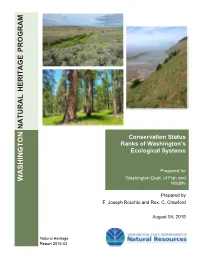
PROGRAM HERITAGE NATURAL Conservation Status Ranks of Washington’s Ecological Systems Prepared for Washington Dept. of Fish and WASHINGTON Wildlife Prepared by F. Joseph Rocchio and Rex. C. Crawford August 04, 2015 Natural Heritage Report 2015-03 Conservation Status Ranks for Washington’s Ecological Systems Washington Natural Heritage Program Report Number: 2015-03 August 04, 2015 Prepared by: F. Joseph Rocchio and Rex C. Crawford Washington Natural Heritage Program Washington Department of Natural Resources Olympia, Washington 98504-7014 .ON THE COVER: (clockwise from top left) Crab Creek (Inter-Mountain Basins Big Sagebrush Steppe and Columbia Basin Foothill Riparian Woodland and Shrubland Ecological Systems); Ebey’s Landing Bluff Trail (North Pacific Herbaceous Bald and Bluff Ecological System and Temperate Pacific Tidal Salt and Brackish Marsh Ecological Systems); and Judy’s Tamarack Park (Northern Rocky Mountain Western Larch Savanna). Photographs by: Joe Rocchio Table of Contents Page Table of Contents ............................................................................................................................ ii Tables ............................................................................................................................................. iii Introduction ..................................................................................................................................... 4 Methods.......................................................................................................................................... -

Invertebrates
State Wildlife Action Plan Update Appendix A-5 Species of Greatest Conservation Need Fact Sheets INVERTEBRATES Conservation Status and Concern Biology and Life History Distribution and Abundance Habitat Needs Stressors Conservation Actions Needed Washington Department of Fish and Wildlife 2015 Appendix A-5 SGCN Invertebrates – Fact Sheets Table of Contents What is Included in Appendix A-5 1 MILLIPEDE 2 LESCHI’S MILLIPEDE (Leschius mcallisteri)........................................................................................................... 2 MAYFLIES 4 MAYFLIES (Ephemeroptera) ................................................................................................................................ 4 [unnamed] (Cinygmula gartrelli) .................................................................................................................... 4 [unnamed] (Paraleptophlebia falcula) ............................................................................................................ 4 [unnamed] (Paraleptophlebia jenseni) ............................................................................................................ 4 [unnamed] (Siphlonurus autumnalis) .............................................................................................................. 4 [unnamed] (Cinygmula gartrelli) .................................................................................................................... 4 [unnamed] (Paraleptophlebia falcula) ........................................................................................................... -

List of Plants for Great Sand Dunes National Park and Preserve
Great Sand Dunes National Park and Preserve Plant Checklist DRAFT as of 29 November 2005 FERNS AND FERN ALLIES Equisetaceae (Horsetail Family) Vascular Plant Equisetales Equisetaceae Equisetum arvense Present in Park Rare Native Field horsetail Vascular Plant Equisetales Equisetaceae Equisetum laevigatum Present in Park Unknown Native Scouring-rush Polypodiaceae (Fern Family) Vascular Plant Polypodiales Dryopteridaceae Cystopteris fragilis Present in Park Uncommon Native Brittle bladderfern Vascular Plant Polypodiales Dryopteridaceae Woodsia oregana Present in Park Uncommon Native Oregon woodsia Pteridaceae (Maidenhair Fern Family) Vascular Plant Polypodiales Pteridaceae Argyrochosma fendleri Present in Park Unknown Native Zigzag fern Vascular Plant Polypodiales Pteridaceae Cheilanthes feei Present in Park Uncommon Native Slender lip fern Vascular Plant Polypodiales Pteridaceae Cryptogramma acrostichoides Present in Park Unknown Native American rockbrake Selaginellaceae (Spikemoss Family) Vascular Plant Selaginellales Selaginellaceae Selaginella densa Present in Park Rare Native Lesser spikemoss Vascular Plant Selaginellales Selaginellaceae Selaginella weatherbiana Present in Park Unknown Native Weatherby's clubmoss CONIFERS Cupressaceae (Cypress family) Vascular Plant Pinales Cupressaceae Juniperus scopulorum Present in Park Unknown Native Rocky Mountain juniper Pinaceae (Pine Family) Vascular Plant Pinales Pinaceae Abies concolor var. concolor Present in Park Rare Native White fir Vascular Plant Pinales Pinaceae Abies lasiocarpa Present -

Sericocarpus Caespitosus, Sp. Nov. Phytoneuron 2021-33: 1–33
Nesom, G.L. 2021. Sericocarpus asteroides (Asteraceae: Astereae), rhizomatous and colonial, and Sericocarpus caespitosus, sp. nov. Phytoneuron 2021-33: 1–33. Published 5 July 2021. ISSN 2153 733X SERICOCARPUS ASTEROIDES (ASTERACEAE: ASTEREAE), RHIZOMATOUS AND COLONIAL, AND SERICOCARPUS CAESPITOSUS, SP. NOV. GUY L. NESOM Research Associate Academy of Natural Sciences of Drexel University Philadelphia, Pennsylvania 19103 guynesom@sbcglobal.net ABSTRACT Allopatric population systems of two growth forms comprise the eastern USA species traditionally identified as Sericocarpus asteroides. The typical form (the type collected by Peter Kalm in New Jersey), which produces slender, stoloniform rhizomes, occurs along the Atlantic coast from southern Maine into South Carolina. Sericocarpus caespitosus Nesom, sp. nov., without stoloniform rhizomes, occurs inland from western New York to coastal counties of Alabama and Florida. An epitype is designated for Conyza asteroides L., clearly showing the rhizomes; neotypes are designated for Aster leucanthemus Raf. and Aster conyzoides var. plantaginifolius Nutt. (both are synonyms of S. asteroides sensu stricto). Sericocarpus oregonensis (with stoloniform rhizomes) and S. californicus (without stoloniform rhizomes) are similar in morphological distinction and have geographically separate distributions –– a similar rationale (morphology and geography) justifies their treatment as separate species. Sericocarpus asteroides (L.) B.S.P. occurs widely through the eastern USA (Fig. 1). Over much of its range, plants produce a relatively short, thick, fibrous-rooted rhizome with short basal offsets arising from a short caudex. Short, thick, caudex branches may arise from growth of these offsets. Along the Atlantic seaboard, however, from southern Maine to South Carolina, in addition to the larger perennating rhizome, plants produce slender, scale-leaved, stoloniform rhizomes that may elongate laterally up to 15 centimeters –– a rooting plantlet is produced at the tip of these rhizomes (these features are shown in type collections–Figs. -
Annotated Checklist of Vascular Flora, Cedar Breaks National
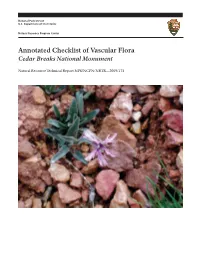
National Park Service U.S. Department of the Interior Natural Resource Program Center Annotated Checklist of Vascular Flora Cedar Breaks National Monument Natural Resource Technical Report NPS/NCPN/NRTR—2009/173 ON THE COVER Peterson’s campion (Silene petersonii), Cedar Breaks National Monument, Utah. Photograph by Walter Fertig. Annotated Checklist of Vascular Flora Cedar Breaks National Monument Natural Resource Technical Report NPS/NCPN/NRTR—2009/173 Author Walter Fertig Moenave Botanical Consulting 1117 W. Grand Canyon Dr. Kanab, UT 84741 Editing and Design Alice Wondrak Biel Northern Colorado Plateau Network P.O. Box 848 Moab, UT 84532 February 2009 U.S. Department of the Interior National Park Service Natural Resource Program Center Fort Collins, Colorado The Natural Resource Publication series addresses natural resource topics that are of interest and applicability to a broad readership in the National Park Service and to others in the management of natural resources, including the scientifi c community, the public, and the NPS conservation and environmental constituencies. Manuscripts are peer-reviewed to ensure that the information is scientifi cally credible, technically accurate, appropriately written for the intended audience, and is designed and published in a professional manner. The Natural Resource Technical Report series is used to disseminate the peer-reviewed results of scientifi c studies in the physical, biological, and social sciences for both the advancement of science and the achievement of the National Park Service’s mission. The reports provide contributors with a forum for displaying comprehensive data that are often deleted from journals because of page limitations. Current examples of such reports include the results of research that addresses natural resource management issues; natural resource inventory and monitoring activities; resource assessment reports; scientifi c literature reviews; and peer- reviewed proceedings of technical workshops, conferences, or symposia. -
Common Native Forbs of the Northern Great Basin Important for Greater Sage-Grouse Tara Luna • Mark R
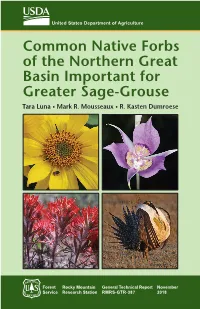
United States Department of Agriculture Common Native Forbs of the Northern Great Basin Important for Greater Sage-Grouse Tara Luna • Mark R. Mousseaux • R. Kasten Dumroese Forest Rocky Mountain General Technical Report November Service Research Station RMRS-GTR-387 2018 Luna, T.; Mousseaux, M.R.; Dumroese, R.K. 2018. Common native forbs of the northern Great Basin important for Greater Sage-grouse. Gen. Tech. Rep. RMRS-GTR-387. Fort Collins, CO: U.S. Department of Agriculture, Forest Service, Rocky Mountain Research Station; Portland, OR: U.S. Department of the Interior, Bureau of Land Management, Oregon–Washington Region. 76p. Abstract: is eld guide is a tool for the identication of 119 common forbs found in the sagebrush rangelands and grasslands of the northern Great Basin. ese forbs are important because they are either browsed directly by Greater Sage-grouse or support invertebrates that are also consumed by the birds. Species are arranged alphabetically by genus and species within families. Each species has a botanical description and one or more color photographs to assist the user. Most descriptions mention the importance of the plant and how it is used by Greater Sage-grouse. A glossary and indices with common and scientic names are provided to facilitate use of the guide. is guide is not intended to be either an inclusive list of species found in the northern Great Basin or a list of species used by Greater Sage-grouse; some other important genera are presented in an appendix. Keywords: diet, forbs, Great Basin, Greater Sage-grouse, identication guide Cover photos: Upper le: Balsamorhiza sagittata, R. -

Aster Curtus: Current Knowledge of Its Biology and Threats to Its Survival
David Giblin Center for Urban Horticulture University of Washington 3501 NE 41st Street Seattle, Washington 98195 Aster Curtus: Current Knowledge of Its Biology and Threats to Its Survival David Giblin Abstract Aster curtus Cronq. , a taxon in the family Asteraceae, is a rhizomatous, herbaceous perennial endemic to the remnant prairies of Oregon, Washington and Vancouver Island, British Columbia. The current population center is located on Fort Lewis Military Base in Pierce and Thurston counties of Washington State. A “species of concern” under the Endangered Species Act, its current listing in Washington is “Sensitive”. Aster curtus cover is highest on prairies with low exotic species invasion and competes poorly with associated native and exotic species at the seedling stage. Under field conditions, recruitment by seed appears to be low, and persistence of this species is achieved primarily through clonal growth. Aster curtus is self-compatible, though putative out crossing appears to result in more filled seeds. Industrial, residential and agricultural developments are the largest threats to its survival. Considering the degree of habitat degradation that has already occurred throughout the range of A. curtus, the long-term survival of this species will depend on how well we understand its autecology and how well we protect its habitat. This paper summarizes past and present information that can be applied to the conservation efforts of this species. Introduction range, as evidenced by the lack of current records for populations between Aster curtus is endemic to the Pierce/Thurston counties, Washington Willamette-Puget lowlands of the Pacific and Vancouver Island, British Columbia. Northwest. Its present range extends Additionally, no populations are from lower Vancouver Island, British presently known to exist between these Columbia to Lane County, Oregon, with two Washington counties and Clackamas the largest populations found on Fort County, Oregon (Gamon and Salstrom; Lewis Military Base in Pierce and 1992).