Original Francoist Sport and Physical Activity As A
Total Page:16
File Type:pdf, Size:1020Kb
Load more
Recommended publications
-

ISCHE 2014 Book of Abstracts
i Published 2014 by ISCHE. ISSN 2313-1837 These abstracts are set in Baskerville Old Face, designed in 1757 by John Baskerville in Birmingham, UK. A writing master, businessman, printer and type designer, he conducted experiments to improve legibility which also included paper making and ink manufacturing. In 1758, he was appointed printer to Cambridge University Press, and despite his personal Atheism, printed a folio Bible in 1763. His typefaces were greatly admired for their simplicity and refinement by Pierre Simon Fournier, and Giambattista Bodoni. Benjamin Franklin, printer and fellow member of the Royal Society of Arts, took the designs to the US, where they were adopted for most federal Government publishing. Baskerville type was revived in 1917 by Harvard University Press and may nowadays be found in Microsoft Word. ii Contents Welcome p. iii Acknowledgements p. viii Conference theme p. x Keynotes: biographies and abstracts p. xi Early career bursaries p. xiv Brian Simon bursaries p. xv Guide to using abstract book p. xvi Abstracts of papers p. 1 (In alphabetical order of authors) Synopses of panels p. 385 (In order of sessions presented at conference) Name index / list of presenters p. 422 iii Welcome To all delegates at ISCHE 36 – a very warm welcome to London! We are looking forward very much indeed to hosting this great event, exploring the immense theme of education, war and peace. My thanks go first of all to the ISCHE executive committee for supporting this event, to the UK History of Education Society as the national hosts, and to the Institute of Education at the University of London for the use of its extensive facilities for the conference. -
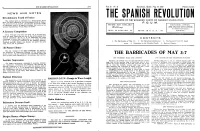
THE SPANISH REVOLUTION and Radio Opes at 8:15, When the Program Changes from English to Ital- Generality of Catalonia, Had Been Making Attacks Against the P.O.U.M
Vol. ii N.° a Barcelona, Spain; May 19, 1937 Please reprint NEWS AND NOTES Revolutionary Youth of France THE SPANISH REVOLUT The example given by Catalonia of a Revolutionary Youth BULLETIN OF THE WORKERS1 PARTY OF MARXIST UNIFICATION Front has been followed by the Revolutionary Youth of France. The Anarchist Youth and the Left Socialist Youth have made P. O. U. M. an agreement which it is hoped will become the nucleus of an AGENTS FOR ENGLAND: EDITORIAL OFFICE: inclusive Revolutionary Youth Front of France. The I. L. P. The Marxist League «77fE SPANISH REVOLUTION* 10. Rambla de los Estudios A Literary Competition PRICE IN ENGLAND: 2d. PRICE IN U. S, A.. OS BARCELONA Every revolution and every war gives rise to its own liter- ature and song. Those who are close to the action express their political aspirations. Th^ P. O. U. M. Militiamen are being encouraged to write their impressions of the battle front by CONTENTS means of a competition organized by the Editorial Marxista. Comrades Andrade, Gorkln and Escuder will select the prize 1: The Barricades of May 3-7. 2: The Barcelona Conference. 3: The Second P. O. U.M. Confe- work, which will be published. rence. 4: Dissention in the Socialist Youth. 5: Fools or Knaves. «E1 Pionero Rojo» The firs; number of the «RED PIONEER», the organ of the Federation of Communist Pioneers (of the Iberian Com- munist Youth), has just appeared. This interesting paper will THE BARRICADES OF MAY 3-7 help to make good Communists of the working class children. THE WORKERS HOLD THE STREETS THE ATTACK ON THE TELEPHONE BUILDING Another Supression Barcelona, the workers' city, has just lived through glorious Monday, May 3rd, at 3 p. -

Physical Activity and Youth in the Franco Dictatorship (1937-1961)
Rev.int.med.cienc.act.fís.deporte - vol. 14 - número 55 - ISSN: 1577-0354 Manrique Arribas, J.C. (2014). Actividad física y juventud en el franquismo (1937-1961) / Physical activity and youth in the Franco dictatorship (1937-1961). Revista Internacional de Medicina y Ciencias de la Actividad Física y el Deporte, vol. 14 (55) pp. 427-449. Http://cdeporte.rediris.es/revista/revista55/artactividad494.htm ORIGINAL PHYSICAL ACTIVITY AND YOUTH IN THE FRANCO DICTATORSHIP (1937-1961) ACTIVIDAD FÍSICA YJUVENTUD EN EL FRANQUISMO (1937-1961) Manrique Arribas, J.C. Profesor contratado doctor de la Universidad de Valladolid manrique@mpc.uva.es Spanish-English translator: Cristina Hernanz García, cristina_hernanz@hotmail.com Código UNESCO / UNESCO Code: 5599 Otras Especialidades: Historia (Historia de la actividad física y el deporte) / Others: History (History of sport and physical activity) Clasificación del Consejo de Europa / Council of Europe Classification: 7. Historia del deporte / History of sport Recibido 4 de enero de 2012 Received January 4, 2012 Aceptado 17 de diciembre de 2012 Accepted December 17, 2012 ABSTRACT This article analyzes the competences that different nationalist political organisations had in the field of physical activity had with regard to youth, particularly the “Delegación Nacional del Frente de Juventudes” and the “Delegación Nacional de Deportes”. Through the revision of the official documentation of the era and the contribution of studies already carried out on the subject, we try to show some common aspects and friction points that existed between the two institutions. While both delegations prioritized sport and physical activity as a tool for the indoctrination and adherence to the regime, however, the “Frente de Juventudes” tried it harder. -

THE SPANISH REVOLUTION N.°3 Vol
THE SPANISH REVOLUTION N.°3 Vol. II N.° 4 Barcelona, March 3, 1937 Please reprint NEWS AND NOTES English Workers Send Aid The Valencian City Council THE SPANISH REVOLUTION The English boat «Pacheo» has arrived at Valencia with On the evening of February 3rd, the new municipal Coun- BULLETIN OF THE WORKERS' PARTY OF MARXIST UNIFICATION 100 tons of provisions sent from London and destined for Ma- cil of Valencia was founded, with a comrade of the C. N. T. drid. The Committee has gathered the support from workers' as mayor and of the U. G. T. as deputy mayor. The body P. O. U. M organisations in all parts of Englard. The Spanish workers will be composed of six representatives of the C. N. T., six are deeply grateful for this new evidence of solidarity abroad. AGENTS FOR ENGLAND: EDITORIAL OFFICE: of the U. G. T., three of the P. A. I. three of the Socialist The 1. L. P. The workers are standing together, and thus they will be Party, three of the Communist Party, two of the P. O. U. M., The Marxist League .THE SPANISH REVOLUTION* invincible. two of the Valencian Left, two of the Left Va'.encian. Party, 10, Rambla de los Estudios two of the Spanish Left, three of the Republican Left, three PRICE IN ENGLAND: 2 d . BARCELONA of the Republican National Union and two of the Syndicalist PRICE IN U. S, A 05 Boycott Franco Party—thirty five in all. The three Scandinavian ships bound for ports of the fas- cist part of Spain are still tied up in England by order of Workers Front? CONTENTS the Scandinavian. -

Los Servicios De Prensa Extranjera En El Primer Franquismo (1936-1945)
Universidad de Alcalá de Henares Facultad de Filosofía y Letras Departamento de Historia II LOS SERVICIOS DE PRENSA EXTRANJERA EN EL PRIMER FRANQUISMO (1936-1945) Tesis doctoral Febrero 2008 Antonio César Moreno Cantano LOS SERVICIOS DE PRENSA EXTRANJERA EN EL PRIMER FRANQUISMO (1936-1945) UNIVERSIDAD DE ALCALÁ DE HENARES Autor: Moreno Cantano, Antonio César. Director: Montero García, Feliciano. ÍNDICE LOS SERVICIOS DE PRENSA EXTRANJERA EN EL PRIMER FRANQUISMO (1936-1945) AGRADECIMIENTOS ................................................................................ VII LISTA DE SIGLAS Y ABREVIATURAS .................................................. IX INTRODUCCIÓN ......................................................................................... XI PRIMERA PARTE: EL CONTROL DE LA PRENSA Y PROPAGANDA EXTRANJERA EN LA ESPAÑA DE FRANCO (1936-1945) ...................................................................................................... 1 CAPÍTULO 1 LA PROPAGANDA: ARMA DE GUERRA E INSTRUMENTO DE LEGITIMACIÓN .......................................................................................... 2 CAPÍTULO 2 ORGANIZACIÓN DEL APARATO DE PRENSA EN LOS INICIOS DEL FRANQUISMO (1936-1945) ................................................................ 16 CAPÍTULO 3 EL CONTROL DE LA PRENSA EXTRANJERA DURANTE LA GUERRA CIVIL (1936-1939) ....................................................................... 33 3.1. El papel de los Servicios de Información Militar ..................................... 34 3.2. Bolín y los -

The Extreme Right in Spain
View metadata, citation and similar papers at core.ac.uk brought to you by CORE provided by NORA - Norwegian Open Research Archives The Extreme Right in Spain Surviving in the Shadow of Franco (1975-2014) Hedda Samdahl Weltz Master in History IAKH Faculty of Humanities UNIVERSITY of OSLO Høst 2014 I II The extreme right in Spain Surviving in the Shadow of Franco (1975-2014) A master thesis By Hedda Samdahl Weltz 2014 IAKH UiO III Copyright ©Hedda Samdahl Weltz 2014 The Extreme Right in Spain – Surviving in the Shadow of Franco (1975-2014) Hedda Samdahl Weltz http://www.duo.uio.no Trykk: Reprosentralen, Universitetet i Oslo IV Abstract In this master thesis my aim is to investigate the extreme right in Spain after Franco, from 1975 to 2014. I will compare the three largest extreme right movements, FE de las JONS, CEDADE and Fuerza Nueva with the newly created coalition LEM. After almost 40 years of a national catholic dictatorship did Spain transform into a democracy in a couple of years. The importance of Franco’s person and the lack of cooperation between the remaining Francoist secured the easy democratic transition. The Falangist tradition of José Antonio Primo de Rivera and Franco’s regime have been of massive importance to the post-Franco extreme right in Spain. They claim to represent something new, but they are unable to escape the national catholic traditions of their predecessor. V VI Preface This master thesis is a party of the master program at the University of Oslo, 2014. The objective with this thesis is to clarify the role of the extreme right in post-Franco Spain. -

Falange, Autarky and Crisis: the Barcelona General Strike of 1951
Articles 29/4 1/9/99 3:27 pm Page 543 Michael Richards Falange, Autarky and Crisis: The Barcelona General Strike of 1951 ‘Salta la liebre donde menos se piensa’1 Barcelona, in February and March 1951, saw the most signifi- cant wave of popular protest since the heyday of the city’s revolu- tion during the Spanish Civil War of 1936–1939. Thousands of people from various social groups and of diverse political back- grounds or affiliation united in an escalating three-week series of protests against the exploitation and violence that had been imposed for eleven years by the Franco dictatorship. Initiated by a boycott of the city tram system, the movement culminated in a general strike in which some 300,000 workers took part, paralysing the city and shutting down production in the industrial centres.2 Within months of the Barcelona protests further strikes took place, both again in Barcelona and in other regions of Spain, principally, the urban centres. These events provide a glimpse of pent-up frustrations and suppressed identities under the dictator- ship: class consciousness, progressive Catalanism, civic soli- darity.3 Not until the mass demonstrations of 1976 which heralded the arrival of democracy in Spain, after forty years of Francoism, would popular unrest reach the level of 1951.4 It is unlikely that Franco’s regime was put in real danger. The massive apparatus of armed public control, which was, for reasons explored in this article, only briefly glimpsed in 1951, could not be more than inconvenienced by such a protest.5 Moreover, Francoism’s militant anti-communism meant that the regime was becoming a significant asset in the West’s Cold War struggle against the Soviet bloc, and was therefore supported and maintained particularly by the United States government.6 European History Quarterly Copyright © 1999 SAGE Publications, London, Thousand Oaks, CA and New Delhi, Vol. -

Original Francoist Sport and Physical Activity As A
Rev.int.med.cienc.act.fís.deporte - vol. X - número X - ISSN: 1577-0354 Manrique Arribas, J.C. (201x) La actividad físico-depotiva franquista como intento socializador de la juventud y la mujer / Sport as an Attempt to Socialize Youth and Women During the Franco Regime. Revista Internacional de Medicina y Ciencias de la Actividad Física y el Deporte vol. (*) pp. *. Http://cdeporte.rediris.es/revista/___* ORIGINAL FRANCOIST SPORT AND PHYSICAL ACTIVITY AS A SCHEME TO INDOCTRINATE YOUTH AND WOMEN LA ACTIVIDAD FÍSICO-DEPOTIVA FRANQUISTA COMO INTENTO SOCIALIZADOR DE LA JUVENTUD Y LA MUJER Manrique Arribas, J.C.1 1 Profesor Contratado Doctor. Universidad de Valladolid (España). manrique@mpc.uva.es Spanish-English translator: Enrique Martínez Gorroño, martingoenrique@gmail.com Código UNESCO / UNESCO code: 5599 Otras Especialidades: Historia (Historia de la actividad física y el deporte) / Others: History (History of sport and phsyical activity) Clasificación Consejo de Europa / Council of Europe classification: 7. Historia del deporte / History of sport Recibido 21 de marzo de 2016 Received March 21, 2016 Aceptado 17 de mayo de 2016 Accepted May 17, 2016 RESUMEN En este trabajo se analiza si los diferentes gobiernos que se fueron sucediendo durante las dos primeras décadas del franquismo (1939-1959) utilizaron la actividad físico-deportiva, especialmente entre la juventud y la mujer, para transmitir mejor los mensajes del modelo de sociedad que proponían y conseguir así un mayor número de afines al nacionalsindicalismo. Mediante la revisión documental de fuentes primarias y secundarias se puede concluir que la actividad físico-deportiva no influyó mayoritariamente en las actitudes de sus practicantes, aunque sí que condicionó las posibilidades de practicarlo. -

History of Youth Work in Europe, Volume 6: "Connections
Youth Knowledge # 23 This sixth publication in the History of Youth Work in Europe project THE HISTORY OF YOUTH WORK IN EUROPE based on the workshop held in Malta – Connections, Disconnections and Reconnections: The Social Dimension of Youth Work, in History and Today – looks at the relationship between youth work and social work and the role youth work can play in the social inclusion of young people. Contributors have reflected on concepts, tools and support measures for 6 Volume – history in Europe The work of youth more vulnerable and often socially excluded young people and have sought to promote a common understanding of youth work as a social practice. The workshop that led to this book sought to understand where youth work has positioned itself from its origins, through its development, to its contemporary identity. Is youth work as much a social practice as a non-formal educational one? Where does the balance between these two dimensions lie? What are the mutually enriching dimensions of these two fields in terms of their impact on young people’s lives? While most agree that youth work needs to be further defined as a practice or profession in itself and that the process of shaping its identity continues in different ways in different countries, it is clear that when it comes to a cross-sectoral perspective and youth work’s interaction with social work, the picture becomes significantly more complex, arguably much richer and certainly more dynamic than might have hitherto been foreseen. PREMS 011618 http://youth-partnership-eu.coe.int youth-partnership@partnership-eu.coe.int ENG The Council of Europe is the continent’s leading human The European Union is a unique economic and political partnership rights organisation. -
SONS AGENCY Office of Education (DHEW), Washington, D.C
DOCUMENT RESUME RD 011 988 24 80 005 497 AUTHOR Bressler, Marvin; Higgins, Judith TITLE The Political Left on Campus and In Society: The Active Decades. Final Report. INSTITUTION Princeton Univ., N.J. SONS AGENCY Office of Education (DHEW), Washington, D.C. Bureau of Research. BUREAU NO BR-9-0442 PUB DATE Dec 72 GRANT 0EG-2-9-400442-1058(010) NOTE 67p. EDRS PRICE MF -$0.65 MC-353.29 DESCRIPTORS *Activism; College Students; Communism; *Comparative Analysis; Dissent; Generation Gap; *Politica... Attitudes; Political Influences; Political Issues; *Social Action; Social Attitudes; Social Change; .Student Attitudes; Student College Relationship IDENTIFIERS *Counter Culture ABSTRACT A comparative analysis is made of the similarities and differences between youthful activists of the1960's with earlier periods, focusing upon the 1920's and 1930's. Thereport briefly sketches the political and romantic Student Left during thedecade of the sixties; delineates the characteristics of non-campus-based youthful radicalism as exemplified by the action and thoughtof the Young Communist League between 1922 and 1943; explores the nature of the student movements which emerged during the immediately ensuing period; and specifies resemblances and differences between thepast and present in order to better anticipate the future. Whilemuch of the data of the study are derived from conventional bibliographical sources, the main historical sections are based on an intensive analysis of all named issues of youth-oriented radicalperiodicals or newspapers. Findings for both past and present youth groups indicate they were preoccupied with social issues ofpeace, poverty, civil liberties, and racial discrimination, and withcampus issues of corporative control of the university, academic freedom, economic issues, and academic offerings. -

The Anti-Franco Student Movement's Contribution to the Return Of
Espacio, Tiempo y Educación E-ISSN: 2340-7263 jlhhuerta@mac.com FahrenHouse España Rodríguez Tejada, Sergio The anti-Franco student movement’s contribution to the return of democracy in Spain Espacio, Tiempo y Educación, vol. 2, núm. 2, julio-diciembre, 2015, pp. 77-106 FahrenHouse Salamanca, España Available in: http://www.redalyc.org/articulo.oa?id=477447182005 How to cite Complete issue Scientific Information System More information about this article Network of Scientific Journals from Latin America, the Caribbean, Spain and Portugal Journal's homepage in redalyc.org Non-profit academic project, developed under the open access initiative Cómo referenciar este artículo / How to reference this article Rodríguez Tejada, S. (2015). The anti-Franco student movement’s contribution to the return of democracy in Spain. Espacio, Tiempo y Educación, 2(2), 77-106. doi: http://dx.doi.org/10.14516/ete.2015.002.002.005 The anti-Franco student movement’s contribution to the return of democracy in Spain La contribución del movimiento estudiantil antifranquista al retorno de la democracia en España Sergio Rodríguez Tejada e-mail: Sergio.Rodriguez@uv.es Universitat de València. España Abstract: This paper analyzes the role played by the student movement in the restitution of democracy in Spain. Taking as a starting point the situation of university under the Franco dictatorship, and how (and why) students were dealt with, the major features that set the student movement apart from other kinds of activism in that time are described and linked to the unique effects that it had on the status quo, with a special stress on its ability to generate the kind of cultural change required for overcoming the atmosphere of resignation and consent that helped to keep the government in power. -

Revitalizing Youth in the Body Politics of Contemporary Spanish Culture by Aaron R. Boalick a Dissertation Submitted in Partial
Revitalizing Youth in the Body Politics of Contemporary Spanish Culture by Aaron R. Boalick A dissertation submitted in partial fulfillment of the requirements for the degree of Doctor of Philosophy (Romance Languages and Literatures: Spanish) in the University of Michigan 2013 Doctoral Committee: Professor Cristina Moreiras-Menor, Chair Professor David Caron Professor David Halperin Professor Alejandro Herrero-Olaizola Professor Juli Highfill © Aaron R. Boalick 2013 To Jeff ii Acknowledgements The Department of Romance Languages and Literatures of the University of Michigan, the Rackham Graduate School, and the Spanish Ministry of Culture’s Program for Cultural Cooperation provided ample financial support for this dissertation. Carin Scott and Katie Hayes graciously shepherded me through its administrative completion. Many dear friends challenged, encouraged, inspired, supported, and amused me during its writing: Ashley Rainey Donahey, Maxime Foerster, Aston Gonzalez, Trevor Hoppe, Tom Maranda, Maria Robles, and Rachel TenHaaf stand out among them. Jarrod Hayes offered precious mentorship and friendship throughout my graduate program. I owe my doctoral committee a great deal for enabling me to study modern Spanish culture, and for their rigorous feedback and mentorship that made my success possible. I am grateful to them for modeling the kinds of pedagogy and scholarship that I aspire to produce. David Caron’s wit is as sharp as his critical insight, and he has shaped my thinking in fundamental ways. David Halperin taught the world How To Be Gay, and he generously continues to teach me how to be an academic. Alejandro Herrero-Olaizola’s knows “all about Almodóvar,” and his support for and critique of my work are invaluable.