Review of the Genus Eucerceris (Hymenoptera: Sphecidae)
Total Page:16
File Type:pdf, Size:1020Kb
Load more
Recommended publications
-
Hymenoptera: Philanthinae) Hunting for Different Prey Types
C. R. Biologies 335 (2012) 279–291 Contents lists available at SciVerse ScienceDirect Comptes Rendus Biologies ww w.sciencedirect.com Animal biology and pathology/Biologie et pathologie animales Antennal sensillar equipment in closely related predatory wasp species (Hymenoptera: Philanthinae) hunting for different prey types E´quipement sensoriel des antennes dans des espe`ces proches de gueˆpes pre´dateurs (Hymenoptera: Philanthinae), qui chassent des proies diffe´rentes a, b a Carlo Polidori *, Alberto Jorge Garcı´a , Jose´ L. Nieves-Aldrey a Departamento de Biodiversidad y Biologı´a Evolutiva, Museo Nacional de Ciencias Naturales, C/Jose´ Gutie´rrez Abascal 2, 28006 Madrid, Spain b Laboratorio de Microscopia, Museo Nacional de Ciencias Naturales, C/Jose´ Gutie´rrez Abascal 2, 28006 Madrid, Spain A R T I C L E I N F O A B S T R A C T Article history: Despite its potential value in phylogenetic and ecological studies, the morphology of Received 17 November 2011 antennal sensilla has rarely been compared quantitatively within the Apoidea. Here, Accepted after revision 19 March 2012 through a scanning electron microscopy analysis, we provide an inventory of different Available online 24 April 2012 types of antennal sensilla and compare their morphology across 10 species of predatory wasps (Crabronidae: Philanthinae) including species that hunt exclusively either on Keywords: beetles or on bees to feed their larvae. A sensilla-free area was found on the apical Hymenoptera flagellomer of all but two species, and its shape and size appear to be useful for separating Crabronidae Philanthini from Cercerini within the subfamily. A total of eight types of sensilla (sensilla Sensilla size placoidea, sensilla basiconica, two types of pit organs, sensilla coelocapitula and three Comparative morphology types of sensilla trichoidea) were found in all species, and an additional rarer type Prey selection (grooved peg sensilla) was found only in three bee-hunting species and for first time in the genus Cerceris. -

Ants As Prey for the Endemic and Endangered Spanish Tiger Beetle Cephalota Dulcinea (Coleoptera: Carabidae) Carlo Polidori A*, Paula C
Annales de la Société entomologique de France (N.S.), 2020 https://doi.org/10.1080/00379271.2020.1791252 Ants as prey for the endemic and endangered Spanish tiger beetle Cephalota dulcinea (Coleoptera: Carabidae) Carlo Polidori a*, Paula C. Rodríguez-Flores b,c & Mario García-París b aInstituto de Ciencias Ambientales (ICAM), Universidad de Castilla-La Mancha, Avenida Carlos III, S/n, 45071, Toledo, Spain; bDepartamento de Biodiversidad y Biología Evolutiva, Museo Nacional de Ciencias Naturales (MNCN-CSIC), Madrid, 28006, Spain; cCentre d’Estudis Avançats de Blanes (CEAB-CSIC), C. d’Accés Cala Sant Francesc, 14, 17300, Blanes, Spain (Accepté le 29 juin 2020) Summary. Among the insects inhabiting endorheic, temporary and highly saline small lakes of central Spain during dry periods, tiger beetles (Coleoptera: Carabidae: Cicindelinae) form particularly rich assemblages including unique endemic species. Cephalota dulcinea López, De la Rosa & Baena, 2006 is an endemic, regionally protected species that occurs only in saline marshes in Castilla-La Mancha (Central Spain). Here, we report that C. dulcinea suffers potential risks associated with counter-attacks by ants (Hymenoptera: Formicidae), while using them as prey at one of these marshes. Through mark–recapture methods, we estimated the population size of C. dulcinea at the study marsh as of 1352 individuals, with a sex ratio slightly biased towards males. Evident signs of ant defensive attack by the seed-harvesting ant Messor barbarus (Forel, 1905) were detected in 14% of marked individuals, sometimes with cut ant heads still grasped with their mandibles to the beetle body parts. Ant injuries have been more frequently recorded at the end of adult C. -

This Work Is Licensed Under the Creative Commons Attribution-Noncommercial-Share Alike 3.0 United States License
This work is licensed under the Creative Commons Attribution-Noncommercial-Share Alike 3.0 United States License. To view a copy of this license, visit http://creativecommons.org/licenses/by-nc-sa/3.0/us/ or send a letter to Creative Commons, 171 Second Street, Suite 300, San Francisco, California, 94105, USA. EVOLUTIONARY ASPECTS OF GEOGRAPHICAL VARIATION IN COLOR AND OF PREY IN THE BEEWOLF SPECIES PHILANTHUS ALBOPILOSUS CRESSON Gerald J. Hilchie Department of Entomology University of Alberta Edmonton, Alberta, Canada Quaestiones Entomologicae T6G2E3 18:91-126 1982 ABSTRACT Prey selection and aspects of life history were studied in a population of Philanthus albopilosus Cresson, near Empress Alberta, and compared with published data reported about other populations. A disproportionately large number of sphecid wasps was used as prey in comparison with prey used by more southern populations. Females did not hunt at flowers, but appeared to hunt suitable apocritans found around the Empress dune, or captured male apocritans which pursued them as potential mates. False burrows appeared to function as visual aid in orientation to the nest. Relative absence of other species of Philanthus implies specialization of wasps of P. albopilosus for life on sand dunes. Differences in prey selected, nest structure and colour of adults suggest geographic isolation and differentiation during Pleistocene glaciations. The Nebraska Sand Hill region is proposed as a northern refugium where differentiation of the dark race, P. albopilosus, occurred during the Wisconsinian glacial stage. A southern refugium in the American Southwest is proposed for the ancestral stock of the pale race, P. albopilosus manuelito a newly described subspecies (type locality Monahans, Ward County, Texas). -
Simplification, Innateness, and the Absorption of Meaning from Context: How Novelty Arises from Gradual Network Evolution
Evol Biol DOI 10.1007/s11692-017-9407-x SYNTHESIS PAPER Simplification, Innateness, and the Absorption of Meaning from Context: How Novelty Arises from Gradual Network Evolution Adi Livnat1 Received: 25 May 2016 / Accepted: 6 January 2017 © The Author(s) 2017. This article is published with open access at Springerlink.com Abstract How does new genetic information arise? Tra- leads to complexity; and that evolution and learning are ditional thinking holds that mutation happens by accident conceptually linked. and then spreads in the population by either natural selec- tion or random genetic drift. There have been at least two Keywords Evolvability · Novelty · Cooption · fundamental conceptual problems with imagining an alter- Parsimony · Gene fusion · Instinct native. First, it seemed that the only alternative is a muta- tion that responds “smartly” to the immediate environment; [C]hange is taking place on many scales at the same but in complex multicellulars, it is hard to imagine how time, and ... it is the interaction among phenomena this could be implemented. Second, if there were mecha- on different scales that must occupy our attention. nisms of mutation that “knew” what genetic changes would —Simon A. Levin (1992). be favored in a given environment, this would have only begged the question of how they acquired that particular knowledge to begin with. This paper offers an alternative 1 Introduction that avoids these problems. It holds that mutational mecha- nisms act on information that is in the genome, based on There have been two main ways of thinking about the considerations of simplicity, parsimony, elegance, etc. nature of mutation and how it allows for adaptive evolution. -

Observations of Cerceris Fumipennis (Hymenoptera: Crabronidae) Phenology and Variation in Its Buprestid Prey in Louisiana C
Observations of Cerceris fumipennis (Hymenoptera: Crabronidae) phenology and variation in its buprestid prey in Louisiana C. Wood Johnson1,*, Ted C. MacRae2, Cavell Brownie3, Warren Virgets III4, and Jeremy D. Allison5 Abstract The non-native emerald ash borer,Agrilus planipennis Fairmaire (Coleoptera: Buprestidae), threatens extirpation of susceptible ash (Fraxinus species; Lamiales: Oleaceae) in North America. Cerceris fumipennis Say (Hymenoptera: Crabronidae), a ground-nesting wasp that preys on Buprestidae in eastern North America, is used as a survey tool for the emerald ash borer in the northeastern U.S. and Canada. The recent detection of the emerald ash borer in Louisiana provides an opportunity to complement trapping surveys with the use of C. fumipennis, but knowledge of C. fumipennis in the region is lacking. From 2011 to 2014, we conducted searches at 155 sites and located C. fumipennis aggregations at 25% (n = 39) of these sites; 36% (n = 14) of these were located at forest harvests, an aggregation habitat not previously reported in the literature. We collected 1,559 buprestids representing 35 species from 2 aggregations in Louisiana between May and Aug 2012. Buprestid collections at these aggregations and observations of C. fumipennis activity at a 3rd aggregation indicated the number of buprestid species and individuals collected declined significantly from May to Jul. We collected significantly moreAgrilus difficilis Gory (Coleoptera: Buprestidae) in the afternoon than morning hours and observed similar diurnal patterns among other buprestid species during the early weeks following aggregation activation. We also discuss evidence suggesting a portion of the regional C. fumipennis population is bivoltine. AlthoughA. planipennis was not collected during this study, our results suggest that C. -

Checklist of the Spheciform Wasps (Hymenoptera: Crabronidae & Sphecidae) of British Columbia
Checklist of the Spheciform Wasps (Hymenoptera: Crabronidae & Sphecidae) of British Columbia Chris Ratzlaff Spencer Entomological Collection, Beaty Biodiversity Museum, UBC, Vancouver, BC This checklist is a modified version of: Ratzlaff, C.R. 2015. Checklist of the spheciform wasps (Hymenoptera: Crabronidae & Sphecidae) of British Columbia. Journal of the Entomological Society of British Columbia 112:19-46 (available at http://journal.entsocbc.ca/index.php/journal/article/view/894/951). Photographs for almost all species are online in the Spencer Entomological Collection gallery (http://www.biodiversity.ubc.ca/entomology/). There are nine subfamilies of spheciform wasps in recorded from British Columbia, represented by 64 genera and 280 species. The majority of these are Crabronidae, with 241 species in 55 genera and five subfamilies. Sphecidae is represented by four subfamilies, with 39 species in nine genera. The following descriptions are general summaries for each of the subfamilies and include nesting habits and provisioning information. The Subfamilies of Crabronidae Astatinae !Three genera and 16 species of astatine wasps are found in British Columbia. All species of Astata, Diploplectron, and Dryudella are groundnesting and provision their nests with heteropterans (Bohart and Menke 1976). Males of Astata and Dryudella possess holoptic eyes and are often seen perching on sticks or rocks. Bembicinae Nineteen genera and 47 species of bembicine wasps are found in British Columbia. All species are groundnesting and most prefer habitats with sand or sandy soil, hence the common name of “sand wasps”. Four genera, Bembix, Microbembex, Steniolia and Stictiella, have been recorded nesting in aggregations (Bohart and Horning, Jr. 1971; Bohart and Gillaspy 1985). -

Diversity and Distribution of Hymenoptera Aculeata in Midwestern Brazilian Dry Forests
See discussions, stats, and author profiles for this publication at: https://www.researchgate.net/publication/264895151 Diversity and Distribution of Hymenoptera Aculeata in Midwestern Brazilian Dry Forests Chapter · September 2014 CITATIONS READS 2 457 6 authors, including: Rogerio Silvestre Manoel F Demétrio UFGD - Universidade Federal da Grande Dourados UFGD - Universidade Federal da Grande Dourados 41 PUBLICATIONS 539 CITATIONS 8 PUBLICATIONS 27 CITATIONS SEE PROFILE SEE PROFILE Bhrenno Trad Felipe Varussa de Oliveira Lima UFGD - Universidade Federal da Grande Dourados 4 PUBLICATIONS 8 CITATIONS 8 PUBLICATIONS 8 CITATIONS SEE PROFILE SEE PROFILE Some of the authors of this publication are also working on these related projects: Phylogeny and Biogeography of genus Eremnophila Menke, 1964 (HYMENOPTERA: Sphecidae) View project Functional diversity, phylogeny, ethology and biogeography of Hymenoptera in the chacoan subregion View project All content following this page was uploaded by Rogerio Silvestre on 28 November 2014. The user has requested enhancement of the downloaded file. 28 R. Silvestre, M. Fernando Demétrio, B. Maykon Trad et al. ENVIRONMENTAL HEALTH - PHYSICAL, CHEMICAL AND BIOLOGICAL FACTORS DRY FORESTS ECOLOGY, SPECIES DIVERSITY AND SUSTAINABLE MANAGEMENT FRANCIS ELIOTT GREER EDITOR Copyright © 2014 by Nova Science Publishers, Inc. Diversity and Distribution of Hymenoptera Aculeata ... 29 In: Dry Forests ISBN: 978-1-63321-291-6 Editor: Francis Eliott Greer © 2014 Nova Science Publishers, Inc. Chapter 2 DIVERSITY AND DISTRIBUTION -

Fauna Europaea: Hymenoptera – Apocrita (Excl
Biodiversity Data Journal 3: e4186 doi: 10.3897/BDJ.3.e4186 Data Paper Fauna Europaea: Hymenoptera – Apocrita (excl. Ichneumonoidea) Mircea-Dan Mitroiu‡§, John Noyes , Aleksandar Cetkovic|, Guido Nonveiller†,¶, Alexander Radchenko#, Andrew Polaszek§, Fredrick Ronquist¤, Mattias Forshage«, Guido Pagliano», Josef Gusenleitner˄, Mario Boni Bartalucci˅, Massimo Olmi ¦, Lucian Fusuˀ, Michael Madl ˁ, Norman F Johnson₵, Petr Janstaℓ, Raymond Wahis₰, Villu Soon ₱, Paolo Rosa₳, Till Osten †,₴, Yvan Barbier₣, Yde de Jong ₮,₦ ‡ Alexandru Ioan Cuza University, Faculty of Biology, Iasi, Romania § Natural History Museum, London, United Kingdom | University of Belgrade, Faculty of Biology, Belgrade, Serbia ¶ Nusiceva 2a, Belgrade (Zemun), Serbia # Schmalhausen Institute of Zoology, Kiev, Ukraine ¤ Uppsala University, Evolutionary Biology Centre, Uppsala, Sweden « Swedish Museum of Natural History, Stockholm, Sweden » Museo Regionale di Scienze Naturi, Torino, Italy ˄ Private, Linz, Austria ˅ Museo de “La Specola”, Firenze, Italy ¦ Università degli Studi della Tuscia, Viterbo, Italy ˀ Alexandru Ioan Cuza University of Iasi, Faculty of Biology, Iasi, Romania ˁ Naturhistorisches Museum Wien, Wien, Austria ₵ Museum of Biological Diversity, Columbus, OH, United States of America ℓ Charles University, Faculty of Sciences, Prague, Czech Republic ₰ Gembloux Agro bio tech, Université de Liège, Gembloux, Belgium ₱ University of Tartu, Institute of Ecology and Earth Sciences, Tartu, Estonia ₳ Via Belvedere 8d, Bernareggio, Italy ₴ Private, Murr, Germany ₣ Université -

Provisioning Patterns and Choice of Prey in the Digger Wasp Cerceris Arenaria (Hymenoptera: Crabronidae): the Role of Prey Size
NOTE Eur. J. Entomol. 102: 801–804, 2005 ISSN 1210-5759 Provisioning patterns and choice of prey in the digger wasp Cerceris arenaria (Hymenoptera: Crabronidae): the role of prey size CARLO POLIDORI, ROBERTO BOESI, FRANCESCO ISOLA and FRANCESCO ANDRIETTI Dipartimento di Biologia, Sezione di Zoologia e Citologia, Università degli Studi di Milano, via Celoria 26, 20133 Milano, Italy; e-mail: cpolidori @virgilio.it Key words. Cerceris arenaria, Hymenoptera, Crabronidae, behaviour, nest provisioning, prey, Curculionidae, hunting specialization Abstract. At a nest site in Northern Italy of females of the weevil-hunting digger wasp Cerceris arenaria L. (Hymenoptera: Crabronidae) the provisioning activity and predator-prey relationship were investigated, in particular their specialization in choice of prey. Females were active from middle of June to end of July, and from 8.00 to 19.00. The wasps made provisioning flights throughout the day, mostly in late morning and early afternoon. Individual wasps generally only hunted for 1 or 2 prey species of all those available, maybe because of their higher abundance. The size of prey, which is positively correlated with that of the female wasps, seems to be the main factor determining choice of prey. The nature of the provisioning flights seems to be related to the size of the prey, being more frequent and shorter for smaller weevils. The correlation between prey and wasp biomass is discussed in relation to the size range of the wasps. INTRODUCTION “small” (about 0.7–1.2 mm), “medium” (1.3–1.9 mm) or “large” prey (2.0–2.7 mm). The accurately measured wasps and prey Recent studies on sphecoid wasps have focused on predator- came from an area close to the aggregation of nests. -

Forest Health Highlights 2010 3
Wisconsin Forest Health Protection Annual Report 2010 Compiled and edited by Forest Health Protection Program Staff Wisconsin Forest Health Protection Program Division of Forestry Department of Natural Resources Premature color change in beech trees affected by beech scale in Door County, September, 2010. Photo by Bill McNee 2 Table of Contents Wisconsin DNR Forest Health Protection Staff ........................................................................................... 3 Wisconsin’s Forest Resources ........................................................................................................................... 5 Exotics ........................................................................................................................................................................ 7 Emerald Ash Borer – Agrilus planipennis ........................................................................................................................................ 7 Current status of EAB in Wisconsin ................................................................................................................................................... 7 Management Strategies ........................................................................................................................................................................... 9 Emerald Ash Borer: Using Sink Trees to Slow Population Spread..................................................................................... 11 Double-Decker Traps for Detecting -
Waspwatcher Program Bio-Surveillance for Invasive Beetles Using Native Wasps
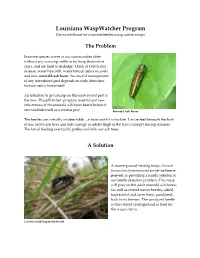
Louisiana WaspWatcher Program Bio-surveillance for invasive beetles using native wasps The Problem Invasive species arrive in our communities often without any warning, settle in for long destructive stays, and are hard to dislodge. Think of Dutch elm disease, water hyacinth, water lettuce, zebra mussels, and now emerald ash borer. Successful management of any introduced pest depends on early detection... forewarned is forearmed! An initiative to get a jump on this most recent pest is the new ‘WaspWatcher’ program used to spot new infestations of the emerald ash borer beetle before it can establish itself as a serious pest. Emerald Ash Borer The beetles are virtually undetectable ...at least until it is too late. Larvae feed beneath the bark of our native ash trees and only emerge as adults (high in the tree's canopy) during summer. The larval feeding eventually girdles and kills our ash trees. A Solution A native ground-nesting wasp, Cerceris fumipennis (pronounced sir-sir-us fum-a- pen-us), is providing a handy solution to our beetle detection problem. This wasp will prey on the adult emerald ash borers (as well as related native beetles, called buprestids) and carry them, paralyzed, back to its burrow. The paralyzed beetle is then stored underground as food for the wasp's larva. Cerceris with buprestid beetle YOU CAN BE A WASP WATCHER! Once nests are located in your vicinity you can watch the wasps as they return to their nests with prey. You can capture and send us what beetles are being collected. The wasp will not sting humans, even when handled. -

Hymenoptera: Sphecidae: Cercerini)
The Great Lakes Entomologist Volume 9 Number 4 - Winter 1976 Number 4 - Winter Article 9 1976 December 1976 A New Prey Record for Cerceris Fumipennis Say (Hymenoptera: Sphecidae: Cercerini) Daniel K. Young Michigan State University Follow this and additional works at: https://scholar.valpo.edu/tgle Part of the Entomology Commons Recommended Citation Young, Daniel K. 1976. "A New Prey Record for Cerceris Fumipennis Say (Hymenoptera: Sphecidae: Cercerini)," The Great Lakes Entomologist, vol 9 (4) Available at: https://scholar.valpo.edu/tgle/vol9/iss4/9 This Entomological Note is brought to you for free and open access by the Department of Biology at ValpoScholar. It has been accepted for inclusion in The Great Lakes Entomologist by an authorized administrator of ValpoScholar. For more information, please contact a ValpoScholar staff member at scholar@valpo.edu. Young: A New Prey Record for <i>Cerceris Fumipennis</i> Say (Hymenoptera 206 THE GREAT LAKES ENTOMOLOGIST Vol. 9. No. 4 From late August through September, 1975, adults of a species of Anaphes were repeatedly reared from eggs of Parydra sp., probably I? quadrituberculata Loew (Diptera: Ephydridae). Observations were made from eggs collected along a drainage ditch in Portage Co., Ohio. The ephydrid eggs had been deposited on reeds, stones, and other objects which protruded above the mud shores bordering the ditch The eggs were covered with a white to slightly green granulose coating composed of diatoms. The female applied this protective coating by defecating over the eggs following oviposition. The eggs measured approximately 0.84 mm by 0.24 mm and were deposited conterminously in clutches of 1 to 15, with 4 to 5 being the mean clutch size.