Santa Cruz Island Photo Interpretation and Mapping Classification Report
Total Page:16
File Type:pdf, Size:1020Kb
Load more
Recommended publications
-

Malosma Laurina (Nutt.) Nutt. Ex Abrams
I. SPECIES Malosma laurina (Nutt.) Nutt. ex Abrams NRCS CODE: Family: Anacardiaceae MALA6 Subfamily: Anacardiodeae Order: Sapindales Subclass: Rosidae Class: Magnoliopsida Immature fruits are green to red in mid-summer. Plants tend to flower in May to June. A. Subspecific taxa none B. Synonyms Rhus laurina Nutt. (USDA PLANTS 2017) C. Common name laurel sumac (McMinn 1939, Calflora 2016) There is only one species of Malosma. Phylogenetic analyses based on molecular data and a combination of D. Taxonomic relationships molecular and structural data place Malosma as distinct but related to both Toxicodendron and Rhus (Miller et al. 2001, Yi et al. 2004, Andrés-Hernández et al. 2014). E. Related taxa in region Rhus ovata and Rhus integrifolia may be the closest relatives and laurel sumac co-occurs with both species. Very early, Malosma was separated out of the genus Rhus in part because it has smaller fruits and lacks the following traits possessed by all species of Rhus : red-glandular hairs on the fruits and axis of the inflorescence, hairs on sepal margins, and glands on the leaf blades (Barkley 1937, Andrés-Hernández et al. 2014). F. Taxonomic issues none G. Other The name Malosma refers to the strong odor of the plant (Miller & Wilken 2017). The odor of the crushed leaves has been described as apple-like, but some think the smell is more like bitter almonds (Allen & Roberts 2013). The leaves are similar to those of the laurel tree and many others in family Lauraceae, hence the specific epithet "laurina." Montgomery & Cheo (1971) found time to ignition for dried leaf blades of laurel sumac to be intermediate and similar to scrub oak, Prunus ilicifolia, and Rhamnus crocea; faster than Heteromeles arbutifolia, Arctostaphylos densiflora, and Rhus ovata; and slower than Salvia mellifera. -

Qty Size Name 6 1G Abies Bracteata 10 1G Abutilon Palmeri 1 1G Acaena Pinnatifida Var
REGIONAL PARKS BOTANIC GARDEN, TILDEN REGIONAL PARK, BERKELEY, CALIFORNIA Celebrating 76 years of growing California native plants: 1940-2016 **FINAL**PLANT SALE LIST **FINAL** (9/30/2016 @ 6:00 PM) visit: www.nativeplants.org for the most up to date plant list FALL PLANT SALE OF CALIFORNIA NATIVE PLANTS SATURDAY, OCTOBER 1, 2016 PUBLIC SALE: 10:00 AM TO 3:00 PM MEMBERS ONLY SALE: 9:00 AM TO 10:00 AM MEMBERSHIPS ARE AVAILABLE AT THE ENTRY TO THE SALE AT 8:30 AM Qty Size Name 6 1G Abies bracteata 10 1G Abutilon palmeri 1 1G Acaena pinnatifida var. californica 18 1G Achillea millefolium 10 4" Achillea millefolium - Black Butte 28 4" Achillea millefolium 'Island Pink' 8 4" Achillea millefolium 'Rosy Red' - donated by Annie's Annuals 2 4" Achillea millefolium 'Sonoma Coast' 7 4" Acmispon (Lotus) argophyllus var. argenteus 9 1G Actea rubra f. neglecta (white fruits) 25 4" Adiantum x tracyi (A. jordanii x A. aleuticum) 5 1G Aesculus californica 1 2G Agave shawii var. shawii 2 1G Agoseris grandiflora 8 1G Alnus incana var. tenuifolia 2 2G Alnus incana var. tenuifolia 5 4" Ambrosia pumila 5 1G Amelanchier alnifolia var. semiintegrifolia 9 1G Anemopsis californica 5 1G Angelica hendersonii 3 1G Angelica tomentosa 1 1G Apocynum androsaemifolium x Apocynum cannabinum 7 1G Apocynum cannabinum 5 1G Aquilegia formosa 2 4" Aquilegia formosa 4 4" Arbutus menziesii 2 1G Arctostaphylos andersonii 2 1G Arctostaphylos auriculata 3 1G Arctostaphylos 'Austin Griffith' 11 1G Arctostaphylos bakeri 5 1G Arctostaphylos bakeri 'Louis Edmunds' 2 1G Arctostaphylos canescens 2 1G Arctostaphylos canescens subsp. -

Prunus Ilicifolia (Hooker & Arnott) D. Dietr. Subsp. Ilicifolia, HOLLY
Prunus ilicifolia (Hooker & Arnott) D. Dietr. subsp. ilicifolia , HOLLY-LEAVED CHERRY, ISLAY . Shrub or small tree, evergreen, sclerophyllous, somewhat spinescent, highly branched and forming a dense canopy, 100–800 cm tall; shoots with dark green foliage, ± folded upward from midrib, with leaves bent downward and hiding stem on water-stressed shrubs, essentially glabrous. Stems: cylindric, when young reddish brown to grayish brown, with odor of bitter almonds (hydrogen cyanide) when scratched; old bark grayish, fairly smooth, with small horizontal lenticels. Leaves: helically alternate, simple, petiolate, with stipules; stipules 2, attached to petiole base, awl-shaped, < 2.5 mm long, entire or sometimes fringed, with some hairs near base, aging purple and early-deciduous; petiole 4–11 mm long, glands absent; blade ovate to round, 16–65 × 12–50 mm, tough, rounded to cordate at base, spinose-dentate or serrate on margins and often wavy, obtuse to rounded or truncate at tip, pinnately veined with midrib raised on lower surface, becoming glabrescent, upper surface initially glossy aging satiny. Inflorescence: raceme or panicle with a central raceme and 2–4 lateral racemes from base, arising mostly from dormant bud prior to vegetative growth, having bud scales at base, each raceme 13–30- flowered, (15–)25–80 × 13–20 mm, flowers ± alternate, bracteate, glabrous to glabrate; bract subtending raceme leaflike but reduced or broadly triangular and 3-toothed at tip; rachis somewhat ridged, glabrous or with widely scattered hairs; bractlet subtending pedicel ± triangular to awl-shaped or cupped-ovate, 0.7–2.6 mm long, light green, deeply 3-toothed with acuminate teeth (basal flowers) to acuminate at tip, sparsely short-ciliate mostly above midpoint, abscising when bud small leaving a raised scar; pedicel 0.2–5 mm long. -

UNIVERSITY of CALIFORNIA Santa Barbara Ancient Plant Use and the Importance of Geophytes Among the Island Chumash of Santa Cruz
UNIVERSITY OF CALIFORNIA Santa Barbara Ancient Plant Use and the Importance of Geophytes among the Island Chumash of Santa Cruz Island, California A dissertation submitted in partial satisfaction of the requirements for the degree of Doctor of Philosophy in Anthropology by Kristina Marie Gill Committee in charge: Professor Michael A. Glassow, Chair Professor Michael A. Jochim Professor Amber M. VanDerwarker Professor Lynn H. Gamble September 2015 The dissertation of Kristina Marie Gill is approved. __________________________________________ Michael A. Jochim __________________________________________ Amber M. VanDerwarker __________________________________________ Lynn H. Gamble __________________________________________ Michael A. Glassow, Committee Chair July 2015 Ancient Plant Use and the Importance of Geophytes among the Island Chumash of Santa Cruz Island, California Copyright © 2015 By Kristina Marie Gill iii DEDICATION This dissertation is dedicated to my Family, Mike Glassow, and the Chumash People. iv ACKNOWLEDGEMENTS I am indebted to many people who have provided guidance, encouragement, and support in my career as an archaeologist, and especially through my undergraduate and graduate studies. For those of whom I am unable to personally thank here, know that I deeply appreciate your support. First and foremost, I want to thank my chair Michael Glassow for his patience, enthusiasm, and encouragement during all aspects of this daunting project. I am also truly grateful to have had the opportunity to know, learn from, and work with my other committee members, Mike Jochim, Amber VanDerwarker, and Lynn Gamble. I cherish my various field experiences with them all on the Channel Islands and especially in southern Germany with Mike Jochim, whose worldly perspective I value deeply. I also thank Terry Jones, who provided me many undergraduate opportunities in California archaeology and encouraged me to attend a field school on San Clemente Island with Mark Raab and Andy Yatsko, an experience that left me captivated with the islands and their history. -
Qty Size Name Price 10 1G Abies Bracteata 12.00 $ 15 1G Abutilon
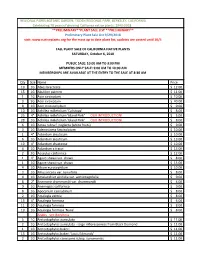
REGIONAL PARKS BOTANIC GARDEN, TILDEN REGIONAL PARK, BERKELEY, CALIFORNIA Celebrating 78 years of growing California native plants: 1940-2018 **PRELIMINARY**PLANT SALE LIST **PRELIMINARY** Preliminary Plant Sale List 9/29/2018 visit: www.nativeplants.org for the most up to date plant list, updates are posted until 10/5 FALL PLANT SALE OF CALIFORNIA NATIVE PLANTS SATURDAY, October 6, 2018 PUBLIC SALE: 10:00 AM TO 3:00 PM MEMBERS ONLY SALE: 9:00 AM TO 10:00 AM MEMBERSHIPS ARE AVAILABLE AT THE ENTRY TO THE SALE AT 8:30 AM Qty Size Name Price 10 1G Abies bracteata $ 12.00 15 1G Abutilon palmeri $ 11.00 1 1G Acer circinatum $ 10.00 3 5G Acer circinatum $ 40.00 8 1G Acer macrophyllum $ 9.00 10 1G Achillea millefolium 'Calistoga' $ 8.00 25 4" Achillea millefolium 'Island Pink' OUR INTRODUCTION! $ 5.00 28 1G Achillea millefolium 'Island Pink' OUR INTRODUCTION! $ 8.00 6 1G Actea rubra f. neglecta (white fruits) $ 9.00 3 1G Adenostoma fasciculatum $ 10.00 1 4" Adiantum aleuticum $ 10.00 6 1G Adiantum aleuticum $ 13.00 10 4" Adiantum shastense $ 10.00 4 1G Adiantum x tracyi $ 13.00 2 2G Aesculus californica $ 12.00 1 4" Agave shawii var. shawii $ 8.00 1 1G Agave shawii var. shawii $ 15.00 4 1G Allium eurotophilum $ 10.00 3 1G Alnus incana var. tenuifolia $ 8.00 4 1G Amelanchier alnifolia var. semiintegrifolia $ 9.00 8 2" Anemone drummondii var. drummondii $ 4.00 9 1G Anemopsis californica $ 9.00 8 1G Apocynum cannabinum $ 8.00 2 1G Aquilegia eximia $ 8.00 15 4" Aquilegia formosa $ 6.00 11 1G Aquilegia formosa $ 8.00 10 1G Aquilegia formosa 'Nana' $ 8.00 Arabis - see Boechera 5 1G Arctostaphylos auriculata $ 11.00 2 1G Arctostaphylos auriculata - large inflorescences from Black Diamond $ 11.00 1 1G Arctostaphylos bakeri $ 11.00 15 1G Arctostaphylos bakeri 'Louis Edmunds' $ 11.00 2 1G Arctostaphylos canescens subsp. -

The Jepson Manual: Vascular Plants of California, Second Edition Supplement II December 2014
The Jepson Manual: Vascular Plants of California, Second Edition Supplement II December 2014 In the pages that follow are treatments that have been revised since the publication of the Jepson eFlora, Revision 1 (July 2013). The information in these revisions is intended to supersede that in the second edition of The Jepson Manual (2012). The revised treatments, as well as errata and other small changes not noted here, are included in the Jepson eFlora (http://ucjeps.berkeley.edu/IJM.html). For a list of errata and small changes in treatments that are not included here, please see: http://ucjeps.berkeley.edu/JM12_errata.html Citation for the entire Jepson eFlora: Jepson Flora Project (eds.) [year] Jepson eFlora, http://ucjeps.berkeley.edu/IJM.html [accessed on month, day, year] Citation for an individual treatment in this supplement: [Author of taxon treatment] 2014. [Taxon name], Revision 2, in Jepson Flora Project (eds.) Jepson eFlora, [URL for treatment]. Accessed on [month, day, year]. Copyright © 2014 Regents of the University of California Supplement II, Page 1 Summary of changes made in Revision 2 of the Jepson eFlora, December 2014 PTERIDACEAE *Pteridaceae key to genera: All of the CA members of Cheilanthes transferred to Myriopteris *Cheilanthes: Cheilanthes clevelandii D. C. Eaton changed to Myriopteris clevelandii (D. C. Eaton) Grusz & Windham, as native Cheilanthes cooperae D. C. Eaton changed to Myriopteris cooperae (D. C. Eaton) Grusz & Windham, as native Cheilanthes covillei Maxon changed to Myriopteris covillei (Maxon) Á. Löve & D. Löve, as native Cheilanthes feei T. Moore changed to Myriopteris gracilis Fée, as native Cheilanthes gracillima D. -

The Genus Ceanothus: Wild Lilacs and Their Kin
THE GENUS CEANOTHUS: WILD LILACS AND THEIR KIN CEANOTHUS, A GENUS CENTERED IN CALIFORNIA AND A MEMBER OF THE BUCKTHORN FAMILY RHAMNACEAE The genus Ceanothus is exclusive to North America but the lyon’s share of species are found in western North America, particularly California • The genus stands apart from other members of the Rhamnaceae by • Colorful, fragrant flowers (blues, purples, pinks, and white) • Dry, three-chambered capsules • Sepals and petals both colored and shaped in a unique way, and • Three-sided receptacles that persist after the seed pods have dropped Ceanothus blossoms feature 5 hooded sepals, 5 spathula-shaped petals, 5 stamens, and a single pistil with a superior ovary Ceanothus seed pods are three sided and appear fleshy initially before drying out, turning brown, and splitting open Here are the three-sided receptacles left behind when the seed pods fall off The ceanothuses range from low, woody ground covers to treelike forms 20 feet tall • Most species are evergreen, but several deciduous kinds also occur • Several species feature thorny side branches • A few species have highly fragrant, resinous leaves • Habitats range from coastal bluffs through open woodlands & forests to chaparral and desert mountains The genus is subdivided into two separate subgenera that seldom exchange genes, even though species within each subgenus often hybridize • The true ceanothus subgenus (simply called Ceanothus) is characterized by • Alternate leaves with deciduous stipules • Leaves that often have 3 major veins (some have a single prominent midrib) • Flowers mostly in elongated clusters • Smooth seed pods without horns • The majority of garden species available belong to this group The leaves of C. -
Sanhedrin Chapter Newsletter Fall 2014
California Native Plant Society - Sanhedrin Chapter Newsletter Fall 2014 Sanhedrin Chapter Fall Presentation - October 16th at 7 pm Ken Montgomery: Native Plant Gardening for the Drought Ukiah Garden Club House, 1203 W. Clay St. Ukiah Free and open to all Ken Montgomery is the longtime owner of the Anderson Valley Nursery in Boonville, specializing in California native plants. He is a delightful, enthusiastic and knowledgeable presenter. Ken brings a wealth of practical knowledge in all aspects of gardening, including native plants. He has spoken with other groups and has been instrumental in restoration work, including involving students in these projects. In this time of drought and lawns drying up, come find out how native plants can save on water use, be low maintenance and enhance our environment. Hedgerow uses will also be discussed. Fall Events Potter Valley Oak Restoration; Public Workshop, September 20 The workshop will highlight the protection and restoration of oaks in Potter Valley, a topic pertinent to all of Mendocino County. Interested residents, especially from Potter Valley, are cordially invited to this free event. Speakers will discuss the status of oaks in California and in Potter Valley followed by a fun and beautiful presentation about wildlife in the oaks, a story of incredible productivity and diversity. Park Steiner (463-4265) or Jackson Ford (463-4622) * Mendocino Co. DOT. Orr Creek Clean-up, Saturday, September 20 Love your rivers? The Russian and its many tributaries such as Orr Creek are in need of help. This is a good time to get involved in one of the many river clean-ups scheduled this fall. -

95 Oak Ecosystem Restoration on Santa Catalina Island, California
95 QUANTIFICATION OF FOG INPUT AND USE BY QUERCUS PACIFICA ON SANTA CATALINA ISLAND Shaun Evola and Darren R. Sandquist Department of Biological Science, California State University, Fullerton 800 N. State College Blvd., Fullerton, CA 92834 USA Email address for corresponding author (D. R. Sandquist): dsandquist@fullerton.edu ABSTRACT: The proportion of water input resulting from fog, and the impact of canopy dieback on fog-water input, was measured throughout 2005 in a Quercus pacifica-dominated woodland of Santa Catalina Island. Stable isotopes of oxygen were measured in water samples from fog, rain and soils and compared to those found in stem-water from trees in order to identify the extent to which oak trees use different water sources, including fog drip, in their transpirational stream. In summer 2005, fog drip contributed up to 29 % of water found in the upper soil layers of the oak woodland but oxygen isotope ratios in stem water suggest that oak trees are using little if any of this water, instead depending primarily on water from a deeper source. Fog drip measurements indicate that the oak canopy in this system actually inhibits fog from reaching soil underneath the trees; however, fog may contribute additional water in areas with no canopy. Recent observations on Santa Catalina show a significant decline in oak woodlands, with replacement by non-native grasslands. The results of this study indicate that as canopy dieback and oak mortality continue additional water may become available for these invasive grasses. KEYWORDS: Fog drip, oak woodland, Quercus pacifica, Santa Catalina Island, stable isotopes, water use. -

Santa Catalina Island1
Oak Restoration Trials: Santa Catalina 1 Island Lisa Stratton2 Two restoration trials involving four oak species have been implemented as part of a larger restoration program for Catalina Island. In 1997 the Catalina Island Conservancy began an active program of restoration after 50 years of ranching and farming activities on the island. The restoration program includes removing feral goats and pigs island-wide and converting 80 acres of old hayfields in Middle Canyon to native plant communities. This conversion presented the opportunity to implement experimental restoration trials to test the efficiency and efficacy of a variety of restoration techniques. The primary challenges to restoration in these areas include bison disturbance, deer browsing, long dry seasons and disturbed, weed saturated soils (e.g., Avena fatua, Cynodon dactylon (Bermuda grass), Phalaris aquatica (Harding grass) and incipient populations of Foeniculum vulgare (fennel) and Nicotiana glauca (tree tobacco). In 1999, an island scrub oak seedling trial (Quercus pacifica) was initiated to compare three different watering treatments: 1) a commercial time-release product, Driwater, 2) monthly deep-pipe watering and, 3) unwatered controls. This trial is also a factorial design that includes a native soil component. Soil from beneath mature oaks, potentially containing spore from the oak ectomycorrhizal associate, was added to half the holes at planting time. After two years the seedlings receiving the monthly watering supplements in the deep pipes were significantly taller (p<0.001) than either the no water or Driwater product treatments (45 inches vs. 33 and 29 respectively). Survivorship was higher for the deep pipe treatment (98 percent vs. -
Rhus Integrifolia (Nutt.) Rothr., LEMONADEBERRY. Shrub Or Small
Rhus integrifolia (Nutt.) Rothr., LEMONADEBERRY. Shrub or small tree, evergreen, sclerophyllous, highly branched with dense canopy, in range 100–600 cm tall; gynodioecious; shoots in full sun with mostly ascending to erect leaves, in early spring forming new shoots from axillary buds below inflorescences, strongly aromatic like wintergreen (Gaultheria) when cut or crushed (having resin ducts with terpenes). Stems: cylindric, limber, when young red and brown with grayish cast from pubescence and scaly waxy plates; producing colorless resin in bark ducts, in ×-section the ducts elliptic, 16–18 arranged in ring; twig bark dull gray, trunk bark with thick, gray flakes; trunk to 40 cm diameter in arborescent forms. Leaves: helically alternate, simple, petiolate, without stipules; petiole 4–12(–15) mm long, reddish, sparsely pubescent and waxy with ± scaly plates; blade broadly elliptic to elliptic-ovate, (15–)25–70 × (10–)20–45 mm, leathery, flat or ± cupped to underside, broadly tapered to round at base, entire or coarsely serrate with shallow teeth and wavy on margins, ± transparent light pink or green at edge, ± obtuse to broadly acute at tip, pinnately veined with principal veins slightly raised on both surfaces, glabrous or with hairs and ± scaly waxy plates along lower midrib, satiny to glaucous, upper surface dark green, lower surface yellow-green. Inflorescence: panicle of spikes having either pistillate flowers or bisexual flowers (separate individuals), panicle 20–70 × 20–50 mm, compact spikes on primary to tertiary branches, many-flowered, -
Tree and Shrub Community Monitoring Protocol for Channel Islands National Park, California
Tree and Shrub Community Monitoring Protocol for Channel Islands National Park, California By Kathryn McEachern U.S. GEOLOGICAL SURVEY Open-File Report 00-74 Sacramento, California 2000 U.S. DEPARTMENT OF THE INTERIOR BRUCE BABBITT, Secretary U.S. GEOLOGICAL SURVEY Charles G. Groat, Director The use of firm, trade, and brand names in this report is for identification purposes only and does not constitute endorsement by the U.S. Geological Survey For additional information write to: Copies of this report can be purchased from: Distsrict Chief U.S. Geological Survey U.S. Geological Survey Information Services Placer Hall, Suite 2012 Box25286 6000 J Street Federal Center Sacramento, CA 95819-6129 Denver, CO 80225 TABLE OF CONTENTS Shrub Monitoring Protocol 2 JT|7i 1C1U. A| /\ Data Analysis 5 Tree Monitoring Protocol 5 Litter Monitoring Protocol 6 Ungulate Use Monitoring 1 Ungulate Use Rating of Vegetation Transects 8 i_fiieraiure ^^IICQ y LIST OF TABLES Table 1. Tree and shrub dominated community sample sizes on San Miguel, Santa Rosa and East Santa Cruz Islands 3 Table 2. Trees, shrubs and sub-shrubs likely to be encountered on sample transects, Channel Islands National Park, California 4 Shrubs and trees should respond to the cessation of grazing in several ways: with increased canopy growth, additional stem production, and for certain species, with seedling recruitment. Therefore, the method for monitoring these changes will record canopy coverage, stem density, plant size and recruitment. Additionally, conservation strategies written for the islands (Coonan et al 1996) identify litter accumulation as an important process for seed bank development and eventual community recovery.