Zeitschrift Für Säugetierkunde
Total Page:16
File Type:pdf, Size:1020Kb
Load more
Recommended publications
-
Mammalian Chromosomes Volume8
AN ATLAS OF MAMMALIAN CHROMOSOMES VOLUME8 T.C.HSU KURT BENIRSCHKE Section of Cytology, Department Department of Obstetries of Biology, The University of & Gynecology, School of Medicine, Texas M. D. Anderson Hospital and University of California, San Diego, Tumor Institute, Houston, Texas La Jolla, California SPRINGER SCIENCE+BUSINESS MEDIA, LLC 1974 ~ All rights reserved, especially that of translation into foreign languages. It is also forbidden to reproduce this book, either whole or in part, by photomechanical means (photostat, microfilm, and/or microcard) or by other procedure without written permission from Springer Science+Business Media, LLC Library of Congress Catalog Card Number 67-19307 © 1974 by Springer Science+Business Media New York Originally published by Springer-Verlag New York Heidelberg Berlin in 1974 ISBN 978-1-4684-7995-9 ISBN 978-1-4615-6432-4 (eBook) DOI 10.1007/978-1-4615-6432-4 Introduction to Volume 8 This series of Mammalian Chromosomes started before the advent of many revolutionary procedures for chromosome characterization. During the last few years, conventional karyotyping was found to be inadequate because the various ban ding techniques ofIer much more precise information. Unfortu nately, it is not feasible to induce banding from old slides, so that wh at was reported with conventional straining methods must remain until new material can be obtained. We present, in this volume, a few of these. We consider presenting the ban ding patterns of a few more important species such as man, mouse, rat, etc., in our future volumes. As complete sets (male and female ) of karyotypes are more and more diffi cult to come by, we begin to place two species in the same genus on one plate. -

High Levels of Gene Flow in the California Vole (Microtus Californicus) Are Consistent Across Spatial Scales," Western North American Naturalist: Vol
Western North American Naturalist Volume 70 Number 3 Article 3 10-11-2010 High levels of gene flow in the California olev (Microtus californicus) are consistent across spatial scales Rachel I. Adams Stanford University, Stanford, California, adamsri@stanford.edu Elizabeth A. Hadly Stanford University, Stanford, California, hadly@stanford.edu Follow this and additional works at: https://scholarsarchive.byu.edu/wnan Recommended Citation Adams, Rachel I. and Hadly, Elizabeth A. (2010) "High levels of gene flow in the California vole (Microtus californicus) are consistent across spatial scales," Western North American Naturalist: Vol. 70 : No. 3 , Article 3. Available at: https://scholarsarchive.byu.edu/wnan/vol70/iss3/3 This Article is brought to you for free and open access by the Western North American Naturalist Publications at BYU ScholarsArchive. It has been accepted for inclusion in Western North American Naturalist by an authorized editor of BYU ScholarsArchive. For more information, please contact scholarsarchive@byu.edu, ellen_amatangelo@byu.edu. Western North American Naturalist 70(3), © 2010, pp. 296–311 HIGH LEVELS OF GENE FLOW IN THE CALIFORNIA VOLE (MICROTUS CALIFORNICUS) ARE CONSISTENT ACROSS SPATIAL SCALES Rachel I. Adams1,2 and Elizabeth A. Hadly1 ABSTRACT.—Gene flow links the genetic and demographic structures of species. Despite the fact that similar genetic and demographic patterns shape both local population structure and regional phylogeography, the 2 levels of population connectivity are rarely studied simultaneously. Here, we studied gene flow in the California vole (Microtus californicus), a small-bodied rodent with limited vagility but high local abundance. Within a 4.86-km2 preserve in central California, genetic diversity in 6 microsatellites was high, and Bayesian methods indicated a single genetic cluster. -

Mammals of the California Desert
MAMMALS OF THE CALIFORNIA DESERT William F. Laudenslayer, Jr. Karen Boyer Buckingham Theodore A. Rado INTRODUCTION I ,+! The desert lands of southern California (Figure 1) support a rich variety of wildlife, of which mammals comprise an important element. Of the 19 living orders of mammals known in the world i- *- loday, nine are represented in the California desert15. Ninety-seven mammal species are known to t ':i he in this area. The southwestern United States has a larger number of mammal subspecies than my other continental area of comparable size (Hall 1981). This high degree of subspeciation, which f I;, ; leads to the development of new species, seems to be due to the great variation in topography, , , elevation, temperature, soils, and isolation caused by natural barriers. The order Rodentia may be k., 2:' , considered the most successful of the mammalian taxa in the desert; it is represented by 48 species Lc - occupying a wide variety of habitats. Bats comprise the second largest contingent of species. Of the 97 mammal species, 48 are found throughout the desert; the remaining 49 occur peripherally, with many restricted to the bordering mountain ranges or the Colorado River Valley. Four of the 97 I ?$ are non-native, having been introduced into the California desert. These are the Virginia opossum, ' >% Rocky Mountain mule deer, horse, and burro. Table 1 lists the desert mammals and their range 1 ;>?-axurrence as well as their current status of endangerment as determined by the U.S. fish and $' Wildlife Service (USWS 1989, 1990) and the California Department of Fish and Game (Calif. -

Safe Harbor Agreement
SAFE HARBOR AGREEMENT FOR THE RE-INTRODUCTION OF THE AMARGOSA VOLE (Microtus californicus scirpensis), IN SHOSHONE, CALIFORNIA Prepared by U.S. Fish and Wildlife Service, Carlsbad Fish and Wildlife Office and Susan Sorrells July 7, 2020 2 Table of Contents 1.0 INTRODUCTION ............................................................................................................ 5 Purpose .................................................................................................................................... 5 Enrolled Lands and Core Area ................................................................................................ 5 Regulatory Framework ........................................................................................................... 5 SHA Standard and Background .............................................................................................. 6 Assurances Provided ............................................................................................................... 6 Relationship to Other Agreements .......................................................................................... 6 2.0 STATUS AND BACKGROUND OF AMARGOSA VOLE .......................................... 7 2.1 Status and Distribution ................................................................................................. 7 2.2 Life History and Habitat Requirements ........................................................................ 8 2.3 Threats ....................................................................................................................... -
Implications of Climate Change for Food-Caching Species
Demographic and Environmental Drivers of Canada Jay Population Dynamics in Algonquin Provincial Park, ON by Alex Odenbach Sutton A Thesis presented to The University of Guelph In partial fulfilment of requirements for the degree of Doctor of Philosophy in Integrative Biology Guelph, Ontario, Canada © Alex O. Sutton, April 2020 ABSTRACT Demographic and Environmental Drivers of Canada Jay Population Dynamics in Algonquin Provincial Park, ON Alex Sutton Advisor: University of Guelph, 2020 Ryan Norris Knowledge of the demographic and environmental drivers of population growth throughout the annual cycle is essential to understand ongoing population change and forecast future population trends. Resident species have developed a suite of behavioural and physiological adaptations that allow them to persist in seasonal environments. Food-caching is one widespread behavioural mechanism that involves the deferred consumption of a food item and special handling to conserve it for future use. However, once a food item is stored, it can be exposed to environmental conditions that can either degrade or preserve its quality. In this thesis, I combine a novel framework that identifies relevant environmental conditions that could cause cached food to degrade over time with detailed long-term demographic data collected for a food-caching passerine, the Canada jay (Perisoreus canadensis), in Algonquin Provincial Park, ON. In my first chapter, I develop a framework proposing that the degree of a caching species’ susceptibility to climate change depends primarily on the duration of storage and the perishability of food stored. I then summarize information from the field of food science to identify relevant climatic variables that could cause cached food to degrade. -
Further Assessment of the Genus Neodon and the Description of a New Species from Nepal
RESEARCH ARTICLE Further assessment of the Genus Neodon and the description of a new species from Nepal 1³ 2 2 3 Nelish PradhanID , Ajay N. Sharma , Adarsh M. Sherchan , Saurav Chhetri , 4 1³ Paliza Shrestha , C. William KilpatrickID * 1 Department of Biology, University of Vermont, Burlington, Vermont, United States of America, 2 Center for Molecular Dynamics±Nepal, Kathmandu, Nepal, 3 Department of Biology, Trinity University, San Antonio, Texas, United States of America, 4 Department of Plant and Soil Science, University of Vermont, Burlington, Vermont, United States of America a1111111111 ³ These authors are joint senior authors on this work. a1111111111 * wkilpatr@uvm.edu a1111111111 a1111111111 a1111111111 Abstract Recent molecular systematic studies of arvicoline voles of the genera Neodon, Lasiopod- omys, Phaiomys, and Microtus from Central Asia suggest the inclusion of Phaiomys leu- OPEN ACCESS curus, Microtus clarkei, and Lasiopodomys fuscus into Neodon and moving Neodon juldaschi into Microtus (Blanfordimys). In addition, three new species of Neodon (N. linz- Citation: Pradhan N, Sharma AN, Sherchan AM, Chhetri S, Shrestha P, Kilpatrick CW (2019) Further hiensis, N. medogensis, and N. nyalamensis) have recently been described from Tibet. assessment of the Genus Neodon and the Analyses of concatenated mitochondrial (Cytb, COI) and nuclear (Ghr, Rbp3) genes recov- description of a new species from Nepal. PLoS ered Neodon as a well-supported monophyletic clade including all the recently described ONE 14(7): e0219157. https://doi.org/10.1371/ and relocated species. Kimura-2-parameter distance between Neodon from western Nepal journal.pone.0219157 compared to N. sikimensis (K2P = 13.1) and N. irene (K2P = 13.4) was equivalent to genetic Editor: Johan R. -
Ecological Niche Evolution and Its Relation To
514 G. Shenbrot Сборник трудов Зоологического музея МГУ им. М.В. Ломоносова Archives of Zoological Museum of Lomonosov Moscow State University Том / Vol. 54 Cтр. / Pр. 514–540 ECOLOGICAL NICHE EVOLUTION AND ITS RELATION TO PHYLOGENY AND GEOGRAPHY: A CASE STUDY OF ARVICOLINE VOLES (RODENTIA: ARVICOLINI) Georgy Shenbrot Mitrani Department of Desert Ecology, Jacob Blaustein Institutes for Desert Research, Ben-Gurion University of the Negev; shenbrot@bgu.ac.il Relations between ecological niches, genetic distances and geographic ranges were analyzed by pair-wise comparisons of 43 species and 38 intra- specifi c phylogenetic lineages of arvicoline voles (genera Alexandromys, Chi onomys, Lasiopodomys, Microtus). The level of niche divergence was found to be positively correlated with the level of genetic divergence and negatively correlated with the level of differences in position of geographic ranges of species and intraspecifi c forms. Frequency of different types of niche evolution (divergence, convergence, equivalence) was found to depend on genetic and geographic relations of compared forms. Among the latter with allopatric distribution, divergence was less frequent and convergence more frequent between intra-specifi c genetic lineages than between either clo sely-related or distant species. Among the forms with parapatric dis- tri bution, frequency of divergence gradually increased and frequencies of both convergence and equivalence gradually decreased from intra-specifi c genetic lineages via closely related to distant species. Among species with allopatric distribution, frequencies of niche divergence, con vergence and equivalence in closely related and distant species were si milar. The results obtained allowed suggesting that the main direction of the niche evolution was their divergence that gradually increased with ti me since population split. -
Young, L.J., & Hammock E.A.D. (2007)
Update TRENDS in Genetics Vol.23 No.5 Research Focus On switches and knobs, microsatellites and monogamy Larry J. Young1 and Elizabeth A.D. Hammock2 1 Department of Psychiatry and Behavioral Sciences, Center for Behavioral Neuroscience, 954 Gatewood Road, Yerkes National Primate Research Center, Emory University School of Medicine, Atlanta, GA 30322, USA 2 Vanderbilt Kennedy Center and Department of Pharmacology, 465 21st Avenue South, MRBIII, Room 8114, Vanderbilt University, Nashville, TN 37232, USA Comparative studies in voles have suggested that a formation. In male prairie voles, infusion of vasopressin polymorphic microsatellite upstream of the Avpr1a locus facilitates the formation of partner preferences in the contributes to the evolution of monogamy. A recent study absence of mating [7]. The distribution of V1aR in the challenged this hypothesis by reporting that there is no brain differs markedly between the socially monogamous relationship between microsatellite structure and mon- and socially nonmonogamous vole species [8]. Site-specific ogamy in 21 vole species. Although the study demon- pharmacological manipulations and viral-vector-mediated strates that the microsatellite is not a universal genetic gene-transfer experiments in prairie, montane and mea- switch that determines mating strategy, the findings do dow voles suggest that the species differences in Avpr1a not preclude a substantial role for Avpr1a in regulating expression in the brain underlie the species differences in social behaviors associated with monogamy. social bonding among these three closely related species of vole [3,6,9,10]. Single genes and social behavior Microsatellites and monogamy The idea that a single gene can markedly influence Analysis of the Avpr1a loci in the four vole species complex social behaviors has recently received consider- mentioned so far (prairie, montane, meadow and pine voles) able attention [1,2]. -
Red Tree Vole High Priority Site Management Recommendation
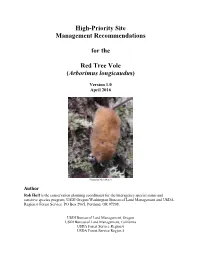
High-Priority Site Management Recommendations for the Red Tree Vole (Arborimus longicaudus) Version 1.0 April 2016 Photo by Nick Hatch Author Rob Huff is the conservation planning coordinator for the interagency special status and sensitive species program, USDI Oregon/Washington Bureau of Land Management and USDA Region 6 Forest Service, PO Box 2965, Portland, OR 97208. USDI Bureau of Land Management, Oregon USDI Bureau of Land Management, California USDA Forest Service Region 6 USDA Forest Service Region 5 Executive summary Management status The red tree vole (Arborimus longicaudus) is a small arboreal microtine that is endemic to the coniferous forests of western Oregon and northwestern California (Howell 1926, Maser 1966, Verts and Carraway 1998). Red tree voles are a category C survey and manage species under the Northwest Forest Plan (USDA and USDI 2001). As such, surveys are required for their nests prior to habitat-disturbing activities, but not all red tree vole sites require protection to provide for a reasonable assurance of species persistence. Sites needing protection to meet that persistence objective and sites not needing protection are called high-priority and non-high priority sites, respectively. Few attempts have been made to discriminate between high- and non-high priority sites; therefore most red tree vole sites are currently protected. The US Fish and Wildlife Service determined that listing the red tree vole as a distinct population segment north of the Siuslaw River in the Oregon Coast Ranges under the Endangered Species Act was warranted but precluded (USDI FWS 2011). The population segment was added to the USFWS candidate species list which triggered the inclusion of red tree voles within this geographic area to the BLM special status and Forest Service sensitive species lists. -

Federal Register/Vol. 76, No. 198
63720 Federal Register / Vol. 76, No. 198 / Thursday, October 13, 2011 / Proposed Rules DEPARTMENT OF THE INTERIOR and Wildlife Service, Oregon Fish and sent a letter to Noah Greenwald, Center Wildlife Office, 2600 S.E. 98th Ave., for Biological Diversity, acknowledging Fish and Wildlife Service Suite 100, Portland, OR 97266; our receipt of the petition and providing telephone 503–231–6179; facsimile our determination that emergency 50 CFR Part 17 503–231–6195. Please submit any new listing was not warranted for the species [Docket No. FWS–R1–ES–2008–0086; information, materials, comments, or at that time. 92210–5008–3922–10–B2] questions concerning this finding to the On October 28, 2008, we published a above street address. 90-day finding for the dusky tree vole in Endangered and Threatened Wildlife FOR FURTHER INFORMATION CONTACT: Paul the Federal Register (73 FR 63919). We and Plants; 12-Month Finding on a Henson, Ph.D., Field Supervisor, U.S. found that the petition presented Petition To List a Distinct Population Fish and Wildlife Service, Oregon Fish substantial information indicating that Segment of the Red Tree Vole as and Wildlife Office (see ADDRESSES listing one of the following three entities Endangered or Threatened section). If you use a as endangered or threatened may be telecommunications device for the deaf warranted: AGENCY: Fish and Wildlife Service, (1) The dusky tree vole subspecies of (TDD), call the Federal Information Interior. the red tree vole; ACTION: Notice of 12-month petition Relay Service (FIRS) at 800–877–8339. (2) The North Oregon Coast DPS of finding. -

Ther5 1 017 024 Golenishchev.Pm6
Russian J. Theriol. 5 (1): 1724 © RUSSIAN JOURNAL OF THERIOLOGY, 2006 The developmental conduit of the tribe Microtini (Rodentia, Arvicolinae): Systematic and evolutionary aspects Fedor N. Golenishchev & Vladimir G. Malikov ABSTRACT. According to the recent data on molecular genetics and comparative genomics of the grey voles of the tribe Microtini it is supposed, that their Nearctic and Palearctic groups had independently originated from different lineages of the extinct genus Mimomys. Nevertheless, that tribe is considered as a natural taxon. The American narrow-skulled voles are referred to a new taxon, Vocalomys subgen. nov. KEY WORDS: homology, homoplasy, phylogeny, vole, Microtini, evolution, taxonomy. Fedor N. Golenishchev [microtus@zin.ru] and Vladimir G. Malikov [microtus@zin.ru], Zoological Institute, Russian Academy of Sciences, Universitetskaya nab. 1, Saint-Petersburg 199034, Russia. «Êàíàë ðàçâèòèÿ» ïîëåâîê òðèáû Microtini (Rodentia, Arvicolinae): ñèñòåìàòèêî-ýâîëþöèîííûé àñïåêò. Ô.Í. Ãîëåíèùåâ, Â.Ã. Ìàëèêîâ ÐÅÇÞÌÅ.  ñîîòâåòñòâèè ñ ïîñëåäíèìè äàííûìè ìîëåêóëÿðíîé ãåíåòèêè è ñðàâíèòåëüíîé ãåíîìè- êè ñåðûõ ïîëåâîê òðèáû Microtini äåëàåòñÿ âûâîä î íåçàâèñèìîì ïðîèñõîæäåíèè íåàðêòè÷åñêèõ è ïàëåàðêòè÷åñêèõ ãðóïï îò ðàçíûõ ïðåäñòàâèòåëåé âûìåðøåãî ðîäà Mimomys. Íåñìîòðÿ íà ýòî, äàííàÿ òðèáà ñ÷èòàåòñÿ åñòåñòâåííûì òàêñîíîì. Àìåðèêàíñêèå óçêî÷åðåïíûå ïîëåâêè âûäåëÿþòñÿ â ñàìîñòîÿòåëüíûé ïîäðîä Vocalomys subgen. nov. ÊËÞ×ÅÂÛÅ ÑËÎÂÀ: ãîìîëîãèÿ, ãîìîïëàçèÿ, ôèëîãåíèÿ, ïîëåâêè, Microtini, ýâîëþöèÿ, òàêñîíîìèÿ. Introduction The history of the group in the light of The Holarctic subfamily Arvicolinae Gray, 1821 is the molecular data known to comprise a number of transberingian vicari- ants together with a few Holarctic forms. Originally, The grey voles are usually altogether regarded as a the extent of their phylogenetic relationships was judged first-hand descendant of the Early Pleistocene genus on their morphological similarity. -
Diversification of Muroid Rodents Driven by the Late Miocene Global Cooling Nelish Pradhan University of Vermont
University of Vermont ScholarWorks @ UVM Graduate College Dissertations and Theses Dissertations and Theses 2018 Diversification Of Muroid Rodents Driven By The Late Miocene Global Cooling Nelish Pradhan University of Vermont Follow this and additional works at: https://scholarworks.uvm.edu/graddis Part of the Biochemistry, Biophysics, and Structural Biology Commons, Evolution Commons, and the Zoology Commons Recommended Citation Pradhan, Nelish, "Diversification Of Muroid Rodents Driven By The Late Miocene Global Cooling" (2018). Graduate College Dissertations and Theses. 907. https://scholarworks.uvm.edu/graddis/907 This Dissertation is brought to you for free and open access by the Dissertations and Theses at ScholarWorks @ UVM. It has been accepted for inclusion in Graduate College Dissertations and Theses by an authorized administrator of ScholarWorks @ UVM. For more information, please contact donna.omalley@uvm.edu. DIVERSIFICATION OF MUROID RODENTS DRIVEN BY THE LATE MIOCENE GLOBAL COOLING A Dissertation Presented by Nelish Pradhan to The Faculty of the Graduate College of The University of Vermont In Partial Fulfillment of the Requirements for the Degree of Doctor of Philosophy Specializing in Biology May, 2018 Defense Date: January 8, 2018 Dissertation Examination Committee: C. William Kilpatrick, Ph.D., Advisor David S. Barrington, Ph.D., Chairperson Ingi Agnarsson, Ph.D. Lori Stevens, Ph.D. Sara I. Helms Cahan, Ph.D. Cynthia J. Forehand, Ph.D., Dean of the Graduate College ABSTRACT Late Miocene, 8 to 6 million years ago (Ma), climatic changes brought about dramatic floral and faunal changes. Cooler and drier climates that prevailed in the Late Miocene led to expansion of grasslands and retreat of forests at a global scale.