A. LEO OPPENHEIM Oi.Uchicago.Edu Oi.Uchicago.Edu
Total Page:16
File Type:pdf, Size:1020Kb
Load more
Recommended publications
-

Outline of the History of Assyria : As Collected from the Inscriptions
: OUTLINE ov THE HISTOTIY OF ASSYRIA. AS COLLECTED TROM THE INSCRIPTIONS DISCOVERED BY AUSTIN HENRY LAYARD, ESQ. IN THE RUINS OP NINEVEH. LIEUT.-COL. EAWLINSON, C.B. PRINTED FROM THE JOURNAL OF THE ROYAL ASIATIC SOCIETY. LONDON JOHN W. PARKER and SON, WEST STRAND. 1852. 1^ # [The following Paper was intended by Colonel Rawlinson to form part of the Annual Report, but was received too late for insertion. It was therefore read at the first General Meeting after the anniver- sary. Colonel Rawlinson, in a letter, dated at the camp, Nineveh, 11th April, 1852, states that the paper was drawn up for the information of the Council— " in great haste, amid torrents of rain, in a little tent upon the mound of Nineveh, without any aids beyond a pocket Bible, a note-book of inscriptions, and a tolerably retentive memory."— It is intended to gratify public curiosity upon a subject of vast and daily increasing interest. Mr. Layard having been present at the reading, and having, at the request of the Council offered a few remarks on this interesting subject, he was requested to commit them to writing, and they are here appended to Colonel Rawlinson's importailt communication.] • OUTLINE OF ASSYRIAN HISTORY, COLLECTED FBOM THE CUNEIFORM INSCRIPTIONS, Every new fact which is brought to light from the study of the Cuneiform inscriptions tends to confirm the scriptural account of the primitive seat of empire having been established in Lower Chaldsea, or in the neighbouring district of Susiana, From hence a migration must have taken place in a western direction to the land of Shinar, or Sinlcar, the name of which is still preserved in the ruins now called Senlcereh. -
Download PDF Version of Article
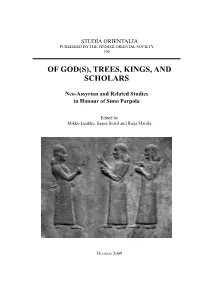
STUDIA ORIENTALIA PUBLISHED BY THE FINNISH ORIENTAL SOCIETY 106 OF GOD(S), TREES, KINGS, AND SCHOLARS Neo-Assyrian and Related Studies in Honour of Simo Parpola Edited by Mikko Luukko, Saana Svärd and Raija Mattila HELSINKI 2009 OF GOD(S), TREES, KINGS AND SCHOLARS clay or on a writing board and the other probably in Aramaic onleather in andtheotherprobably clay oronawritingboard ME FRONTISPIECE 118882. Assyrian officialandtwoscribes;oneiswritingincuneiformo . n COURTESY TRUSTEES OF T H E BRITIS H MUSEUM STUDIA ORIENTALIA PUBLISHED BY THE FINNISH ORIENTAL SOCIETY Vol. 106 OF GOD(S), TREES, KINGS, AND SCHOLARS Neo-Assyrian and Related Studies in Honour of Simo Parpola Edited by Mikko Luukko, Saana Svärd and Raija Mattila Helsinki 2009 Of God(s), Trees, Kings, and Scholars: Neo-Assyrian and Related Studies in Honour of Simo Parpola Studia Orientalia, Vol. 106. 2009. Copyright © 2009 by the Finnish Oriental Society, Societas Orientalis Fennica, c/o Institute for Asian and African Studies P.O.Box 59 (Unioninkatu 38 B) FIN-00014 University of Helsinki F i n l a n d Editorial Board Lotta Aunio (African Studies) Jaakko Hämeen-Anttila (Arabic and Islamic Studies) Tapani Harviainen (Semitic Studies) Arvi Hurskainen (African Studies) Juha Janhunen (Altaic and East Asian Studies) Hannu Juusola (Semitic Studies) Klaus Karttunen (South Asian Studies) Kaj Öhrnberg (Librarian of the Society) Heikki Palva (Arabic Linguistics) Asko Parpola (South Asian Studies) Simo Parpola (Assyriology) Rein Raud (Japanese Studies) Saana Svärd (Secretary of the Society) -

In the Wake of the Compendia Science, Technology, and Medicine in Ancient Cultures
In the Wake of the Compendia Science, Technology, and Medicine in Ancient Cultures Edited by Markus Asper Philip van der Eijk Markham J. Geller Heinrich von Staden Liba Taub Volume 3 In the Wake of the Compendia Infrastructural Contexts and the Licensing of Empiricism in Ancient and Medieval Mesopotamia Edited by J. Cale Johnson DE GRUYTER ISBN 978-1-5015-1076-2 e-ISBN (PDF) 978-1-5015-0250-7 e-ISBN (EPUB) 978-1-5015-0252-1 ISSN 2194-976X Library of Congress Cataloging-in-Publication Data A CIP catalog record for this book has been applied for at the Library of Congress. Bibliographic information published by the Deutsche Nationalbibliothek The Deutsche Nationalbibliothek lists this publication in the Deutsche Nationalbibliografie; detailed bibliographic data are available on the Internet at http://dnb.dnb.de. © 2015 Walter de Gruyter Inc., Boston/Berlin Typesetting: Meta Systems Publishing & Printservices GmbH, Wustermark Printing and binding: Hubert & Co. GmbH & Co. KG, Göttingen ♾ Printed on acid-free paper Printed in Germany www.degruyter.com Notes on Contributors Florentina Badalanova Geller is Professor at the Topoi Excellence Cluster at the Freie Universität Berlin. She previously taught at the University of Sofia and University College London, and is currently on secondment from the Royal Anthropological Institute (London). She has published numerous papers and is also the author of ‘The Bible in the Making’ in Imagining Creation (2008), Qurʾān in Vernacular: Folk Islam in the Balkans (2008), and 2 (Slavonic Apocalypse of) Enoch: Text and Context (2010). Siam Bhayro was appointed Senior Lecturer in Early Jewish Studies in the Department of Theology and Religion, University of Exeter, in 2012, having previously been Lecturer in Early Jewish Studies since 2007. -
Burn Your Way to Success Studies in the Mesopotamian Ritual And
Burn your way to success Studies in the Mesopotamian Ritual and Incantation Series Šurpu by Francis James Michael Simons A thesis submitted to the University of Birmingham for the degree of Doctor of Philosophy Department of Classics, Ancient History and Archaeology School of History and Cultures College of Arts and Law University of Birmingham March 2017 University of Birmingham Research Archive e-theses repository This unpublished thesis/dissertation is copyright of the author and/or third parties. The intellectual property rights of the author or third parties in respect of this work are as defined by The Copyright Designs and Patents Act 1988 or as modified by any successor legislation. Any use made of information contained in this thesis/dissertation must be in accordance with that legislation and must be properly acknowledged. Further distribution or reproduction in any format is prohibited without the permission of the copyright holder. Abstract The ritual and incantation series Šurpu ‘Burning’ is one of the most important sources for understanding religious and magical practice in the ancient Near East. The purpose of the ritual was to rid a sufferer of a divine curse which had been inflicted due to personal misconduct. The series is composed chiefly of the text of the incantations recited during the ceremony. These are supplemented by brief ritual instructions as well as a ritual tablet which details the ceremony in full. This thesis offers a comprehensive and radical reconstruction of the entire text, demonstrating the existence of a large, and previously unsuspected, lacuna in the published version. In addition, a single tablet, tablet IX, from the ten which comprise the series is fully edited, with partitur transliteration, eclectic and normalised text, translation, and a detailed line by line commentary. -
Babylonian Populations, Servility, and Cuneiform Records
Journal of the Economic and Social History of the Orient 60 (2017) 715-787 brill.com/jesh Babylonian Populations, Servility, and Cuneiform Records Jonathan S. Tenney Cornell University tenney@cornell.edu Abstract To date, servility and servile systems in Babylonia have been explored with the tradi- tional lexical approach of Assyriology. If one examines servility as an aggregate phe- nomenon, these subjects can be investigated on a much larger scale with quantitative approaches. Using servile populations as a point of departure, this paper applies both quantitative and qualitative methods to explore Babylonian population dynamics in general; especially morbidity, mortality, and ages at which Babylonians experienced important life events. As such, it can be added to the handful of publications that have sought basic demographic data in the cuneiform record, and therefore has value to those scholars who are also interested in migration and settlement. It suggests that the origins of servile systems in Babylonia can be explained with the Nieboer-Domar hy- pothesis, which proposes that large-scale systems of bondage will arise in regions with * This was written in honor, thanks, and recognition of McGuire Gibson’s efforts to impart a sense of the influence of aggregate population behavior on Mesopotamian development, notably in his 1973 article “Population Shift and the Rise of Mesopotamian Civilization”. As an Assyriology student who was searching texts for answers to similar questions, I have occasionally found myself in uncharted waters. Mac’s encouragement helped me get past my discomfort, find the data, and put words on the page. The necessity of assembling Mesopotamian “demographic” measures was something made clear to me by the M.A.S.S. -
Tayinat's Building XVI: the Religious Dimensions and Significance of A
Tayinat’s Building XVI: The Religious Dimensions and Significance of a Tripartite Temple at Neo-Assyrian Kunulua by Douglas Neal Petrovich A thesis submitted in conformity with the requirements for the degree of Doctor of Philosophy Graduate Department of Near and Middle Eastern Civilizations University of Toronto © Copyright by Douglas Neal Petrovich, 2016 Building XVI at Tell Tayinat: The Religious Dimensions and Significance of a Tripartite Temple at Neo-Assyrian Kunulua Douglas N. Petrovich Doctor of Philosophy Department of Near and Middle Eastern Civilizations University of Toronto 2016 Abstract After the collapse of the Hittite Empire and most of the power structures in the Levant at the end of the Late Bronze Age, new kingdoms and powerful city-states arose to fill the vacuum over the course of the Iron Age. One new player that surfaced on the regional scene was the Kingdom of Palistin, which was centered at Kunulua, the ancient capital that has been identified positively with the site of Tell Tayinat in the Amuq Valley. The archaeological and epigraphical evidence that has surfaced in recent years has revealed that Palistin was a formidable kingdom, with numerous cities and territories having been enveloped within its orb. Kunulua and its kingdom eventually fell prey to the Neo-Assyrian Empire, which decimated the capital in 738 BC under Tiglath-pileser III. After Kunulua was rebuilt under Neo- Assyrian control, the city served as a provincial capital under Neo-Assyrian administration. Excavations of the 1930s uncovered a palatial district atop the tell, including a temple (Building II) that was adjacent to the main bit hilani palace of the king (Building I). -

SUMERIAN LITERATURE and SUMERIAN IDENTITY My Title Puts
CNI Publicati ons 43 SUMERIAN LITERATURE AND SUMERIAN IDENTITY JERROLD S. COOPER PROBLEMS OF C..\NONlCl'TY AND IDENTITY FORMATION IN A NCIENT EGYPT AND MESOPOTAMIA There is evidence of a regional identity in early Babylonia, but it does not seem to be of the Sumerian ethno-lingusitic sort. Sumerian Edited by identity as such appears only as an artifact of the scribal literary KIM RYHOLT curriculum once the Sumerian language had to be acquired through GOJKO B AR .I AMOVIC educati on rather than as a mother tongue. By the late second millennium, it appears there was no notion that a separate Sumerian ethno-lingui stic population had ever existed. My title puts Sumerian literature before Sumerian identity, and in so doing anticipates my conclusion, which will be that there was little or no Sumerian identity as such - in the sense of "We are all Sumerians!" outside of Sumerian literature and the scribal milieu that composed and transmitted it. By "Sumerian literature," I mean the corpus of compositions in Sumerian known from manuscripts that date primarily 1 to the first half of the 18 h century BC. With a few notable exceptions, the compositions themselves originated in the preceding three centuries, that is, in what Assyriologists call the Ur III and Isin-Larsa (or Early Old Babylonian) periods. I purposely eschew the too fraught and contested term "canon," preferring the very neutral "corpus" instead, while recognizing that because nearly all of our manuscripts were produced by students, the term "curriculum" is apt as well. 1 The geographic designation "Babylonia" is used here for the region to the south of present day Baghdad, the territory the ancients would have called "Sumer and Akkad." I will argue that there is indeed evidence for a 3rd millennium pan-Babylonian regional identity, but little or no evidence that it was bound to a Sumerian mother-tongue community. -
Judeans in Babylonia a Study of Deportees in the Sixth and Fifth Centuries BCE
Tero Alstola Judeans in Babylonia A Study of Deportees in the Sixth and Fifth Centuries BCE ACADEMIC DISSERTATION TO BE PUBLICLY DISCUSSED, BY DUE PERMISSION OF THE FACULTY OF THEOLOGY AT THE UNIVERSITY OF HELSINKI IN AUDITORIUM XII OF THE UNIVERSITY MAIN BUILDING, ON THE 17TH OF JANUARY, 2018 AT 12 O’CLOCK. This dissertation project has been financially supported by the ERC Starting Grant project ‘By the Rivers of Babylon: New Perspectives on Second Temple Judaism from Cuneiform Texts’ and by the Centre of Excellence in Changes in Sacred Texts and Traditions, funded by the Academy of Finland. Cover illustration by Suvi Tuominen ISBN 978-951-51-3831-6 (paperback) ISBN 978-951-51-3832-3 (PDF) Unigrafia Oy Helsinki 2017 SUMMARY Judeans in Babylonia: A Study of Deportees in the Sixth and Fifth Centuries BCE The dissertation investigates Judean deportees in Babylonia in the sixth and fifth centuries BCE. These people arrived in Babylonia from Judah in the early sixth century BCE, being but one of numerous ethnic groups deported and resettled by King Nebuchadnezzar II. Naming practices among many deportee groups have been thoroughly analysed, but there has been little interest in writing a socio-historical study of Judeans or other immigrants in Babylonia on the basis of cuneiform sources. The present dissertation fills this gap by conducting a case study of Judean deportees and placing its results in the wider context of Babylonian society. The results from the study of Judeans are evaluated by using a group of Neirabian deportees as a point of comparison. The sources of this study consist of 289 clay tablets written in Akkadian cuneiform. -

2 the Assyrian Empire, the Conquest of Israel, and the Colonization of Judah 37 I
ISRAEL AND EMPIRE ii ISRAEL AND EMPIRE A Postcolonial History of Israel and Early Judaism Leo G. Perdue and Warren Carter Edited by Coleman A. Baker LONDON • NEW DELHI • NEW YORK • SYDNEY 1 Bloomsbury T&T Clark An imprint of Bloomsbury Publishing Plc Imprint previously known as T&T Clark 50 Bedford Square 1385 Broadway London New York WC1B 3DP NY 10018 UK USA www.bloomsbury.com Bloomsbury, T&T Clark and the Diana logo are trademarks of Bloomsbury Publishing Plc First published 2015 © Leo G. Perdue, Warren Carter and Coleman A. Baker, 2015 All rights reserved. No part of this publication may be reproduced or transmitted in any form or by any means, electronic or mechanical, including photocopying, recording, or any information storage or retrieval system, without prior permission in writing from the publishers. Leo G. Perdue, Warren Carter and Coleman A. Baker have asserted their rights under the Copyright, Designs and Patents Act, 1988, to be identified as Authors of this work. No responsibility for loss caused to any individual or organization acting on or refraining from action as a result of the material in this publication can be accepted by Bloomsbury or the authors. British Library Cataloguing-in-Publication Data A catalogue record for this book is available from the British Library. ISBN: HB: 978-0-56705-409-8 PB: 978-0-56724-328-7 ePDF: 978-0-56728-051-0 Library of Congress Cataloging-in-Publication Data A catalogue record for this book is available from the British Library. Typeset by Forthcoming Publications (www.forthpub.com) 1 Contents Abbreviations vii Preface ix Introduction: Empires, Colonies, and Postcolonial Interpretation 1 I. -

Seminary Studies
ANDREWS UNIVERSITY SEMINARY STUDIES VOLUME VI JANUARI 1968 NUMBER I CONTENTS Heimmerly-Dupuy, Daniel, Some Observations on the Assyro- Babylonian and Sumerian Flood Stories Hasel, Gerhard F., Sabbatarian Anabaptists of the Sixteenth Century: Part II 19 Horn, Siegfried H., Where and When was the Aramaic Saqqara Papyrus Written ? 29 Lewis, Richard B., Ignatius and the "Lord's Day" 46 Neuffer, Julia, The Accession of Artaxerxes I 6o Specht, Walter F., The Use of Italics in English Versions of the New Testament 88 Book Reviews iio ANDREWS UNIVERSITY BERRIEN SPRINGS, MICHIGAN 49104, USA ANDREWS UNIVERSITY SEMINARY STUDIES The Journal of the Seventh-day Adventist Theological Seminary of Andrews University, Berrien Springs, Michigan SIEGFRIED H. HORN Editor EARLE HILGERT KENNETH A. STRAND Associate Editors LEONA G. RUNNING Editorial Assistant SAKAE Kos() Book Review Editor ROY E. BRANSON Circulation Manager ANDREWS UNIVERSITY SEMINARY STUDIES publishes papers and short notes in English, French and German on the follow- ing subjects: Biblical linguistics and its cognates, textual criticism, exegesis, Biblical archaeology and geography, an- cient history, church history, theology, philosophy of religion, ethics and comparative religions. The opinions expressed in articles are those of the authors and do not necessarily represent the views of the editors. ANDREWS UNIVERSITY SEMINARY STUDIES is published in January and July of each year. The annual subscription rate is $4.00. Payments are to be made to Andrews University Seminary Studies, Berrien Springs, Michigan 49104, USA. Subscribers should give full name and postal address when paying their subscriptions and should send notice of change of address at least five weeks before it is to take effect; the old as well as the new address must be given. -

The Beautiful Cubit System I Douglas 2019 the Beautiful Cubit System
The Beautiful Cubit System I Douglas 2019 The Beautiful Cubit System Ian Douglas, B.Sc ian@zti.co.za 30 June 2019 Version 1.0.0 DOI: https://doi.org/10.5281/zenodo.3263864 This work is licensed under the Creative Commons Attribution 4.0 International License. Abstract An analysis of the Egyptian Royal cubit, presenting some research and opinions flowing from that research, into what I believe was the original cubit, and how it was corrupted. I show various close arithmetic approximations and multiple ways of getting the divisions of the cubit, as well as some related measures. The cubit also encapsulates the basic components for the metric system. Keywords: Egyptology, metrology, royal cubit, cubit, metre, foot, metric system Contents 1. Introduction 2. Overview of current understanding 3. An alternative origin 4. Different ways of approximating the royal cubit 5. Different ways of getting the cubit divisions 6. Geometry, the Royal Cubit and the metric system 7. Bibliography 1. Introduction The cubit is a well-know ancient measure of length, used around various places in the Middle East and Mediterranean region in the distant past. 1 The Beautiful Cubit System I Douglas 2019 It is allegedly based on the length of a human (male) fore-arm. It is typically measured from the back of the elbow to some point between the wrist and the end of the outstretched middle finger, or in some variants, a point beyond that. The problem with this approach is that everyone’s arm is a different length. If the heights of the dynastic Egyptians is taken as representative, then their arms would have been too short to justify the accepted lengths. -

Step Into Isaiah the 37Th Chapter! (King Hezekiah's Prayer and The
Step into Isaiah the 37th chapter! (King Hezekiah’s prayer and the Lord’s response) Isaiah 37:1-38 (NKJV) 1 And so it was, when King Hezekiah heard it, that he tore his clothes, covered himself with sackcloth, and went into the house of the LORD. 2 Then he sent Eliakim, who was over the household, Shebna the scribe, and the elders of the priests, covered with sackcloth, to Isaiah the prophet, the son of Amoz. 3 And they said to him, "Thus says Hezekiah: 'This day is a day of trouble and rebuke and blasphemy; for the children have come to birth, but there is no strength to bring them forth. 4 It may be that the LORD your God will hear the words of the Rabshakeh, whom his master the king of Assyria has sent to reproach the living God, and will rebuke the words which the LORD your God has heard. Therefore lift up your prayer for the remnant that is left.' " 5 So the servants of King Hezekiah came to Isaiah. 6 And Isaiah said to them, "Thus shall you say to your master, 'Thus says the LORD: "Do not be afraid of the words which you have heard, with which the servants of the king of Assyria have blasphemed Me. 7 Surely I will send a spirit upon him, and he shall hear a rumor and return to his own land; and I will cause him to fall by the sword in his own land." ' " 8 Then the Rabshakeh returned, and found the king of Assyria warring against Libnah, for he heard that he had departed from Lachish.