Dean Acheson's Press Club Speech Reexamined
Total Page:16
File Type:pdf, Size:1020Kb
Load more
Recommended publications
-

Oral History Interview – 2/10/2003 Administrative Information
Sid Davis Oral History Interview – 2/10/2003 Administrative Information Creator: Sid Davis Interviewer: Vicki Daitch Date of Interview: February 10, 2003 Place of Interview: Washington D.C. Length: 76 pages Biographical Note Davis was a journalist, a White House correspondent (1959-1968) and Washington News Bureau chief (1968-1977) for the Westinghouse Broadcasting; director (1977-1979), bureau chief (1979-1980), and vice president and bureau chief (1980-1982) for NBC News; and a senior Washington correspondent (1982-1987) and director of office programs for the Voice of America (1987-1994). In this interview, he discusses the 1960 presidential campaign, John F. Kennedy’s assassination and Lyndon B. Johnson’s swearing in, and the press coverage of the White House, among other issues. Access Open. Usage Restrictions According to the deed of gift signed on April 5, 2004, copyright of these materials has been assigned to the United States Government. Users of these materials are advised to determine the copyright status of any document from which they wish to publish. Copyright The copyright law of the United States (Title 17, United States Code) governs the making of photocopies or other reproductions of copyrighted material. Under certain conditions specified in the law, libraries and archives are authorized to furnish a photocopy or other reproduction. One of these specified conditions is that the photocopy or reproduction is not to be “used for any purpose other than private study, scholarship, or research.” If a user makes a request for, or later uses, a photocopy or reproduction for purposes in excesses of “fair use,” that user may be liable for copyright infringement. -

Woman War Correspondent,” 1846-1945
View metadata, citation and similar papers at core.ac.uk brought to you by CORE provided by Carolina Digital Repository CONDITIONS OF ACCEPTANCE: THE UNITED STATES MILITARY, THE PRESS, AND THE “WOMAN WAR CORRESPONDENT,” 1846-1945 Carolyn M. Edy A dissertation submitted to the faculty of the University of North Carolina at Chapel Hill in partial fulfillment of the requirements for the degree of Doctor of Philosophy in the School of Journalism and Mass Communication. Chapel Hill 2012 Approved by: Jean Folkerts W. Fitzhugh Brundage Jacquelyn Dowd Hall Frank E. Fee, Jr. Barbara Friedman ©2012 Carolyn Martindale Edy ALL RIGHTS RESERVED ii Abstract CAROLYN M. EDY: Conditions of Acceptance: The United States Military, the Press, and the “Woman War Correspondent,” 1846-1945 (Under the direction of Jean Folkerts) This dissertation chronicles the history of American women who worked as war correspondents through the end of World War II, demonstrating the ways the military, the press, and women themselves constructed categories for war reporting that promoted and prevented women’s access to war: the “war correspondent,” who covered war-related news, and the “woman war correspondent,” who covered the woman’s angle of war. As the first study to examine these concepts, from their emergence in the press through their use in military directives, this dissertation relies upon a variety of sources to consider the roles and influences, not only of the women who worked as war correspondents but of the individuals and institutions surrounding their work. Nineteenth and early 20th century newspapers continually featured the woman war correspondent—often as the first or only of her kind, even as they wrote about more than sixty such women by 1914. -

The Pulitzer Prizes for International Reporting in the Third Phase of Their Development, 1963-1977
INTRODUCTION THE PULITZER PRIZES FOR INTERNATIONAL REPORTING IN THE THIRD PHASE OF THEIR DEVELOPMENT, 1963-1977 Heinz-Dietrich Fischer The rivalry between the U.S.A. and the U.S.S.R. having shifted, in part, to predomi- nance in the fields of space-travel and satellites in the upcoming space age, thus opening a new dimension in the Cold War,1 there were still existing other controversial issues in policy and journalism. "While the colorful space competition held the forefront of public atten- tion," Hohenberg remarks, "the trained diplomatic correspondents of the major newspa- pers and wire services in the West carried on almost alone the difficult and unpopular East- West negotiations to achieve atomic control and regulation and reduction of armaments. The public seemed to want to ignore the hard fact that rockets capable of boosting people into orbit for prolonged periods could also deliver atomic warheads to any part of the earth. It continued, therefore, to be the task of the responsible press to assign competent and highly trained correspondents to this forbidding subject. They did not have the glamor of TV or the excitement of a space shot to focus public attention on their work. Theirs was the responsibility of obliging editors to publish material that was complicated and not at all easy for an indifferent public to grasp. It had to be done by abandoning the familiar cliches of journalism in favor of the care and the art of the superior historian .. On such an assignment, no correspondent was a 'foreign' correspondent. The term was outdated. -
Newsletter Still Doesn't Have Any Reporting on Direct Queries and Submissions To: Recent Developments in U.S
N ewsletter NoVEMbER, 1991 VolUME 5 NuMbER 5 SpEciAl JournaL Issue In This Issue................................................................ 2 The Speed of DAnksess ancI "CrazecJ V ets on tHe oorstep rama e o s e PublJshER's S tatement, by Ka U TaL .............................5 D D ," by DAvId J. D R ...............40 REMF Books, by DAvid WHLs o n .............................. 45 A nnouncements, Notices, & Re p o r t s ......................... 4 eter C ortez In DarIen, by ALan FarreU ........................... 22 PoETRy, by P D ssy............................................4 4 FIctIon: Hie Romance of Vietnam, VoIces fROM tHe Past: TTie SearcTi foR Hanoi HannaK by RENNy ChRlsTophER...................................... 24 by Don NortTi ...................................................44 A FiREbAlL In tBe Nlqlrr, by WHUam M. KiNq...........25 H ollyw ood CoNfidENTlAl: 1, b y FREd GARdNER........ 50 Topics foR VJetnamese-U.S. C ooperation, PoETRy, by DennIs FRiTziNqER................................... 57 by Tran Qoock VuoNq....................................... 27 Ths A ll CWnese M ercenary BAskETbAll Tournament, Science FIctIon: This TIme It's War, by PauI OLim a r t ................................................ 57 by ALascIaIr SpARk.............................................29 (Not Much of a) War Story, by Norman LanquIst ...59 M y Last War, by Ernest Spen cer ............................50 Poetry, by Norman LanquIs t ...................................60 M etaphor ancI War, by GEORqE LAkoff....................52 A notBer -

SAY NO to the LIBERAL MEDIA: CONSERVATIVES and CRITICISM of the NEWS MEDIA in the 1970S William Gillis Submitted to the Faculty
SAY NO TO THE LIBERAL MEDIA: CONSERVATIVES AND CRITICISM OF THE NEWS MEDIA IN THE 1970S William Gillis Submitted to the faculty of the University Graduate School in partial fulfillment of the requirements for the degree Doctor of Philosophy in the School of Journalism, Indiana University June 2013 ii Accepted by the Graduate Faculty, Indiana University, in partial fulfillment of the requirements for the degree of Doctor of Philosophy. Doctoral Committee David Paul Nord, Ph.D. Mike Conway, Ph.D. Tony Fargo, Ph.D. Khalil Muhammad, Ph.D. May 10, 2013 iii Copyright © 2013 William Gillis iv Acknowledgments I would like to thank the helpful staff members at the Brigham Young University Harold B. Lee Library, the Detroit Public Library, Indiana University Libraries, the University of Kansas Kenneth Spencer Research Library, the University of Louisville Archives and Records Center, the University of Michigan Bentley Historical Library, the Wayne State University Walter P. Reuther Library, and the West Virginia State Archives and History Library. Since 2010 I have been employed as an editorial assistant at the Journal of American History, and I want to thank everyone at the Journal and the Organization of American Historians. I thank the following friends and colleagues: Jacob Groshek, Andrew J. Huebner, Michael Kapellas, Gerry Lanosga, J. Michael Lyons, Beth Marsh, Kevin Marsh, Eric Petenbrink, Sarah Rowley, and Cynthia Yaudes. I also thank the members of my dissertation committee: Mike Conway, Tony Fargo, and Khalil Muhammad. Simply put, my adviser and dissertation chair David Paul Nord has been great. Thanks, Dave. I would also like to thank my family, especially my parents, who have provided me with so much support in so many ways over the years. -
Hong Kong's Endgame and the Rule of Law (Ii): the Battle Over "The People" and the Business Community in the Transition to Chinese Rule
HONG KONG'S ENDGAME AND THE RULE OF LAW (II): THE BATTLE OVER "THE PEOPLE" AND THE BUSINESS COMMUNITY IN THE TRANSITION TO CHINESE RULE JACQUES DELISLE* & KEVIN P. LANE- 1. INTRODUCTION Transitional Hong Kong's endgame formally came to a close with the territory's reversion to Chinese rule on July 1, 1997. How- ever, a legal and institutional order and a "rule of law" for Chi- nese-ruled Hong Kong remain works in progress. They will surely bear the mark of the conflicts that dominated the final years pre- ceding Hong Kong's legal transition from British colony to Chinese Special Administrative Region ("S.A.R."). Those endgame conflicts reflected a struggle among adherents to rival conceptions of a rule of law and a set of laws and institutions that would be adequate and acceptable for Hong Kong. They unfolded in large part through battles over the attitudes and allegiance of "the Hong Kong people" and Hong Kong's business community. Hong Kong's Endgame and the Rule of Law (I): The Struggle over Institutions and Values in the Transition to Chinese Rule ("Endgame I") focused on the first aspect of this story. It examined the political struggle among members of two coherent, but not monolithic, camps, each bound together by a distinct vision of law and sover- t Special Series Reprint: Originally printed in 18 U. Pa. J. Int'l Econ. L. 811 (1997). Assistant Professor, University of Pennsylvania Law School. This Article is the second part of a two-part series. The first part appeared as Hong Kong's End- game and the Rule of Law (I): The Struggle over Institutions and Values in the Transition to Chinese Rule, 18 U. -
Telling Stories to a Different Beat: Photojournalism As a “Way of Life”
Bond University DOCTORAL THESIS Telling stories to a different beat: Photojournalism as a “Way of Life” Busst, Naomi Award date: 2012 Link to publication General rights Copyright and moral rights for the publications made accessible in the public portal are retained by the authors and/or other copyright owners and it is a condition of accessing publications that users recognise and abide by the legal requirements associated with these rights. • Users may download and print one copy of any publication from the public portal for the purpose of private study or research. • You may not further distribute the material or use it for any profit-making activity or commercial gain • You may freely distribute the URL identifying the publication in the public portal. Telling stories to a different beat: Photojournalism as a “Way of Life” Naomi Verity Busst, BPhoto, MJ A thesis submitted in total fulfilment of the requirements of the degree of Doctor of Philosophy School of Media and Communication Faculty of Humanities and Social Sciences Bond University February 2012 Abstract This thesis presents a grounded theory of how photojournalism is a way of life. Some photojournalists dedicate themselves to telling other people's stories, documenting history and finding alternative ways to disseminate their work to audiences. Many self-fund their projects, not just for the love of the tradition, but also because they feel a sense of responsibility to tell stories that are at times outside the mainstream media’s focus. Some do this through necessity. While most photojournalism research has focused on photographers who are employed by media organisations, little, if any, has been undertaken concerning photojournalists who are freelancers. -

198J. M. Thornton Phd.Pdf
Kent Academic Repository Full text document (pdf) Citation for published version Thornton, Joanna Margaret (2015) Government Media Policy during the Falklands War. Doctor of Philosophy (PhD) thesis, University of Kent. DOI Link to record in KAR https://kar.kent.ac.uk/50411/ Document Version UNSPECIFIED Copyright & reuse Content in the Kent Academic Repository is made available for research purposes. Unless otherwise stated all content is protected by copyright and in the absence of an open licence (eg Creative Commons), permissions for further reuse of content should be sought from the publisher, author or other copyright holder. Versions of research The version in the Kent Academic Repository may differ from the final published version. Users are advised to check http://kar.kent.ac.uk for the status of the paper. Users should always cite the published version of record. Enquiries For any further enquiries regarding the licence status of this document, please contact: researchsupport@kent.ac.uk If you believe this document infringes copyright then please contact the KAR admin team with the take-down information provided at http://kar.kent.ac.uk/contact.html Government Media Policy during the Falklands War A thesis presented by Joanna Margaret Thornton to the School of History, University of Kent In partial fulfilment of the requirements for the degree of Doctor of Philosophy in the subject of History University of Kent Canterbury, Kent January 2015 ©Joanna Thornton All rights reserved 2015 Abstract This study addresses Government media policy throughout the Falklands War of 1982. It considers the effectiveness, and charts the development of, Falklands-related public relations’ policy by departments including, but not limited to, the Ministry of Defence (MoD). -
Power, Coercion, Legitimacy and the Press in Pinochet's Chile a Dissertation Presented to the Faculty Of
Writing the Opposition: Power, Coercion, Legitimacy and the Press in Pinochet's Chile A dissertation presented to the faculty of the College of Arts and Sciences of Ohio University In partial fulfillment of the requirements for the degree Doctor of Philosophy Brad T. Eidahl December 2017 © 2017 Brad T. Eidahl. All Rights Reserved. 2 This dissertation titled Writing the Opposition: Power, Coercion, Legitimacy and the Press in Pinochet's Chile by BRAD T. EIDAHL has been approved for the Department of History and the College of Arts and Sciences by Patrick M. Barr-Melej Professor of History Robert Frank Dean, College of Arts and Sciences 3 ABSTRACT EIDAHL, BRAD T., Ph.D., December 2017, History Writing the Opposition: Power, Coercion, Legitimacy and the Press in Pinochet's Chile Director of Dissertation: Patrick M. Barr-Melej This dissertation examines the struggle between Chile’s opposition press and the dictatorial regime of Augusto Pinochet Ugarte (1973-1990). It argues that due to Chile’s tradition of a pluralistic press and other factors, and in bids to strengthen the regime’s legitimacy, Pinochet and his top officials periodically demonstrated considerable flexibility in terms of the opposition media’s ability to publish and distribute its products. However, the regime, when sensing that its grip on power was slipping, reverted to repressive measures in its dealings with opposition-media outlets. Meanwhile, opposition journalists challenged the very legitimacy Pinochet sought and further widened the scope of acceptable opposition under difficult circumstances. Ultimately, such resistance contributed to Pinochet’s defeat in the 1988 plebiscite, initiating the return of democracy. -

NEEDLESS DEATHS in the GULF WAR Civilian Casualties During The
NEEDLESS DEATHS IN THE GULF WAR Civilian Casualties During the Air Campaign and Violations of the Laws of War A Middle East Watch Report Human Rights Watch New York $$$ Washington $$$ Los Angeles $$$ London Copyright 8 November 1991 by Human Rights Watch. All rights reserved. Printed in the United States of America. Cover design by Patti Lacobee Watch Committee Middle East Watch was established in 1989 to establish and promote observance of internationally recognized human rights in the Middle East. The chair of Middle East Watch is Gary Sick and the vice chairs are Lisa Anderson and Bruce Rabb. Andrew Whitley is the executive director; Eric Goldstein is the research director; Virginia N. Sherry is the associate director; Aziz Abu Hamad is the senior researcher; John V. White is an Orville Schell Fellow; and Christina Derry is the associate. Needless deaths in the Gulf War: civilian casualties during the air campaign and violations of the laws of war. p. cm -- (A Middle East Watch report) Includes bibliographical references. ISBN 1-56432-029-4 1. Persian Gulf War, 1991--United States. 2. Persian Gulf War, 1991-- Atrocities. 3. War victims--Iraq. 4. War--Protection of civilians. I. Human Rights Watch (Organization) II. Series. DS79.72.N44 1991 956.704'3--dc20 91-37902 CIP Human Rights Watch Human Rights Watch is composed of Africa Watch, Americas Watch, Asia Watch, Helsinki Watch, Middle East Watch and the Fund for Free Expression. The executive committee comprises Robert L. Bernstein, chair; Adrian DeWind, vice chair; Roland Algrant, Lisa Anderson, Peter Bell, Alice Brown, William Carmichael, Dorothy Cullman, Irene Diamond, Jonathan Fanton, Jack Greenberg, Alice H. -

Unquiet American: Malcolm Browne in Saigon, 1961–65
THE UNQUIET AMERICAN: Malcolm Browne in Saigon, 1961–65 The Unquiet American: Malcolm Browne in Saigon, 1961–65, other invidious means to impede reporting he perceived Browne’s photograph of the self-immolation of Thich an exhibit drawn from The Associated Press Corporate as critical of his government. Meanwhile, the White House Quan Duc, taken on June 11, 1963, led President John F. From left: Archives, honors the courageous journalism of Malcolm and Pentagon provided little information to reporters and Kennedy to reappraise U.S. support of Diem. After Diem’s Malcolm Browne at work in New York as a chemist for the Foster D. Snell Browne (1931–2012) during the early years of the Vietnam pressured them for favorable coverage of both the political murder on Nov. 1, 1963, in a coup that most probably had Co. in 1953, before his induction into the military and subsequent career War. While Browne was reporting a war being run largely and military situations. the administration’s tacit approval, Browne provided an in journalism. covertly by the White House, the CIA and the Pentagon, unmatched account of Diem’s final hours that received PHOTO COURTESY LE LIEU BROWNE he was waging his own battles in another: the war against Browne arrived in Saigon on Nov. 7, 1961, joining Vietnamese tremendous play. For his breaking news stories and his Associated Press General Manager Wes Gallagher, left, walks with AP journalists. Meanwhile, he accompanied U.S. advisers colleague Ha Van Tran. The bureau soon acquired two astute analysis of a war in the making, Browne won the correspondent Malcolm Browne in Saigon upon Gallagher’s arrival, March 20, by helicopter into the countryside seeking the latest formidable additions, correspondent Peter Arnett and Pulitzer Prize for international reporting in 1964. -
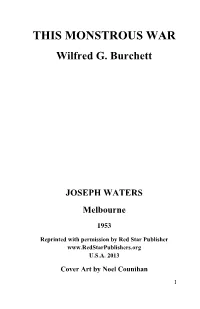
THIS MONSTROUS WAR Wilfred G
THIS MONSTROUS WAR Wilfred G. Burchett JOSEPH WATERS Melbourne 1953 Reprinted with permission by Red Star Publisher www.RedStarPublishers.org U.S.A. 2013 Cover Art by Noel Counihan 1 This is the first time this book is appearing in the United States. According to Gavan McCormack, “in the United States the entire consignment of the book (500 copies) was seized by US Customs and dumped in the sea on its arrival in that country late in the same year (1953), and as a result no major American library possesses a copy to this day.” CONTENTS Chapter Page PUBLISHER’S NOTE ................................................................ 1 INTRODUCTION ....................................................................... 3 1. BACKGROUND TO LIBERATION ................................... 5 2. LIBERATION .................................................................... 16 3. LIBERATION OR OCCUPATION? .................................. 33 4. KOREA DIVIDED ............................................................. 48 5. BACKGROUND TO WAR ................................................. 62 6. GATHERING CLOUDS ..................................................... 77 7. THE STORM BREAKS ...................................................... 86 8. ENTER – THE CHINESE VOLUNTEERS ...................... 100 9. FIRST STEPS TO PEACE ................................................ 123 10. GANGSTER DIPLOMACY ............................................. 139 11. FRONTLINE BATTLES FOR PEACE ............................ 152 12. TACTICS AND TRICKERY ...........................................