The Mont Pelerin Society
Total Page:16
File Type:pdf, Size:1020Kb
Load more
Recommended publications
-
Michael Polanyi and Early Neoliberalism
MICHAEL POLANYI AND EARLY NEOLIBERALISM Martin Beddeleem Keywords: Friedrich Hayek, Louis Rougier, Michael Polanyi, Mont-Pèlerin Society, neoliberalism, planning, Walter Lippmann ABSTRACT1 Between the late 1930s and the 1950s, Michael Polanyi came in close contact with a diverse cast of intellectuals seeking a renewal of the liberal doctrine. The elaboration of this “neoliberalism” happened through a transnational collaboration between economists, philosophers, and social theorists, united in their rejection of central planning. Defining a common agenda for this “early neoliberalism” offered an opportunity to discard the old laissez-faire doctrine and restore a supervisory role of the state. Ultimately, post-war dissensions regarding the direction of these efforts led Polanyi away from the neoliberal core. Between the publication of his pamphlet on the failures of economic planning in the Soviet Union in 1936 (CF, 61-95) and that of The Logic of Liberty in 1951, Michael Polanyi progressively lost interest in chemistry and started to investigate the political and sociological conditions necessary to scientific freedom and the pursuit of truth. During that time, he became involved with a group of scholars who, equally, perceived the democratic collapse of Europe as a wake-up call for a restatement of its liberal tradition. Whereas the values of individual dignity and social progress that liber- alism carried were needed then more than ever, they agreed that the method to achieve these ideals had become obsolete. Therefore, they focused their efforts on revamping a science of liberalism, which could answer the scientific claims of plannism and totalitar- ian ideologies. Tradition & Discovery: The Journal of the Polanyi Society 45:3 © 2019 by the Polanyi Society 31 For two decades, Michael Polanyi took part in the inception and the consolida- tion of “early neoliberalism” (Schulz-Forberg 2018; Beddeleem 2019), a period that predates the later development of neoliberalism from the 1960s onwards. -
Removing Obstacles on the Path to Economic Freedom1
Removing Obstacles on the Path to Economic Freedom1 John B. Taylor Mont Pelerin Society Fort Worth, Texas May 22, 2019 My remarks on removing obstacles on the path to economic freedom touch on themes raised at Mont Pelerin Society meetings for many years. But here I emphasize that the obstacles often change their form over time and pop up in surprising ways. I see two basic kinds of obstacles. First are obstacles based on claims that the principle ideas of economic freedom are wrong or do not work. The principle ideas of economic freedom include the rule of law, predictable policies, reliance on markets, attention to incentives, and limitations on government.2 This first kind of obstacle largely promotes the opposite of these principles, arguing that the rule of law should be replaced by arbitrary government actions, that policy predictability is no virtue, that market prices can be replaced by central decrees, that incentives matter little, and that government does not need to be restrained. Many were making such claims at the time that the Mont Pelerin Society was founded in 1947. Communist governments were taking hold. Socialism was creeping up everywhere. “The common objective of those who met at Mont Pelerin was undoubtedly to halt and reverse current political, social, and economic trends toward socialism,” as R. M. Hartwell described the first meeting in his history of the Mont Pelerin Society.3 Despite many successes, these claims have returned today in renewed calls for socialism and criticism of free market capitalism as a way to improved standards of living. -
An Ordoliberal Theory of the State
An Ordoliberal Theory of the State Nedergaard, Peter Published in: German Politics DOI: 10.1080/09644008.2018.1514598 Publication date: 2019 Document version Early version, also known as pre-print Citation for published version (APA): Nedergaard, P. (2019). An Ordoliberal Theory of the State. German Politics, 28(1), 20-34. https://doi.org/10.1080/09644008.2018.1514598 Download date: 28. Sep. 2021 German Politics ISSN: 0964-4008 (Print) 1743-8993 (Online) Journal homepage: https://www.tandfonline.com/loi/fgrp20 An Ordoliberal Theory of the State Peter Nedergaard To cite this article: Peter Nedergaard (2019) An Ordoliberal Theory of the State, German Politics, 28:1, 20-34, DOI: 10.1080/09644008.2018.1514598 To link to this article: https://doi.org/10.1080/09644008.2018.1514598 Published online: 02 Sep 2018. Submit your article to this journal Article views: 282 View related articles View Crossmark data Full Terms & Conditions of access and use can be found at https://www.tandfonline.com/action/journalInformation?journalCode=fgrp20 An Ordoliberal Theory of the State PETER NEDERGAARD The interest in the theory of the state seems to be growing due to the turmoil in different parts of the world, which the state is otherwise assumed able to stabilise. This article distils the theory of the state that is inherent in the classics of ordo- liberalism from the 1930s and 1940s, which is a specific German variant of lib- eralism. Based on structure-and-agency conceptualizations of the state, I offer an ordoliberal state theory that is constituted by some specific characteristics regarding the concepts of authority, power, and association, as well as a number of specific characteristics concerning individuals’ interests and values, the potential for influencing state employees, and regarding the factions of the state. -
PDF Edition 2009/1
Historical Association of Deutsche Bank Bank and History Historical Review No. 19 April 2009 Remembering Karl Klasen Karl Klasen was born in Hamburg on He was awarded a doctorate in 1933 for his April 23, 1909. His family lived close to the thesis on an international law topic. port, where his father, a stevedore by trade, Although civil service was initially on his worked as an inspector at Lütgens & agenda after passing the state examinations, Reimers. Looking back on his childhood, Karl Klasen quickly realised it would be advisable Klasen described how his father’s hard not to continue down the path towards the working day, which began at 6 in the judges’ bench in a national socialist regime. morning, determined every aspect of the He became a member of the SPD in 1931 family’s life. Their circumstances were before joining the Reichsbanner Schwarz- »comfortable yet modest«. In spite of this, Rot-Gold (a multiparty Socialist Democratic Klasen’s parents managed to send both sons paramilitary force set up during the Weimar to university. Karl Klasen started reading law Republic in 1924), which regarded itself as a in 1928. In the first semesters of his studies, dedicated custodian of Germany’s he was employed as a working student at democratic traditions. After working as an Hamburg Port and travel guide at Hapag – assistant judge in a civil court for four the same shipping company where he would months, by coincidence, an opportunity chair the supervisory board three decades arose for him to join Deutsche Bank. Klasen later. was offered a position in the Legal Department of the main Hamburg Branch, where he was employed as a legal adviser from October 1935. -
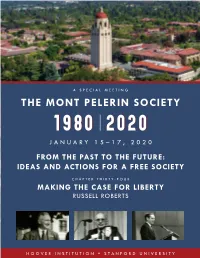
The Mont Pelerin Society
A SPECIAL MEETING THE MONT PELERIN SOCIETY JANUARY 15–17, 2020 FROM THE PAST TO THE FUTURE: IDEAS AND ACTIONS FOR A FREE SOCIETY CHAPTER THIRTY-FOUR MAKING THE CASE FOR LIBERTY RUSSELL ROBERTS HOOVER INSTITUTION • STANFORD UNIVERSITY 1 1 MAKING THE CASE FOR LIBERTY Prepared for the January 2020 Mont Pelerin Society Meeting Hoover Institution, Stanford University Russ Roberts John and Jean De Nault Research Fellow Hoover Institution Stanford University russroberts@gmail.com 1 2 According to many economists and pundits, we are living under the dominion of Milton Friedman’s free market, neoliberal worldview. Such is the claim of the recent book, The Economists’ Hour by Binyamin Applebaum. He blames the policy prescriptions of free- market economists for slower growth, inequality, and declining life expectancy. The most important figure in this seemingly disastrous intellectual revolution? “Milton Friedman, an elfin libertarian…Friedman offered an appealingly simple answer for the nation’s problems: Government should get out of the way.” A similar judgment is delivered in a recent article in the Boston Review by Suresh Naidu, Dani Rodrik, and Gabriel Zucman: Leading economists such as Friedrich Hayek and Milton Friedman were among the founders of the Mont Pelerin Society, the influential group of intellectuals whose advocacy of markets and hostility to government intervention proved highly effective in reshaping the policy landscape after 1980. Deregulation, financialization, dismantling of the welfare state, deinstitutionalization of labor markets, reduction in corporate and progressive taxation, and the pursuit of hyper-globalization—the culprits behind rising inequalities—all seem to be rooted in conventional economic doctrines. -

Hayek's the Constitution of Liberty
Hayek’s The Constitution of Liberty Hayek’s The Constitution of Liberty An Account of Its Argument EUGENE F. MILLER The Institute of Economic Affairs contenTs The author 11 First published in Great Britain in 2010 by Foreword by Steven D. Ealy 12 The Institute of Economic Affairs 2 Lord North Street Summary 17 Westminster Editorial note 22 London sw1p 3lb Author’s preface 23 in association with Profile Books Ltd The mission of the Institute of Economic Affairs is to improve public 1 Hayek’s Introduction 29 understanding of the fundamental institutions of a free society, by analysing Civilisation 31 and expounding the role of markets in solving economic and social problems. Political philosophy 32 Copyright © The Institute of Economic Affairs 2010 The ideal 34 The moral right of the author has been asserted. All rights reserved. Without limiting the rights under copyright reserved above, no part of this publication may be reproduced, stored or introduced into a PART I: THE VALUE OF FREEDOM 37 retrieval system, or transmitted, in any form or by any means (electronic, mechanical, photocopying, recording or otherwise), without the prior written permission of both the copyright owner and the publisher of this book. 2 Individual freedom, coercion and progress A CIP catalogue record for this book is available from the British Library. (Chapters 1–5 and 9) 39 isbn 978 0 255 36637 3 Individual freedom and responsibility 39 The individual and society 42 Many IEA publications are translated into languages other than English or are reprinted. Permission to translate or to reprint should be sought from the Limiting state coercion 44 Director General at the address above. -

Public Choice, Constitutional Political Economy and Law and Economics
View metadata, citation and similar papers at core.ac.uk brought to you by CORE provided by Research Papers in Economics 0610 PUBLIC CHOICE, CONSTITUTIONAL POLITICAL ECONOMY AND LAW AND ECONOMICS Ludwig Van den Hauwe Brussels, Belgium © Copyright 1999 Ludwig Van den Hauwe Abstract The various subdisciplines within the emerging ‘new institutionalism’ in economics all draw special attention to the legal-political constraints within which economic and political agents choose and therefore represent a return of economics to its appropriate legal foundations. By changing the name of his research programme to constitutional political economy Buchanan distanced himself from those parts of the public choice literature that remained too close to the traditional welfare economics approach. This chapter draws lessons for law and economics from recent developments in the re-emerging field of constitutional political economy. CPE compares alternative sets of institutional arrangements, in markets and the polity, and their outcomes, using ‘democratic consent’ as an internal standard of comparison. The chapter discusses the methodological foundation of the CPE approach, presents Buchanan’s reconstruction of the Coase theorem along subjectivist-contractarian lines and gives an overview of recent contributions to the literature. JEL classification: B41, D70, H10 Keywords: Constitutional Economics, Constitutional Political Economy, Public Choice, James M. Buchanan, Methodological Foundation A. The Manifold Legacy of Adam Smith 1. Introduction As the title of this chapter suggests, the new law and economics movement on the one hand and the now rapidly emerging field of constitutional political economy - as well as the somewhat older public choice branch of economics from which it emerged - on the other hand, are research traditi- ons that are in some respects genuinely related. -

The Mont Pelerin Society: a MANDATE RENEWED
1 The Mont Pelerin Society: A MANDATE RENEWED By Deepak Lal Ladies and Gentlemen, Welcome to this special meeting of the MPS. In this address I would like to explain why it has been called at such short notice and how I hope it provides a renewal of the mandate our founders set for the society.1 After being anointed with the Presidency of this august body in Tokyo (in early September), my wife and I went on to a lecture tour in China. We were in Shanghai on a tour of the magnificent Suzhou industrial estate outside Shanghai, with MPS member Steven Cheung. On the afternoon of the 15th September Steve received a call on his Blackberry that Lehman Brothers had gone into bankruptcy. Steve opined that this marked the end of American capitalism. I thought this somewhat hyperbolic. But, on getting back to London at the end of September, as I was tending my roses, my neighbor, a Thatcherite heart surgeon, said over the hedge that, given the recent events in the capital markets, did I still stand by the views I had expressed in my last book on "Reviving the Invisible Hand".2 I replied that even a severe trade cycle downturn would not undermine the well tested classical liberal principles I had espoused. Though, Gordon Brown might be in trouble having repeatedly congratulated himself for having abolished boom and bust. Two subsequent events shattered this complacency. I had been following a political betting site called Betfair on which some youngsters at the Tokyo MPS meeting were placing bets on a McCain victory. -
Neoliberal Reason and Its Forms: Depoliticization Through Economization∗
Neoliberal reason and its forms: Depoliticization through economization∗ Yahya M. Madra Department of Economics Boğaziçi University Bebek, 34342, Istanbul, Turkey ymadra@boun.edu.tr Yahya M. Madra studied economics in Istanbul and Amherst, Massachusetts. He has taught at the universities of Massachusetts and Boğaziçi, and at Skidmore and Gettysburg Colleges. He currently conducts research in history of modern economics at Boğaziçi University with the support of TÜBITAK-BIDEB Scholarship. His work appeared in Journal of Economic Issues, Rethinking Marxism, The European Journal of History of Economic Thought, Psychoanalysis, Society, Culture and Subjectivity as well as edited volumes. His current research is on the role of subjectivity in political economy of capitalism and post-capitalism. and Fikret Adaman Department of Economics, Boğaziçi University Bebek, 34342, Istanbul, Turkey fikret.adaman@gmail.com Fikret Adaman studied economics in Istanbul and Manchester. He has been lecturing at Boğaziçi University on political economy, ecological economics and history of economics. His work appeared in Journal of Economic Issues, New Left Review, Cambridge Journal of Economics, Economy and Society, Ecological Economics, The European Journal of History of Economic Thought, Energy Policy and Review of Political Economy as well as edited volumes. His current research is on the political ecology of Turkey. DRAFT: Istanbul, October 3, 2012 ∗ Earlier versions of this paper have been presented in departmental and faculty seminars at Gettysburg College, Uludağ University, Boğaziçi University, İstanbul University, University of Athens, and New School University. The authors would like to thank the participants of those seminars as well as to Jack Amariglio, Michel Callon, Pat Devine, Harald Hagemann, Stavros Ioannides, Ayşe Mumcu, Ceren Özselçuk, Maliha Safri, Euclid Tsakalatos, Yannis Varoufakis, Charles Weise, and Ünal Zenginobuz for their thoughtful comments and suggestions on the various versions of this paper. -

Econstor Wirtschaft Leibniz Information Centre Make Your Publications Visible
A Service of Leibniz-Informationszentrum econstor Wirtschaft Leibniz Information Centre Make Your Publications Visible. zbw for Economics Goldschmidt, Nils Working Paper Alfred Müller-Armack and Ludwig Erhard: Social Market Liberalism Freiburger Diskussionspapiere zur Ordnungsökonomik, No. 04/12 Provided in Cooperation with: Institute for Economic Research, University of Freiburg Suggested Citation: Goldschmidt, Nils (2004) : Alfred Müller-Armack and Ludwig Erhard: Social Market Liberalism, Freiburger Diskussionspapiere zur Ordnungsökonomik, No. 04/12, Albert-Ludwigs-Universität Freiburg, Institut für Allgemeine Wirtschaftsforschung, Abteilung für Wirtschaftspolitik, Freiburg i. Br. This Version is available at: http://hdl.handle.net/10419/4344 Standard-Nutzungsbedingungen: Terms of use: Die Dokumente auf EconStor dürfen zu eigenen wissenschaftlichen Documents in EconStor may be saved and copied for your Zwecken und zum Privatgebrauch gespeichert und kopiert werden. personal and scholarly purposes. Sie dürfen die Dokumente nicht für öffentliche oder kommerzielle You are not to copy documents for public or commercial Zwecke vervielfältigen, öffentlich ausstellen, öffentlich zugänglich purposes, to exhibit the documents publicly, to make them machen, vertreiben oder anderweitig nutzen. publicly available on the internet, or to distribute or otherwise use the documents in public. Sofern die Verfasser die Dokumente unter Open-Content-Lizenzen (insbesondere CC-Lizenzen) zur Verfügung gestellt haben sollten, If the documents have been made -

Minority Positions in the German Council of Economic Experts: a Political Economic Analysis
A Service of Leibniz-Informationszentrum econstor Wirtschaft Leibniz Information Centre Make Your Publications Visible. zbw for Economics Potrafke, Niklas Working Paper Minority positions in the German Council of Economic Experts: A political economic analysis ifo Working Paper, No. 160 Provided in Cooperation with: Ifo Institute – Leibniz Institute for Economic Research at the University of Munich Suggested Citation: Potrafke, Niklas (2013) : Minority positions in the German Council of Economic Experts: A political economic analysis, ifo Working Paper, No. 160, ifo Institute - Leibniz Institute for Economic Research at the University of Munich, Munich This Version is available at: http://hdl.handle.net/10419/73843 Standard-Nutzungsbedingungen: Terms of use: Die Dokumente auf EconStor dürfen zu eigenen wissenschaftlichen Documents in EconStor may be saved and copied for your Zwecken und zum Privatgebrauch gespeichert und kopiert werden. personal and scholarly purposes. Sie dürfen die Dokumente nicht für öffentliche oder kommerzielle You are not to copy documents for public or commercial Zwecke vervielfältigen, öffentlich ausstellen, öffentlich zugänglich purposes, to exhibit the documents publicly, to make them machen, vertreiben oder anderweitig nutzen. publicly available on the internet, or to distribute or otherwise use the documents in public. Sofern die Verfasser die Dokumente unter Open-Content-Lizenzen (insbesondere CC-Lizenzen) zur Verfügung gestellt haben sollten, If the documents have been made available under an Open gelten abweichend von diesen Nutzungsbedingungen die in der dort Content Licence (especially Creative Commons Licences), you genannten Lizenz gewährten Nutzungsrechte. may exercise further usage rights as specified in the indicated licence. www.econstor.eu Ifo Institute – Leibniz Institute for Economic Research at the University of Munich Minority positions in the German Council of Economic Experts: A political economic analysis Niklas Potrafke Ifo Working Paper No. -

Profile Persönlichkeiten Der Universität Hamburg Profile Persönlichkeiten Der Universität Hamburg Inhalt
FALZ FÜR EINKLAPPER U4 RÜCKENFALZ FALZ FÜR EINKLAPPER U1 4,5 mm Profile persönlichkeiten der universität hamburg Profile persönlichkeiten der universität hamburg inhalt 6 Grußwort des Präsidenten 8 Profil der Universität Portraits 10 von Beust, Ole 12 Breloer, Heinrich 14 Dahrendorf, Ralf Gustav 16 Harms, Monika 18 Henkel, Hans-Olaf 20 Klose, Hans-Ulrich 22 Lenz, Siegfried 10 12 14 16 18 20 22 24 Miosga, Caren 26 von Randow, Gero 28 Rühe, Volker 30 Runde, Ortwin 32 Sager, Krista 34 Schäuble, Wolfgang 24 26 28 30 32 34 36 36 Schiller, Karl 38 Schmidt, Helmut 40 Scholz, Olaf 42 Schröder, Thorsten 44 Schulz, Peter 46 Tawada, Yoko 38 40 42 44 46 48 50 48 Voscherau, Henning 50 von Weizsäcker, Carl Friedrich 52 Impressum grusswort des präsidenten Grußwort des Präsidenten der Universität Hamburg Dieses Buch ist ein Geschenk – sowohl für seine Empfänger als auch für die Universität Hamburg. Die Persönlichkeiten in diesem Buch machen sich selbst zum Geschenk, denn sie sind der Universität auf verschiedene Weise verbunden – als Absolventinnen und Absolventen, als ehemalige Rektoren, als prägende Lehrkräfte oder als Ehrendoktoren und -senatoren. Sie sind über ihre unmittelbare berufliche Umgebung hinaus bekannt, weil sie eine öffentliche Funktion wahrnehmen oder wahrgenommen haben. Die Universität Hamburg ist fern davon, sich selbst als Causa des beruflichen Erfolgs ihrer prominenten Alumni zu betrach- ten. Dennoch hat die Universität mit ihnen zu tun. Sie ist der Ort gewesen, in dem diese Frauen und Männer einen Teil ihrer Sozialisation erfahren haben. Im glücklicheren Fall war das Studium ein Teil der Grundlage ihres Erfolges, weil es Wissen, Kompetenz und Persönlichkeitsbildung ermöglichte.