Iain Banks – the Culture Series
Total Page:16
File Type:pdf, Size:1020Kb
Load more
Recommended publications
-

Coalescence and the Fiction of Iain Banks
Études écossaises 12 | 2009 La Science Coalescence and the fiction of Iain Banks David Leishman Electronic version URL: http://journals.openedition.org/etudesecossaises/208 DOI: 10.4000/etudesecossaises.208 ISSN: 1969-6337 Publisher UGA Éditions/Université Grenoble Alpes Printed version Date of publication: 30 April 2009 Number of pages: 215-230 ISBN: 978-2-84310-138-0 ISSN: 1240-1439 Electronic reference David Leishman, « Coalescence and the fiction of Iain Banks », Études écossaises [Online], 12 | 2009, Online since 30 April 2010, connection on 08 September 2020. URL : http://journals.openedition.org/ etudesecossaises/208 ; DOI : https://doi.org/10.4000/etudesecossaises.208 © Études écossaises David Leishman Université Stendhal – Grenoble 3 Coalescence and the fi ction of Iain Banks Iain Banks’s second novel, Walking on Glass, seems to be ideally suited for the 2007 SAES conference theme of “l’envers du décor” or “behind the scenes”, since it is preoccupied with the exploration of literature’s mechanisms and workings and with the frontiers of fi ctional worlds. All this is foregrounded in the novel’s incipit. The opening paragraphs are dominated by the colour white as if to reaffi rm the ultimate liminality of the text, the presence of the blank page that lies permanently beneath (p.11). Meanwhile, an incongruous character has opened up a service hatch in the (white) fl oor and is scrabbling about inside with a torch, the unfamiliar conduit leading to hidden levels and unimagined apparatus that defamiliarise the surface reality and challenge its seamlessness. The text precisely specifi es the time as being “3:33” and this trinity is pre- sented by the narrator as a “good omen”, portentous of “a day events would coalesce” (p. -

The Banksoniain #15 an Iain (M.) Banks Fanzine March 2010
The Banksoniain #15 An Iain (M.) Banks Fanzine March 2010 Editorial Banks’s Next Book This issue spectacularly failed to be a special Banks's next book is an M. It was originally one timed to coincide with Iain‟s appearance listed by Orbit for publication in September at the Satellite 2 convention in July 2009, so 2010, but now seems to have been put back after then getting caught up with a great deal until February 2011. of the Hitchhiker fandom activity that Iain said in October 2009 that he was working accompanied Eoin Colfer‟s sixth book in on the plan for the new novel and in late 2009 Douglas Adams‟s trilogy it has ended up that he would begin writing in in the New being the 26th anniversary of The Wasp Year, i.e. January 2010 and be finished by the Factory edition, and late for that as well! end of March. Banks was originally going to Focussing on Transition, we look at the be Guest of Honour at PCon7, in March 2010, timeline of the book and the reaction to it. We but pulled out as he wanted to concentrate on take a look back at the stage production of the novel. At the end of January 2010 The Wasp Factory from 2008 including an disclosed that he was about a third of the way interview with director Ed Robson. Gary through the first draft, his working title was Lloyd talks about the approach to the Surface Detail and it was “going splendidly”. Espedair Street album. -

A Liberal Order Beyond Earth? Civil Sphere, “The Culture” and the Future of Liberalism
doi: 10.17323/1728-192x-2020-4-36-60 A Liberal Order Beyond Earth? Civil Sphere, “The Culture” and the Future of Liberalism Werner Binder PhD, Assistant Professor, Department of Sociology, Faculty of Social Studies, Masaryk University, Brno (Czech Republic) Address: Joštova 10, 602 00 Brno, Czech Republic E-mail: werner.binder@muni.cz Starting with George Orwell’s liberal problem of meaning, this article investigates liberalism as cultural structure and myth, drawing on the theory of civil sphere by Jeffrey C. Alexander and the science fiction novels of Ian M. Banks. Following Alexander, it is argued that liberal societies are built around a sacred core described by the cultural structures of the civil sphere, which are structures of meaning as well as feeling. Civil discourses and movements in liberal (and not so liberal) societies mobilize powerful symbols of the sacred and profane and are thus able to inspire an almost religious devotion. The article then continues to explore the meaning structure, cultural contradictions and possible future of the liberal order discussing Bank’s Culture series. These novels are set in the borderlands of “the Culture”, a galactic civili- zation and liberal utopia. It is precisely this utopian setting, which allows Banks to probe the internal dilemmas of liberalism, for example between pacifism and interventionism, while addressing issues of contemporary relevance, such as the liberal problem of meaning, the al- lure of authoritarianism or the social status of artificial intelligence. With their literary imagi- nation, science fiction writers construct “a myth of the future” (Banks), which may often reflect the myths of their time, but which can also—as in the case of Banks—reflect on those myths, their implications and contradictions. -

Serious Shenanigans the New Space Opera and Social
SERIOUS SHENANIGANS THE NEW SPACE OPERA AND SOCIAL COMMENTARY: AN ANALYSIS OF IAIN M. BANKS’S SURFACE DETAIL AND THE HYDROGEN SONATA AND ANN LECKIE’S IMPERIAL RADCH TRILOGY. Marloes de Vogel 3865878 RMA Comparative Literary Studies Supervisor dr. Barnita Bagchi Second Reader dr. Monica Janssen August 2018 1 Abstract This thesis contributes to research on the genre of space opera. Space opera is generally considered the least sophisticated form of science fiction, and remains underrepresented in scholarly research. Yet, a considerable part of the greatest science fiction published over the past three decades has been space opera. Specifically, it has been New Space Opera (NSO), a renewed, innovative form of space opera that arose during the second half of the 1980s. The NSO uses space opera’s core elements of adventure and conflict to both entertain and address serious contemporary social, political, and economic issues. The aim of this thesis is to demonstrate that the NSO is an exceptionally suitable form to provide social commentary. I will show that the NSO is an innovation of the Classic Space Opera (CSO) in terms of both form and content, that the critical and satirical space operas written during the 1960s and 1970s aided this innovation, and that the perceived unsophisticated and clichéd nature of the Classic Space Opera (CSO) actually encouraged the development of the NSO. Furthermore, through a close-reading analysis of US-American author Ann Leckie’s Imperial Radch trilogy (2013-2015) and Scottish author Iain M. Banks’ Culture novels Surface Detail (2010) and The Hydrogen Sonata (2012), which are typical examples of NSO novels, I will analyze how the narrative strategies of estrangement, defamiliarization, affect, and the novum, which are integral to the speculative and imaginative nature of space opera, are employed to provide social commentary on topics such as the oppression and dehumanization of cultural others, and on issues of identity and subjectivity formation. -

The Banksoniain 17
The Banksoniain #17 An Iain (M.) Banks Fanzine April 2012 Editorial Banks’s Next Book The publication of Stonemouth is upon us. Iain is writing, or hopefully just about Apologies for not publishing in 2011, but then finishing, an ‘M’ book at the moment. An again neither did Iain. This issue looks at the early public comment about it was in an build up to the new book, and also the next interview with Irish SF magazine Albedo Culture novel, The Hydrogen Sonata. There is One (issue 41) that was conducted in April a bit more film news, and over a year of 2011. At that point he said it was to be Banks’s public appearances to report on, as “written over Jan/Feb/Mar next year, and it’s well as the calendar of forthcoming Banks almost certain to be a Culture novel.” He events on the back page. added that, “I think I need to tackle the idea of Subliming; it has delighted us with its The Wasp Factory Film vagueness long enough.” This is a long and complicated story Early in January 2012 it got an ISBN, previously discussed in various editions of 9780356501505, and a listing on book selling The Banksoniain. There was a step forward websites calling it Untitled New Iain M. when on the Friday of Novacon 40 Banks 1. However, Iain said that the working (12/11/2010) Iain commented that a deal had title was, The Hydrogen Sonata, and this was been done, and on the night he mentioned confirmed when bookselling websites were Stephen Daldry. -
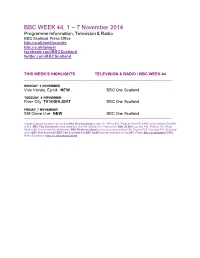
BBC WEEK 44, 1 – 7 November 2014
BBC WEEK 44, 1 – 7 November 2014 Programme Information, Television & Radio BBC Scotland Press Office bbc.co.uk/mediacentre bbc.co.uk/iplayer facebook.com/BBCScotland twitter.com/BBCScotland THIS WEEK’S HIGHLIGHTS TELEVISION & RADIO / BBC WEEK 44 _____________________________________________________________________________________________________ MONDAY 3 NOVEMBER Viva Variety, Ep1/4 NEW BBC One Scotland TUESDAY 4 NOVEMBER River City TV HIGHLIGHT BBC One Scotland FRIDAY 7 NOVEMBER Still Game Live NEW BBC One Scotland _____________________________________________________________________________________________________ Viewers outside Scotland can access BBC One Scotland on Sky 141 (HD) & 951, Freesat 108 (HD) & 960, Virgin Media 108 (HD) & 862. BBC Two Scotland can be viewed on Sky 142 (HD) & 970, Freesat 970. BBC ALBA is on Sky 143, Freesat 110, Virgin Media 188, Freeview 8 (Scotland only). BBC Radio Scotland can be accessed on Sky 0116, Freesat 712, Freeview 719 (Scotland only). BBC One Scotland, BBC Two Scotland and BBC ALBA are also available on the BBC iPlayer bbc.co.uk/iplayer & BBC Radio Scotland on bbc.co.uk/radioscotland EDITORIAL 2014 / BBC WEEK 44 _____________________________________________________________________________________________________ STELLAR CAST ANNOUNCED FOR BBC DRAMA STONEMOUTH, ADAPTED FROM THE LATE IAIN BANKS NOVEL An impressive cast including Peter Mullan, Gary Lewis, Sharon Small, Christian Cooke and Charlotte Spencer are to star in new BBC drama, Stonemouth, a two-part dramatization of acclaimed author Iain Banks’ novel made by BBC Scotland and Slate North which started shooting in Scotland this week, to air on both BBC One Scotland and BBC Two in 2015. The first TV adaptation of Banks' work since his death in 2013, Stonemouth is a rite-of-passage tale delving into love, loyalty and vengeance, focusing on the character of Stewart Gilmour played by Christian Cooke (The Promise, Magic City), who returns to the fictional village of Stonemouth for his best friend's funeral. -
Rejecting Limits and Opening Possibilities in the Works of Iain Banks
Rejecting Limits and Opening Possibilities in the Works of Iain Banks Olga Roebuck Abstract This text deals with the question of Scottish self-definition and also the escape from it. Scottish identity debate in 1980s and 1990s took on different forms and searched for other inspirations: outside Scotland or in dealing with identities traditionally overlooked due to the overall focus on national identity. This paper thus analyses the question of Scottishness through the subversive voice addressing the identities traditionally problematic in Scotland or even through individual self-definition as presented in Iain Banks’s novels The Wasp Factory (1984) and The Crow Road (1992). Keywords Scotland, cultural subversion, Scottishness, Iain Banks, The Wasp Factory, The Crow Road The classification of Iain Banks as a writer is probably as difficult as the classification of Scottishness itself. To claim that Iain Banks is a representative of a Scottish literary tradition poses several problems: to what extent can the works of this author be regarded as representative and how does he fit into the context of any literary tradition? He is not part of any school or movement and his literary voice does not fall under any simple label. Banks embodies many dualities, many undecided and hard-to-classify issues – and this is perhaps a feature that makes him particularly Scottish. To assess the cultural milieu as represented in Banks’s works, the most significant aspect seems to be an omnipresent mood of identity tiredness. After the traumatic experience of the failed devolution vote in 1979, when Scotland lost the chance to alter its status as a stateless nation after not being able to muster the necessary forty per cent of votes to enable the abolishing of the Home Rule, the sense of national identity sank into depths. -

The Hydrogen Sonata Pdf, Epub, Ebook
THE HYDROGEN SONATA PDF, EPUB, EBOOK Iain M. Banks | 640 pages | 09 Oct 2013 | Little, Brown Book Group | 9780356501499 | English | London, United Kingdom The Hydrogen Sonata PDF Book I think I was mostly right. It goes some way towards preventing readers from taking the Culture as an endorsement of the American neo- conservatives Banks loathes, but it does so by reducing the distance between the Culture as an entity and present countries, particularly America. That those who have long thought themselves your friends and allies—. Along the way there's a variety of stuff that's seen throughout the series that's fun - lots of inter-Mind and internal Mind conversations and rivalries and multiple amazing landscapes and cultures and aliens described in loving detail. It's sad coming to the end of the series which I've enjoyed a lot even when I've criticised it , especially knowing that it's the end because the brilliant author has died. The Hydrogen Sonata is a Culture novel, part of that vast and complex tapestry of future history with which Banks revitalized the subgenre of space opera and, in large measure, helped to make SF in general fun again. The Culture citizen does not own everything in common with their fellow citizens; they merely can afford to own whatever they want. This is a very fun book, from the setpieces to the humor. The Zihdren-Remnant , what is left of an older species that Sublimed before the Culture was formed, send an envoy to confess a long- kept secret before the Gzilt depart but a Gzilt warship intercepts and destroys their ship several weeks before the Sublimation is due to take place in order to preserve that secret. -

The Banksoniain #10 an Iain (M.) Banks Fanzine August 2006
The Banksoniain #10 An Iain (M.) Banks Fanzine August 2006 Editorial Banks’s Next Books Apologies for the lateness of this issue, The next Banks book has been put back to unfortunately real life got in the way of March 2007. It also seems to have undergone writing and it basically missed its slot in my a name change and is now called The Steep quarterly schedule. If you want issues to Approach to Garbadale, rather than Matter come out on a more regular basis then please (which could have been a dull Physics contribute articles, or even just ideas for textbook). It also seems to have had another articles, or anything really. Contact details at working title, Empire (a History textbook?) the end of the last page. Please expect publication to be biannual from now on so The book after next, an Iain M. Banks effort look for issue #11 in February 2007. that is definitely Culture - the opening section of this book having been written before Steep The issue features The Crow Road, the book, Approach was started - has also been put back the TV series, the radio reading and the audio as a consequence of its predecessor‟s delay. book, and to help you make all the Iain is taking the summer off, and probably connections we have produced a family tree the winter as well, and plans to start work on of the major characters. This is probably my the Untitled Culture Novel in 2007 with favourite Banks book, and I found it difficult publication currently scheduled for August to write about possibly for that reason, but 2008. -

Anticipatory Knowledge on Post-Scarcity Futures in John Barnes's Thousand Cultures Tetralogy
After Work: Anticipatory Knowledge on Post-Scarcity Futures in John Barnes’s Thousand Cultures Tetralogy By Michael Godhe Abstract What would happen if we could create societies with an abundance of goods and services created by cutting-edge technology, making manual wage labour unne- cessary – what has been labelled societies with a post-scarcity economy. What are the pros and cons of such a future? Several science fiction novels and films have discussed these questions in recent decades, and have examined them in the so- cio-political, cultural, economic, scientific and environmental contexts of globa- lization, migration, nationalism, automation, robotization, the development of nanotechnology, genetic engineering, artificial intelligence and global warming. In the first section of this article, I introduce methodological approaches and theoretical perspectives connected to Critical Future Studies and science fiction as anticipatory knowledge. In the second and third section, I introduce the question of the value of work by discussing some examples from speculative fiction. In sec- tion four to seven, I analyze the Thousand Culture tetralogy (1992–2006), written by science fiction author John Barnes. The Thousand Cultures tetralogy is set in the 29th century, in a post-scarcity world. It highlights the question of work and leisure, and the values of each, and discusses these through the various societies depicted in the novels. What are the possible risks with societies where work is voluntary? Keywords: post-scarcity, work, utopia, dystopia, critical future studies Godhe, Michael: “After Work: Anticipatory Knowledge on Post-Scarcity Futures in John Barnes’s Thousand Cultures tetralogy”, Culture Unbound, Volume 10, issue 2, 2018: 246–262. -

A Genre Analysis of Iain M. Banks' the Player of Games Juhani Lammi
View metadata, citation and similar papers at core.ac.uk brought to you by CORE provided by UEF Electronic Publications A Genre Analysis of Iain M. Banks’ The Player of Games Juhani Lammi (student n:o 153298) Graduate Thesis School of Humanities University of Eastern Finland November 2012 ITÄ-SUOMEN YLIOPISTO – UNIVERSITY OF EASTERN FINLAND Tiedekunta – Faculty Osasto – School Humanistinen tdk. / Humanities Englannin kieli / English Tekijät – Author Juhani Lammi Työn nimi – Title A Genre Analysis of Iain M. Banks’ The Player of Games Pääaine – Main Työn laji – Level Päivämäärä – Date Sivumäärä – Number of subject pages Englannin kieli / Pro gradu -tutkielma x English Sivuainetutkielma 84 p. Kandidaatin tutkielma Aineopintojen tutkielma Tiivistelmä – Abstract This thesis is a study of Iain M. Banks’ The Player of Games using genre theory as the key critical concept. The text, which I will analyze, is a utopian science fiction story. My interest is centered on how the story acts as a new utopian text, using the age-old utopian genre and fusing it with new and modern ideas and how it combines classic utopia with its new science fiction version. First, I introduce the topic. Utopian fiction is a genre of literature with ancient roots and a cultural phenomenon, which is even older. Even though the first utopia novel was published in 1516, utopia is a force which has always played a part in human society and imagination from a time earlier than the ancient Greeks. The story is very close to the classic utopian tale, where two societies are placed in opposition and all the positive aspects of the utopian one are described. -

Sunfish Culture Guide
North Central Regional Aquaculture Center Sunfish Culture Guide In cooperation with USDA\CSREES NCRAC Culture Series Sunfish Culture Guide Editors Joseph E. Morris, Iowa State University Charles C. Mischke, Mississippi State University (formerly with Iowa State University) Donald L. Garling, Michigan State University A publication of the North Central Regional Aquaculture Center (NCRAC) In cooperation with United States Department of Agriculture Cooperative State Research, Education, and Extension Service (CSREES) Grant 94-38500-0048 North Central Regional Aquaculture Center NCRAC Culture Series 102 (First Edition, 2002) Sunfish Culture Manual ii NCRAC Culture Series North Central Regional Aquaculture Center The North Central Regional Aquaculture The NCRAC serves 12 states in the Midwest: Center (NCRAC) was formed in February Illinois, Indiana, Iowa, Kansas, Michigan, 1988. It is one of five regional aquaculture Missouri, Minnesota, Nebraska, North Dakota, centers administered by the U.S. Department Ohio, South Dakota, and Wisconsin. It relies of Agriculture (USDA). on leaders in the aquaculture industry for The mission of these centers is to support direction in its programs. The Industry Advisory aquaculture research, development, Council (IAC) sets priorities. demonstration, and extension education to A Technical Committee, researchers, and enhance viable and profitable U.S. extension specialists work with the IAC to aquaculture production that will benefit formulate program priorities. Regional consumers, producers, service industries, and programs are meshed with the other Centers the American economy. to avoid duplication. They work together within the broader, Research teams and extension aquaculture integrated aquaculture program of the USDA specialists from regional universities and to promote a well-developed sustainable public agencies develop and execute work aquaculture industry in the USA.