The Praetorian Guard Receives a Witness
Total Page:16
File Type:pdf, Size:1020Kb
Load more
Recommended publications
-

Helena Chester the Discursive Construction of Freedom in The
The Discursive Construction of Freedom in the Watchtower Society Helena Chester Diploma of Teaching (Early Childhood): Riverina – Murray Institute of Higher Education Graduate Diploma of Education (Special Education): Victoria College. Master of Education (Honours): University of New England Thesis submitted in fulfilment of requirements of the degree of Doctor of Philosophy at Charles Darwin University, Darwin. October 2018 Certification I certify that the substance of this dissertation has not already been submitted for any degree and is not currently being submitted for any other degree or qualification. I certify that any help received in preparing this thesis, and all sources used, have been acknowledged in this thesis. Contents Acknowledgements ............................................................................................................... 4 Dedication ............................................................................................................................. 5 Thesis Abstract ..................................................................................................................... 6 Keywords .............................................................................................................................. 7 Acronyms and Abbreviations ................................................................................................ 8 Chapter 1: The Discursive Construction of Freedom in the Watchtower Society ................... 9 The Freedom Claim in the Watchtower Society ............................................................. -

CLAS 4000 Seminar in Classics on Seneca's Thyestes and LATN 4002 Roman Drama
CLAS 4000 Seminar in Classics on Seneca’s Thyestes and LATN 4002 Roman Drama http://myweb.ecu.edu/stevensj/CLAS4000/2016syllabus.pdf Prof. John A. Stevens Spring 2016 Office: Ragsdale 133 stevensj@ecu.edu Office Hours: TTh 11-1:30 and by appt. (252) 328-6056 Objectives. Upon completion of this course, you will be able to: • Situate Senecan tragedy in the contexts of Roman literature, history and political philosophy • Analyze the elements of Roman Stoicism present in Seneca’s Thyestes • Characterize contemporary literary approaches to the play • Evaluate the play’s literary and philosophical elements as an integral whole Writing Intensive (WI) CLAS 4000 is a writing intensive course in the Writing Across the Curriculum Program at East Carolina University. With committee approval, this course contributes to the twelve-hour WI requirement for students at ECU. Additional information is available at: http://www.ecu.edu/writing/wac/. WI Course goals: • Use writing to investigate complex, relevant topics and address significant questions through engagement with and effective use of credible sources; • Produce writing that reflects an awareness of context, purpose, and audience, particularly within the written genres (including genres that integrate writing with visuals, audio or other multi-modal components) of their major disciplines and/or career fields; • Understand that writing as a process made more effective through drafts and revision; • Produce writing that is proofread and edited to avoid grammatical and mechanical errors; • Ability to assess and explain the major choices made in the writing process. • Students are responsible for uploading the following to iWebfolio (via Courses/Student Portfolio in OneStop): 1) A final draft of a major writing project from the WI course, 2) A description of the assignment for which the project was written, and 3) A writing self-analysis document (a component of our QEP). -

The Crisis and Collapse of the Roman Empire
The Crisis and Collapse of the Roman Empire The Crisis and Collapse of the Roman Empire Lesson plan (Polish) Lesson plan (English) The Crisis and Collapse of the Roman Empire The capture of Rome by the Vandals Source: Karl Bryullo, Zdobycie Rzymu przez Wandalów, between 1833 and 1836, Tretyakov Gallery, licencja: CC 0. Link to the lesson You will learn to define the causes of the crisis of the Roman Empire in the third century CE; telling who was Diocletian and what he did to end the crisis; to describe when was the Roman Empire divided into the East and West Empires; to define what was the Migration Period and how did it influence the collapse of the Western Roman Empire; to define at what point in history the Antiquity ended and the Middle Ages started. Nagranie dostępne na portalu epodreczniki.pl Nagranie abstraktu The period of “Roman Peace”, ushered in by Emperor Augustus, brought the Empire peace and prosperity. Halfway through the second century CE the Roman Empire reached the peak of its power and greatness. The provinces thrived, undergoing the process of romanization, i.e. the spread of Roman models and customs. It was, however, not an easy task to maintain peace and power in such a large area. In order to keep the borders safe, the construction of the border fortification system, known as the limes was undertaken. Its most widely‐known portion – the over 120 kilometer‐long Hadrian’s Wall – is still present in Britain. That notwithstanding, the Empire was facing ever greater inner problems. The bust of Emperor Augustus Source: Augustus Bevilacqua, Glyptothek, Munich, licencja: Especially in the third century, the state’s CC 0. -

The Roman Wall Around Miles
Let’s walk! St Giles Cripplegate Use this map and the key to help you find your way around. Remember, you can pause the audio walk at any point to take a closer look at your surroundings, complete St Alphage one of the activities Gardens overleaf or to stop for a rest. Barbican Moorgate This walk will take about 23 minutes plus This circular walk starts Guildhall Yard. We’ll move through stops and covers 1.6km Barbican and St. Giles before looping back on ourselves and (1 mi). This walk is finishing where we began. On the way we’ll find out all about suitable for pushchairs life and work in Roman London– then called and wheelchairs. Londinium and how they kept the city safe. Remember to check the opening times and admission prices of any venues before starting Noble Street your walk. A list of Guildhall Yard them can be found on St. Paul’s the final page. Start and End Key Point of Interest Look out for Bex! As well as your audio guide, Rest points she’s also here to point out additional things and Restrooms give you fun challenges to complete as you walk. ^ Fold me along the lines and read me like a book! me like me along the lines and read ^ Fold Venues on and around the walk Fun Kids Family Walks: The City of London Remember to always check the opening times and admission prices of venues before starting your journey. The Roman Museum of London museumoflondon.org.uk Wall Barbican barbican.org.uk Guildhall guildhall.cityoflondon.gov.uk London’s Wall is one of the oldest structures in the City. -
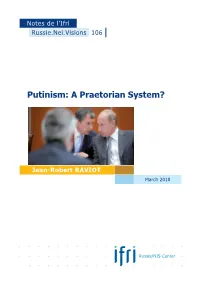
Putinism: a Praetorian System?
Notes de l’Ifri Russie.Nei.Visions 106 Putinism: A Praetorian System? Jean-Robert RAVIOT March 2018 Russia/NIS Center The Institut français des relations internationales (Ifri) is a research center and a forum for debate on major international political and economic issues. Headed by Thierry de Montbrial since its founding in 1979, Ifri is a non-governmental, non-profit organization. As an independent think tank, Ifri sets its own research agenda, publishing its findings regularly for a global audience. Taking an interdisciplinary approach, Ifri brings together political and economic decision-makers, researchers and internationally renowned experts to animate its debate and research activities. The opinions expressed in this text are the responsibility of the author alone. This text is published with the support of DGRIS (Directorate General for International Relations and Strategy) under “Russia, Caucasus and Eastern Europe Observatory”. ISBN: 978-2-36567-808-7 © All rights reserved, Ifri, 2018 How to quote this document: Jean-Robert Raviot, “Putinism: A Praetorian System?”, Russie.Nei.Visions, No. 106, Ifri, March 2018. Ifri 27 rue de la Procession 75740 Paris Cedex 15—FRANCE Tel.: +33 (0)1 40 61 60 00—Fax: +33 (0)1 40 61 60 60 Email: accueil@ifri.org Website: Ifri.org Russie.Nei.Visions Russie.Nei.Visions is an online collection dedicated to Russia and the other new independent states (Belarus, Ukraine, Moldova, Armenia, Georgia, Azerbaijan, Kazakhstan, Uzbekistan, Turkmenistan, Tajikistan and Kyrgyzstan). Written by leading experts, these policy-oriented papers deal with strategic, political and economic issues. Author Jean-Robert Raviot is a doctor of political science with accreditation to supervise research and professor of contemporary Russian civilization at Paris Nanterre University. -

The Praetorian Guard Received a Witness
The Praetorian Guard Received a Witness In the year 59 C.E., the centurion Julius and his tired soldiers led a group of prisoners into Rome. They came into the city through the Porta Capena gate. On Palatine Hill they could see the palace of Emperor Nero, which was protected by Praetorian sol- diers armed with swords. (See footnote.) The prisoners walked by the Roman Forum and up Viminal Hill. They went past a gar- RMN-Grand Palais/Art Resource, NY den with many altars to Roman gods and then past a large area used for parades and military training. One of the prisoners was the apostle Paul. Some time earlier, during a storm at sea, an angel had told Paul: “You must stand be- fore Caesar.” (Acts 27:24) Paul might have been wondering if these words would soon come true. As he looked around at the city, he may have remembered what Jesus had told him at the Tower of Antonia in Jerusalem years earlier: “Be of good courage! For as you A carving of Praetorian soldiers have been giving a thorough witness on the things about me in Je- thought to be from the Arch of rusalem, so you must also bear witness in Rome.”—Acts 23:10, 11. Claudius, built in the year 51 Perhaps Paul looked at the Praetorian camp, called the Castra Praetoria. This was a large fortress with high red-brick walls and towers. It housed 12 cohorts of the Praetorian Guard and sever- al cohorts of the city’s police, including cavalry. -

Il Legionario 51 La Guarnigione Di Roma
IL LEGIONARIO COMMENTARIVS DEL SOLDATO ROMANO NOTIZIARIO DELL’ASSOCIAZIONE ANNO VI N.51 – GENNAIO 2019 - Testo e struttura a cura di TETRVS LA GUARNIGIONE DI ROMA Guardia Pretoriana -Arco di Trionfo di Tiberio Claudio - Roma - Museo del Louvre PREMESSA La guarnigione di Roma è stata la forza militare di stanza a Roma a partire dal principato di Ottaviano Augusto (imperatore dal 27 a. C. al 14 d. C.). La sua formazione è stata progressiva, dapprima con l’istituzione formale del corpo dei pretoriani, poi di quello degli urbaniciani (nati da una costola delle coorti pretorie), quindi dei Vigiles e successivamente dell’unità denominata “Equites Singulares Augusti”; in sostanza diverse forze per compiti specifici. Come “guarnigione” (termine moderno usato per definire questo insieme di unità) la loro storia dura circa tre secoli e mezzo, terminando apparentemente nel 312 quando Costantino sciolse sia il corpo dei pretoriani sia quello degli “Equites”. COORTI PRETORIE Le coorti pretorie nascono tra il 26 o il 37 a.C. quando Ottaviano – appena salito al trono imperiale – formalizza delle precedenti uniti che avevano la funzione di guardie personali di comandati, pretori (da cui assumono la denominazione, essendo la forza militare che accompagnavano nelle campagne questi magistrati, durante la Repubblica) e altre cariche di rango. Inizialmente vengono istituite 12 coorti pretorie (di circa 500 uomini) sotto il comando di un prefetto del pretorio (diventeranno due a partire dal 2. a.C.); intorno al 13 a.C. il numero delle coorti sarà ridotto a 9. Questa riduzione risponde a due fattori: 1) Mantenere il numero di coorti al di sotto di quello (10) che avrebbe composto una legione (in quanto una vecchia legge vietava la presenza di legioni dentro le mura di Roma); 2) Creare in contemporanea il corpo delle Coorti Urbane, al servizio del Senato e sotto il controllo del prefetto dell’Urbe), un’operazione dal sapore strategico volta a bilanciare un eventuale ( e di fatto poi dimostratosi concreto) strapotere delle coorti pretorie. -

Ancient Rome
Ancient Rome William E. Dunstan ROWMAN & LITTLEFIELD PUBLISHERS, INC. Lanham • Boulder • New York • Toronto • Plymouth, UK ................. 17856$ $$FM 09-09-10 09:17:21 PS PAGE iii Published by Rowman & Littlefield Publishers, Inc. A wholly owned subsidiary of The Rowman & Littlefield Publishing Group, Inc. 4501 Forbes Boulevard, Suite 200, Lanham, Maryland 20706 http://www.rowmanlittlefield.com Estover Road, Plymouth PL6 7PY, United Kingdom Copyright ᭧ 2011 by Rowman & Littlefield Publishers, Inc. All maps by Bill Nelson. All rights reserved. No part of this book may be reproduced in any form or by any electronic or mechanical means, including information storage and retrieval systems, without written permission from the publisher, except by a reviewer who may quote passages in a review. The cover image shows a marble bust of the nymph Clytie; for more information, see figure 22.17 on p. 370. British Library Cataloguing in Publication Information Available Library of Congress Cataloging-in-Publication Data Dunstan, William E. Ancient Rome / William E. Dunstan. p. cm. Includes bibliographical references and index. ISBN 978-0-7425-6832-7 (cloth : alk. paper) ISBN 978-0-7425-6833-4 (pbk. : alk. paper) ISBN 978-0-7425-6834-1 (electronic) 1. Rome—Civilization. 2. Rome—History—Empire, 30 B.C.–476 A.D. 3. Rome—Politics and government—30 B.C.–476 A.D. I. Title. DG77.D86 2010 937Ј.06—dc22 2010016225 ⅜ϱ ீThe paper used in this publication meets the minimum requirements of American National Standard for Information Sciences—Permanence of Paper for Printed Library Materials, ANSI/ NISO Z39.48–1992. Printed in the United States of America ................ -
2017 Njcl Certamen Advanced Division Round One
2017 NJCL CERTAMEN ADVANCED DIVISION ROUND ONE 1. What author born on July 12, 100 BC led an illustrious political and military life, the latter of which he documented in painstaking detail in his Commentāriī dē Bellō Gallicō? (C. JULIUS) CAESAR B1: While there are eight books total in the Commentāriī dē Bellō Gallicō, Caesar only wrote the first seven. What lieutenant wrote the final book of his commentaries? (A.) HIRTIUS B2: What work of Caesar covered his war against Pompey? (COMMENTĀRIĪ) DĒ BELLŌ CĪVĪLĪ / BELLUM CĪVĪLE 2. Using one word, say in Latin: “It’s getting late.” (AD)VESPERĀSCIT B1: Now say in Latin using one word: “The dew will fall.” RŌRĀBIT B2: Now say in Latin using two words: “It was raining for a rather long time.” DIŪTIUS PLUĒBAT 3. What son of Gaia and Tartarus terrorized the gods until he was buried under Mt. Aetna? TYPH(A)ON / TYPHOEUS B1: After Typhon cut out Zeus’ sinews with a sickle, what two deities stole them back? HERMES AND AEGIPAN B2: Typhon fathered a passel of other monsters with what snake lady? ECHIDNA 4. According to tradition, what two small groups fought a duel to determine the outcome of a war between Rome and Alba Longa during the reign of Tullus Hostilius? HORĀTIĪ AND CŪRIĀTIĪ B1: After the duel, what incited the one surviving Horatius to kill his sister? SHE WEPT FOR ONE OF THE CURIATII TO WHOM SHE HAD BEEN BETROTHED B2: What was the name of the opposing ruler of Alba Longa? METTIUS FŪFETIUS 5. Dēscrībāmus nunc proprietātēs dictiōnum in hāc sententiā: Nūllum est iam dictum quod nōn dictum sit prius. -

Pagan-City-And-Christian-Capital-Rome-In-The-Fourth-Century-2000.Pdf
OXFORDCLASSICALMONOGRAPHS Published under the supervision of a Committee of the Faculty of Literae Humaniores in the University of Oxford The aim of the Oxford Classical Monographs series (which replaces the Oxford Classical and Philosophical Monographs) is to publish books based on the best theses on Greek and Latin literature, ancient history, and ancient philosophy examined by the Faculty Board of Literae Humaniores. Pagan City and Christian Capital Rome in the Fourth Century JOHNR.CURRAN CLARENDON PRESS ´ OXFORD 2000 3 Great Clarendon Street, Oxford ox2 6dp Oxford University Press is a department of the University of Oxford. It furthers the University's aim of excellence in research, scholarship, and education by publishing worldwide in Oxford New York Athens Auckland Bangkok Bogota Bombay Buenos Aires Calcutta Cape Town Chennai Dar es Salaam Delhi Florence Hong Kong Istanbul Karachi Kuala Lumpur Madrid Melbourne Mexico City Mumbai Nairobi Paris SaÄo Paulo Singapore Taipei Tokyo Toronto Warsaw with associated companies in Berlin Ibadan Oxford is a registered trade mark of Oxford University Press in the UK and certain other countries Published in the United States by Oxford University Press Inc., New York # John Curran 2000 The moral rights of the author have been asserted Database right Oxford University Press (maker) First published 2000 All rights reserved. No part of this publication may be reproduced, stored in a retrieval system, or transmitted, in any form or by any means, without the prior permission in writing of Oxford University Press, or as expressly permitted by law, or under terms agreed with the appropriate reprographics rights organizations. Enquiries concerning reproduction outside the scope of the above should be sent to the Rights Department, Oxford University Press, at the address above You must not circulate this book in any other binding or cover and you must impose the same conditions on any acquirer British Library Cataloguing in Publication Data Data applied for Library of Congress Cataloging in Publication Data Curran, John R. -

QHN Spring 2020 Layout 1
WESTWARD HO! QHN FEATURES JOHN ABBOTT COLLEGE & MONTREAL’S WEST ISLAND $10 Quebec VOL 13, NO. 2 SPRING 2020 News “An Integral Part of the Community” John Abbot College celebrates seven decades Aviation, Arboretum, Islands and Canals Heritage Highlights along the West Island Shores Abbott’s Late Dean The Passing of a Memorable Mentor Quebec Editor’s desk 3 eritageNews H Vocation Spot Rod MacLeod EDITOR Who Are These Anglophones Anyway? 4 RODERICK MACLEOD An Address to the 10th Annual Arts, Matthew Farfan PRODUCTION Culture and Heritage Working Group DAN PINESE; MATTHEW FARFAN The West Island 5 PUBLISHER A Brief History Jim Hamilton QUEBEC ANGLOPHONE HERITAGE NETWORK John Abbott College 8 3355 COLLEGE 50 Years of Success Heather Darch SHERBROOKE, QUEBEC J1M 0B8 The Man from Argenteuil 11 PHONE The Life and Times of Sir John Abbott Jim Hamilton 1-877-964-0409 (819) 564-9595 A Symbol of Peace in 13 FAX (819) 564-6872 St. Anne de Bellevue Heather Darch CORRESPONDENCE EDITOR@QAHN.ORG A Backyard Treasure 15 on the West Island Heather Darch WEBSITES QAHN.ORG QUEBECHERITAGEWEB.COM Boisbriand’s Legacy 16 100OBJECTS.QAHN.ORG A Brief History of Senneville Jim Hamilton PRESIDENT Angus Estate Heritage At Risk 17 GRANT MYERS Matthew Farfan EXECUTIVE DIRECTOR MATTHEW FARFAN Taking Flight on the West Island 18 PROJECT DIRECTORS Heather Darch DWANE WILKIN HEATHER DARCH Muskrats and Ruins on Dowker Island 20 CHRISTINA ADAMKO Heather Darch GLENN PATTERSON BOOKKEEPER Over the River and through the Woods 21 MARION GREENLAY to the Morgan Arboretum We Go! Heather Darch Quebec Heritage News is published quarterly by QAHN with the support Tiny Island’s Big History 22 of the Department of Canadian Heritage. -
2013 Virginia Senior Classical League State Finals Certamen Level III NOTE to MODERATORS: in Answers, Information in Parentheses Is Optional Extra Information
2013 Virginia Senior Classical League State Finals Certamen Level III NOTE TO MODERATORS: in answers, information in parentheses is optional extra information. A slash ( / ) indicates an alternate answer. Underlined portions of a longer, narrative answer indicate required information. ROUND ONE 1. TOSSUP: From what Latin noun, with what meaning, do the words ignition and igneous ultimately derive? ANS: IGNIS, FIRE BONUS: From what Latin verb, with what meaning, do the words coherent and adhesion derive? ANS: HAEREŌ, STICK/CLING 2. TOSSUP: According to Livy and Plutarch, what legendary Roman triumphed four times, was dictator five times, was never once consul, was honored with the title “Second Founder of Rome,” and conquered the city of Veii in 396 BC? ANS: (M. FURIUS) CAMILLUS BONUS: Following the victory over Veii, for what accusation did his political adversaries impeach Camillus? ANS: EMBEZZLEMENT 3. TOSSUP: According to Hesiod, what moon titan, the daughter of Ouranos and Gaia, bore Leto from the union with her brother Coeus? ANS: PHOEBE BONUS: According to Hesiod, what Star goddess was also the daughter of Phoebe and Coeus and the mother of Hecate? ANS: Asteria 4. TOSSUP: What fifteen-book work of Ovid ends with the apotheosis of Julius Caesar? ANS: METAMORPHOSES BONUS: What other work of Ovid, consisting of epistolary poems written by mythological heroines, allowed him to claim that he had created a new genre of mythological elegy? ANS: HEROIDES rd 5. TOSSUP: Give the 3 person singular, pluperfect active subjunctive of noceō, nocēre. ANS: NOCUISSET nd BONUS: Now give the 2 person plural present subjunctive of morior, morī.