The Jaipur Economic and Industrial Museum
Total Page:16
File Type:pdf, Size:1020Kb
Load more
Recommended publications
-

7. Know Me: I Am Your Capital City
7. Know me: I am your Capital City I am your capital city. My name is Jaipur. It is after the name of my founder Raja Jai Singh II. I was founded in 1727. I am popularly known as pink city. It is because of the stone used for the construction of all the structures. I was first painted in pink colour in 1857 to welcome the first visit of the Prince of Wales. I was repainted in 1876 during his second visit. I was planned according to Bhartiya Vastu Shastra by a Bengali architect, Vidhyadhar Bhattacharya. The directions of each road, street and market are East to West and North to South. There is a rampart around me. There are seven gates to enter the city. I am connected with all the parts of Rajasthan and India by air, road and rail network. In 2011 I had a population of more than thirty five lakh. I am the 10th largest city of India as per the census of 2011. I have a semi arid climate. Most of the rainfall occurs in the monsoon months. I have several tourist places. Some of them are; City palace, JantarMantar, Hawamahal, Albert Hall Museum, Amber Fort, Birla Mandir, etc. The State Government rules the state from here. The Raj Bhawan for the Governor. The secretariat is for the offices of the Chief Minister, Other ministers and the administrative officers. There is the Vidhansabha for People’s Representatives. The Jaipur Municipal Corporation is responsible for maintaining civic infrastructure and carrying out administrative duties. It has a Mayor, a Deputy Mayor and the office bearers. -

NAMASTE! (Nah-Mahs-Teh) in a Number of India’S Many Languages (Including Hindi), the Word for Hello Greetings, Good-Bye, Etc
NAMASTE! (Nah-mahs-teh) In a number of India’s many languages (including Hindi), the word for hello greetings, good-bye, etc. Derivatives of this word include namaskar, namaskara & namaskaram. DECEMBER 2018 EDITION (Originally published April 2010) JAIPUR! India is, by its very nature, a land of great contrasts. For instance, it has been listed as both one of the driest & wettest places in the world. At Cherrapunji (in the far northeastern part of the country), it is not unusual for the total annual rainfall to be 40 FEET. In the Great Indian Desert (also called the Thar Desert), rainfall can often be less than 1 inch per year. Take a look at the great metropolitan areas of India. The 6 major ones are Bombay (now called Mumbai), Madras (now Chennai), Calcutta, Delhi, Bangalore and Hyderabad. This is where about 10% of the total population of the country lives. In fact, India has more cities of 1 million or more inhabitants than any other country in the world. On the other hand, India is home to over 600,000 villages that have a population of 5,000 or less. Jaipur is the capital city of Rajasthan. Rajasthan is a place of great contrast to much of the rest of India. It is a desert city, now with a population of at least 6 million people, and is one of the fastest-growing cities in the world. The Rajasthani people are just— well, they are different. They are Indian, to be sure, but with a flair that is not found in other places of the country. -

In the Name of Krishna: the Cultural Landscape of a North Indian Pilgrimage Town
In the Name of Krishna: The Cultural Landscape of a North Indian Pilgrimage Town A DISSERTATION SUBMITTED TO THE FACULTY OF THE GRADUATE SCHOOL OF THE UNIVERSITY OF MINNESOTA BY Sugata Ray IN PARTIAL FULFILLMENT OF THE REQUIREMENTS FOR THE DEGREE OF DOCTOR OF PHILOSOPHY Frederick M. Asher, Advisor April 2012 © Sugata Ray 2012 Acknowledgements They say writing a dissertation is a lonely and arduous task. But, I am fortunate to have found friends, colleagues, and mentors who have inspired me to make this laborious task far from arduous. It was Frederick M. Asher, my advisor, who inspired me to turn to places where art historians do not usually venture. The temple city of Khajuraho is not just the exquisite 11th-century temples at the site. Rather, the 11th-century temples are part of a larger visuality that extends to contemporary civic monuments in the city center, Rick suggested in the first class that I took with him. I learnt to move across time and space. To understand modern Vrindavan, one would have to look at its Mughal past; to understand temple architecture, one would have to look for rebellions in the colonial archive. Catherine B. Asher gave me the gift of the Mughal world – a world that I only barely knew before I met her. Today, I speak of the Islamicate world of colonial Vrindavan. Cathy walked me through Mughal mosques, tombs, and gardens on many cold wintry days in Minneapolis and on a hot summer day in Sasaram, Bihar. The Islamicate Krishna in my dissertation thus came into being. -

Robert's Roughguide to Rajasthan
Robert’s Royal Rajasthan Rider’s Roughguide in association with All work herein has been sourced and collated by Robert Crick, a participant in the 2007 Ferris Wheels Royal Rajasthan Motorcycle Safari, from various resources freely available on the Internet. Neither the author nor Ferris Wheels make any assertions as to the relevance or accuracy of any content herein. 2 CONTENTS 1 HISTORY OF INDIA - AN OVERVIEW ....................................... 3 POLITICAL INTRODUCTION TO INDIA ..................................... 4 TRAVEL ADVISORY FOR INDIA ............................................... 6 ABOUT RAJASTHAN .............................................................. 9 NEEMRANA (ALWAR) ........................................................... 16 MAHANSAR ......................................................................... 16 BIKANER ............................................................................ 17 PHALODI ............................................................................ 21 JAISALMER ......................................................................... 23 JODPHUR ........................................................................... 26 PALI .................................................................................. 28 MT ABU .............................................................................. 28 UDAIPUR ............................................................................ 31 AJMER/PUSKAR ................................................................... 36 JAIPUR -

India – Jaipur
India – Jaipur April 3, 2022 — April 9, 2022 Starting at: $2,300 OVERVIEW The Need India is the world’s second most populous country and in spite of a well trained and functional health care system, India still faces significant public health issues. Sanitation, overcrowding, and poverty all contribute to illness, especially among the poor. In 2018, India reported a 30% infant mortality rate. India also still faces several gender health disparities, where women are more vulnerable to different health risks. Join International Medical Relief (IMR) in providing quality medical care for the communities surrounding Jaipur. The team will care for those with the greatest need for medical attention. Our clinics are nestled among the throwback of centuries old traditions in southern India. Engage with this culture first hand as you provide greatly needed medical care to the densely inhabited communities. Those left out of the medical system will not only get medical attention, but will also be given needed education to help them survive in places where healthcare International Medical Relief | (970) 635-0110 | office@imrus.org | imrus.org is difficult to access. Our Work International Medical Relief began relief efforts in India in 2011. Since then we have served nearly 16,000 patients through more than 400 staff and volunteers. IMR continues to provide sustainable health care through education initiatives that include clean water, dehydration/rehydration, malnutrition, family planning, oral health, respiratory diseases, malaria prevention and hygiene/hand washing. We expect to continue collaborating with local health officials and growing our relationships with communities in India. With diligent planning and preparation, IMR is dedicated to ensuring that specific goals are met on our missions, each in correlation to the United Nations Sustainable Development Goals 3 and 17. -
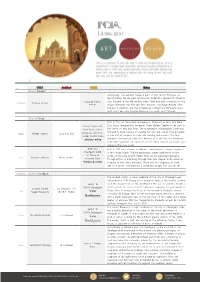
India Architecture Guide 2017
WHAT Architect WHERE Notes Zone 1: Zanskar Geologically, the Zanskar Range is part of the Tethys Himalaya, an approximately 100-km-wide synclinorium. Buddhism regained its influence Lungnak Valley over Zanskar in the 8th century when Tibet was also converted to this ***** Zanskar Desert ཟངས་དཀར་ religion. Between the 10th and 11th centuries, two Royal Houses were founded in Zanskar, and the monasteries of Karsha and Phugtal were built. Don't miss the Phugtal Monastery in south-east Zanskar. Zone 2: Punjab Built in 1577 as the holiest Gurdwara of Sikhism. The fifth Sikh Guru, Golden Temple Rd, Guru Arjan, designed the Harmandir Sahib (Golden Temple) to be built in Atta Mandi, Katra the centre of this holy tank. The construction of Harmandir Sahib was intended to build a place of worship for men and women from all walks *** Golden Temple Guru Ram Das Ahluwalia, Amritsar, Punjab 143006, India of life and all religions to come and worship God equally. The four entrances (representing the four directions) to get into the Harmandir ਹਰਿਮੰਦਿ ਸਾਰਹਬ Sahib also symbolise the openness of the Sikhs towards all people and religions. Mon-Sun (3-22) Near Qila Built in 2011 as a museum of Sikhism, a monotheistic religion originated Anandgarh Sahib, in the Punjab region. Sikhism emphasizes simran (meditation on the Sri Dasmesh words of the Guru Granth Sahib), that can be expressed musically *** Virasat-e-Khalsa Moshe Safdie Academy Road through kirtan or internally through Nam Japo (repeat God's name) as ਰਿਿਾਸਤ-ਏ-ਖਾਲਸਾ a means to feel God's presence. -

The Walled City of Jaipur, Rajasthan, India for Inclusion on World Heritage List
i ES Executive Summary State Party: India State, Province or Region: Rajasthan, India Name of Property: Jaipur City, Rajasthan Geographical coordinates to the nearest second: N 26° 55’ 27.4” E 75° 49’ 18.7” (Central coordinates of World Heritage Site of Jantar Mantar) Textual description of the boundary(ies) of the nominated property: The boundaries of the nominated property coincide with the historic walled city of Jaipur, which was founded in 1727 A.D. by the Rajput ruler Sawai Jai Singh of Kacchawah dynasty. The city is roughly divided into nine rectangular sectors with straight roads intersecting only at right angles and is enclosed within massive wall to protect the city in a total area of 709 hectares. The wall encircles the city and 9 city gates are present to provide the access to the city from various directions. Several iconic monuments and temples are housed within this walled city area with two main North South axes crossing to form 3 main pubic squares (Badi Chaupar, Choti Chaupar and a 3rd one Ramganj Chaupar extending on the eastern side) on the East West axes that define the overall grid iron city plan. It has a total of 12 main bazaar areas across the main axial streets. The buffer zone area of the nominated property conforms to the surrounding landmarks and natural terrain that were used as reference points to mark the ground plan of the city including Ganeshgarh in the north, hills of Galtaji in the East, Nahargarh and Hathroi in the west and Shankergarh in the south. iv Nomination of the Walled city of Jaipur, Rajasthan, India for inclusion on World Heritage List i ES Map(s) of the nominated property, showing boundaries and buffer zone E 75°49'24.7 '' N 26°55'24.7'' Nominated Property Buffer Zone Survey of India map of Jaipur and its surroundings marking the nominated property and buffer zone (Central coordinates of World Heritage Site of Jantar Mantar) Source: Survey of India. -

Report on Rajasthan Trip
Sarvajanik Education Society Sarvajanik College of Engineering & Technology, Surat A report on Academic trip to Rajasthan By Faculty members of Faculty of Civil Engineering, SCET For the students, of BE IV Civil (05-03-2018 to 14-03-2018) Team Members: Prof. (Dr.) Pratima A Patel (HOD, FCE) Prof. (Dr.) Jigar K. Sevalia Prof. Palak S. Shah Mr. Hitendra M. Patel 1 JAIPUR: 05/03/2018 Departure from Surat at 08:30pm by BDTS JP SF EXP, Over Night Journey (Non- A/c Sleeper Class) 06/03/2018 Pick up from Railway Station at 10:45am, Check in, Lunch and Half Day Sightseeing, Dinner and Night Halt Sight Seeing Places: Lunch Jaipur Albert Hall Dinner Zoo Hotel Jaipur Birla Temple Shalimar Local Market 07/03/2018 Breakfast, Full Day Sightseeing, Dinner and Night Halt Sight Seeing Places: Hawa Mahal JantarMantar Breakfast City Palace Dinner KholeKeHanumanji Temple Local Market Hotel Shalimar JAISALMER: 08/03/2018 Breakfast, Lunch, check out and Half Day Sightseeing, Dinner and Drop at Railway Station at 11:00pm, Departure for Jaisalmer at 11:45pm by DLI JSM EXPRESS (Non A/c Sleeper Class) Over Night Journey. Sight Seeing Places: Jal Mahal Breakfast Jaigarh Fort Dinner Amer Fort 09/03/2018 Pick up from Railway Station at 11:45am, Check in, Lunch and Proceed for Desert, Dinner and Night Halt Activities: LunchDinner Camel Ride Evening high tea Camp fire with Rajasthani culture programme with folk dance & folk music Rajasthani dinner DDS Tent Accommodation on Swiss tent quard sharing 10/03/2018 Breakfast, Proceed for Jaisalmer, Sightseeing, -

Specialists in STEM Student Travel
Tour: India Unveiled Destination: Delhi, Agra & Jaipur - India Specialization: Archaeology, Anthropology, Astronomy, Environmental Sciences, History, Architecture, Geography & Culture Itinerary: 8-days / 7-night package Flight Duration Note: Outbound flights include an overnight flight en route to India. INDIA UNVEILED - Sample Itinerary Day Morning Afternoon Evening 1 Travel to Delhi, India via air 2 Arrive Delhi; Transfer to Hotel Dinner 3 Breakfast Archaeological Master Class Old & New Delhi Tour & Sightseeing Excursions Dinner Nehru Planetarium & Qutub Minar / Ruins of Ancient Lal 4 Breakfast Indian Anthropology Master Class Bagh Dinner 5 Breakfast Transfer to Agra Agra Tour & Sightseeing Excursions Dinner 6 Breakfast Transfer to Jaipur / Fatehpur Sikri en route Environmental Master Class / University of Rajasthan Dinner 7 Breakfast Amber Fort & Albert Hall Museum Jaipur Tour & Sightseeing Excursions Dinner 8 Breakfast Transfer to Delhi; fly home Specialists in STEM Student Travel As with all sample itineraries, please be advised that this is an ‘example’ of a schedule and that the activities and hotels shown may be variable dependent upon dates, weather, special requests and other factors. Itineraries will be confirmed prior to travel. Day 1 Dinner in Flight Start your travel to India via air and travel overnight to arrive in Delhi. Dinner and breakfast will be served during your flight. Note: Visas are required from all visitors entering India. These costs are not included in tour costs and are the responsibility of individual members of the traveling party. Please ensure party members have researched the most up-to-date requirements and applied for all necessary documentation. Day 2 Breakfast in flight, lunch on own, dinner Included Good morning India!! After landing and clearing Customs and Immigrations, we’ll transfer to our Delhi hotel. -

FORTS of INDIA Anurit Vema
FORTS OF INDIA Anurit Vema *'9^7” \ < > k M' . J . i <• : » I : *='>- >.% ' nvjl •I' 4 V FORTS OF INDIA ■ \ f 0i''. ■ V'; ’ V, , ’' I* ;■'; -r^/A ci''> Digitized by the Internet Archive in 2018 with funding from Public.Resource.org https ;//archive.org/details/fortsofindiaOOverm JAMkJ AND KASHMIR FORTS OF INDIA HARIPARBAT "■^Arot kangraW ( HIMACHAL\ ( .' V.PRADESH\ r PUNJAB S', i /kalibangM ■'HARYANA > ARUNACHAL PRADESH ®BIKANER \ A/ D. AMBEr'f-X UTTAR PRADESH^-'... ® RAJASTHAN ® X BHUTAN "'^JAISALMER BHARATPUR’^A--^,@i®/lGPA JODHPUR /^^f^ji^^i^gff^j^^®^ BWALIOR J ALLAHABAD ROHTASGARH MEGHALAYA 'KUMBHALGARH % (\ \ ®\ .0 n.1 , ^•‘-fCHUHAR BANGLADESH TRIPURA f AHtAADABAD ■> WEST C !■ r'^' BENGALI, ® .^XHAMPANIR MADHYA PRADESH FORT WILLIAM A RAT /rOABHOlV ®MANDU BURMA DAULATABAD MAHARASHTRA ^AHMEDNABAR SHJVNER ARABIAN SEA mSINHGARH l\i,' WARANGAL 1, bay of BENGAL RAIGARH . /“ < GULBARGA GOLKUNOA PANHALA BIJAPUR JANDHRA PRADESH VUAYANAGAR iKARNATAKA| '^RJRANGAPATAM m GINGEEi LAKSHADWEEP (INDIA) SRI \ INDIAN OCEAN LANKA 6aMd upon Survey ol India outline map printed in 1980 The territorial waters of India extend into the sea to a distance of twelve nautical miles measured from the appropriate base line. ) Government of India copyrliht. The twundary of Meghalaya shown on this map is as interpreted from the Nonh-Eestern Areas (Reorgamaaiion) Act, 1971. but has yet to be venlied 49 FORTS OF INDIA AMRIT VERMA PUBLICATIONS DIVISION MINISTRY OF INFORMATION AND BROADCASTING GOVERNMENT OF INDIA May 1985 {Jyaistha 1907) ® Publications Division Price -

'Indian Architecture' and the Production of a Postcolonial
‘Indian Architecture’ and the Production of a Postcolonial Discourse: A Study of Architecture + Design (1984-1992) Shaji K. Panicker B. Arch (Baroda, India), M. Arch (Newcastle, Australia) A Thesis Submitted to the University of Adelaide in fulfilment of the Requirements for the Degree of Doctor of Philosophy School of Architecture, Landscape Architecture and Urban Design Centre for Asian and Middle Eastern Architecture 2008 Table of Contents Abstract ............................................................................................................................................................................................iv Declaration ............................................................................................................................................................................................vi Acknowledgements..........................................................................................................................................................................vii List of Figures ........................................................................................................................................................................................ ix 1 Introduction ........................................................................................... 1 1.1: Overview..................................................................................................................................................................1 1.2: Background...........................................................................................................................................................2 -

Riding Through Change History, Horses, and the Restructuring of Tradition in Rajasthan
Riding Through Change History, Horses, and the Restructuring of Tradition in Rajasthan By Elizabeth Thelen Senior Thesis Comparative History of Ideas University of Washington Seattle, Washington June 2006 Advisor: Dr. Kathleen Noble CONTENTS Page Introduction……………………………………………………………………… 1 Notes on Interpretation and Method History…………………………………………………………………………… 7 Horses in South Asia Rise of the Rajputs Delhi Sultanate (1192-1398 CE) Development of Rajput States The Mughal Empire (1526-1707 CE) Decline of the Mughal Empire British Paramountcy Independence (1947-1948 CE) Post-Independence to Modern Times Sources of Tradition……………………………………………………………… 33 Horses in Art Technical Documents Folk Sayings and Stories Col. James Tod Rana Pratap and Cetak Building a Tradition……………………………………………………………… 49 Economics Tourism and Tradition Publicizing Tradition Breeding a Tradition…………………………………………………………….. 58 The Marwari Horse “It's in my blood.” Conclusion……………………………………………………………………….. 67 Bibliography……………………………………………………………………… 70 ILLUSTRATIONS Figure Page 1. District Map of Rajasthan…………………………………………………… 2 2. Province Map of India………………………………………………………. 2 3. Bone Structure in Marwari, Akhal-Teke and Arab Horses…………………. 9 4. Rajput horse paintings……………………………………………................. 36 5. Shalihotra manuscript pages……………………………………………….... 37 6. Representations of Cetak……………………………………………………. 48 7. Maharaj Narendra Singh of Mewar performing ashvapuja…………………. 54 8. Marwari Horses……………………………………………………………… 59 1 Introduction The academic discipline of history follows strict codes of acceptable evidence and interpretation in its search to understand and explain the past. Yet, what this discipline frequently neglects is an examination of how history informs tradition. Local knowledge of history, while it may contradict available historical evidence, is an important indicator of the social, economic, and political pressures a group is experiencing. History investigates processes over time, while tradition is decidedly anachronistic in its function and conceptualization.