Arc Light Era
Total Page:16
File Type:pdf, Size:1020Kb
Load more
Recommended publications
-

Patrolling Fall 2008 75 Th Ranger Regiment Association, Inc
PATROLLING FALL 2008 75 TH RANGER REGIMENT ASSOCIATION, INC. VOLUME 23 ISSUE II Vietnamese Rangers (37 th Biet Dong Quan), and their US advisors inspect a captured NVA recoilless rifle during the battle at Khe Sanh, Tet, 1968. Trench lines were necessary due to sniper fire and constant incoming enemy rounds. Senior Advisor CPT Walter Gunn is in the forefront, Officers’ Messages ................................1-10 kneeling; SFC Willard Langdon, 4 th from right, with BDQ General ..................................11-24 & 72-80 patch. Unit Reports ........................................25-71 CHINA - BURMA - INDIA VIETNAM IRAN GRENADA PANAMA IRAQ SOMALIA AFGHANISTAN PATROLLING – FALL 2008 PATROLLING – FALL 2008 WHO WE ARE: The 75th Ranger Regiment Association, Inc., is a We have funded trips for families to visit their wounded sons and registered 501 (c) corporation, registered in the State of Georgia. We were husbands while they were in the hospital. We have purchased a learning founded in 1986 by a group of veterans of F/58, (LRP) and L/75 (Ranger). program soft ware for the son of one young Ranger who had a brain The first meeting was held on June 7, 1986, at Ft. Campbell, KY. tumor removed. The Army took care of the surgery, but no means existed OUR MISSION: to purchase the learning program. We fund the purchase of several awards 1. To identify and offer membership to all eligible 75th Infantry Rangers, for graduates of RIP and Ranger School. We have contributed to each of and members of the Long Range Reconnaissance Patrol the three Battalion’s Memorial Funds and Ranger Balls, Companies, Long Range Patrol Companies, Ranger and to the Airborne Memorial at Ft. -

MISSISSIPPI LEGISLATURE REGULAR SESSION 2014 By
MISSISSIPPI LEGISLATURE REGULAR SESSION 2014 By: Representatives Jennings, Alday, Bain, To: Rules Baker, Beckett, Bell, Bennett, Bounds, Boyd, Brown (66th), Byrd, Calhoun, Carpenter, Chism, Clark, Currie, DeBar, Denny, Dixon, Evans (43rd), Evans (91st), Formby, Gibbs, Gipson, Guice, Hamilton, Haney, Hood, Horne, Howell, Kinkade, Ladner, Martinson, Massengill, Mayo, Middleton, Miles, Moore, Oberhousen, Pigott, Powell, Rogers (14th), Rogers (61st), Rushing, Shirley, Shows, Smith (39th), Staples, Steverson, Straughter, Sullivan, Taylor, Thomas, Turner, Watson, Weathersby, Willis, Zuber HOUSE RESOLUTION NO. 53 1 A RESOLUTION COMMEMORATING THE 50TH ANNIVERSARY OF THE 2 VIETNAM WAR. 3 WHEREAS, it is the custom of this Legislative Body to honor 4 those who served in the American Armed Forces during wartime and 5 strengthen our shared commitment to the exercise of freedom, and 6 therefore the Mississippi House of Representatives commemorates 7 the 50th Anniversary of the Vietnam War; and 8 WHEREAS, Mississippi House of Representatives members Mac 9 Huddleston (United States Army Captain - 1966-67), Manly Barton 10 (United States Army Specialist 5 - 1969-70), Thomas G. Taylor 11 (United States Army Specialist 5 - 1968-69), Representative Rufus 12 Straughter's brother, Robert Laurence Straughter (United States 13 Army First Sergeant) and Representative Wanda Jennings' husband 14 Terry Jennings (United States Air Force Captain) each bravely and 15 patriotically served in Vietnam; and 16 WHEREAS, in the late 1950s, the United States began sending -

Intellipedia-Operationpocketmoney
This document is made available through the declassification efforts and research of John Greenewald, Jr., creator of: The Black Vault The Black Vault is the largest online Freedom of Information Act (FOIA) document clearinghouse in the world. The research efforts here are responsible for the declassification of hundreds of thousands of pages released by the U.S. Government & Military. Discover the Truth at: http://www.theblackvault.com NATIONAL SECURITY AGENCY FORT GEORGE G. MEADE, MARYLAND 20755-6000 FOIA Case: 105679A 12 December 2018 JOHN GREENEWALD 27305 W LIVE OAK ROAD SUITE #1203 CASTAIC CA 91384 Dear Mr. Greenewald: This responds to your Freedom of Information Act (FOIA) request of 11 November 2018, for Intellipedia pages on Operation Pocket Money. As stated in our initial response dated 26 November 2018, your request was assigned Case Number 105679. For purposes of this request and based on the information you provided, you are considered an "all other" requester. As such, you are allowed 2 hours of search and the duplication of 100 pages at no cost. There are no assessable fees for this request. Your request has been processed under the provisions of the FOIA. For your information, NSA provides a service of common concern for the Intelligence Community (IC) by serving as the executive agent for Intelink. As such, NSA provides technical services that enable users to access and share information with peers and stakeholders across the IC and DoD. Intellipedia pages are living documents that may be originated by any user organization, and any user organization may contribute to or edit pages after their origination. -

Operation Barrel Roll
In 1962, the United States began a “secret war” in Laos. The operation wasn’t revealed until 1970, by which time it con- sumed half of all US attack sorties in Southeast Asia. Barrel Roll By John T. Correll n early 1961, the hot spot of lead- ing concern in Southeast Asia was not Vietnam but Laos. The new US President, John IF. Kennedy, rated Laos as “the most im- mediate of the problems that we found upon taking office” in January. On March 23, Kennedy held a news conference, nationally televised, to talk about Laos. He pointed out the communist advance on a large map. The Pathet Lao insur- gents, supported by the Russians and the North Vietnamese, had captured the northeastern part of the country. “Laos is far away from America, but the world is small,” Kennedy said. “The security of all Southeast Asia will be endangered if Laos loses its neutral independence. Its own safety runs with the safety of us all, in real neutrality observed by all.” In itself, Laos had little strategic im- portance. It was remote and landlocked, with a population of only two million. However, it shared borders with six other countries and had traditionally served as a buffer zone between the more powerful neighboring states. Thousands of ancient stone jars dot the plains in the center of Laos. The real concern about Laos was that the insurgency would spread and destabilize the rest of the region. “If the group, about 750 people, left promptly, pilots flying air support for the Laotian communists [are] able to move in and but no more than 40 of the 7,000 North ground forces. -
Vietnam: Tet Offensive Resource Packet
Virginians at War Vietnam: Tet Offensive Resource Packet Contains: Glossary, Timeline, Images, Discussion Questions, Additional Resources Program Description: Virginians at War: The Tet Offensive explores the experience of Virginians that fought during the critical Tet Offensive in 1968, a turning point of the Vietnam War. Launched by the North Vietnamese Army on 30 January, the coordinated attack against thirteen different provincial capitals throughout South Vietnam took Americans and South Vietnamese by surprise. The result was a costly, long campaign that ended in a hard –fought military victory for the United States and South Vietnamese. However, the outcome of the campaign had a significantly negative impact on support for the war in the United States, from which the nation would not fully recover. Copyright: Virginia War Memorial Foundation, 2006 Length: 18:59 Streaming link: https://vimeo.com/367038067 Featured Speakers: MSG Lonnie S. Ashton, Montross SPC Orthea Harcum, Richmond MSG Lauren P. Bands, Colonial Heights LT Hugh D. Keogh, Midlothian COL Robert C. Barrett, Jr., Colonial Heights SGT Prentis Lee, Clifton LT COL Frank S. Blair, Richmond SP/4 Powhatan “Red Cloud” Owen, Charles City MSG Charles M. Carter, Warsaw SGM Douglass I. Randolph, Charlotte Court House SGT Earl E. Cousins, Ashland MAJ John A. Rawls, M.D., Mechanicsville CPT James H. Dement, Jr., Richmond 1st LT Cathie Lynn Solomonson, R.N., Woodbridge 1st LT Daniel G. Doyle, Richmond 1st LT James F. Walker, Roanoke LT COL John D. Edgerton, Williamsburg For a transcript of this program and more information on the Vietnam War, please visit vawarmemorial.org/learn/resources/vietnam. -

H-Diplo/ISSF Forum on “Audience Costs and the Vietnam War”
H-Diplo | ISSF Forum, No. 3 (2014) A production of H-Diplo with the journals Security Studies, International Security, Journal of Strategic Studies, and the International Studies Association’s Security Studies Section (ISSS). http://issforum.org H-Diplo/ISSF Editors: James McAllister and Diane Labrosse H-Diplo/ISSF Web and Production Editor: George Fujii Commissioned for H-Diplo/ISSF by James McAllister Introduction by James McAllister H-Diplo/ISSF Forum on “Audience Costs and the Vietnam War” Published by H-Diplo/ISSF on 7 November 2014 Stable URL: http://issforum.org/ISSF/PDF/ISSF-Forum-3.pdf Contents Introduction by James McAllister, Williams College ................................................................ 2 Essay by Marc Trachtenberg, University of California, Los Angeles ......................................... 6 Essay by Bronwyn Lewis, University of California, Los Angeles .............................................. 43 Comments by Richard K. Betts, Columbia University ............................................................. 70 Comments by Robert Jervis, Columbia University .................................................................. 75 Comments by Fredrik Logevall, Cornell University ................................................................. 80 Comments by John Mearsheimer, University of Chicago ....................................................... 86 © 2014 This work is licensed under a Creative Commons Attribution-NonCommercial- NoDerivatives 4.0 International License. H-Diplo/ISSF Forum, No. 3 -
How Important Was the Tet Offensive of 1968 in Changing US Policy in Vietnam?
How important was the Tet offensive of 1968 in changing US policy in Vietnam? An answer given a mark in Level 5 of the published mark scheme The Tet offensive which began at the end of January 1968 was the largest operation of the war in Vietnam to date. The Vietcong launched a massive attack on towns and cities throughout South Vietnam which stunned the US government and their commanders in Vietnam, especially as there was meant to be a two-day ceasefire for the Tet festival. Although the offensive was a military disaster for the Vietcong, who suffered massive casualties, it had major effects on US policy. The attacks on the south continued for many months and had the effect of dramatically changing US military and political policies towards the whole Vietnam war. EXAMINER COMMENT The introduction is focused on the question. It outlines briefly and effectively the nature of the Tet offensive and notes that it had military and political implications for the US government. At first Tet was a great success for the North Vietnamese. In Saigon, they took over many important buildings, including the US embassy (though only for a few hours before being repulsed by US marines), many important government buildings, the presidential palace and the airfield. It took three weeks for the US and ARVN troops to remove the VC from Saigon. The largest battle of the entire war took place in Hué, which the VC held for a month. They executed over 5,000 civilians loyal to the South Vietnamese, and when the ARVN took the city they killed far more people who they thought had collaborated with the VC. -
The Tet Offensive 1968
The Tet Offensive 1968 Early in 1968 the Communists launched a major offensive to coincide with the traditional Vietnamese New Year celebrations (29 to 31 January). It was a time of an agreed cease-fire. NVA/VC suicide troops struck in Saigon, Hue was temporarily occupied, news media reported immense damage in the South, and 19 suicide sappers broke into the compound of the American Embassy. They were all killed. In all 80 different cities, towns or military bases were attacked, more or less simultaneously. The people of the South refused to rally to the cause as the NVA leaders had hoped and the whole thing was a military disaster. NVA General Giap was devastated. He felt that the gamble was a total waste. It was a resounding defeat for the NVA and VC. And then Walter Cronkite, America's most respected journalist at that time, suggested that America wasn't winning the war. It was inaccurate, based on a 30 second TV grab and was not much better than stupid as the figures will show. However it created the first significant crack in President Johnson's belief that he could win both the war and re-election. As it turned out he did neither. Growing reluctance in America to support a war it wasn't winning, combined with Johnson's new reticence and a NVA fresh surge of hope that these things bought, meant that the beginning of the end had been reached. Losses during Tet Offensive Country/Force Killed Wounded Missing US, Korea, Australia 1,536 7,764 11 South Viet Nam 2,788 8,299 587 North Viet Nam /Viet Cong 45,000 not known not known Civilian 14,000 24,000 Homeless 630,000 Hanoi was perfectly aware of the growing US peace movement and of the deep divisions the war was causing in American society. -

Vietnam WAR Fact Sheet
Vietnam WAR Fact Sheet † US Troops Who Served in South Vietnam January 1965 – March 1973: 2,594,000 * US Troops from Wisconsin who served in Vietnam: 165,400 * Surviving Vietnam Veterans who are disabled: 11% Average age of the Vietnam War GI: † 19 US Casualties † Killed in Action 47,418 Non-hostile Deaths 10,811 Hospitalized Wounded 153,329 Non-Hospitalized Wounded 150,375 Missing in Action 2338 (at war’s end) Prisoners of War 766 (114 died in captivity) Wisconsin Casualties Killed in Action ‡ 1241 – Missing in Action # 37 Timeline 1950 – 1975 † Beginning of US advisory war in Vietnam. AUG 1950 Battle of Dien Bien Phu. First US casualties in advisory war. MAR – MAY 1954 Gulf of Tonkin Incident. Beginning of US combat operations. AUG 1964 First US POW taken. Operation Rolling Thunder begins bombing raids on North Vietnam. MAR 1965 Marines land at Da Nang. Start of the ground war. MAR 1965 Operation Game Warden begins US Navy inland waterway interdiction. APR 1966 Battle of Khe Sanh. Marines come under siege for 77 days. US KIA 205. JAN – APR 1968 Tet Offensive. US KIA 3,895. Turning point in the war. JAN – FEB 1968 Operation Rolling Thunder Ends. OCT 1968 Battle of Hamburger Hill. After 11 assaults, 1000 troops of the 101st Airborne MAY 1969 capture Hill 937 in the A Shau Valley. US KIA 70. US Navy ends inland waterway combat. DEC 1970 Operation Linebacker/Linebacker I/Linebacker II. Throughout 1972 Concentrated bombing of North Vietnam. Operation Homecoming begins. Release of US POWs. FEB 1973 Last US Ground Troops Leave Vietnam. -

Chronology of US Vietnam Relations, Timeline
Timeline Timeline 1930-1949 Chronology of U.S -Vietnam Relations 1950-1959 1930 1960-1969 Indochinese Communist Party, opposed to French rule, organized by Ho Chi Minh and his followers. 1970-1979 1932 1980-1989 Bao Dai returns from France to reign as emperor of Vietnam under the French. 1990-1999 September, 1940 Japanese troops occupy Indochina, but allow the French to continue their colonial adminstration of 2000- the area. Japan's move into southern part of Vietnam in July 1941 sparks an oil boycott by the U.S. Characteristics of the Vietnam and Great Britain. The resulting oil shortage strengthens Japan's desire to risk war against the U.S. War and Britain. Vietnam Related News & 1945 Opinion An OSS (Office of Strategic Services, forerunner of the CIA) team parachutes into Ho Chi Minh's jungle camp in northern Vietnam and saves Ho Chi Minh who is ill with malaria and other tropical diseases. Ho Chi Minh August, 1945 Japan surrenders. Ho Chi Minh establishes the Viet Minh, a guerilla army. Bao Dai abdicates after a general uprising led by the Viet Minh. September, 1945 Seven OSS officers, led by Lieutenant Colonel A. Peter Dewey, land in Saigon to liberate Allied war prisoners, search for missing Americans, and gather intelligence. September 2, 1945 Ho Chi Minh reads Vietnam's Declaration of Independence to end 80 years of colonialism under French rule and establish the Democratic Republic of Vietnam in Hanoi. Vietnam is divided north and south. General Vo Nguyen Giap September 26, 1945 OSS Lieutenant Dewey killed in Saigon, the first American to be killed in Vietnam. -
LCSH Section H
H (The sound) H.P. 42 (Transport plane) Waha (African people) [P235.5] USE Handley Page H.P. 42 (Transport plane) BT Ethnology—Tanzania BT Consonants H.P. 80 (Jet bomber) Hāʾ (The Arabic letter) Phonetics USE Victor (Jet bomber) BT Arabic alphabet H-2 locus H.P. 115 (Jet planes) HA 132 Site (Niederzier, Germany) UF H-2 system USE Handley Page 115 (Jet planes) USE Hambach 132 Site (Niederzier, Germany) BT Immunogenetics H.P.11 (Bomber) HA 500 Site (Niederzier, Germany) H 2 regions (Astrophysics) USE Handley Page Type O (Bomber) USE Hambach 500 Site (Niederzier, Germany) USE H II regions (Astrophysics) H.P.12 (Bomber) HA 512 Site (Niederzier, Germany) H-2 system USE Handley Page Type O (Bomber) USE Hambach 512 Site (Niederzier, Germany) USE H-2 locus H.P. Sutton House (McCook, Neb.) HA 516 Site (Niederzier, Germany) H-8 (Computer) USE Sutton House (McCook, Neb.) USE Hambach 516 Site (Niederzier, Germany) USE Heathkit H-8 (Computer) H.R. 10 plans Ha-erh-pin chih Tʻung-chiang kung lu (China) H-34 Choctaw (Military transport helicopter) USE Keogh plans USE Ha Tʻung kung lu (China) USE Choctaw (Military transport helicopter) H.R.D. motorcycle Ha family (Not Subd Geog) H-43 (Military transport helicopter) (Not Subd Geog) USE Vincent H.R.D. motorcycle Ha ʻIvri (The Hebrew word) UF Huskie (Military transport helicopter) H-R diagrams USE ʻIvri (The Hebrew word) Kaman H-43 Huskie (Military transport USE HR diagrams Hà lăng (Southeast Asian people) helicopter) H regions (Astrophysics) USE Sedang (Southeast Asian people) Pedro (Military transport helicopter) USE H II regions (Astrophysics) Ha language (May Subd Geog) BT Military helicopters H.S.C. -
Patrolling Fall
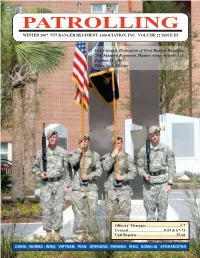
PATROLLING WINTER 2007 75 TH RANGER REGIMENT ASSOCIATION, INC. VOLUME 22 ISSUE III Color Guard, Dedication of First Ranger Battalion, 75th Infantry Regiment, Hunter Army Airfield, GA, October 18, 2007. Photo by J. Chester Officers’ Messages ..................................1-7 General ....................................8-24 & 67-73 Unit Reports ........................................25-66 CHINA - BURMA - INDIA VIETNAM IRAN GRENADA PANAMA IRAQ SOMALIA AFGHANISTAN PATROLLING – WINTER 2007 WHO WE ARE: The 75th Ranger Regiment Association, Inc., is a regis - We have funded trips for families to visit their wounded sons and husbands tered 501 (c) corporation, registered in the State of Georgia. We were while they were in the hospital. We have purchased a learning program founded in 1986 by a group of veterans of F/58, (LRP) and L/75 (Ranger). soft ware for the son of one young Ranger who had a brain tumor removed. The first meeting was held on June 7, 1986, at Ft. Campbell, KY. The Army took care of the surgery, but no means existed to purchase the OUR MISSION: learning program. We fund the purchase of several awards for graduates 1. To identify and offer membership to all eligible 75th Infantry Rangers, of RIP and Ranger School. We have contributed to each of the three Bat - and members of the Long Range Reconnaissance Patrol talion’s Memorial Funds and Ranger Balls, and to the Air - Companies, Long Range Patrol Companies, Ranger borne Memorial at Ft. Benning. Companies and Detachments, Vietnamese Ranger Advi - We have bi-annual reunions and business meetings. Our sors of the Biet Dong Quan; members of LRSU units that Officers, (President, 1st & 2nd Vice-Presidents, Secretary trace their lineage to Long Range Patrol Companies that & Treasurer), are elected at this business meeting.