American Telephone & Telegraph Company Building, First Floor Interior
Total Page:16
File Type:pdf, Size:1020Kb
Load more
Recommended publications
-

The US Experiment with Government Ownership of the Telephone
University of Pennsylvania Carey Law School Penn Law: Legal Scholarship Repository Faculty Scholarship at Penn Law 4-1-2013 The Wires Go to War: The U.S. Experiment with Government Ownership of the Telephone System During World War I Michael A. Janson Federal Communications Commission Christopher S. Yoo University of Pennsylvania Carey Law School Follow this and additional works at: https://scholarship.law.upenn.edu/faculty_scholarship Part of the Antitrust and Trade Regulation Commons, Communications Law Commons, Economic History Commons, Legal History Commons, Other Business Commons, Policy History, Theory, and Methods Commons, Science and Technology Law Commons, and the United States History Commons Repository Citation Janson, Michael A. and Yoo, Christopher S., "The Wires Go to War: The U.S. Experiment with Government Ownership of the Telephone System During World War I" (2013). Faculty Scholarship at Penn Law. 467. https://scholarship.law.upenn.edu/faculty_scholarship/467 This Article is brought to you for free and open access by Penn Law: Legal Scholarship Repository. It has been accepted for inclusion in Faculty Scholarship at Penn Law by an authorized administrator of Penn Law: Legal Scholarship Repository. For more information, please contact PennlawIR@law.upenn.edu. Articles The Wires Go to War: The U.S. Experiment with Government Ownership of the Telephone System During World War I Michael A. Janson* & Christopher S. Yoo** One of the most distinctive characteristics of the U.S. telephone system is that it has always been privately owned, in stark contrast to the pattern of government ownership followed by virtually every other nation. What is not widely known is how close the United States came to falling in line with the rest of the world. -

Paintings by John W. Alexander ; Sculpture by Chester Beach
SPECIAL EXHIBITIONS THE ART INSTITUTE OF CHICAGO, DECEMBER 12 1916 TO JANUARY 2, 1917 PAINTINGS BY JOHN W. ALEXANDER SCULPTURE BY CHESTER BEACH PAINTINGS BY CALIFORNIA ARTISTS PAINTINGS BY WILSON IRVINE PAINTINGS BY EDWARD W. REDFIELD PAINTINGS, DRAWINGS AND SKETCHES BY MAURICE STERNE 0 SPECIAL EXHIBITIONS OF WORK BY THE FOLLOWING ARTISTS PAINTINGS BY JOHN W. ALEXANDER SCULPTURE BY CHESTER BEACH PAINTINGS BY CALIFORNIA ARTISTS PAINTINGS BY WILSON IRVINE PAINTINGS BY EDWARD W. REDFIELD PAINTINGS, DRAWINGS AND SKETCHES BY MAURICE STERNE THE ART INSTITUTE OF CHICAGO DEC. 12, 1916 TO JAN. 2, 1917 PAINTINGS BY JOHN WHITE ALEXANDER OHN vV. ALEXANDER. Born, Pittsburgh, J Pennsylvania, 1856. Died, New York, May 31, 1915. Studied at the Royal Academy, Munich, and with Frank Duveneck. Societaire of Societe Nationale des Beaux Arts, Paris; Member of the International Society of Sculptors, Painters and Gravers, London; Societe Nouvelle, Paris ; Societaire of the Royal Society of Fine Arts, Brussels; President of the National Academy of Design, New York; President of the Natiomrl Academy Association; President of the National Society of Mural Painters, New York; Ex- President of the National Institute of Arts and Letters, New York; American Academy of Arts and Letters; Vice-President of the National Fine Arts Federation, Washington, D. C.; Member of the Architectural League, Fine Arts Federation and Fine Arts Society, New York; Honorary Member of the Secession Society, Munich, and of the Secession Society, Vienna; Hon- orary Member of the Royal Society of British Artists, of the American Institute of Architects and of the New York Society of Illustrators; President of the School Art League, New York; Trustee of the New York Public Library; Ex-President of the MacDowell Club, New York; Trustee of the Metropolitan Museum of Art; Trustee of the American Academy in Rome; Chevalier of the Legion of Honor, France; Honorary Degree of Master of Arts, Princeton University, 1892, and of Doctor of Literature, Princeton, 1909. -

Download This Issue
Your Treasures are in Specialists in high quality ancient, medieval, and early Good Hands with us modern coins and medals. First established as a numismatic trading Auctions in Switzerland, company in 1971, today we have achieved a yearly price list, appraisals, solid reputation among the leading coin and medal auction houses of Europe. More than purchases and sales by 10,000 clients worldwide place their trust private treaty. zürich, switzerland Baltic States, City of Riga. Auction 135 in us. Our company’s fi rst auction was held Under Sweden. Charles X. Gustav, 1654-1660. 5 ducats “1645” (1654). in 1985, and we can look back on a positive Estimate: € 15,000. Price realized: € 70,000. track record of over 180 auctions since that time. Four times a year, the Künker auction gallery becomes a major rendezvous for numismatic afi cionados. This is where several thousand bidders regularly participate in our auctions. • We buy your gold assets at a fair, daily market price • International customer care Auction III • Yearly over 20,000 objects in Ancient Greek, Roman, our auctions Byzantine & Early European coins and medals of the • Large selection of gold coins highest quality. • Top quality color printed catalogues May 10th 2011 Russian Empire. Auction 135 Alexander I., 1801-1825. Gold medal of 48 ducats, 1814, by tsarina in the morning M. Feodorovna for Alexander I. in Zürich Estimate: € 30,000. Price realized: € 220,000. Auction IV The BCD Collection Profi t from our experience of more than 180 successful auctions – of Thessaly. scaled consign your coins and medals! down May 10th 2011 Tel.: +49 541 96 20 20 in the afternoon Roman Empire. -

Preserving the Mountain
Article: Preserving the mountain Author(s): Gerri Ann Strickler Source: Objects Specialty Group Postprints, Volume Thirteen, 2006 Pages: 85-99 Compilers: Virginia Greene, Patricia Griffin, and Christine Del Re th © 2006 by The American Institute for Conservation of Historic & Artistic Works, 1156 15 Street NW, Suite 320, Washington, DC 20005. (202) 452-9545 www.conservation-us.org Under a licensing agreement, individual authors retain copyright to their work and extend publications rights to the American Institute for Conservation. Objects Specialty Group Postprints is published annually by the Objects Specialty Group (OSG) of the American Institute for Conservation of Historic & Artistic Works (AIC). A membership benefit of the Objects Specialty Group, Objects Specialty Group Postprints is mainly comprised of papers presented at OSG sessions at AIC Annual Meetings and is intended to inform and educate conservation-related disciplines. Papers presented in Objects Specialty Group Postprints, Volume Thirteen, 2006 have been edited for clarity and content but have not undergone a formal process of peer review. This publication is primarily intended for the members of the Objects Specialty Group of the American Institute for Conservation of Historic & Artistic Works. Responsibility for the methods and materials described herein rests solely with the authors, whose articles should not be considered official statements of the OSG or the AIC. The OSG is an approved division of the AIC but does not necessarily represent the AIC policy or opinions. Strickler AIC Objects Specialty Group Postprints, Volume 13, 2006 PRESERVING THE MOUNTAIN Gerri Ann Strickler Abstract Outdoor sculpture in New England requires a financial commitment of annual maintenance that is difficult for some owners to bear. -

The Whitney to Present American Legends: from Calder to O’Keeffe
THE WHITNEY TO PRESENT AMERICAN LEGENDS: FROM CALDER TO O’KEEFFE Charles Demuth, My Egypt, 1927. Oil on fiberboard, 35 3/4 × 30 in. (90.8 × 76.2 cm). Whitney Museum of American Art, New York; purchase with funds from Gertrude Vanderbilt Whitney 31.172 NEW YORK, December 3, 2012—Eighteen early to mid-century American artists who forged distinctly modern styles are the subjects of American Legends: From Calder to O’Keeffe, opening December 22 at the Whitney Museum of American Art. Drawing from the Whitney’s permanent collection, the year-long show features iconic as well as lesser known works by Oscar Bluemner, Charles Burchfield, Paul Cadmus, Alexander Calder, Joseph Cornell, Ralston Crawford, Stuart Davis, Charles Demuth, Arthur Dove, Marsden Hartley, Edward Hopper, Gaston Lachaise, Jacob Lawrence, John Marin, Reginald Marsh, Elie Nadelman, Georgia O’Keeffe, and Joseph Stella. Curator Barbara Haskell has organized the museum’s holdings of each of these artists’ work into small-scale retrospectives. Many of the works included will be on view for the first time in years; others, such as Hopper’s A Woman in the Sun, Calder’s Circus, Jacob Lawrence’s War Series, and Georgia O’Keeffe’s Summer Days, are cornerstones of the Whitney’s collection. The show will run for a year in the museum’s fifth-floor Leonard & Evelyn Lauder Galleries and both the Sondra Gilman Gallery and Howard & Jean Lipman Gallery on the fifth-floor mezzanine. To showcase the breadth and depth of the Museum’s impressive modern art collection, a rotation will occur in May 2013 in order that other artists and works can be installed. -

The Lachaise Foundation
THE LACHAISE FOUNDATION Marie P. Charles, Director Frederick D. Ballou, Trustee Paula R. Hornbostel, Curator & Trustee Ronald D. Spencer, Trustee REMINDER February 21, 2012 www.frelinghuysen.org www.lachaisefoundation.org www.nyc.gov/parks GASTON LACHAISE’S LA MONTAGNE (THE MOUNTAIN) IN TRAMWAY PLAZA New York City’s Department of Parks & Recreation, The Lachaise Foundation and the Frelinghuysen-Morris Foundation are pleased to remind the public of the loan of La Montagne (The Mountain) modeled in 1934 by American Modernist sculptor Gaston Lachaise (1882-1935). The monumental bronze earth goddess lies at Tramway Plaza, located on Second Avenue between 59th and 60th Streets, where it is on loan to the New York City Parks Department from September 23rd until June 4th, 2012. Born in Paris in 1882, Gaston Lachaise studied sculpture at the Ecole des Beaux-Arts, coming to the United States in 1906. He arrived in New York in 1912, and gained work with Paul Manship. He is known for his striking, voluptuous sculptures of women, they having been inspired by one woman, his muse model and wife Isabel. In 1935 the Museum of Modern Art gave Lachaise a retrospective exhibition of his work. He died later that year at the height of his career. The work of Lachaise’s work can be seen at Rockefeller Center on the 6th avenue facade of the GE building; in the sculpture garden at Moma (Floating Figure 1927) at the Metropolitan Museum of Art and at the Whitney Museum. This bronze cast, the second in an edition of five, was made in 2002 by the Modern Art Foundry. -
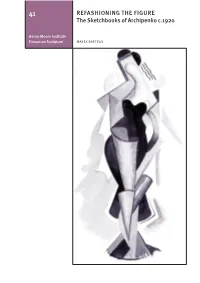
REFASHIONING the FIGURE the Sketchbooks of Archipenko C.1920
41 REFASHIONING THE FIGURE The Sketchbooks of Archipenko c.1920 Henry Moore Institute Essays on Sculpture MAREK BARTELIK 2 3 REFASHIONING THE FIGURE The Sketchbooks of Archipenko c.19201 MAREK BARTELIK Anyone who cannot come to terms with his life while he is alive needs one hand to ward off a little his despair over his fate…but with his other hand he can note down what he sees among the ruins, for he sees different (and more) things than the others: after all, he is dead in his own lifetime, he is the real survivor.2 Franz Kafka, Diaries, entry on 19 October 1921 The quest for paradigms in modern art has taken many diverse paths, although historians have underplayed this variety in their search for continuity of experience. Since artists in their studios produce paradigms which are then superseded, the non-linear and heterogeneous development of their work comes to define both the timeless and the changing aspects of their art. At the same time, artists’ experience outside of their workplace significantly affects the way art is made and disseminated. The fate of artworks is bound to the condition of displacement, or, sometimes misplacement, as artists move from place to place, pledging allegiance to the old tradition of the wandering artist. What happened to the drawings and watercolours from the three sketchbooks by the Ukrainian-born artist Alexander Archipenko presented by the Henry Moore Institute in Leeds is a poignant example of such a fate. Executed and presented in several exhibitions before the artist moved from Germany to the United States in the early 1920s, then purchased by a private collector in 1925, these works are now being shown to the public for the first time in this particular grouping. -

September 17, 2020 Contact: Paula Hornbostel | Director, Lachaise Foundation Phornbos@Lachaisefoundation.Org | (212) 605-0380
PRESS RELEASE. For Immediate Release: September 17, 2020 Contact: Paula Hornbostel | Director, Lachaise Foundation phornbos@lachaisefoundation.org | (212) 605-0380 Gaston Lachaise Sculpture, Floating Woman, 1927, to be Installed in Hunter’s Point South Park On Thursday, September 24 at 3pm The Lachaise Foundation and the Hunters Point Parks Conservancy will be hosting a brief, socially distant unveiling ceremony, with short dance performance by local dance company Karesia Batan | The Physical Plant to celebrate the addition of Floating Woman in Hunter’s Point South Park. Members of the press are invited to attend. Event will occur by the sculpture, near the intersection of 51st Ave. and Center Blvd. Follow by Live- stream: @Paula_Hornbostel_LachaiseFoundation Long Island City, NY – Hunters Point Parks Conservancy and the Lachaise Foundation are thrilled to announce the temporary installation of Gaston Lachaise’s Floating Woman (Floating Figure) in Hunter’s Point South Park. The work is one of Lachaise’s best-known, monumental works dating from the late twenties. The buoyant, expansive figure represents a timeless earth goddess, one Lachaise knew and sought to capture throughout his career. This vision was inspired by his wife, who was his muse and model, Isabel, that “majestic woman” who walked by him once by the Bank of the Seine. This work is a tribute to the power of all women, to ‘Woman,’ as the artist referred to his wife, with a capital W. Gaston Lachaise devoted himself to the human form, producing a succession of powerfully conceived nude figures in stone and bronze that reinvigorated the sculptural traditions of Auguste Rodin and Aristide Maillol. -

Press Release
Press Release FOR IMMEDIATE RELEASE Media Contact Troy Ellen Dixon Director, Marketing & Communications 203 413-6735 | tdixon@brucemuseum.org Face & Figure: The Sculpture of Gaston Lachaise Opens at the Bruce Museum on Saturday, September 22, 2012 Gaston Lachaise was more than a gifted sculptor of the human body. He was one of the finest portraitists of his age. Greenwich CT, September 13, 2012 – Face & Figure: The Sculpture of Gaston Lachaise features key examples of the artist’s work – many on loan from leading museums, private collections and the Lachaise Foundation – that reveal the full range of his vision, with special Press Release attention to the fascinating interchange between figural work and portraiture. Executive Director Peter Sutton notes that the sculpture of Gaston Lachaise is among the most powerful, recognizable and enduring of the early twentieth century. “The inspired sensuality of his buoyant nudes uplifts us all and the individuality of his portraits achieves an incisive statement of character scarcely rivaled in three dimensions. Face & Figure addresses these two aspects of the sculptor’s work and explores the intersection of their aims.” Running throughout this contemplative exhibition is the overriding narrative of the obsession Lachaise had with his muse, model and wife, Isabel Dutaud Nagle, who – sirenlike – inspired him to become that rare exception among artists of the 1920s and ’30s, an expatriate Frenchman in New York. Lachaise’s oeuvre is a sustained elaboration of his intense feeling for Nagle’s beauty. The series of great nudes that secured his Head of a Woman (Egyptian Head), 1922 Bronze,13 x 8 x 8 ¼ in. -

Biography, Thomas Lamont: the Ambassador from Wall Street
eA Library The Boston Letter from eAthenteum No. 105 JUNE 1994 Work Proceeds on 14 Beacon Street Wing OR those readers who missed the announcement in the Annual Report for 1993, it bears repeating that the Athenreum recently signed papers purchasing parts of the basement and sub-basement of the Congregational Building at no. 14 Beacon Street, which abuts the Athenreum's current residence at no. 10'h. It will come as no surprise to those of you who have over the years put up with wails and moans in these pages about dwindling space at lOlh that this announcement was greeted with a collective sigh of relief from the hearts and souls of both the staff and the Trustees. For now (or at least in an imaginable future) most, if not all, of our vol umes stored off -site in places such as Allston and Lawrence will be reunited with the rest of the collection, and many members of the staff who have worked for years in offices the size of closets will be able to spread out and breathe. And the Conservation Department will expand into new and enlarged space, enabling its staff to increase in number and more efficiently service some of our ailing books that have long been pa tiently waiting for treatment. The move is a milestone, representing the first real estate the A thenreum has pur chased in nearly 100 years. And, although much noise, dust, and some inconvenience will lie ahead, the initial phase of renovation is already complete, in the form of a "demising wall" which was installed in the 14 Beacon Street building to isolate the Athenreum's space from the upper floors of that building. -

Lincoln Kirstein and American Art Indicates Work Cited in a Figure of Influence
Library Guide A Figure of Influence: Lincoln Kirstein and American Art Indicates work cited in A Figure of Influence Lincoln Kirstein (1907–1996) was an art insider with the imposing personality and ambitious projects to match his sizable six-foot, three-inch frame. Kirstein was involved in the early history of the Museum of Modern Art in New York and co-founded the New York City Ballet. Though he abandoned his own painting career, Kirstein directed considerable energy toward shaping the lives of artists and the art world. He organized exhibitions, wrote about art, and connected artists with collectors, museums, and private galleries. An avid collector himself, he eventually donated work by the artists he championed to several institutions, including The Nelson-Atkins Museum of Art. If you have questions, please contact the reference staff at the Spencer Art Reference Library (telephone: 816.751.1216). Library hours and services are listed on the Museum’s website at www.nelson-atkins.org On Kirstein By Kirstein By other authors Kirstein, Lincoln. Quarry: A Collection In Lieu of Duberman, Martin. The Worlds of Lincoln Kirstein. Memoirs. Pasadena, CA: Twelvetrees Press, 1986. New York: Alfred A. Knopf, 2007. Call No: N5220 K57 1986. Call No: PS3521 .I74 Z65 2007 Inscribed: “For Larry [Lawrence Sickman] with love from Lincoln: February 1987” Eakins Press Foundation & Ballet Society, Inc. “Lincoln Kirstein: The Published Writings.” Kirstein, Lincoln. Mosaic: Memoirs. Accessed February 2018. New York: Farrar, Straus and Giroux, 1994. http://www.lincolnkirstein.org/ Call No: PS 3521 .I74 Z47 1994 Library Resource List 2018 | Lincoln Kirstein | 1 Kayafas, Peter, ed. -

Special Exhibitions of Work by the Following Artists : Paintings by John
N 6510 S64 1916 NMAA SPECIAL EXHIBITIONS THE ART INSTITUTE OF CHICAGO, DECEMBER 12 1916 TO JANUARY 2, 1917 PAINTINGS BY JOHN W. ALEXANDER SCULPTURE BY CHESTER BEACH PAINTINGS BY CALIFORNIA ARTISTS PAINTINGS BY WILSON IRVINE PAINTINGS BY EDWARD W. REDFIELD PAINTINGS, DRAWINGS AND SKETCHES BY MAURICE STERNE o WQ> SPECIAL EXHIBITIONS OF WORK BY THE FOLLOWING ARTISTS PAINTINGS BY JOHN W. ALEXANDER SCULPTURE BY CHESTER BEACH PAINTINGS BY CALIFORNIA ARTISTS PAINTINGS BY WILSON IRVINE PAINTINGS BY EDWARD W. REDFIELD PAINTINGS, DRAWINGS AND SKETCHES BY MAURICE STERNE THE ART INSTITUTE OF CHICAGO DEC. 12, 1916 TO JAN. 2, 1917 PAINTINGS BY JOHN WHITE ALEXANDER ; JOHN W. ALEXANDER. Born, Pittsburgh. Pennsylvania, 1856. Died, New York, May 31, 1 91 5. Studied at the Royal Academy, Munich, and with Frank Duveneck. Societaire of Societe Nationale des Beaux Arts, Paris; Member of the International Society of Sculptors, Painters and Gravers, London Societe Nouvelle, Paris ; Societaire of the Royal Society of Fine Arts, Brussels ; President of the National Academy of Design, New York; President of the National Academy Association ; President of the National Society of Mural Painters, New York; Ex- President of the National Institute of Arts and Letters, New York ; American Academy of Arts and Letters Vice-President of the National Fine Arts Federation, Washington, D. C. ; Member of the Architectural League, Fine Arts Federation and Fine Arts Society, New York ; Honorary Member of the Secession Society, Munich, and of the Secession Society, Vienna ; Hon- orary Member of the Royal Society of British Artists, of the American Institute of Architects and of the New York Society of Illustrators ; President of the School Art League, New York ; Trustee of the New York Public Library ; Ex-President of the MacDowell Club, New York ; Trustee of the Metropolitan Museum of Art ; Trustee of the American Academy in Rome ; Chevalier of the Legion of Honor, France; Honorary Degree of Master of Arts, Princeton University, 1892, and of Doctor of Literature, Princeton, 1909.