CEREUS, CLEISTOCACTUS, DENMOZA, ECHINOPSIS Y MONVILLEA (CACTACEAE, CACTOIDEAE)
Total Page:16
File Type:pdf, Size:1020Kb
Load more
Recommended publications
-
Haseltonia Articles and Authors.Xlsx
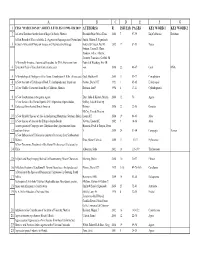
ABCDEFG 1 CSSA "HASELTONIA" ARTICLE TITLES #1 1993–#26 2019 AUTHOR(S) R ISSUE(S) PAGES KEY WORD 1 KEY WORD 2 2 A Cactus Database for the State of Baja California, Mexico Resendiz Ruiz, María Elena 2000 7 97-99 BajaCalifornia Database A First Record of Yucca aloifolia L. (Agavaceae/Asparagaceae) Naturalized Smith, Gideon F, Figueiredo, 3 in South Africa with Notes on its uses and Reproductive Biology Estrela & Crouch, Neil R 2012 17 87-93 Yucca Fotinos, Tonya D, Clase, Teodoro, Veloz, Alberto, Jimenez, Francisco, Griffith, M A Minimally Invasive, Automated Procedure for DNA Extraction from Patrick & Wettberg, Eric JB 4 Epidermal Peels of Succulent Cacti (Cactaceae) von 2016 22 46-47 Cacti DNA 5 A Morphological Phylogeny of the Genus Conophytum N.E.Br. (Aizoaceae) Opel, Matthew R 2005 11 53-77 Conophytum 6 A New Account of Echidnopsis Hook. F. (Asclepiadaceae: Stapeliae) Plowes, Darrel CH 1993 1 65-85 Echidnopsis 7 A New Cholla (Cactaceae) from Baja California, Mexico Rebman, Jon P 1998 6 17-21 Cylindropuntia 8 A New Combination in the genus Agave Etter, Julia & Kristen, Martin 2006 12 70 Agave A New Series of the Genus Opuntia Mill. (Opuntieae, Opuntioideae, Oakley, Luis & Kiesling, 9 Cactaceae) from Austral South America Roberto 2016 22 22-30 Opuntia McCoy, Tom & Newton, 10 A New Shrubby Species of Aloe in the Imatong Mountains, Southern Sudan Leonard E 2014 19 64-65 Aloe 11 A New Species of Aloe on the Ethiopia-Sudan Border Newton, Leonard E 2002 9 14-16 Aloe A new species of Ceropegia sect. -

Nitrogen Containing Volatile Organic Compounds
DIPLOMARBEIT Titel der Diplomarbeit Nitrogen containing Volatile Organic Compounds Verfasserin Olena Bigler angestrebter akademischer Grad Magistra der Pharmazie (Mag.pharm.) Wien, 2012 Studienkennzahl lt. Studienblatt: A 996 Studienrichtung lt. Studienblatt: Pharmazie Betreuer: Univ. Prof. Mag. Dr. Gerhard Buchbauer Danksagung Vor allem lieben herzlichen Dank an meinen gütigen, optimistischen, nicht-aus-der-Ruhe-zu-bringenden Betreuer Herrn Univ. Prof. Mag. Dr. Gerhard Buchbauer ohne dessen freundlichen, fundierten Hinweisen und Ratschlägen diese Arbeit wohl niemals in der vorliegenden Form zustande gekommen wäre. Nochmals Danke, Danke, Danke. Weiteres danke ich meinen Eltern, die sich alles vom Munde abgespart haben, um mir dieses Studium der Pharmazie erst zu ermöglichen, und deren unerschütterlicher Glaube an die Fähigkeiten ihrer Tochter, mich auch dann weitermachen ließ, wenn ich mal alles hinschmeissen wollte. Auch meiner Schwester Ira gebührt Dank, auch sie war mir immer eine Stütze und Hilfe, und immer war sie da, für einen guten Rat und ein offenes Ohr. Dank auch an meinen Sohn Igor, der mit viel Verständnis akzeptierte, dass in dieser Zeit meine Prioritäten an meiner Diplomarbeit waren, und mein Zeitbudget auch für ihn eingeschränkt war. Schliesslich last, but not least - Dank auch an meinen Mann Joseph, der mich auch dann ertragen hat, wenn ich eigentlich unerträglich war. 2 Abstract This review presents a general analysis of the scienthr information about nitrogen containing volatile organic compounds (N-VOC’s) in plants. -

Copyright Notice
Copyright Notice This electronic reprint is provided by the author(s) to be consulted by fellow scientists. It is not to be used for any purpose other than private study, scholarship, or research. Further reproduction or distribution of this reprint is restricted by copyright laws. If in doubt about fair use of reprints for research purposes, the user should review the copyright notice contained in the original journal from which this electronic reprint was made. Journal of Vegetation Science 7: 667-680, 1996 © IAVS; Opulus Press Uppsala. Printed in Sweden - Biogeographic patterns of Argentine cacti - 667 Species richness of Argentine cacti: A test of biogeographic hypotheses Mourelle, Cristina & Ezcurra, Exequiel Centro de Ecología, UNAM, Apartado Postal 70-275, 04510 - Mexico, D.F., Mexico; Fax +52 5 6228995; E-mail eezcurra@miranda.ecologia.unam.mx Abstract. Patterns of species richness are described for 50 cacti and (e) pereskioid cacti. Columnar species have columnar, 109 globose and 50 opuntioid cacti species in 318 column-like stems with ribs, formed by an arrangement grid cells (1°×1°) covering Argentina. Biological richness of the areoles in longitudinal rows. These species have hypotheses were tested by regressing 15 environmental parallel vascular bundles, separated by succulent paren- descriptors against species richness in each group. We also chyma, sometimes fusing towards a woody base in the included the collection effort (estimated as the logarithm of the number of herbarium specimens collected in each cell) to adults. We broadly considered as columnar cacti: estimate the possible error induced by underrepresentation in candelabriform arborescent species, unbranched erect certain cells. -

University of Florida Thesis Or Dissertation Formatting
SYSTEMATICS OF TRIBE TRICHOCEREEAE AND POPULATION GENETICS OF Haageocereus (CACTACEAE) By MÓNICA ARAKAKI MAKISHI A DISSERTATION PRESENTED TO THE GRADUATE SCHOOL OF THE UNIVERSITY OF FLORIDA IN PARTIAL FULFILLMENT OF THE REQUIREMENTS FOR THE DEGREE OF DOCTOR OF PHILOSOPHY UNIVERSITY OF FLORIDA 2008 1 © 2008 Mónica Arakaki Makishi 2 To my parents, Bunzo and Cristina, and to my sisters and brother. 3 ACKNOWLEDGMENTS I want to express my deepest appreciation to my advisors, Douglas Soltis and Pamela Soltis, for their consistent support, encouragement and generosity of time. I would also like to thank Norris Williams and Michael Miyamoto, members of my committee, for their guidance, good disposition and positive feedback. Special thanks go to Carlos Ostolaza and Fátima Cáceres, for sharing their knowledge on Peruvian Cactaceae, and for providing essential plant material, confirmation of identifications, and their detailed observations of cacti in the field. I am indebted to the many individuals that have directly or indirectly supported me during the fieldwork: Carlos Ostolaza, Fátima Cáceres, Asunción Cano, Blanca León, José Roque, María La Torre, Richard Aguilar, Nestor Cieza, Olivier Klopfenstein, Martha Vargas, Natalia Calderón, Freddy Peláez, Yammil Ramírez, Eric Rodríguez, Percy Sandoval, and Kenneth Young (Peru); Stephan Beck, Noemí Quispe, Lorena Rey, Rosa Meneses, Alejandro Apaza, Esther Valenzuela, Mónica Zeballos, Freddy Centeno, Alfredo Fuentes, and Ramiro Lopez (Bolivia); María E. Ramírez, Mélica Muñoz, and Raquel Pinto (Chile). I thank the curators and staff of the herbaria B, F, FLAS, LPB, MO, USM, U, TEX, UNSA and ZSS, who kindly loaned specimens or made information available through electronic means. Thanks to Carlos Ostolaza for providing seeds of Haageocereus tenuis, to Graham Charles for seeds of Blossfeldia sucrensis and Acanthocalycium spiniflorum, to Donald Henne for specimens of Haageocereus lanugispinus; and to Bernard Hauser and Kent Vliet for aid with microscopy. -

Pollen Morphology of Five Species of Cactoideae Subfamily (Fam: Cactaceae), from the Lima Province (Perú)
ISSN Versión Impresa 1816-0719 ISSN Versión en linea 1994-9073 ISSN Versión CD ROM 1994-9081 The Biologist (Lima) ORIGINAL ARTICLE /ARTÍCULO ORIGINAL POLLEN MORPHOLOGY OF FIVE SPECIES OF CACTOIDEAE SUBFAMILY (FAM: CACTACEAE), FROM THE LIMA PROVINCE (PERÚ) MORFOLOGÍA POLÍNICA DE CINCO ESPECIES DE LA SUBFAMILIA CACTOIDEAE (FAM: CACTACEAE), DEL DEPARTAMENTO DE LIMA (PERÚ) Luis De La Cruz V.1, Luis Chirinos S., Willy Aquino T., Pamela Puchuri O., Erika Pajuelo P., Roberto Ubidia & Karen Ventura Z.2 Laboratorio de Ecofisiologia Vegetal, Facultad de Ciencias Naturales y Matemática, Universidad Nacional Federico Villarreal Jr. Rio Chepen s/n cuadra Nº 1 Hospital Hipólito Unánue, El Agustino Laboratorio de Palinología y Paleobotánica de la Universidad Peruana Cayetano Heredia – LPP. Herbario Magdalena Pavlich de la Universidad Peruana Cayetano Heredia – HUPCH. LID. Área de Ciencias Ambientales- LID. Av. Honorio Delgado 430, Urb. Ingeniería, S.M.P. Lima - Perú. 1e-mail: luiscdelacruz@hotmail.com, 2acaciaspp@yahoo.es The Biologist (Lima), 2013, 11(1), jan-jun: 1-7. ABSTRACT The morphological characteristics of five species of pollen from the subfamily Cactoideae, family Cactaceae, were described: Three species, Echinopsis chalaensis (Rauh & Backeb.) Friedrich & G.D.Rowley, Haageocereus decumbens (Vaupel) Backeb. and Pygmaeocereus sp. Johnson & Backeb., (Trichocereeae tribe); Corryocactus brevistylus (K. Schum. ex Vaupel) Britton & Rose (Pachycereeae tribe) and Neoraimondia arequipensis (Meyen) Backeb., (Browningieae tribe). All pollen grains observed under a light microscope appeared in monades, shape varying from spheroidal to spheroidal oblate; all colpate, with the exception of C. brevistylus, with spinules < 1 µm to 2 µm; exine thickness varied 2 - 3 µm; tectum without perceptible differences, always was pierced. -

Plethora of Plants - Collections of the Botanical Garden, Faculty of Science, University of Zagreb (2): Glasshouse Succulents
NAT. CROAT. VOL. 27 No 2 407-420* ZAGREB December 31, 2018 professional paper/stručni članak – museum collections/muzejske zbirke DOI 10.20302/NC.2018.27.28 PLETHORA OF PLANTS - COLLECTIONS OF THE BOTANICAL GARDEN, FACULTY OF SCIENCE, UNIVERSITY OF ZAGREB (2): GLASSHOUSE SUCCULENTS Dubravka Sandev, Darko Mihelj & Sanja Kovačić Botanical Garden, Department of Biology, Faculty of Science, University of Zagreb, Marulićev trg 9a, HR-10000 Zagreb, Croatia (e-mail: dubravka.sandev@biol.pmf.hr) Sandev, D., Mihelj, D. & Kovačić, S.: Plethora of plants – collections of the Botanical Garden, Faculty of Science, University of Zagreb (2): Glasshouse succulents. Nat. Croat. Vol. 27, No. 2, 407- 420*, 2018, Zagreb. In this paper, the plant lists of glasshouse succulents grown in the Botanical Garden from 1895 to 2017 are studied. Synonymy, nomenclature and origin of plant material were sorted. The lists of species grown in the last 122 years are constructed in such a way as to show that throughout that period at least 1423 taxa of succulent plants from 254 genera and 17 families inhabited the Garden’s cold glass- house collection. Key words: Zagreb Botanical Garden, Faculty of Science, historic plant collections, succulent col- lection Sandev, D., Mihelj, D. & Kovačić, S.: Obilje bilja – zbirke Botaničkoga vrta Prirodoslovno- matematičkog fakulteta Sveučilišta u Zagrebu (2): Stakleničke mesnatice. Nat. Croat. Vol. 27, No. 2, 407-420*, 2018, Zagreb. U ovom članku sastavljeni su popisi stakleničkih mesnatica uzgajanih u Botaničkom vrtu zagrebačkog Prirodoslovno-matematičkog fakulteta između 1895. i 2017. Uređena je sinonimka i no- menklatura te istraženo podrijetlo biljnog materijala. Rezultati pokazuju kako je tijekom 122 godine kroz zbirku mesnatica hladnog staklenika prošlo najmanje 1423 svojti iz 254 rodova i 17 porodica. -
South American Cacti in Time and Space: Studies on the Diversification of the Tribe Cereeae, with Particular Focus on Subtribe Trichocereinae (Cactaceae)
Zurich Open Repository and Archive University of Zurich Main Library Strickhofstrasse 39 CH-8057 Zurich www.zora.uzh.ch Year: 2013 South American Cacti in time and space: studies on the diversification of the tribe Cereeae, with particular focus on subtribe Trichocereinae (Cactaceae) Lendel, Anita Posted at the Zurich Open Repository and Archive, University of Zurich ZORA URL: https://doi.org/10.5167/uzh-93287 Dissertation Published Version Originally published at: Lendel, Anita. South American Cacti in time and space: studies on the diversification of the tribe Cereeae, with particular focus on subtribe Trichocereinae (Cactaceae). 2013, University of Zurich, Faculty of Science. South American Cacti in Time and Space: Studies on the Diversification of the Tribe Cereeae, with Particular Focus on Subtribe Trichocereinae (Cactaceae) _________________________________________________________________________________ Dissertation zur Erlangung der naturwissenschaftlichen Doktorwürde (Dr.sc.nat.) vorgelegt der Mathematisch-naturwissenschaftlichen Fakultät der Universität Zürich von Anita Lendel aus Kroatien Promotionskomitee: Prof. Dr. H. Peter Linder (Vorsitz) PD. Dr. Reto Nyffeler Prof. Dr. Elena Conti Zürich, 2013 Table of Contents Acknowledgments 1 Introduction 3 Chapter 1. Phylogenetics and taxonomy of the tribe Cereeae s.l., with particular focus 15 on the subtribe Trichocereinae (Cactaceae – Cactoideae) Chapter 2. Floral evolution in the South American tribe Cereeae s.l. (Cactaceae: 53 Cactoideae): Pollination syndromes in a comparative phylogenetic context Chapter 3. Contemporaneous and recent radiations of the world’s major succulent 86 plant lineages Chapter 4. Tackling the molecular dating paradox: underestimated pitfalls and best 121 strategies when fossils are scarce Outlook and Future Research 207 Curriculum Vitae 209 Summary 211 Zusammenfassung 213 Acknowledgments I really believe that no one can go through the process of doing a PhD and come out without being changed at a very profound level. -

Rarity Patterns and Conservation Priorities in Cactaceae Species from the Southern Central Andes: a Case Study from the Calchaquíes Valleys, Salta, Argentina
7Ecología2 Austral 26:072-082. Año 2016 AC GODOY-BÜRKI ET AL. Ecología Austral 26:072-082 E�������� �� ��� ��� �������� C������ A���� 73 Asociación Argentina de Ecología Rarity patterns and conservation priorities in Cactaceae species from the Southern Central Andes: a case study from the Calchaquíes Valleys, Salta, Argentina A�� C. G����-B����₁,*; L��� A������₁; J���� M. S�����₂; S����� B����₂; M������ A�����-P�����₂ � P���� O�����-B���₂ 1 Instituto de Botánica Darwinion (IBODA)-CONICET. San Isidro, Buenos Aires, Argentina. 2 Laboratorio de Investigaciones Botánicas (LABIBO)-CONICET, Facultad de Ciencias Naturales, Universidad Nacional de Salta. Salta, Argentina. ABSTRACT. In this study, 34 Cactaceae species from the Calchaquíes Valleys, Argentina, were studied to determine 1) species rarity level, 2) proportion of rare species among taxonomic and ecological groups and, 3) whether rareness is consistently distributed throughout the species geographical ranges. We used a model where rarity is defined by the geographic range and the local population size to define species rarity. Rareness was not concentrated in any particular taxonomic or ecological group of Cactaceae; however 28 species were rare at some level. In most species, rarity varied across the geographical range, only five species remained consistently rare in all the surveyed populations. Six species qualified as extremely rare, all from the Cactoideae subfamily, four endemic to the southernmost Central Andes and differing in their growth forms. Only two of the 34 studied species, appeared as both extremely and consistently rare across its distribution. Determining rarity levels is useful for identifying species that may be in danger and/or in need for further studies. Rarity, used as an indicator of species vulnerability, allowed us, to identify Cactaceae species that are more vulnerable to anthropogenic or natural disturbance, compared with common species. -
Studies on Inter- Generic Grafting Compatibility of Ornamental Cacti
Int.J.Curr.Microbiol.App.Sci (2020) 9(11): 2133-2144 International Journal of Current Microbiology and Applied Sciences ISSN: 2319-7706 Volume 9 Number 11 (2020) Journal homepage: http://www.ijcmas.com Original Research Article https://doi.org/10.20546/ijcmas.2020.911.253 Studies on Inter- generic Grafting Compatibility of Ornamental Cacti R. Perumal, M. Prabhu*, M. Kannan and S. Srinivasan Horticultural College and Research Institute, Tamil Nadu Agricultural University, Coimbatore, India *Corresponding author ABSTRACT In cacti, grafting has become a commercial method of propagation to accelerate and hasten the growth rate of slow growing species, to ensure the survival of the plants with poor root system, to ensure the survival of genetic aberration of variegated and brightly coloured K e yw or ds cacti that lack chlorophyll, to accelerate the growth of plants for commercial use. With the above futuristic background, the present study on ornamental cacti grafting with all Cacti, Compatibility , possible combinations of two species of rootstocks (Hylocereus triangularis and Grafting , Myrtillocactus geometrizans) and five species of scions (Mammillaria beneckei, Intergeneric , Hamatocactus setispinu, Ferocactus latispinus, Echinopsis mamillosa and Gymnocalycium Ornamental mihanovichii) was carried out during 2017-18 at the Horticultural College and Research Institute, Tamil Nadu Agricultural University, Coimbatore, Tamil Nadu, India to assess the Article Info compatibility of grafted ornamental cacti and its performance. Among the graft combinations, the success and survival percentage were found to be maximum in graft Accepted: with Hylocereus triangularis as stock and Echinopsis mamillosa as scion (90 % and 15 October 2020 100%) whereas it was maximum with Myrtillocactus geometrizans as stock and Available Online: 10 November 2020 Hamatocactus setispinus as scion (96 % and 100%). -

CACTUS CORNER NEWS Fresno Cactus & Succulent Society
CACTUS CORNER NEWS Fresno Cactus & Succulent Society www.fresnocss.com Affiliated with the Cactus & Succulent Society of America Vol. 35, no. 8 August 2017 NEXT MEETING: Thursday, August 3, 7:00 pm. (Doors open 6:30 p.m.) Deaf & Hard of Hearing Service Center (DHHSC), 5340 North Fresno Street, Fresno PROGRAM: Lithops: The Wild and the Tame PRESENTOR: Doug Dawson Doug began his passion for Lithops in the 1990’s. Previous to then, he would occasionally buy one and shortly thereafter kill the poor thing. During the last 20 years he has grown most of his lithops from seed in the extremely harsh desert climate of Phoenix. The four summer months have regular temperatures at night around 90deg and days around 110deg. Doug will discuss what it takes to keep these colorful “living stones” alive. The PowerPoint will display many photos of what the plants look like in habitat in Namibia and South Africa. Then photos of plants in Doug’s collection will be shown, with many colorful cultivars as well as many of the species and varieties. For those of you who are not yet open to including lithops in your collection, it is hoped that you will be convinced to give them a try. Doug is a retired math professor and does extensive botanical travels to areas of the world where succulents grow, include Mexico, Chile, Argentina, Yemen, Socotra, Africa, and his own state of Arizona. He has organized 15 botanical exploratory trips to South Africa and Namibia, camping on local farms and public areas for three weeks and exploring the surrounding mountains and hills by day. -
Cactus Explorers Journal
TTHHEE CCHHIILLEEAANNSS 22000099 VOLUME 21 NUMBER 68 Parodia camargensis East of Villa Abecia, Bolivia Photo:- F. Vandenbroeck Photo:- F.Berger Near Cacheuta de Potrerillos Photo:-J. Lambert Cuesta Miranda Photo:- J. Lambert North of Mendoza City Photo:- K.Gilmer Pyrrhocactus strausianus 42 FROM MENDOZA TO BARREAL By H. Kallenowsky Coming over the Andes from Chile in mid-August, we made an overnight stop at Mendoza city. Next day we took the road leading from Mendoza to Uspallata which passes through Cacheuta and Portrerillos and then starts to enter a valley which becomes steadily narrower. The road follows the Rio Mendoza, which has cut its way through the Sierra Uspallata on the outer range of the Andean Cordillera. In places there are huge cliffs to be seen bordering the east side of the river but the road runs along the hillside on the west side of the river. There are no bridges across the river until one reaches the western side of the Sierra Uspallata. The hillsides next to the road were occupied by a patchwork of dense clumps of shrubs and bare ground which was made up of earth and stones. Where the hillsides sloped less steeply there were occasional tall Denmoza which could be seen from the road, standing up above the shrubs. One of these was 1.7m tall. In order to climb a hillside we had to look for a way of winding round the clumps of bushes. In places the hillsides are very steep and often the bare ground is covered in loose stones, whilst in other places it is less steep, but one still has to be very careful when walking over a hillside because of the loose stones. -

Cactaceae), a Threatened Species in Restinga Sandy Coastal Plain of Brazil
Anais da Academia Brasileira de Ciências (2013) 85(2): 615-622 (Annals of the Brazilian Academy of Sciences) Printed version ISSN 0001-3765 / Online version ISSN 1678-2690 www.scielo.br/aabc The effect of temperature on the germination of Melocactus violaceus Pfeiff. (Cactaceae), a threatened species in restinga sandy coastal plain of Brazil LUIZ R. ZAMITH1, DENISE D. CRUZ2 and BÁRBARA T.T. RICHERS3 1Universidade Federal Fluminense, Instituto de Biologia, Departamento de Biologia Geral, Caixa Postal 100436, 24020-971 Niterói, RJ, Brasil 2Universidade Federal da Paraíba, CCEN, Cidade Universitária, 58059-900 João Pessoa, PB, Brasil 3Instituto de Desenvolvimento Sustentável Mamirauá, Av. Brasil, 197, Juruá, Caixa Postal 38, 69470-000 Tefé, AM, Brasil Manuscript received on April 8, 2011; accepted for publication on May 14, 2012 ABSTRACT Melocactus violaceus is an endangered species due to habitat destruction and the overcollection of this species for ornamental use. The aim of this study was to test the effect of different temperatures on the germination of M. violaceus. Three treatments were conducted: a constant temperature of 25°C, a 20-35°C alternating temperature, both inside germination chamber, and an alternating temperature under room temperature (mean temperature ranged from 25-37°C). The fi nal seed germination rates at the alternating temperature treatments were not signifi cantly different (65% in the seed germinator and 62.5% at room condition). However, both treatments with alternating temperatures had signifi cantly higher germination rates compared to the treatment kept at the constant temperature (8%). Our study showed that alternating temperatures between 20 and 37°C provides satisfactory conditions to induce a high percentage of seed germination of M.