State Wildlife Action Plan for New Mexico 22 November 2016 I
Total Page:16
File Type:pdf, Size:1020Kb
Load more
Recommended publications
-

Fishes of New Mexicoi
Threatened and Endangered Fishes of New MexicoI BY DAVID L. PROPST ILLUSTRATED BY W. HOWARD BRANDENBURG MAPS BY AMBER L. HOBBES ◆ EDITED BY PAUL C. MARSH TECHNICAL REPORT NO. 1 1999 NEW MEXICO DEPARTMENT OF GAME AND FISH STATE OF NEW MEXICO: Gary E. Johnson, Governor STATE GAME COMMISSION: William H. Brininstool, Chairman ◆ Jal Gail J. Cramer ◆ Farmington Steve Padilla ◆ Albuquerque Dr. William E. Schuler ◆ Albuquerque George A. Ortega ◆ Santa Fe Bud Hettinga ◆ Las Cruces Stephen E. Doerr ◆ Portales DEPARTMENT OF GAME AND FISH: Gerald A. Maracchini, Director CONSERVATION SERVICES DIVISION: Andrew V. Sandoval, Chief $10.00 1999 Threatened and Endangered FISHES of New Mexico ◆ 1 Propst, D.L. 1999. Threatened and endangered fishes of New Mexico. Tech. Rpt. No. 1. New Mexico Department of Game and Fish, Santa Fe, NM. 84 pp. Cover by NoBul Graphics, Albuquerque, NM. Design and production by Janelle Harden, The Studio, Albuquerque, NM. Publication and printing supported by the Turner Foundation, Atlanta, GA. In part, a contribution of Federal Aid in Fish and Wildlife Restoration., Project FW–17–RD. Contents may be reprinted if credit is given to the New Mexico Department of Game and Fish. Complete copies may be purchased for $10.00 U.S. (see address below). Make checks payable to “New Mexico Department of Game and Fish.” Conservation Services Division New Mexico Department of Game and Fish P.O. Box 25112 Santa Fe, NM 87504 (505) 827-7882 2 ◆ New Mexico Department of Game and Fish FORWARD Threatened and Endangered Fishes of New a major concern. Over half of the rivers in New Mexico Mexico by Dr. -
Abstract Effects of Wildfire on Water Quality and Benthic Macroinvertebrate Communities of a Chihuahuan Desert Spring System
ABSTRACT EFFECTS OF WILDFIRE ON WATER QUALITY AND BENTHIC MACROINVERTEBRATE COMMUNITIES OF A CHIHUAHUAN DESERT SPRING SYSTEM by Tara Jo Haan Wildfire disturbances affect resource availability and alter community composition in arid environments. Traditionally, fire effects on arid-land aquatic ecosystems are under-studied compared to terrestrial ecosystems. Chihuahuan Desert spring systems offer a unique opportunity to study such effects on macroinvertebrate community resistance and resilience. I took advantage of a rare opportunity to employ a BACI design to observe changes in water quality and macroinvertebrate communities to wildfire in a spring system on Bitter Lake National Wildlife Refuge, New Mexico. The results suggest significant water quality and species-specific response to wildfire. I observed an increase in an endangered snail, Juturnia kosteri, but there were no significant community-based changes. These results suggest that arid-land aquatic communities can be resistant to abiotic/biotic changes caused by wildland fire. With climate change predicted to increase the frequency and intensity of arid-land fires, aquatic communities may be more vulnerable to severe events in the future. EFFECTS OF WILDFIRE ON WATER QUALITY AND BENTHIC MACROINVERTEBRATE COMMUNITIES OF A CHIHUAHUAN DESERT SPRING SYSTEM A Thesis Submitted to the Faculty of Miami University in partial fulfillment of the requirements for the degree of Master of Science Department of Zoology by Tara Jo Haan Miami University Oxford, OH 2012 Advisor _______________________ Dr. David J. Berg Reader _______________________ Dr. Craig Williamson Reader _______________________ Dr. Ann L. Rypstra TABLE OF CONTENTS List of tables iii List of figures iv List of appendices v Acknowledgements vi 1. -

Lindheimer Chapter
Native Plant Society of Texas Lindheimer Chapter Plant of the Month November, 2011 Prairie Flameleaf Sumac, Rhus lanceolata Flower Fruit USDA Range Map: Texas Prairie Flameleaf Sumac – Fall Color Prairie Flameleaf Sumac is named for (and known for) its brilliant red and orange fall foliage. A large shrub or small tree, growing 20 to 30 feet tall, it is a great ornamental that has some of the best fall color in Central Texas. Besides its great fall color, it also has large plumes of white flowers in summer, followed by clusters of red fruit in the fall. The fruit are an important food source for many species of birds and small mammals. If you can collect the fruit before the animals get to it, it makes a high Vitamin C drink that has a lemony flavor. Prairie Flameleaf Sumac is found in Central and West Texas in rocky limestone hillsides and grasslands. In our area it is frequently seen along roadsides. As is obvious from the locations where it is found, this is a tough plant that can withstand heat, drought and cold. Although it can sucker and form thickets, it is not as aggressive as several East Texas Sumac cousins (Shining Sumac, R. copallina, also called Flameleaf Sumac, and Smooth Sumac, R. glabra). It is available in nurseries that specialize in native plants. Protect it from deer when first planted and give it supplemental water for the first year or two, until it is well established. After that it is drought tolerant. Text by John Siemssen. Photos by Sally and Andy Wasowski and Joseph A. -

(LOWER PENNSYLVANIAN) in the PERMIAN BASIN Wayne R. Wright Bureau of Economic Geol
DEPOSITIONAL HISTORY OF THE ATOKAN SUCCESSION (LOWER PENNSYLVANIAN) IN THE PERMIAN BASIN Wayne R. Wright Bureau of Economic Geology Jackson School of Geosciences The University of Texas at Austin Austin, Texas ABSTRACT Atokan-age units in the Permian Basin record a 2nd-order transgression, with aerially restricted, lower Atokan fluvial to shallow-marine siliciclastics followed by pervasive carbonate deposition. In general, Atokan-age siliciclastics dominated deposition in the west of the Permian Basin while carbonate deposition dominated throughout the rest of the basin. Predominance of carbonate facies across most of the Permian Basin is due to (1) lack of siliciclastic supply, (2) overall 2nd-order rising sea level, and (3) progradation of the Upper Marble Falls Formation onto the Eastern Shelf. Progradation was due partly to lower accommodation to the west and backstepping/retreat from encroaching Atokan deltaics to the east. The beginning of the Atokan is marked by a sea-level drop and subsequent lowstand conditions. A sequence boundary separates the Atokan from the underlying Morrowan carbonate section throughout the Permian Basin. Siliciclastic deposition in and around the Permian Basin is more aerially restricted than in the Morrowan. The earliest Atokan lowstand event is manifested in alluvial and fluvial incised-valley sediments in Lea County, New Mexico, and the Broken Bone Graben (Cottle County, Texas); fan- delta deposits in the Palo Duro Basin and Taylor Draw field (Upton County, Texas); and 1 post-Lower Marble Falls–pre-Upper Marble falls conglomerates (Gibbons Formation?) on the Llano Uplift. Following the lowstand event, a 2nd-order transgression appears to have dominated throughout the rest of the Atokan; however 3rd- and 4th-order, high- amplitude, sea-level fluctuations also occurred. -
A Vegetation Classification and Map: White Sands National Monument
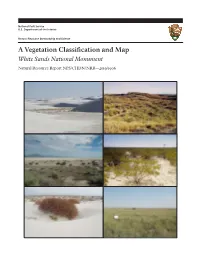
National Park Service U.S. Department of the Interior Natural Resource Stewardship and Science A Vegetation Classification and Map White Sands National Monument Natural Resource Report NPS/CHDN/NRR—2019/1906 ON THE COVER Representative vegetation communities of White Sands National Monument. Photography by E. Muldavin, Charlie Jack- son, Yvonne Chauvin, and Jamie Thompson A Vegetation Classification and Map White Sands National Monument Natural Resource Report NPS/WHSA/NRR—2019/1906 Esteban Muldavin1 Yvonne Chauvin1 Keith Schulz2 Teri Neville1 Paul Neville3 Jacqueline Smith1 Anthony Fettes1 1Natural Heritage New Mexico Division Museum of Southwestern Biology University of New Mexico, Albuquerque, NM 2NatureServe Boulder, CO 3Earth Data Analysis Center University of New Mexico, Albuquerque, NM April 2019 U.S. Department of the Interior National Park Service Natural Resource Stewardship and Science Fort Collins, Colorado The National Park Service, Natural Resource Stewardship and Science office in Fort Collins, Colorado, publishes a range of reports that address natural resource topics. These reports are of interest and applicability to a broad audience in the National Park Service and others in natural resource management, including scientists, conservation and environmental constituencies, and the public. The Natural Resource Report Series is used to disseminate comprehensive information and analysis about natural resources and related topics concerning lands managed by the National Park Service. The series supports the advancement of science, informed decision-making, and the achievement of the National Park Service mission. The series also provides a forum for presenting more lengthy results that may not be accepted by publications with page limitations. All manuscripts in the series receive the appropriate level of peer review to ensure that the information is scientifically credible, technically accurate, appropriately written for the intended audience, and designed and published in a professional manner. -

Endangered Species
FEATURE: ENDANGERED SPECIES Conservation Status of Imperiled North American Freshwater and Diadromous Fishes ABSTRACT: This is the third compilation of imperiled (i.e., endangered, threatened, vulnerable) plus extinct freshwater and diadromous fishes of North America prepared by the American Fisheries Society’s Endangered Species Committee. Since the last revision in 1989, imperilment of inland fishes has increased substantially. This list includes 700 extant taxa representing 133 genera and 36 families, a 92% increase over the 364 listed in 1989. The increase reflects the addition of distinct populations, previously non-imperiled fishes, and recently described or discovered taxa. Approximately 39% of described fish species of the continent are imperiled. There are 230 vulnerable, 190 threatened, and 280 endangered extant taxa, and 61 taxa presumed extinct or extirpated from nature. Of those that were imperiled in 1989, most (89%) are the same or worse in conservation status; only 6% have improved in status, and 5% were delisted for various reasons. Habitat degradation and nonindigenous species are the main threats to at-risk fishes, many of which are restricted to small ranges. Documenting the diversity and status of rare fishes is a critical step in identifying and implementing appropriate actions necessary for their protection and management. Howard L. Jelks, Frank McCormick, Stephen J. Walsh, Joseph S. Nelson, Noel M. Burkhead, Steven P. Platania, Salvador Contreras-Balderas, Brady A. Porter, Edmundo Díaz-Pardo, Claude B. Renaud, Dean A. Hendrickson, Juan Jacobo Schmitter-Soto, John Lyons, Eric B. Taylor, and Nicholas E. Mandrak, Melvin L. Warren, Jr. Jelks, Walsh, and Burkhead are research McCormick is a biologist with the biologists with the U.S. -

ECOLOGY of NORTH AMERICAN FRESHWATER FISHES
ECOLOGY of NORTH AMERICAN FRESHWATER FISHES Tables STEPHEN T. ROSS University of California Press Berkeley Los Angeles London © 2013 by The Regents of the University of California ISBN 978-0-520-24945-5 uucp-ross-book-color.indbcp-ross-book-color.indb 1 44/5/13/5/13 88:34:34 AAMM uucp-ross-book-color.indbcp-ross-book-color.indb 2 44/5/13/5/13 88:34:34 AAMM TABLE 1.1 Families Composing 95% of North American Freshwater Fish Species Ranked by the Number of Native Species Number Cumulative Family of species percent Cyprinidae 297 28 Percidae 186 45 Catostomidae 71 51 Poeciliidae 69 58 Ictaluridae 46 62 Goodeidae 45 66 Atherinopsidae 39 70 Salmonidae 38 74 Cyprinodontidae 35 77 Fundulidae 34 80 Centrarchidae 31 83 Cottidae 30 86 Petromyzontidae 21 88 Cichlidae 16 89 Clupeidae 10 90 Eleotridae 10 91 Acipenseridae 8 92 Osmeridae 6 92 Elassomatidae 6 93 Gobiidae 6 93 Amblyopsidae 6 94 Pimelodidae 6 94 Gasterosteidae 5 95 source: Compiled primarily from Mayden (1992), Nelson et al. (2004), and Miller and Norris (2005). uucp-ross-book-color.indbcp-ross-book-color.indb 3 44/5/13/5/13 88:34:34 AAMM TABLE 3.1 Biogeographic Relationships of Species from a Sample of Fishes from the Ouachita River, Arkansas, at the Confl uence with the Little Missouri River (Ross, pers. observ.) Origin/ Pre- Pleistocene Taxa distribution Source Highland Stoneroller, Campostoma spadiceum 2 Mayden 1987a; Blum et al. 2008; Cashner et al. 2010 Blacktail Shiner, Cyprinella venusta 3 Mayden 1987a Steelcolor Shiner, Cyprinella whipplei 1 Mayden 1987a Redfi n Shiner, Lythrurus umbratilis 4 Mayden 1987a Bigeye Shiner, Notropis boops 1 Wiley and Mayden 1985; Mayden 1987a Bullhead Minnow, Pimephales vigilax 4 Mayden 1987a Mountain Madtom, Noturus eleutherus 2a Mayden 1985, 1987a Creole Darter, Etheostoma collettei 2a Mayden 1985 Orangebelly Darter, Etheostoma radiosum 2a Page 1983; Mayden 1985, 1987a Speckled Darter, Etheostoma stigmaeum 3 Page 1983; Simon 1997 Redspot Darter, Etheostoma artesiae 3 Mayden 1985; Piller et al. -

Crustacea: Amphipoda) in Texas and New Mexico, Usa
ANALYSIS OF THE GAMMARUS-PECOS COMPLEX (CRUSTACEA: AMPHIPODA) IN TEXAS AND NEW MEXICO, USA GERALD A. COLE Route 4, Box 892 Flagstaff, Arizona 86001 ABSTRACT A comparative study was made of representatives from seven populations of Gammarus in Texan and New Mexican fresh-to-miohaline waters in areas once overlain by Permian seas. They included the described species: G. pecos Cole and Bousfield (symbolized P) from Pecos Co., TX; G. hyalelloides Cole (H) from Phantom Lake Spring, Jeff Davis Co., TX; and G. desperatus Cole (D) from Chaves Co., NM. Members of other populations were examined from: San Solomon Spring (S), Toyahvale, Reeves Co., TX; a large species (C) co-occurring with H in Phantom Lake Spring; a small form (M) that came either from Phantom Lake Spring or from a spring 350 m to the north; and a species (E) from a pool near Carlsbad, Eddy Co., NM. All members of the group lack calceoli, bear C-setae on their mandibular palps, and have narrow oostegites. Coxae 1-4, in the larger individuals, are armed abundantly with long setae, and all animals have at least one spine at the posterodistal corner of the first peduncular article of the antennule. Twenty Mann-Whitney U tests were applied to certain morphologic attributes of the seven populations. The results suggest that: P and S are conspecific, with the latter showing some affinities to the larger animals (C) in the nearby Phantom Lake Spring system; C probably is a new species although more closely related to M and H than are the other four; G. -

Permian Basin, West Texas and Southeastern New Mexico
Report of Investigations No. 201 Stratigraphic Analysis of the Upper Devonian Woodford Formation, Permian Basin, West Texas and Southeastern New Mexico John B. Comer* *Current address Indiana Geological Survey Bloomington, Indiana 47405 1991 Bureau of Economic Geology • W. L. Fisher, Director The University of Texas at Austin • Austin, Texas 78713-7508 Contents Abstract ..............................................................................................................................1 Introduction ..................................................................................................................... 1 Methods .............................................................................................................................3 Stratigraphy .....................................................................................................................5 Nomenclature ...................................................................................................................5 Age and Correlation ........................................................................................................6 Previous Work .................................................................................................................6 Western Outcrop Belt ......................................................................................................6 Central Texas ...................................................................................................................7 Northeastern Oklahoma -

Evolutionary History of the Grasses1
Update on Evolution Evolutionary History of the Grasses1 Elizabeth A. Kellogg* Department of Biology, University of Missouri, St. Louis, Missouri 63121 While some scientists have been working to se- studying form, many systematists now use DNA se- quence and describe the human genome, with in- quences to determine relationships among organ- creasingly dramatic results, another set of scientists isms. If large enough stretches of DNA can be com- has been quietly providing a map of evolutionary pared for enough organisms, the phylogenetic history, a time line that shows how life has evolved. relationships generally become clear. The need for Unlike the genome projects, which accumulate mega- large numbers of DNA sequences has led to collab- bases of sequence from many genes in one organism, orative groups of scientists who combine their data to evolutionary projects accumulate megabases of se- reach a common goal. This is an unusual endeavor quence from the same handful of genes in many for systematists who traditionally have worked alone, organisms. The scientists who investigate the pattern each investigating a single group of organisms. of evolutionary change are predominantly system- atists, meaning, literally, those who study natural systems. Their work has three major goals. The first is EVOLUTIONARY TREE OF THE GRASS FAMILY to decipher the evolutionary history, or phylogeny, (POACEAE OR GRAMINEAE) commonly drawn as a cladogram or branching dia- The grass family is of particular interest to humans. gram. Once that is accomplished, the second goal is Most people on earth rely on grasses, including rice, to determine for each speciation event what sorts of wheat, and maize, for a major portion of their diet. -

Kenai National Wildlife Refuge Species List, Version 2018-07-24
Kenai National Wildlife Refuge Species List, version 2018-07-24 Kenai National Wildlife Refuge biology staff July 24, 2018 2 Cover image: map of 16,213 georeferenced occurrence records included in the checklist. Contents Contents 3 Introduction 5 Purpose............................................................ 5 About the list......................................................... 5 Acknowledgments....................................................... 5 Native species 7 Vertebrates .......................................................... 7 Invertebrates ......................................................... 55 Vascular Plants........................................................ 91 Bryophytes ..........................................................164 Other Plants .........................................................171 Chromista...........................................................171 Fungi .............................................................173 Protozoans ..........................................................186 Non-native species 187 Vertebrates ..........................................................187 Invertebrates .........................................................187 Vascular Plants........................................................190 Extirpated species 207 Vertebrates ..........................................................207 Vascular Plants........................................................207 Change log 211 References 213 Index 215 3 Introduction Purpose to avoid implying -
Common Browse Plants Used by White-Tailed Deer in the Cross Timbers and Prairies of Texas
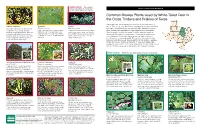
THIRD CHOICE — Plants lightly consumed and/or when first and texas parks and wildlife second choice plants are absent Common Browse Plants Used by White-Tailed Deer in the Cross Timbers and Prairies of Texas White-tailed deer eat the leaves, stems, and fruits of a wide variety of Western Soapberry Texas Ash Agarito plants. They choose vegetation based on palatability, seasonal availability, Sapindus saponaria var. drummondii Fraxinus texensis Berberis trifoliata abundance, precipitation, and overall health of the habitat. Deer prefer Small tree to 15m; narrow, alternate Small tree; leaves oval or spade shaped, Evergreen shrub; leaves blue-gray above, forbs; however, forb abundance is highly dependent on precipitation. leaves turning bright yellow in the fall; gray pale below with prominent veins; bark holly-like with sharp points, occurring in We often gauge the value of a habitat to white-tailed deer based on to red bark with small, reddish scales rough and gray color; fruit wing shaped, three leaflets; stems gray-brown, yellow the volume and variety of browse plants. Browse plants make up the possible; when ripe, fruits are grape-sized in clusters; common on limestone slopes within; bright red berries in June; dry, most stable part of the habitat because they are deep rooted and and bluffs translucent globes; often found along rocky limestone soils. less dependent on seasonal rainfall. This brochure is intended to help fence rows and wooded edges landowners identify common browse plants and their relative importance to deer in the Cross Timbers and Prairies of Texas. Diet studies, field experience, stem counts, and cursory observations of plants under natural habitat conditions were used to place plants into preference classes.