Iran 2013 Human Rights Report
Total Page:16
File Type:pdf, Size:1020Kb
Load more
Recommended publications
-

IRAN EXECUTIVE SUMMARY the Islamic Republic of Iran
IRAN EXECUTIVE SUMMARY The Islamic Republic of Iran is a constitutional, theocratic republic in which Shia Muslim clergy and political leaders vetted by the clergy dominate the key power structures. Government legitimacy is based on the twin pillars of popular sovereignty--albeit restricted--and the rule of the supreme leader of the Islamic Revolution. The current supreme leader, Ayatollah Ali Khamenei, was chosen by a directly elected body of religious leaders, the Assembly of Experts, in 1989. Khamenei’s writ dominates the legislative, executive, and judicial branches of government. He directly controls the armed forces and indirectly controls internal security forces, the judiciary, and other key institutions. The legislative branch is the popularly elected 290-seat Islamic Consultative Assembly, or Majlis. The unelected 12-member Guardian Council reviews all legislation the Majlis passes to ensure adherence to Islamic and constitutional principles; it also screens presidential and Majlis candidates for eligibility. Mahmoud Ahmadinejad was reelected president in June 2009 in a multiparty election that was generally considered neither free nor fair. There were numerous instances in which elements of the security forces acted independently of civilian control. Demonstrations by opposition groups, university students, and others increased during the first few months of the year, inspired in part by events of the Arab Spring. In February hundreds of protesters throughout the country staged rallies to show solidarity with protesters in Tunisia and Egypt. The government responded harshly to protesters and critics, arresting, torturing, and prosecuting them for their dissent. As part of its crackdown, the government increased its oppression of media and the arts, arresting and imprisoning dozens of journalists, bloggers, poets, actors, filmmakers, and artists throughout the year. -
En En Motion for a Resolution
EUROPEAN PARLIAMENT 2009 - 2014 Plenary sitting 15.11.2011 B7-0598/2011 MOTION FOR A RESOLUTION with request for inclusion in the agenda for the debate on cases of breaches of human rights, democracy and the rule of law pursuant to Rule 122 of the Rules of Procedure on Iran - recent cases of human rights violations Véronique De Keyser, María Muñiz De Urquiza, Kathleen Van Brempt, Pino Arlacchi, Corina Creţu, Kristian Vigenin on behalf of the S&D Group RE\P7_B(2011)0598_EN.doc PE472.810v01-00 EN United in diversityEN B7-0598/2011 European Parliament resolution on Iran - recent cases of human rights violations The European Parliament, - having regard to its previous resolutions on Iran, notably those concerning human rights and, in particular, those of February 2010 and January 2011, - having regard to the UN Universal Declaration of Human Rights, the International Covenant on Civil and Political Rights, the International Covenant on Economic, Social and Cultural Rights, to all of which Iran is a party, - having regard to Rule 122(5) of its Rules of Procedure, A. whereas the multi-faceted human rights crisis is gripping Iran, including the persecution and prosecution of civil society actors, political activists, journalists, students, artists, lawyers, and environmental activists; as well as the routine denial of freedom of assembly, women’s rights, the rights of religious and ethnic minorities, and the skyrocketing rates of executions; B. whereas recent deaths of two human rights defenders, Haleh Sahabi and Hoda Saber, for which the officials were responsible, illustrate the existential threats to jailed human rights defenders and dissidents in Iran; C. -
As It Sides with Qatar, Turkey Tries to Pre-Empt Own Isolation
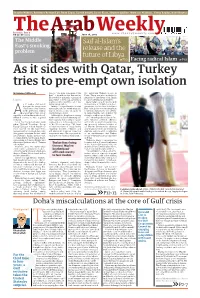
Roufan Nahhas, Rashmee Roshan Lall, Iman Zayat, Gareth Smyth, Jareer Elass, Stephen Quillen, Mamoon Alabbasi , Yavuz Baydar, Rami Rayess Issue 111, Year 3 www.thearabweekly.com UK £2/ EU €2.50 June 18, 2017 The Middle Saif al-Islam’s East’s smoking release and the problem future of Libya P4 P22 P10 Facing radical Islam P18 As it sides with Qatar, Turkey tries to pre-empt own isolation Mohammed Alkhereiji Saud — “the elder statesman of the 150 additional Turkish troops in Gulf” — should resolve the matter. Doha. There was also a pledge by He needed to maintain a margin of members of the Qatari royal family London manoeuvre to keep his meditation for more investments in Turkey. posture and forestall the risk of An- Galip Dalay, research director at Al s it makes statements kara’s own isolation. Sharq Forum, a Turkish research or- that give the impression Turkish Foreign Minister Mevlut ganisation, told the New York Times of a position of mediation Cavusoglu, who met with King Sal- that Turkey was “transitioning from in the Gulf crisis, Turkey man in Mecca on June 16, spoke in neutral mediator to the role of firm- is working to make sure it similarly vague terms. ly supporting the side of Qatar” by isA not the next Muslim Brotherhood- “Although the kingdom is a party voting to send troops to Qatar. affiliated country to face regional in this crisis, we know that King Sal- The Turkish position was in line isolation. man is a party in resolving it,” Cavu- with Ankara’s common affinities A lot has happened since 2015 soglu said at a Doha stopover prior with Doha as another country fac- when Turkish President Recep to his Mecca meeting. -

IRAN COUNTRY of ORIGIN INFORMATION (COI) REPORT COI Service
IRAN COUNTRY OF ORIGIN INFORMATION (COI) REPORT COI Service Date 28 June 2011 IRAN JUNE 2011 Contents Preface Latest News EVENTS IN IRAN FROM 14 MAY TO 21 JUNE Useful news sources for further information REPORTS ON IRAN PUBLISHED OR ACCESSED BETWEEN 14 MAY AND 21 JUNE Paragraphs Background Information 1. GEOGRAPHY ............................................................................................................ 1.01 Maps ...................................................................................................................... 1.04 Iran ..................................................................................................................... 1.04 Tehran ................................................................................................................ 1.05 Calendar ................................................................................................................ 1.06 Public holidays ................................................................................................... 1.07 2. ECONOMY ................................................................................................................ 2.01 3. HISTORY .................................................................................................................. 3.01 Pre 1979: Rule of the Shah .................................................................................. 3.01 From 1979 to 1999: Islamic Revolution to first local government elections ... 3.04 From 2000 to 2008: Parliamentary elections -
Protestant Ecclesiastical Law and the Ius Commune
The Catholic University of America, Columbus School of Law CUA Law Scholarship Repository Scholarly Articles and Other Contributions Faculty Scholarship 2016 Protestant Ecclesiastical Law and the Ius Commune Kenneth Pennington The Catholic University of America, Columbus School of Law Follow this and additional works at: https://scholarship.law.edu/scholar Part of the Legal History Commons Recommended Citation Kenneth Pennington, Protestant Ecclesiastical Law and the Ius Commune, 26 RIVISTA INTERNAZIONALE DI DIRITTO COMUNE 9 (2015). This Article is brought to you for free and open access by the Faculty Scholarship at CUA Law Scholarship Repository. It has been accepted for inclusion in Scholarly Articles and Other Contributions by an authorized administrator of CUA Law Scholarship Repository. For more information, please contact edinger@law.edu. 1 Protestant Ecclesiastical Law and the Ius commune Kenneth Pennington Protestants almost never called their ecclesiastical norms ‘canons.’1 When Protestant jurists or theologians wrote ‘canon law’ (Ius canonicum) in their works, it was clear to their readers that they meant Roman canon law. Surprisingly, Protestant jurists often cited Roman canon law and its jurisprudence long after Martin Luther burned books of Roman canon law at the Elster gate in Wittenberg. These jurists also continued to teach courses at the universities that treated the Ius canonicum. Consequently, an essay on Protestant canon law must confront the question: how much Roman canon law and the jurisprudence of the medieval Ius commune remained embedded in the Reformers’ legislation and jurisprudence and how much was rejected? Until relatively recently scholars answered that question largely according to their confessional affiliations. -

Historical Notes on the Canon Law on Solemnized Marriage
The Catholic Lawyer Volume 2 Number 2 Volume 2, April 1956, Number 2 Article 3 Historical Notes on the Canon Law on Solemnized Marriage William F. Cahill, B.A., J.C.D. Follow this and additional works at: https://scholarship.law.stjohns.edu/tcl Part of the Catholic Studies Commons This Article is brought to you for free and open access by the Journals at St. John's Law Scholarship Repository. It has been accepted for inclusion in The Catholic Lawyer by an authorized editor of St. John's Law Scholarship Repository. For more information, please contact selbyc@stjohns.edu. The nature and importance of the Catholic marriage ceremony is best understood in the light of historicalantecedents. With such a perspective, the canon law is not likely to seem arbitrary. HISTORICAL NOTES ON THE CANON LAW ON SOLEMNIZED MARRIAGE WILLIAM F. CAHILL, B.A., J.C.D.* T HE law of the Catholic Church requires, under pain of nullity, that the marriages of Catholics shall be celebrated in the presence of the parties, of an authorized priest and of two witnesses.1 That law is the product of an historical development. The present legislation con- sidered apart from its historical antecedents can be made to seem arbitrary. Indeed, if the historical background is misconceived, the 2 present law may be seen as tyrannical. This essay briefly states the correlation between the present canons and their antecedents in history. For clarity, historical notes are not put in one place, but follow each of the four headings under which the present Church discipline is described. -
Pragmatism As a Philosophy of Law Walter B
Marquette Law Review Volume 9 Article 1 Issue 2 February 1925 Pragmatism as a Philosophy of Law Walter B. Kennedy Follow this and additional works at: http://scholarship.law.marquette.edu/mulr Part of the Law Commons Repository Citation Walter B. Kennedy, Pragmatism as a Philosophy of Law, 9 Marq. L. Rev. 63 (1925). Available at: http://scholarship.law.marquette.edu/mulr/vol9/iss2/1 This Article is brought to you for free and open access by the Journals at Marquette Law Scholarly Commons. It has been accepted for inclusion in Marquette Law Review by an authorized administrator of Marquette Law Scholarly Commons. For more information, please contact megan.obrien@marquette.edu. Marquette Law Review VOL. 9 FEBRUARY, I925 No. 2 PRAGMATISM AS A PHILOSOPHY OF LAW WALTER B. KENNEDY* F ORMERLY the case-hardened lawyer coldly rejected the suggestion that legal philosophy might aid him in the practice of the law. His younger brethren in the law schools caught his look of disdain and re- sisted the entry of philosophy of law as a course of study in preparation for the bar. But times are changing. It is becoming quite respectable to discuss the nature and the origin of law, its ends and functions. Law schools are adding such studies to their curricula, and the progressive lawyer is becoming aware of the fact that the courts are paying tribute to the law-teacher and the student of juristic science.' The excursion into this new field of legal development promises dividends in satisfac- tion and success amply repaying for the time spent. -

Download Report
Iranian Internet Infrastructure and Policy Report April 2014 smallmedia.org.uk This work is licensed under a Creative Commons Attribution-NonCommercial 3.0 Unported License INTRODUCTION // Despite the election of the moderate Hassan Rouhani to the presidency last year, Iran’s systematic filtering of online content and mobile phone apps continues at full-pace. In this month’s edition of the Iranian Internet Infrastructure and Policy Report, Small Media takes a closer look at one of the bodies most deeply-enmeshed with the process of overseeing and directing filtering policies - the ‘Commission to Determine the Instances of Criminal Content’ (or CDICC). This month’s report also tracks all the usual news about Iran’s filtering system, national Internet policy, and infrastructure development projects. As well as tracking high-profile splits in the estab- lishment over the filtering of the chat app WhatsApp, this month’s report also finds evidence that the government has begun to deploy the National Information Network (SHOMA), or ‘National Internet’, with millions of Iranians using it to access the government’s new online platform for managing social welfare and support. 2 THE COMMISSION TO DETERMINE THE INSTANCES OF CRIMINAL CONTENT (CDICC) THE COMMISSION TO DETERMINE THE INSTANCES OF CRIMINAL CONTENT (CDICC) overview The Commission to Determine the Instances of Criminal Content (CDICC) is the body tasked with monitoring cyberspace, and filtering criminal Internet content. It was established as a consequence of Iran’s Cyber Crime Law (CCL), which was passed by Iran’s Parliament in May 2009. According to Article 22 of the CCL, Iran’s Judiciary System was given the mandate of establishing CDICC under the authority of Iran’s Prosecutor’s Office. -

Report of the Special Rapporteur on the Situation of Human Rights in the Islamic Republic of Iran, Ahmed Shaheed*,**
A/HRC/28/70 Advance Unedited Version Distr.: General 12 March 2015 Original: English Human Rights Council Twenty-eighth session Agenda item 4 Human rights situations that require the Council’s attention Report of the Special Rapporteur on the situation of human rights in the Islamic Republic of Iran, Ahmed Shaheed*,** Summary In the present report, the fourth to be submitted to the Human Rights Council pursuant to Council resolution 25/24, the Special Rapporteur highlights developments in the situation of human rights in the Islamic Republic of Iran since his fourth interim report submitted to the General Assembly (A/68/503) in October 2013. The report examines ongoing concerns and emerging developments in the State’s human rights situation. Although the report is not exhaustive, it provides a picture of the prevailing situation as observed in the reports submitted to and examined by the Special Rapporteur. In particular, and in view of the forthcoming adoption of the second Universal Periodic Review of the Islamic Republic of Iran, it analysis these in light of the recommendations made during the UPR process. * Late submission. ** The annexes to the present report are circulated as received, in the language of submission only. GE.15- A/HRC/28/70 Contents Paragraphs Page I. Introduction ............................................................................................................. 1-5 3 II. Methodology ........................................................................................................... 6-7 4 III. Cooperation -

U.S. and Iranian Strategic Competition
Iran V: Sanctions Competition January 4, 2013 0 U.S. AND IRANIAN STRATEGIC COMPETITION Sanctions, Energy, Arms Control, and Regime Change Anthony H. Cordesman, Bryan Gold, Sam Khazai, and Bradley Bosserman April 19, 2013 Anthony H. Cordesman Arleigh A. Burke Chair in Strategy acordesman@gmail.com Note: This report is will be updated. Please provide comments and suggestions to acordesman@gmail.com Iran V: Sanctions Competition April, 19 2013 I Executive Summary This report analyzes four key aspects of US and Iranian strategic competition - sanctions, energy, arms control, and regime change. Its primary focus is on the ways in which the sanctions applied to Iran have changed US and Iranian competition since the fall of 2011. This escalation has been spurred by the creation of a series of far stronger US unilateral sanctions and the EU‘s imposition of equally strong sanctions – both of which affect Iran‘s ability to export, its financial system and its overall economy. It has been spurred by Iran‘s ongoing missile deployments and nuclear program, as reported in sources like the November 2011 IAEA report that highlights the probable military dimensions of Iran‘s nuclear program. And, by Iranian rhetoric, by Iranian threats to ―close‖ the Gulf to oil traffic; increased support of the Quds Force and pro-Shiite governments and non-state actors; and by incidents like the Iranian-sponsored assassination plot against the Saudi Ambassador to the US, an Iranian government instigated mob attack on the British Embassy in Tehran on November 30, 2011, and the Iranian-linked attacks against Israeli diplomats. -

Read the Annual Report on the Death Penalty in Iran
ANNUAL REPORT ON THE DEATH PENALTY IN IRAN 2020 In 2020, the year of the extraordinary and overwhelming worldwide COVID-19 pandemic, most countries have been fighting to save lives. Meanwhile, Iran not only continued executing as usual, ANNUAL REPORT but used the death penalty more than ever to nip the freedom of speech and expression in the bud. The death penalty in 2020 has been used as a repressive tool against protesters, ethnic minority groups and any opponents or independent thinkers. Nevertheless, this report shows how exasperated the Iranian population is with the authorities’ ON THE DEATH PENALTY practices. Public opposition to the death penalty has increased drastically. Mass online campaigns of millions of Iranians expressing their opposition to the death penalty and the dramatic increase in the number of people choosing diya (blood money) or forgiveness over execution, are all examples of this opposition. With this report, we demand transparency and accountability and IN IRAN 2020 call on the international community to support the abolitionist movement in Iran. 2020 ON THE DEATH PENALTY IN IRAN ANNUAL REPORT © IHR, ECPM, 2021 ISBN : 978-2-491354-18-3 Mahmood Amiry-Moghaddam Director Iran Human Rights (IHR) and ECPM Iran Human Rights Raphaël Chenuil-Hazan have been working together since P.O.Box 2691 Solli Executive director 2011 for the international release and circulation of the annual report 0204 Oslo - Norway Email: rchenuil@ecpm.org on the death penalty in Iran. IHR Tel: +47 91742177 62bis avenue Parmentier and ECPM see the death penalty as Email: mail@iranhr.net 75011 PARIS a benchmark for the human rights situation in the Islamic Republic of Iran. -
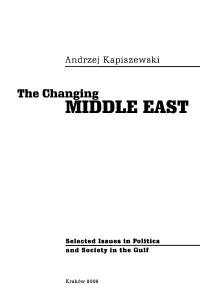
The Changing MIDDLE EAST
Andrzej Kapiszewski The Changing MIDDLE EAST Selected Issues in Politics and Society in the Gulf Kraków 2006 Editorial Board: Klemens Budzowski, Andrzej Kapiszewski, Zbigniew Maciąg, Jacek M. Majchrowski Cover design: Igor Stanisławski Copyright© by Andrzej Kapiszewski ISBN 83-89823-17-9 Printed by: Drukarnia Tercja s.c. Acknowledgments Articles published in this volume originally appeared in the following publications: 1. George W. Bush’s “promotion o f democracy" agenda in the Middle East—Acta Asiatica Varsoviensa, no. 17, 2004, pp. 71—90 (expanded and updated version of the original) 2. Elections and parliamentary activity in the GCCstates. Broadening political participation in the Gulf monarchies — Constitutional Reform and Political Participation in the Gulf, Abdulhada Khalaf and Giacomo Luciani (eds), Dubai, Gulf Research Center, 2006, p p .88-131 3. Saudi Arabia: Steps toward democratization or reconfiguration of authoritarianism? — fournal of Asian and African Studies, 2006, no. 41. 4. The Iraqi elections and their consequences. Power-sharing, a key to the country’s political future - Looking into Iraq, Chaillot Paper, no. 79, Walter Posh (ed.), July 2005, Institute for Security Studies, European Union, Paris, pp. 13-24 Acknowledgments 5. Iran’s new revolution? President Ahmadinejad and the power struggle in Tehran - Politeja, no. 2 (4), 2005, pp. 245-255. 6. Arab vs. Asian migrant workers in the GCC countries — paper presented at the Expert Group Meeting on “International Migration and Development in the Arab Region”, The Population Division of the Department of Economic and Social Affairs, United Nations, Beirut, Lebanon, 15-17 May, 2006. 7. Population and workforce in Oman - Oman. Studies on Politics, Economy, Environment and Culture of the Sultanate, Andrzej Kapiszewski, Abdulrahman Al-Salimi and Andrzej Pikulski (eds), Kraków, Księgarnia Akademicka, 2006, pp.