Hugh Masekela Notes.Indd
Total Page:16
File Type:pdf, Size:1020Kb
Load more
Recommended publications
-

África · Rutas Literarias
ÁFRICA ‐ AFRIKA Rutas literarias. Destinos internacionales Ibilbide literarioak. Nazioarteko norakoak Se acerca el verano y la biblioteca pone a disposición de sus lectores más viajeros una selección de rutas literarias, cinematográficas y musicales por los cinco continentes. Mil sugerencias culturales para completar la información más práctica de las guías de viaje. Uda iristen ari da eta liburutegiak bere irakurle ibiltarienei bost kontinenteetan zehar ibilbide literario, zinematografiko eta musikalen aukeraketa bat eskeintzen die. Hamaika iradokizun kulturalak bidai‐giden informazio praktikoena osatzeko. BURKINA FASO ∙ BURKINA FASO música ∙ musika KIENOU, Amadou. Taabali. Felmay, 2006 libros ∙ liburuak ARRETXE, Jon. Griot. Elkar, 2004 CABO VERDE ∙ CABO VERDE música ∙ musika BAU. Ilha azul. Harmonia, 2005 CHANTRE, Teofilo. Rodatempo. Tropical Music, 2000 EVORA, Cesaria. Mar azul. Lusafrica, 1992 LURA. Di korpu ku alma. Lusafrica, 2005 TAVARES, Sara. Xinti. World Connection, 2009 libros ∙ liburuak CASO, Ángeles. Contra el viento. Planeta, 2009 LOPES, Baltasar. Chiquinho. El Cobre, 2003 PORTELL, Raimon. Una canción de Cabo Verde. La Galera, 2006 CAMERÚN ∙ KAMERUN música ∙ musika BASS, Apolo. Another world without racism. 2006 BONA, Richard. Munia. The tale. Universal Music, 2003 DIBANGO, Manu. The very best of Manu. Africadelic. Wrasse Records, 2003 MBASSI, Coco. Sisea. Tropical Music, 2003 NYOLO, Sally. Béti. Lusafrica, 2000 www.bibliotecaspublicas.es/civican/ CivicanLib.blogspot.com/ * material disponible en otras bibliotecas de Navarra / Nafarroako beste liburutegietako material librea libros ∙ liburuak BARLEY, Nigel. El antropólogo inocente. Anagrama, 1991 EBENÉZER, Bassi. Pequeñas cosas. Esas maravillas. Bassi Ebenezer, 2006 EGIPTO ∙ EGIPTO música ∙ musika ATLAS, Natasha. Halim. Beggars Banquet, 1997 FADL, Mahmoud. Love letter from King Tut‐ank‐amen. Piranha, 1998 RAMZY, Hossam. -

Kindle # King Kong
M8TREPC2CM \ King Kong - Our Knot of Time and Music: A personal memoir... Book King Kong - Our Knot of Time and Music: A personal memoir of South A frica s legendary musical (Paperback) By Pat Williams GRANTA BOOKS, United Kingdom, 2017. Paperback. Condition: New. Language: English . Brand New Book. On 2 February 1959, a musical about the life and times of heavyweight boxing star Ezekiel Dhlamini (known as King Kong ) opened in Johannesburg to a packed audience that included Nelson Mandela. King Kong was not just South Africa s first ever musical, but one that grew out of a collaboration between black people and white, and showcased an all-black cast. It was an instant hit, bursting through the barriers of apartheid and eventually playing to 200,000 South Africans of every colour before transferring to London s West End. Pat Williams, the show s lyricist, was at the time an apolitical young woman trying to free herself from the controls and prejudices of the genteel white society in which she lived. Here she recounts her experience of growing up in a divided South Africa, her involvement in the musical, and its lasting impact both on herself and on the show s cast, many of whom went on to find international fame, like South African jazz legends Miriam Makeba and Hugh Masekela. Her memoir takes the story up to the present day. It is both a... READ ONLINE [ 6.91 MB ] Reviews A must buy book if you need to adding benefit. It is rally intriguing throgh reading time period. I am pleased to tell you that here is the very best book i actually have study in my very own lifestyle and may be he finest ebook for at any time. -

Africa Secures 400 Million More Covid-19 Vaccine Doses
THE AFRICAN STORY ADVERTISE WITH US DON’T BE LEFT BEHIND ISSUE NUMBER 754 VOLUME 2 01 FEB - 07 FEB 2020 Botswana’s Debswana diamond exports fell 30% in 2020 page 3 Young diamond jewellery designers called to enter AFRICA Shining Light SECURES Awards 400 MILLION page 4 Zambia’s MORE COVID-19 corruption perception VACCINE worsens on latest DOSES Transparency • WHO rebukes Tanzania over decision to stop International reporting Covid-19 cases index page 5 2 Echo Report Echo Newspaper 01 Feb - 07 Feb 2020 THE AFRICAN STORY News, Finance, Travel and Sport Telephone: (267) 3933 805/6. E-mail: newsdesk@echo. co.bw Advertising Telephone: (267) 3933 805/6 E-mail: sales@echo.co.bw Sales & Marketing Manager Ruele Ramoeng ruele@ymhp.co.bw Editor Bright Kholi kholib@ymhp.co.bw Head of Design Ame Kolobetso ame.kolobetso@ymhp.co.bw Distribution & Circulation Mogapi Ketletseng Africa secures 400 million ketletsengm@echo.co.bw Echo is published by YMH Publishing YMH Publishing, more COVID-19 vaccine doses Unit 3, Kgale Court, Plot 128, GIFP, Gaborone Postal address: P O BOX 840, Gaborone, The director of the AU’s disease Separately from the AU’s efforts, disadvantage. foreign plot to spread illness and Botswana Telephone: (267) 3933 805/6. control and prevention body Africa is to receive about 600 Africa has reported 3.5 million steal Africa’s wealth. He urged E-mail: info@echo.co.bw John Nkengasong, has said that million vaccine doses this year infections and 88,000 deaths, Tanzanians instead to trust God www.echo.co.bw The African Union (AU) has via the COVAX facility co-led by according to a Reuters tally. -
The Characteristics of Trauma
DIPLOMARBEIT Titel der Diplomarbeit „Music and Trauma in the Contemporary South African Novel“ Verfasser Christian Stiftinger angestrebter akademischer Grad Magister der Philosophie (Mag.phil.) Wien, 2011. Studienkennzahl lt. Studienblatt: A 190 344 Studienrichtung lt. Studienblatt: UF Englisch Betreuer: Univ. Prof. DDr . Ewald Mengel Declaration of Authenticity I hereby confirm that I have conceived and written this thesis without any outside help, all by myself in English. Any quotations, borrowed ideas or paraphrased passages have been clearly indicated within this work and acknowledged in the bibliographical references. There are no hand-written corrections from myself or others, the mark I received for it can not be deducted in any way through this paper. Vienna, November 2011 Christian Stiftinger Table of Contents 1. Introduction......................................................................................1 2. Trauma..............................................................................................3 2.1 The Characteristics of Trauma..............................................................3 2.1.1 Definition of Trauma I.................................................................3 2.1.2 Traumatic Event and Subjectivity................................................4 2.1.3 Definition of Trauma II................................................................5 2.1.4 Trauma and Dissociation............................................................7 2.1.5 Trauma and Memory...……………………………………………..8 2.1.6 Trauma -

Review: International Jazz Day, Istanbul
jazzjo urnal.co .uk http://www.jazzjournal.co.uk/magazine/583/review-international-jazz-day-istanbul Review: International Jazz Day, Istanbul N. Buket Cengiz reports on an event marked by star-studded concerts and discussions that revealed the ’heretofore unknown’ rhetorical powers of bassist Marcus Miller On 30 April, the sun shone with the hum of jazz tunes in Istanbul, inviting Istanbulites to wake up f or a day of a sweet rush in the host city f or International Jazz Day 2013. The 32nd International Istanbul Film Festival, a major cinema f estival in Europe, had been wrapped up just a couple of weeks prior with yet another collection of unf orgettable memories, and the city was ready f or the International Jazz Day event to be celebrated in collaboration with the Republic of Turkey and Istanbul Jazz Festival as the host city partner, with preparations underway since winter. In Istanbul, culture and arts as well as night lif e are remarkable, particularly f or music enthusiasts. Throughout the year, there is an abundance of clubs to choose f rom, and thanks to its temperate climate, there are open air concerts and f estivals as well. All year round, rock and indie, classical, ethnic and f olk, and of course jazz tunes f lit about the city, particularly during the never-ending summer nights. Istanbul is proud of its two international jazz f estivals: The Istanbul Jazz Festival organized by Istanbul Foundation f or Culture and Arts (IKSV), which will celebrate its 20th anniversary this July, and the Akbank Jazz Festival, which will be held f or the 23rd time this September. -

Music Outside? the Making of the British Jazz Avant-Garde 1968-1973
Banks, M. and Toynbee, J. (2014) Race, consecration and the music outside? The making of the British jazz avant-garde 1968-1973. In: Toynbee, J., Tackley, C. and Doffman, M. (eds.) Black British Jazz. Ashgate: Farnham, pp. 91-110. ISBN 9781472417565 There may be differences between this version and the published version. You are advised to consult the publisher’s version if you wish to cite from it. http://eprints.gla.ac.uk/222646/ Deposited on 28 August 2020 Enlighten – Research publications by members of the University of Glasgow http://eprints.gla.ac.uk Race, Consecration and the ‘Music Outside’? The making of the British Jazz Avant-Garde: 1968-1973 Introduction: Making British Jazz ... and Race In 1968 the Arts Council of Great Britain (ACGB), the quasi-governmental agency responsible for providing public support for the arts, formed its first ‘Jazz Sub-Committee’. Its main business was to allocate bursaries usually consisting of no more than a few hundred pounds to jazz composers and musicians. The principal stipulation was that awards be used to develop creative activity that might not otherwise attract commercial support. Bassist, composer and bandleader Graham Collier was the first recipient – he received £500 to support his work on what became the Workpoints composition. In the early years of the scheme, further beneficiaries included Ian Carr, Mike Gibbs, Tony Oxley, Keith Tippett, Mike Taylor, Evan Parker and Mike Westbrook – all prominent members of what was seen as a new, emergent and distinctively British avant-garde jazz scene. Our point of departure in this chapter is that what might otherwise be regarded as a bureaucratic footnote in the annals of the ACGB was actually a crucial moment in the history of British jazz. -

Abdullah Ibrahim and the Politics of Jazz in South Africa Nusra Khan Jazz Has Had an Especial Role in the Social and Cultural Politics of South Africa
Abdullah Ibrahim and the Politics of Jazz in South Africa Nusra Khan Jazz has had an especial role in the social and cultural politics of South Africa. This paper will trace its function in the political struggle waged by Black and Colored musicians against the apartheid regime, from the early 1950s until the 1990s, focusing on the work of one artist particularly. While Abdullah Ibrahim is by no means the only South African musician to use jazz for political goals, the development of his career provides an incredible example of the convergence of race, protest, and memory in the performance as well as study of jazz. Ibrahim’s musical career is entrenched in South Africa’s struggle against apartheid, and it is through this lens that I will examine his life and the role of jazz music in general. As early as the 1940s, jazz had emerged as the favored genre of the elite in South Africa. Professional musicians preferred American ‘international’ performance styles, and only a few African jazz musicians brought anything identifiably South African to their performances of American swing. The negative association between traditional African music and the ‘tribal’ past or rural present was begun by missionaries and had become entrenched in African society, most obviously under the Afrikaner’s government’s policy of “forcing Africans to develop along their own lines1”. Like the leaders of the American Harlem Renaissance, the African elite hoped that achievements in the artistic and intellectual fields would help break down the color bar2. Indeed the similar experience of Black Americans and Africans, of “two peoples under white domination,”3 may have increased the appeal of Black American style in amongst South African performers. -

Mirror, Mediator, and Prophet: the Music Indaba of Late-Apartheid South Africa
VOL. 42, NO. 1 ETHNOMUSICOLOGY WINTER 1998 Mirror, Mediator, and Prophet: The Music Indaba of Late-Apartheid South Africa INGRID BIANCA BYERLY DUKE UNIVERSITY his article explores a movement of creative initiative, from 1960 to T 1990, that greatly influenced the course of history in South Africa.1 It is a movement which holds a deep affiliation for me, not merely through an extended submersion and profound interest in it, but also because of the co-incidence of its timing with my life in South Africa. On the fateful day of the bloody Sharpeville march on 21 March 1960, I was celebrating my first birthday in a peaceful coastal town in the Cape Province. Three decades later, on the weekend of Nelson Mandela’s release from prison in February 1990, I was preparing to leave for the United States to further my studies in the social theories that lay at the base of the remarkable musical movement that had long engaged me. This musical phenomenon therefore spans exactly the three decades of my early life in South Africa. I feel privi- leged to have experienced its development—not only through growing up in the center of this musical moment, but particularly through a deepen- ing interest, and consequently, an active participation in its peak during the mid-1980s. I call this movement the Music Indaba, for it involved all sec- tors of the complex South African society, and provided a leading site within which the dilemmas of the late-apartheid era could be explored and re- solved, particularly issues concerning identity, communication and social change. -

Umass Fine Arts Center Concert Hall
umassumass finefine artsarts center center CENTERCENTER SERIESSERIES 2008–20092008–2009 1 1 2 3 2 3 playbill playbill 1 Paul Taylor Dance Company 11/13/08 2 Avery Sharpe Trio 11/21/08 3 Soweto Gospel Choir 12/03/08 1 Paul Taylor Dance Company 11/13/08 2 Avery Sharpe Trio 11/21/08 3 Soweto Gospel Choir 12/03/08 UMA021-PlaybillCover.indd 3 8/6/08 11:03:54 PM UMA021-PlaybillCover.indd 3 8/6/08 11:03:54 PM DtCokeYoga8.5x11.qxp 5/17/07 11:30 AM Page 1 DC-07-M-3214 Yoga Class 8.5” x 11” YOGA CLASS ©2007The Coca-Cola Company. Diet Coke and the Dynamic Ribbon are registered trademarks The of Coca-Cola Company. 2 We’ve mastered the fine art of health care. Whether you need a family doctor or a physician specialist, in our region it’s Baystate Medical Practices that takes center stage in providing quality and excellence. From Greenfield to East Longmeadow, from young children to seniors, from coughs and colds to highly sophisticated surgery — we’ve got the talent and experience it takes to be the best. Visit us at www.baystatehealth.com/bmp 3 &ALLON¬#OMMUNITY¬(EALTH¬0LAN IS¬PROUD¬TO¬SPONSOR¬THE 5-ASS¬&RIENDS¬OF¬THE¬&INE¬!RTS¬#ENTER 4 5 Supporting The Community We Live In Helps Create a Better World For All Of Us Allen Davis, CFP® and The Davis Group Are Proud Supporters of the Fine Arts Center! The work we do with our clients enables them to share their assets with their families, loved ones, and the causes they support. -
The New Fillmore
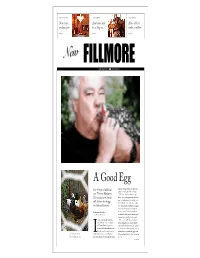
RETAIL REPORT FOOD & DRINK REAL ESTATE New shops, A new bar, and Home sells for medspa open it’s a long one under a million PAGES 5 - 7 PAGE 10 PAGE 14 New FILLMORE SAN FRANCISCO ■ AUGUST 2008 A Good Egg For 40 years, Phil Dean and drives along Golden Gate Park as he makes his way back to Fillmore Street. was Fillmore Hardware. He retired two and a half years ago, He’s retired now, but he but he’s never really gotten away from the neighborhood where he worked for most still delivers fresh eggs of his adult life. As he looks for a parking on Friday afternoon. space near Fillmore and Pine, he can glance out the window and see his fi ngerprints B B K R on nearly every Victorian on the block T R — lumber he sold, paint he mixed, repairs made according to advice he dispensed. ’ on a Friday afternoon, For an hour on Friday afternoon, just and Phil Dean, longtime manager before closing time, he’s back behind the of Fillmore Hardware, gets into counter of the hardware store, still greeting his truck in Pacifi ca and makes the customers and occasionally giving advice or drive he’s made so many times: up cutting keys — and delivering eggs, some ISkyline Drive, onto the Great Highway, of them gathered from his henhouse earlier S B past Ocean Beach. He turns right on Fulton that day. TO PAGE 8 4 LOCALS NEIGHBORHOOD NEWS Good Riddance, Say Locals, as Redevelopment Ends B D G “In the early days,” said executive di- But by this time, the African American destroyed a community, a way of life.” rector Fred Blackwell, “there is much that community had had enough. -
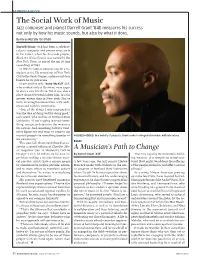
The Social Work of Music a Musician's Path to Change
ALUMNI GAZETTE The Social Work of Music Jazz composer and pianist Darrell Grant ’84E measures his success not only by how his music sounds, but also by what it does. b y Karen McCally ’02 (PhD) Darrell Grant ’84E has been a celebrat- ed jazz composer and pianist since early in his career, when his first solo project, Black Art (Criss Cross), was named by the New York Times as one of the top 10 jazz recordings of 1994. In 1997, he took an unusual step for a ris- ing jazz artist. He moved out of New York City to Portland, Oregon, a place much less known for its jazz scene. Grant and his wife, Anne McFall ’85E, who studied viola at Eastman, were eager to start a new life there. Yet it was also a place Grant felt would allow him, to a far greater extent than in New York City, to form meaningful connections with audi- ences and with his community. “One of the things I was interested in was the idea of doing well by doing good,” says Grant, who teaches at Portland State University. “If you’re going to create some- thing, you get to determine the measures for success. And something I always want- ed to figure out was ways to connect my musical projects to something broader in VaLuE(S)-aDDED: In a variety of projects, Grant seeks to integrate his music with his values. the community.” ESSAY This past fall, Grant contributed an es- say for a special edition of Chamber Mu- sic magazine (see “A Musician’s Path to A Musician’s Path to Change Change”). -

Conference Abstracts
SEMSCHC 2020 Abstracts Saturday, February 8 8:30-10:30 Session 1A: Queer Studies in Music (INTS 1113) Chair: Matthew Leslie Santana, UCSD Queerness as the Missing Note: The Agency of Gay Men Khrueang Sai Musicians through the Aesthetics of Naaphaat Music Nattapol Wisuttipat, UC Riverside Naaphaat is among the revered repertoire in Thai classical music. They are used in various contexts, most notably theatrical accompaniment and wai khruu, a teacher-honoring ritual. Because of its association with Thai cosmology, naaphaat operates within rigid conditions including strict ritual permissions and players’ identity. It is ideally performed by piiphaat ensembles, preferably with male musicians. In the past few years, however, the norms of naaphaat face an unprecedented development. The repertoire is increasingly played by an ensemble of string instruments that only performs secular entertainment music, and by gay musicians. This challenges not only the strict instrumental demarcation of naaphaat performance but also the binarily gendered practices behind Thai classical music. What does it mean for gay musicians to play such a highly regarded musical category on unconventional – or even incorrect – instruments? What are they trying to do? How might the sexuality of these musicians tell us about the underlying heteromasculinity in Thai culture? With these questions, I examine the aesthetics behind the nonconforming performances of naaphaat repertoire. Drawing on semiotics as filtered through Thomas Turino and queer theories through Gregory Barz, I argue that the performance is a site of non-heteronormative erotics and naaphaat an agentive tool for the gender nonconforming musicians to leverage their otherwise subversive sexuality. This paper is aimed to present a fresh but not new ethnomusicological perspective on identity politics to nuance the study of Thai classical music and to resituate the subject within contemporary discourse both in Thai and Southeast Asian Studies.