' ^Aflteo * NUMBER 129
Total Page:16
File Type:pdf, Size:1020Kb
Load more
Recommended publications
-
Specifications and Measurements Amended July 2012 Electronic Version July 2012 (In the Event of Discrepancies, the Handbook Hardcopy Takes Precedence) 1
By-Law 3 Specifications and Measurements Amended July 2012 Electronic version July 2012 (In the event of discrepancies, the Handbook hardcopy takes precedence) 1. Objectives 1.1. The Objectives of By-Law 3, Specifications and Measurements, are: i. to define a DS class yacht which is eligible to participate in all Association- sanctioned events. ii. to regulate the one-design character of the DS class yacht. iii. to guide DS owners. Association members, and other sailors who wish to participate in Association-sanctioned events. iv. to provide a uniform set of guidelines, to maintain fairness and high quality events for DS one-design class racing, in which race results are mainly determined by sailing skill, teamwork, and seamanship of the crew. 2. Jurisdiction 2.1. This By-Law regulates all sanctioned DS one-design racing events. All DS class yachts competing in such events shall conform to the contents of this By-Law. Authority to modify this By-Law is as specified in the Association Constitution. 2.2. Interpretations of the By-Laws by any measurer may be applied as follows: (i) give informal advice to any class Member, (ii) to complete a Measurement Certificate, or (iii) to advise a Protest Committee. The Class Measurer shall have the greatest authority to interpret the contents of the By-Laws, and shall always have the authority to modify a previous action by any measurer. Only the Class Measurer may issue Waivers per Paragraph 3.3 below. Except for the provisions of Paragraph 11 below, only the class Measurer may add or remove an Attachment to a Measurement Certificate. -

Historic-Cultural Monument (HCM) List City Declared Monuments
Historic-Cultural Monument (HCM) List City Declared Monuments No. Name Address CHC No. CF No. Adopted Community Plan Area CD Notes 1 Leonis Adobe 23537 Calabasas Road 08/06/1962 Canoga Park - Winnetka - 3 Woodland Hills - West Hills 2 Bolton Hall 10116 Commerce Avenue & 7157 08/06/1962 Sunland - Tujunga - Lake View 7 Valmont Street Terrace - Shadow Hills - East La Tuna Canyon 3 Plaza Church 535 North Main Street and 100-110 08/06/1962 Central City 14 La Iglesia de Nuestra Cesar Chavez Avenue Señora la Reina de Los Angeles (The Church of Our Lady the Queen of Angels) 4 Angel's Flight 4th Street & Hill Street 08/06/1962 Central City 14 Dismantled May 1969; Moved to Hill Street between 3rd Street and 4th Street, February 1996 5 The Salt Box 339 South Bunker Hill Avenue (Now 08/06/1962 Central City 14 Moved from 339 Hope Street) South Bunker Hill Avenue (now Hope Street) to Heritage Square; destroyed by fire 1969 6 Bradbury Building 300-310 South Broadway and 216- 09/21/1962 Central City 14 224 West 3rd Street 7 Romulo Pico Adobe (Rancho 10940 North Sepulveda Boulevard 09/21/1962 Mission Hills - Panorama City - 7 Romulo) North Hills 8 Foy House 1335-1341 1/2 Carroll Avenue 09/21/1962 Silver Lake - Echo Park - 1 Elysian Valley 9 Shadow Ranch House 22633 Vanowen Street 11/02/1962 Canoga Park - Winnetka - 12 Woodland Hills - West Hills 10 Eagle Rock Eagle Rock View Drive, North 11/16/1962 Northeast Los Angeles 14 Figueroa (Terminus), 72-77 Patrician Way, and 7650-7694 Scholl Canyon Road 11 The Rochester (West Temple 1012 West Temple Street 01/04/1963 Westlake 1 Demolished February Apartments) 14, 1979 12 Hollyhock House 4800 Hollywood Boulevard 01/04/1963 Hollywood 13 13 Rocha House 2400 Shenandoah Street 01/28/1963 West Adams - Baldwin Hills - 10 Leimert City of Los Angeles May 5, 2021 Page 1 of 60 Department of City Planning No. -
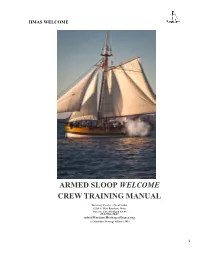
Armed Sloop Welcome Crew Training Manual
HMAS WELCOME ARMED SLOOP WELCOME CREW TRAINING MANUAL Discovery Center ~ Great Lakes 13268 S. West Bayshore Drive Traverse City, Michigan 49684 231-946-2647 info@MaritimeHeritageAlliance.org (c) Maritime Heritage Alliance 2011 1 1770's WELCOME History of the 1770's British Armed Sloop, WELCOME About mid 1700’s John Askin came over from Ireland to fight for the British in the American Colonies during the French and Indian War (in Europe known as the Seven Years War). When the war ended he had an opportunity to go back to Ireland, but stayed here and set up his own business. He and a partner formed a trading company that eventually went bankrupt and Askin spent over 10 years paying off his debt. He then formed a new company called the Southwest Fur Trading Company; his territory was from Montreal on the east to Minnesota on the west including all of the Northern Great Lakes. He had three boats built: Welcome, Felicity and Archange. Welcome is believed to be the first vessel he had constructed for his fur trade. Felicity and Archange were named after his daughter and wife. The origin of Welcome’s name is not known. He had two wives, a European wife in Detroit and an Indian wife up in the Straits. His wife in Detroit knew about the Indian wife and had accepted this and in turn she also made sure that all the children of his Indian wife received schooling. Felicity married a man by the name of Brush (Brush Street in Detroit is named after him). -

Terminology of Yacht Parts, Fittings, Sails & Sheets Etc
Terminology of yacht parts, fittings, sails & sheets etc. Some of the obvious, and not so obvious, parts encountered on model yachts (and full size yachts). Bowsie, flat. Small drilled ‘plate’ through which runs a line, or cord, for adjustment of that line. Pre-war bowsies were often made in ivory, some were made in a fine plywood; today hard plastic is used. Bowsie, ring . A circular version of the flat bowsie, usually for larger yachts such as the A-class. Deck eye. An eye on a horizontal plate with fixing holes, located on the deck. Normally used for accepting backstay/forestay attachment, also shroud attachment on smaller yachts. Eyebolt. An eye, at the end of a threaded spigot, or bolt. Eyelet, sail. A sail eyelet is a brass part, in the shape of a ‘funnel’ before compression, and when pressed into a hole in a sail it makes a firm metal ring. It is then used to facilitate making off a line (or on occasions a wire hawser in full size practise). Larger/stronger eyelets used on laying up covers for full size boats, were turnovers , where a brass ring was firstly sewn in place over a hole punched in the sail or sheet, the turnover (eyelet) was then hammered in place using a rawhide mallet and dies. It made an immensely strong eyelet. Ferrule (slang, crimp). A brass ferrule, or sleeve, which when made off on one end of a wire, secures/attaches it by means of a loop made in the wire to a fitting or line. Head crane. -

September 2014
TM The sailing magazine for the rest of us! www.goodoldboat.com Issue 98 September/October 2014 10 00 00 $8 (Canada $8 CDN) 10 0 62825 97035 7 TM SEPTEMBER/OCTOBER 2014 CONTENTS ISSUE 98 58 38 14 For the love of sailboats Speaking seriously Review boat Sailboats 101 10 Pearson 27 14 Paper Charts 101 A sweet sailer with an innovative interior Some sailors still value the printed world Dinghies and tenders BY TOM WELLS BY DON LAUNER 38 The cruising-capable dinghy It’s everything from taxi to truck 58 Nimble Arctic 25 Electronic wizardry BY JAN IRONS It’s neither mediocre nor boring 16 Lightning protection? BY ALLEN PENTICOFF Mitigating mayhem might be your best hope Trailer-sailing BY DAVID LYNN 50 Trailer revival Refit boat New life for a good old boat’s wheels 46 A fresh bout of old-boatitis . Exterior improvements BY ROCCO DRYFKA . and an International Folkboat 21 A leak-proof deck gland feels the love It lets wires in and keeps water out BY KEN JACOBSEN BY ROBERT NEEFUS Seamanship skills Spotlight on . 24 In search of solitude The rich rewards of sailing solo Making your own BY KAREN SULLIVAN 32 Ten-minute tethers 32 Wire leashes tame hardware wanderlust 26 One brain, six hands BY PAUL ESTERLE A solo sailor is active in mind and body BY KAREN SULLIVAN 35 A crane for tight places Extracting an engine with grace and ease BY BRIAN BUCK www.audioseastories.com September/October 2014 Good Old Boat 1 29 56 TM CONTENTS SEPTEMBER/OCTOBER 2014 ISSUE 98 What’s more 5 Web sightings Quick and easy Annapolis 2014, classic classifieds, and books -

Appropriate Sailing Rigs for Artisanal Fishing Craft in Developing Nations
SPC/Fisheries 16/Background Paper 1 2 July 1984 ORIGINAL : ENGLISH SOUTH PACIFIC COMMISSION SIXTEENTH REGIONAL TECHNICAL MEETING ON FISHERIES (Noumea, New Caledonia, 13-17 August 1984) APPROPRIATE SAILING RIGS FOR ARTISANAL FISHING CRAFT IN DEVELOPING NATIONS by A.J. Akester Director MacAlister Elliott and Partners, Ltd., U.K. and J.F. Fyson Fishery Industry Officer (Vessels) Food and Agriculture Organization of the United Nations Rome, Italy LIBRARY SOUTH PACIFIC COMMISSION SPC/Fisheries 16/Background Paper 1 Page 1 APPROPRIATE SAILING RIGS FOR ARTISANAL FISHING CRAFT IN DEVELOPING NATIONS A.J. Akester Director MacAlister Elliott and Partners, Ltd., U.K. and J.F. Fyson Fishery Industry Officer (Vessels) Food and Agriculture Organization of the United Nations Rome, Italy SYNOPSIS The plight of many subsistence and artisanal fisheries, caused by fuel costs and mechanisation problems, is described. The authors, through experience of practical sail development projects at beach level in developing nations, outline what can be achieved by the introduction of locally produced sailing rigs and discuss the choice and merits of some rig configurations. CONTENTS 1. INTRODUCTION 2. RISING FUEL COSTS AND THEIR EFFECT ON SMALL MECHANISED FISHING CRAFT IN DEVELOPING COUNTRIES 3. SOME SOLUTIONS TO THE PROBLEM 3.1 Improved engines and propelling devices 3.2 Rationalisation of Power Requirements According to Fishing Method 3.3 The Use of Sail 4. SAILING RIGS FOR SMALL FISHING CRAFT 4.1 Requirements of a Sailing Rig 4.2 Project Experience 5. DESCRIPTIONS OF RIGS USED IN DEVELOPMENT PROJECTS 5.1 Gaff Rig 5.2 Sprit Rig 5.3 Lug Sails 5.3.1 Chinese type, fully battened lug sail 5.3.2 Dipping lug 5.3.3 Standing lug 5.4 Gunter Rig 5.5 Lateen Rig 6. -

Mast Furling Installation Guide
NORTH SAILS MAST FURLING INSTALLATION GUIDE Congratulations on purchasing your new North Mast Furling Mainsail. This guide is intended to help better understand the key construction elements, usage and installation of your sail. If you have any questions after reading this document and before installing your sail, please contact your North Sails representative. It is best to have two people installing the sail which can be accomplished in less than one hour. Your boat needs facing directly into the wind and ideally the wind speed should be less than 8 knots. Step 1 Unpack your Sail Begin by removing your North Sails Purchasers Pack including your Quality Control and Warranty information. Reserve for future reference. Locate and identify the battens (if any) and reserve for installation later. Step 2 Attach the Mainsail Tack Begin by unrolling your mainsail on the side deck from luff to leech. Lift the mainsail tack area and attach to your tack fitting. Your new Mast Furling mainsail incorporates a North Sails exclusive Rope Tack. This feature is designed to provide a soft and easily furled corner attachment. The sail has less patching the normal corner, but has the Spectra/Dyneema rope splayed and sewn into the sail to proved strength. Please ensure the tack rope is connected to a smooth hook or shackle to ensure durability and that no chafing occurs. NOTE: If your mainsail has a Crab Claw Cutaway and two webbing attachment points – Please read the Stowaway Mast Furling Mainsail installation guide. Step 2 www.northsails.com Step 3 Attach the Mainsail Clew Lift the mainsail clew to the end of the boom and run the outhaul line through the clew block. -

Mainsail Trim Pointers, Reefing and Sail Care for the Beneteau Oceanis Series
Neil Pryde Sails International 1681 Barnum Avenue Stratford, CT 06614 203-375-2626 admin@neilprydesails.com INTERNATIONAL DESIGN AND TECHNICAL OFFICE Mainsail Trim Pointers, Reefing and Sail Care for the Beneteau Oceanis Series The following points on mainsail trim apply both to the Furling and Classic mainsails we produce for Beneteau USA and the Oceanis Line of boats. In sailing the boats we can offer these general ideas and observations that will apply to the 311’s through to the newest B49. Mainsail trim falls into two categories, upwind and downwind. MAINSAIL TRIM: The following points on mainsail trim apply both to the Furling and Classic mainsail, as the concepts are the same. Mainsail trim falls into two categories, upwind and downwind. Upwind 1. Upwind in up to about 8 knots true wind the traveler can be brought to weather of centerline. This ensures that the boom will be close centerline and the leech of the sail in a powerful upwind mode. 2. The outhaul should be eased 2” / 50mm at the stopper, easing the foot of the mainsail away from the boom about 8”/200mm 3. Mainsheet tension should be tight enough to have the uppermost tell tail on the leech streaming aft about 50% of the time in the 7- 12 true wind range. For those with furling mainsails the action of furling and unfurling the sail can play havoc with keeping the telltales on the sail and you may need to replace them from time to time. Mainsail outhaul eased for light air upwind trim You will find that the upper tell tail will stall and fold over to the weather side of the sail about 50% of the time in 7-12 knots. -

Cape Cod Catboat
Cape Cod Catboat Instructions: Follow these instructions carefully and step by step. The rigging lines of the boat could tangle easily so do not undo the lines until instructed. 1. Unwrap the hull and stand. Place the hull into the stand with the hull facing forward to your right. Keep the starboard side of the boat facing you in order to follow the instructions and to compare with the diagrams. 2. Study brass eye “A” and the cleats on the boat. There are 7 cleats on this model but we will only be using 3-7. They each have a fixed position that corresponds to different rigging lines and sail sheets of the boat. See diagram (1). 3. Unwrap the packing of the mast; find brass eyes G1, G2, G3, G4, & G5 on the mast. The brass eyes must face towards the stern of the boat. Insert the mast into the mast step on the deck. 4. Unpack the sail. You may want to press the sail with an iron to get out any wrinkles. Find the headstay line on the front top portion of the mast. Attach the line to eye A on the bow. See diagram (1). 5. Put the gaff jaw at the end of gaff pole to brass eye M on the mast. Then find a pin at the end of the boom, insert the pin to a brass hole about 1 inch up the mast from the deck. Find a block with hook on the topping lift line. Attach the hook of the line to eye G1, then lead the line down the mast and through an eye at the bottom of the mast, starboard side, then fix the end of the line to cleat 4 on the cockpit bulkhead. -
Dictionary.Pdf
THE SEAFARER’S WORD A Maritime Dictionary A B C D E F G H I J K L M N O P Q R S T U V W X Y Z Ranger Hope © 2007- All rights reserved A ● ▬ A: Code flag; Diver below, keep well clear at slow speed. Aa.: Always afloat. Aaaa.: Always accessible - always afloat. A flag + three Code flags; Azimuth or bearing. numerals: Aback: When a wind hits the front of the sails forcing the vessel astern. Abaft: Toward the stern. Abaft of the beam: Bearings over the beam to the stern, the ships after sections. Abandon: To jettison cargo. Abandon ship: To forsake a vessel in favour of the life rafts, life boats. Abate: Diminish, stop. Able bodied seaman: Certificated and experienced seaman, called an AB. Abeam: On the side of the vessel, amidships or at right angles. Aboard: Within or on the vessel. About, go: To manoeuvre to the opposite sailing tack. Above board: Genuine. Able bodied seaman: Advanced deckhand ranked above ordinary seaman. Abreast: Alongside. Side by side Abrid: A plate reinforcing the top of a drilled hole that accepts a pintle. Abrolhos: A violent wind blowing off the South East Brazilian coast between May and August. A.B.S.: American Bureau of Shipping classification society. Able bodied seaman Absorption: The dissipation of energy in the medium through which the energy passes, which is one cause of radio wave attenuation. Abt.: About Abyss: A deep chasm. Abyssal, abysmal: The greatest depth of the ocean Abyssal gap: A narrow break in a sea floor rise or between two abyssal plains. -

Buy the Boat of Your Dreams from Campbell's!
Buy the boat of your dreams from Campbell’s! ★ ★ ★ ★ ★ www.campbellsyachtsales.com ★ ★ ★ ★ ★ CYS Featured Boats NEW LISTINGS 2002 Catalina 42 MK II “Two Cabin Pullman Model” 1986 Irwin 43 Center Console - $69,900 $126,500 This Irwin 43 has been privately owned. Two Cabin Pullman Catalina 42 that is completely loaded with • Yanmar Diesel with low hours gear. The owner has been meticulous in getting this boat exactly • Spacious aft cabin w/centerline berth the way he wanted it – with features that make it user friendly in and plenty of storage space. the sailing mode. Includes furling genoa, mack pack with Lazy Jack • Large forward berth , Two Heads System for the Main , Garhauer Rigid Boom Vang and Main Sheet • Shallow Draft, Heat/Air Conditioning, Traveler System, Flex 0 Fold Propeller and a Dodger/Bimini/ Radar, Autopilot, GPS, Plotter, Wind Connector over helm . The electronics include Garmin Touch Screen and more. Plotter, Wind, Depth, Speed, Autopilot at wheel. • Bow Thruster, Windlass, Bimini, Dodger, Dinghy Davits. Many upgrades and new equipment. Well Maintained. Great for a live aboard or cruising We are actively looking for new listings—contact P.J. about selling your boat. NEW LISTINGS * * * * * NEW PRICE REDUCTION * * * * * 1984 Marine Trader 50 Pilot House Motor Yacht $219,000 • Three Staterooms • Twin Ford Lehman 120hp Diesel Engines • Northern Lights Generator • Bow Thruster • Radar • GPS • Auto Pilot • Windlass • West Marine Inflatable with 8hp Engine 1986 Island Packet 27 “Angel” - $32,900 26,900 Features 18hp Yanmar Diesel and lots of improvements. Versatile, easily managed rig with a spacious livable interior. She is cleaned up and ready to sail. -
Sailing Course Materials Overview
SAILING COURSE MATERIALS OVERVIEW INTRODUCTION The NCSC has an unusual ownership arrangement -- almost unique in the USA. You sail a boat jointly owned by all members of the club. The club thus has an interest in how you sail. We don't want you to crack up our boats. The club is also concerned about your safety. We have a good reputation as competent, safe sailors. We don't want you to spoil that record. Before we started this training course we had many incidents. Some examples: Ran aground in New Jersey. Stuck in the mud. Another grounding; broke the tiller. Two boats collided under the bridge. One demasted. Boats often stalled in foul current, and had to be towed in. Since we started the course the number of incidents has been significantly reduced. SAILING COURSE ARRANGEMENT This is only an elementary course in sailing. There is much to learn. We give you enough so that you can sail safely near New Castle. Sailing instruction is also provided during the sailing season on Saturdays and Sundays without appointment and in the week by appointment. This instruction is done by skippers who have agreed to be available at these times to instruct any unkeyed member who desires instruction. CHECK-OUT PROCEDURE When you "check-out" we give you a key to the sail house, and you are then free to sail at any time. No reservation is needed. But you must know how to sail before you get that key. We start with a written examination, open book, that you take at home.