Jūnishi 十二支 the Zodiac Animals
Total Page:16
File Type:pdf, Size:1020Kb
Load more
Recommended publications
-

Game Play Mechanics in Old Monster Yarns Sugoroku
LEAPING MONSTERS AND REALMS OF PLAY: GAME PLAY MECHANICS IN OLD MONSTER YARNS SUGOROKU by FAITH KATHERINE KRESKEY A THESIS Presented to the Department of the History of Art and Architecture and the Graduate School of the University of Oregon in partial fulfillment of the requirements for the degree of Master of Arts December 2012 THESIS APPROVAL PAGE Student: Faith Katherine Kreskey Title: Leaping Monsters and Realms of Play: Game Play Mechanics in Old Monster Yarns Sugoroku This thesis has been accepted and approved in partial fulfillment of the requirements for the Master of Arts degree in the Department of the History of Art and Architecture by: Professor Akiko Walley Chairperson Professor Glynne Walley Member Professor Charles Lachman Member and Kimberly Andrews Espy Vice President for Research and Innovation Dean of the Graduate School Original approval signatures are on file with the University of Oregon Graduate School. Degree awarded December 2012 ii © 2012 Faith Katherine Kreskey iii THESIS ABSTRACT Faith Katherine Kreskey Master of Arts Department of the History of Art and Architecture December 2012 Title: Leaping Monsters and Realms of Play: Game Play Mechanics in Old Monster Yarns Sugoroku Taking Utagawa Yoshikazu’s woodblock printed game board Monster Yarns as my case study, I will analyze how existing imagery and game play work together to create an interesting and engaging game. I will analyze the visual aspect of this work in great detail, discussing how the work is created from complex and disparate parts. I will then present a mechanical analysis of game play and player interaction with the print to fully address how this work functions as a game. -

The Mathematics of the Chinese, Indian, Islamic and Gregorian Calendars
Heavenly Mathematics: The Mathematics of the Chinese, Indian, Islamic and Gregorian Calendars Helmer Aslaksen Department of Mathematics National University of Singapore aslaksen@math.nus.edu.sg www.math.nus.edu.sg/aslaksen/ www.chinesecalendar.net 1 Public Holidays There are 11 public holidays in Singapore. Three of them are secular. 1. New Year’s Day 2. Labour Day 3. National Day The remaining eight cultural, racial or reli- gious holidays consist of two Chinese, two Muslim, two Indian and two Christian. 2 Cultural, Racial or Religious Holidays 1. Chinese New Year and day after 2. Good Friday 3. Vesak Day 4. Deepavali 5. Christmas Day 6. Hari Raya Puasa 7. Hari Raya Haji Listed in order, except for the Muslim hol- idays, which can occur anytime during the year. Christmas Day falls on a fixed date, but all the others move. 3 A Quick Course in Astronomy The Earth revolves counterclockwise around the Sun in an elliptical orbit. The Earth ro- tates counterclockwise around an axis that is tilted 23.5 degrees. March equinox June December solstice solstice September equinox E E N S N S W W June equi Dec June equi Dec sol sol sol sol Beijing Singapore In the northern hemisphere, the day will be longest at the June solstice and shortest at the December solstice. At the two equinoxes day and night will be equally long. The equi- noxes and solstices are called the seasonal markers. 4 The Year The tropical year (or solar year) is the time from one March equinox to the next. The mean value is 365.2422 days. -

Through the Case of Izumo Taishakyo Mission of Hawaii
The Japanese and Okinawan American Communities and Shintoism in Hawaii: Through the Case of Izumo Taishakyo Mission of Hawaii A THESIS SUBMITTED TO THE GRADUATE DIVISION OF THE UNIVERSITY OF HAWAIʽI AT MĀNOA IN PARTIAL FULFILLMENT OF THE REQUIREMENTS FOR THE DEGREE OF MASTER OF ARTS IN AMERICAN STUDIES MAY 2012 By Sawako Kinjo Thesis Committee: Dennis M. Ogawa, Chairperson Katsunori Yamazato Akemi Kikumura Yano Keywords: Japanese American Community, Shintoism in Hawaii, Izumo Taishayo Mission of Hawaii To My Parents, Sonoe and Yoshihiro Kinjo, and My Family in Okinawa and in Hawaii Acknowledgement First and foremost, I would like to express my deep and sincere gratitude to my committee chair, Professor Dennis M. Ogawa, whose guidance, patience, motivation, enthusiasm, and immense knowledge have provided a good basis for the present thesis. I also attribute the completion of my master’s thesis to his encouragement and understanding and without his thoughtful support, this thesis would not have been accomplished or written. I also wish to express my warm and cordial thanks to my committee members, Professor Katsunori Yamazato, an affiliate faculty from the University of the Ryukyus, and Dr. Akemi Kikumura Yano, an affiliate faculty and President and Chief Executive Officer (CEO) of the Japanese American National Museum, for their encouragement, helpful reference, and insightful comments and questions. My sincere thanks also goes to the interviewees, Richard T. Miyao, Robert Nakasone, Vince A. Morikawa, Daniel Chinen, Joseph Peters, and Jikai Yamazato, for kindly offering me opportunities to interview with them. It is a pleasure to thank those who made this thesis possible. -
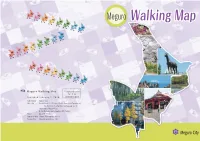
Meguro Walking Map
Meguro Walking Map Meguro Walking Map Primary print number No. 31-30 Published February 2, 2020 December 6, 2019 Published by Meguro City Edited by Health Promotion Section, Health Promotion Department; Sports Promotion Section, Culture and Sports Department, Meguro City 2-19-15 Kamimeguro, Meguro City, Tokyo Phone 03-3715-1111 Cooperation provided by Meguro Walking Association Produced by Chuo Geomatics Co., Ltd. Meguro City Total Area Course Map Contents Walking Course 7 Meguro Walking Courses Meguro Walking Course Higashi-Kitazawa Sta. Total Area Course Map C2 Walking 7 Meguro Walking Courses P2 Course 1: Meguro-dori Ave. Ikenoue Sta. Ke Walk dazzling Meguro-dori Ave. P3 io Inok Map ashira Line Komaba-todaimae Sta. Course 2: Komaba/Aobadai area Shinsen Sta. Walk the ties between Meguro and Fuji P7 0 100 500 1,000m Awas hima-dori St. 3 Course 3: Kakinokizaka/Higashigaoka area Kyuyamate-dori Ave. Walk the 1964 Tokyo Olympics P11 2 Komaba/Aobadai area Walk the ties between Meguro and Fuji Shibuya City Tamagawa-dori Ave. Course 4: Himon-ya/Meguro-honcho area Ikejiri-ohashi Sta. Meguro/Shimomeguro area Walk among the history and greenery of Himon-ya P15 5 Walk among Edo period townscape Daikan-yama Sta. Course 5: Meguro/Shimomeguro area Tokyu Den-en-toshi Line Walk among Edo period townscape P19 Ebisu Sta. kyo Me e To tro Hibiya Lin Course 6: Yakumo/Midorigaoka area Naka-meguro Sta. J R Walk a green road born from a culvert P23 Y Yutenji/Chuo-cho area a m 7 Yamate-dori Ave. a Walk Yutenji and the vestiges of the old horse track n o Course 7: Yutenji/Chuo-cho area t e L Meguro City Office i Walk Yutenji and the vestiges of the old horse track n P27 e / S 2 a i k Minato e y Kakinokizaka/Higashigaoka area o in City Small efforts, L Yutenji Sta. -

[Japan] SALA GIOCHI ARCADE 1000 Miglia
SCHEDA NEW PLATINUM PI4 EDITION La seguente lista elenca la maggior parte dei titoli emulati dalla scheda NEW PLATINUM Pi4 (20.000). - I giochi per computer (Amiga, Commodore, Pc, etc) richiedono una tastiera per computer e talvolta un mouse USB da collegare alla console (in quanto tali sistemi funzionavano con mouse e tastiera). - I giochi che richiedono spinner (es. Arkanoid), volanti (giochi di corse), pistole (es. Duck Hunt) potrebbero non essere controllabili con joystick, ma richiedono periferiche ad hoc, al momento non configurabili. - I giochi che richiedono controller analogici (Playstation, Nintendo 64, etc etc) potrebbero non essere controllabili con plance a levetta singola, ma richiedono, appunto, un joypad con analogici (venduto separatamente). - Questo elenco è relativo alla scheda NEW PLATINUM EDITION basata su Raspberry Pi4. - Gli emulatori di sistemi 3D (Playstation, Nintendo64, Dreamcast) e PC (Amiga, Commodore) sono presenti SOLO nella NEW PLATINUM Pi4 e non sulle versioni Pi3 Plus e Gold. - Gli emulatori Atomiswave, Sega Naomi (Virtua Tennis, Virtua Striker, etc.) sono presenti SOLO nelle schede Pi4. - La versione PLUS Pi3B+ emula solo 550 titoli ARCADE, generati casualmente al momento dell'acquisto e non modificabile. Ultimo aggiornamento 2 Settembre 2020 NOME GIOCO EMULATORE 005 SALA GIOCHI ARCADE 1 On 1 Government [Japan] SALA GIOCHI ARCADE 1000 Miglia: Great 1000 Miles Rally SALA GIOCHI ARCADE 10-Yard Fight SALA GIOCHI ARCADE 18 Holes Pro Golf SALA GIOCHI ARCADE 1941: Counter Attack SALA GIOCHI ARCADE 1942 SALA GIOCHI ARCADE 1943 Kai: Midway Kaisen SALA GIOCHI ARCADE 1943: The Battle of Midway [Europe] SALA GIOCHI ARCADE 1944 : The Loop Master [USA] SALA GIOCHI ARCADE 1945k III SALA GIOCHI ARCADE 19XX : The War Against Destiny [USA] SALA GIOCHI ARCADE 2 On 2 Open Ice Challenge SALA GIOCHI ARCADE 4-D Warriors SALA GIOCHI ARCADE 64th. -

Shaping Darkness in Hyakki Yagyō Emaki
Asian Studies III (XIX), 1 (2015), pp.9–27 Shaping Darkness in hyakki yagyō emaki Raluca NICOLAE* Abstract In Japanese culture, the yōkai, the numinous creatures inhabiting the other world and, sometimes, the boundary between our world and the other, are obvious manifestations of the feeling of fear, “translated” into text and image. Among the numerous emaki in which the yōkai appear, there is a specific type, called hyakki yagyō (the night parade of one hundred demons), where all sorts and sizes of monsters flock together to enjoy themselves at night, but, in the end, are scattered away by the first beams of light or by the mysterious darani no hi, the fire produced by a powerful magical invocation, used in the Buddhist sect Shingon. The nexus of this emakimono is their great number, hyakki, (one hundred demons being a generic term which encompasses a large variety of yōkai and oni) as well as the night––the very time when darkness becomes flesh and blood and starts marching on the streets. Keywords: yōkai, night, parade, painted scrolls, fear Izvleček Yōkai (prikazni, demoni) so v japonski kulturi nadnaravna bitja, ki naseljuje drug svet in včasih tudi mejo med našim in drugim svetom ter so očitno manifestacija občutka strahu “prevedena” v besedila in podobe. Med številnimi slikami na zvitkih (emaki), kjer se prikazni pojavljajo, obstaja poseben tip, ki se imenuje hyakki yagyō (nočna parade stotih demonov), kjer se zberejo pošasti različne vrste in velikosti, da bi uživali v noči, vendar jih na koncu preženejo prvi žarki svetlobe ali skrivnosten darani no hi, ogenj, ki se pojavi z močnim magičnim zaklinjanje in se uporablja pri budistični sekti Shingon. -

The Story of IZUMO KAGURA What Is Kagura? Distinguishing Features of Izumo Kagura
The Story of IZUMO KAGURA What is Kagura? Distinguishing Features of Izumo Kagura This ritual dance is performed to purify the kagura site, with the performer carrying a Since ancient times, people in Japan have believed torimono (prop) while remaining unmasked. Various props are carried while the dance is that gods inhabit everything in nature such as rocks and History of Izumo Kagura Shichiza performed without wearing any masks. The name shichiza is said to derive from the seven trees. Human beings embodied spirits that resonated The Shimane Prefecture is a region which boasts performance steps that comprise it, but these steps vary by region. and sympathized with nature, thus treasured its a flourishing, nationally renowned kagura scene, aesthetic beauty. with over 200 kagura groups currently active in the The word kagura is believed to refer to festive prefecture. Within Shimane Prefecture, the regions of rituals carried out at kamikura (the seats of gods), Izumo, Iwami, and Oki have their own unique style of and its meaning suggests a “place for calling out and kagura. calming of the gods.” The theory posits that the word Kagura of the Izumo region, known as Izumo kamikuragoto (activity for the seats of gods) was Kagura, is best characterized by three parts: shichiza, shortened to kankura, which subsequently became shikisanba, and shinno. kagura. Shihoken Salt—signifying cleanliness—is used In the first stage, four dancers hold bells and hei (staffs with Shiokiyome paper streamers), followed by swords in the second stage of Sada Shinno (a UNESCO Intangible Cultural (Salt Purification) to purify the site and the attendees. -

THIRTEEN MOONS in MOTION: a Dreamspell Primer
© Galactic Research Institute of the Foundation for the Law of Time - www.lawoftime.org THIRTEEN MOONS IN MOTION: A Dreamspell Primer “Just as air is the atmosphere of the body, so time is the atmosphere of the mind; if the time in which we live consists of uneven months and days regulated by mechanized minutes and hours, that is what becomes of our mind: a mechanized irregularity. Since everything follows from mind, it is no wonder that The atmosphere in which we live daily becomes more polluted, And the greatest complaint is: ‘I just don’t have enough time!’ Who owns your time, owns your mind. Own your own time and you will know your own mind.” Foundation for the Law of Time www.lawoftime.org © Galactic Research Institute of the Foundation for the Law of Time - www.lawoftime.org 13-Moon Planetary Kin Starter Calendar 3 A Season Of Apocalypses: The Gregorian Calendar Unmasked A 13-Moon Postscript to the Mayan Factor 1. Thinking about the Unthinkable Of all the unexamined assumptions and criteria upon which we base and gauge our daily lives as human beings on planet Earth, by far the greatest and most profoundly unquestioned is the instrument and institution known as the Gregorian Calendar. A calendar, any calendar, is commonly understood as a system for dividing time over extended periods. A day is the base unit of a calendar, and the solar year is the base extended period. The length of the solar year is currently reckoned at 365.242199 days. The Gregorian calendar divides this duration into twelve uneven months – four months of 30 days, seven of 31 days, and one of 28 days. -

The Myth of the Goddess of the Undersea World and the Tale of Empress Jingu’S Subjugation of Silla
Japanese Journal of Religious Studies 1993 20/2-3 The Myth of the Goddess of the Undersea World and the Tale of Empress Jingu’s Subjugation of Silla Akima Toshio In prewar Japan, the mythical tale of Empress Jingii’s 神功皇后 conquest of the Korean kingdoms comprised an important part of elementary school history education, and was utilized to justify Japan5s coloniza tion of Korea. After the war the same story came to be interpreted by some Japanese historians—most prominently Egami Namio— as proof or the exact opposite, namely, as evidence of a conquest of Japan by a people of nomadic origin who came from Korea. This theory, known as the horse-rider theory, has found more than a few enthusiastic sup porters amone Korean historians and the Japanese reading public, as well as some Western scholars. There are also several Japanese spe cialists in Japanese history and Japan-Korea relations who have been influenced by the theory, although most have not accepted the idea (Egami himself started as a specialist in the history of northeast Asia).1 * The first draft of this essay was written during my fellowship with the International Research Center for Japanese Studies, and was read in a seminar organized by the institu tion on 31 January 199丄. 1 am indebted to all researchers at the center who participated in the seminar for their many valuable suggestions. I would also like to express my gratitude to Umehara Takeshi, the director general of the center, and Nakanism Susumu, also of the center, who made my research there possible. -

The Calendars of India
The Calendars of India By Vinod K. Mishra, Ph.D. 1 Preface. 4 1. Introduction 5 2. Basic Astronomy behind the Calendars 8 2.1 Different Kinds of Days 8 2.2 Different Kinds of Months 9 2.2.1 Synodic Month 9 2.2.2 Sidereal Month 11 2.2.3 Anomalistic Month 12 2.2.4 Draconic Month 13 2.2.5 Tropical Month 15 2.2.6 Other Lunar Periodicities 15 2.3 Different Kinds of Years 16 2.3.1 Lunar Year 17 2.3.2 Tropical Year 18 2.3.3 Siderial Year 19 2.3.4 Anomalistic Year 19 2.4 Precession of Equinoxes 19 2.5 Nutation 21 2.6 Planetary Motions 22 3. Types of Calendars 22 3.1 Lunar Calendar: Structure 23 3.2 Lunar Calendar: Example 24 3.3 Solar Calendar: Structure 26 3.4 Solar Calendar: Examples 27 3.4.1 Julian Calendar 27 3.4.2 Gregorian Calendar 28 3.4.3 Pre-Islamic Egyptian Calendar 30 3.4.4 Iranian Calendar 31 3.5 Lunisolar calendars: Structure 32 3.5.1 Method of Cycles 32 3.5.2 Improvements over Metonic Cycle 34 3.5.3 A Mathematical Model for Intercalation 34 3.5.3 Intercalation in India 35 3.6 Lunisolar Calendars: Examples 36 3.6.1 Chinese Lunisolar Year 36 3.6.2 Pre-Christian Greek Lunisolar Year 37 3.6.3 Jewish Lunisolar Year 38 3.7 Non-Astronomical Calendars 38 4. Indian Calendars 42 4.1 Traditional (Siderial Solar) 42 4.2 National Reformed (Tropical Solar) 49 4.3 The Nānakshāhī Calendar (Tropical Solar) 51 4.5 Traditional Lunisolar Year 52 4.5 Traditional Lunisolar Year (vaisnava) 58 5. -
Chapter 5 – Date
Chapter 5 – Date Luckily, most of the problems involving time have mostly been solved and packed away in software and hardware where we, and our customers overseas, do not have to deal with it. Thanks to standardization, if a vender in Peking wants to call a customer in Rome, he checks the Internet for the local time. As far as international business goes, it’s generally 24/7 anyway. Calendars on the other hand, are another matter. You may know what time it is in Khövsgöl, Mongolia, but are you sure what day it is, if it is a holiday, or even what year it is? The purpose of this chapter is to make you aware of just how many active calendars there are out there in current use and of the short comings of our Gregorian system as we try to apply it to the rest of the world. There just isn’t room to review them all so think of this as a kind of around the world in 80 days. There are so many different living calendars, and since the Internet is becoming our greatest library yet, a great many ancient ones that must be accounted for as well. We must consider them all in our collations. As I write this in 2010 by the Gregorian calendar, it is 2960 in Northwest Africa, 1727 in Ethopia, and 4710 by the Chinese calendar. A calendar is a symbol of identity. They fix important festivals and dates and help us share a common pacing in our lives. They are the most common framework a civilization or group of people can have. -
The Symbol of the Dragon and Ways to Shape Cultural Identities in Institute Working Vietnam and Japan Paper Series
2015 - HARVARD-YENCHING THE SYMBOL OF THE DRAGON AND WAYS TO SHAPE CULTURAL IDENTITIES IN INSTITUTE WORKING VIETNAM AND JAPAN PAPER SERIES Nguyen Ngoc Tho | University of Social Sciences and Humanities, Vietnam National University – Ho Chi Minh City THE SYMBOL OF THE DRAGON AND WAYS TO SHAPE 1 CULTURAL IDENTITIES IN VIETNAM AND JAPAN Nguyen Ngoc Tho University of Social Sciences and Humanities Vietnam National University – Ho Chi Minh City Abstract Vietnam, a member of the ASEAN community, and Japan have been sharing Han- Chinese cultural ideology (Confucianism, Mahayana Buddhism etc.) and pre-modern history; therefore, a great number of common values could be found among the diverse differences. As a paddy-rice agricultural state of Southeast Asia, Vietnam has localized Confucianism and absorbed it into Southeast Asian culture. Therefore, Vietnamese Confucianism has been decentralized and horizontalized after being introduced and accepted. Beside the local uniqueness of Shintoism, Japan has shared Confucianism, the Indian-originated Mahayana Buddhism and other East Asian philosophies; therefore, both Confucian and Buddhist philosophies should be wisely laid as a common channel for cultural exchange between Japan and Vietnam. This semiotic research aims to investigate and generalize the symbol of dragons in Vietnam and Japan, looking at their Confucian and Buddhist absorption and separate impacts in each culture, from which the common and different values through the symbolic significances of the dragons are obviously generalized. The comparative study of Vietnamese and Japanese dragons can be enlarged as a study of East Asian dragons and the Southeast Asian legendary naga snake/dragon in a broader sense. The current and future political, economic and cultural exchanges between Japan and Vietnam could be sped up by applying a starting point at these commonalities.