Cairns Regional Council Plant Checklist
Total Page:16
File Type:pdf, Size:1020Kb
Load more
Recommended publications
-

Brooklyn, Cloudland, Melsonby (Gaarraay)
BUSH BLITZ SPECIES DISCOVERY PROGRAM Brooklyn, Cloudland, Melsonby (Gaarraay) Nature Refuges Eubenangee Swamp, Hann Tableland, Melsonby (Gaarraay) National Parks Upper Bridge Creek Queensland 29 April–27 May · 26–27 July 2010 Australian Biological Resources Study What is Contents Bush Blitz? Bush Blitz is a four-year, What is Bush Blitz? 2 multi-million dollar Abbreviations 2 partnership between the Summary 3 Australian Government, Introduction 4 BHP Billiton and Earthwatch Reserves Overview 6 Australia to document plants Methods 11 and animals in selected properties across Australia’s Results 14 National Reserve System. Discussion 17 Appendix A: Species Lists 31 Fauna 32 This innovative partnership Vertebrates 32 harnesses the expertise of many Invertebrates 50 of Australia’s top scientists from Flora 62 museums, herbaria, universities, Appendix B: Threatened Species 107 and other institutions and Fauna 108 organisations across the country. Flora 111 Appendix C: Exotic and Pest Species 113 Fauna 114 Flora 115 Glossary 119 Abbreviations ANHAT Australian Natural Heritage Assessment Tool EPBC Act Environment Protection and Biodiversity Conservation Act 1999 (Commonwealth) NCA Nature Conservation Act 1992 (Queensland) NRS National Reserve System 2 Bush Blitz survey report Summary A Bush Blitz survey was conducted in the Cape Exotic vertebrate pests were not a focus York Peninsula, Einasleigh Uplands and Wet of this Bush Blitz, however the Cane Toad Tropics bioregions of Queensland during April, (Rhinella marina) was recorded in both Cloudland May and July 2010. Results include 1,186 species Nature Refuge and Hann Tableland National added to those known across the reserves. Of Park. Only one exotic invertebrate species was these, 36 are putative species new to science, recorded, the Spiked Awlsnail (Allopeas clavulinus) including 24 species of true bug, 9 species of in Cloudland Nature Refuge. -
Abelmoschus Moschatus Subsp
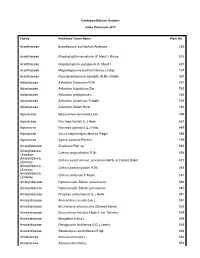
Cooktown Botanic Gardens Index Plantarum 2011 Family Published Taxon Name Plate No Acanthaceae Eranthemum pulchellum Andrews 720 Acanthaceae Graptophyllum excelsum (F.Meull.) Druce 515 Acanthaceae Graptophyllum spinigerum (F.Meull.) 437 Acanthaceae Megaskepasma erythrochlamys Lindau 107 Acanthaceae Pseuderanthemum variabile (R.Br.) Radlk. 357 Adiantaceae Adiantum formosum R.Br. 761 Adiantaceae Adiantum hispidulum Sw. 762 Adiantaceae Adiantum philippense L. 765 Adiantaceae Adiantum silvaticum Tindale 763 Adiantaceae Adiantum Walsh River 764 Agavaceae Beaucarnea recurvata Lem. 399 Agavaceae Furcraea foetida (L.) Haw. 637 Agavaceae Furcraea gigantea (L.) Haw. 049 Agavaceae Yucca elephantipes Hort.ex Regel 388 Agavaceae Agave sisalana Perrine. 159 Amarylidaceae Scadoxus Raf. sp 663 Amaryllidacea, Crinum angustifolium R.Br. 536 Liliaceae Amaryllidacea, Crinum asiaticum var. procerum (Herb. et Carey) Baker 417 Liliaceae Amaryllidacea, Crinum pedunculatum R.Br. 265 Liliaceae Amaryllidacea, Crinum uniflorum F.Muell. 161 Liliaceae Amaryllidaceae Hymenocallis Salisb. americanus 046 Amaryllidaceae Hymenocallis Salisb. peruvianna 045 Amaryllidaceae Proiphys amboinensis (L.) Herb. 041 Anacardiaceae Anacardium occidentale L. 051 Anacardiaceae Buchanania arborescens (Blume) Blume. 022 Anacardiaceae Euroschinus falcatus Hook.f. var. falcatus 429 Anacardiaceae Mangifera indica L. 009 Anacardiaceae Pleiogynium timorense (DC.) Leenh. 029 Anacardiaceae Semecarpus australiensis Engl. 368 Annonaceae Annona muricata L. 054 Annonaceae Annona reticulata L. 053 Annonaceae Annona squamosa 602 Annonaceae Cananga odorata (Lam.) Hook.f.&Thomson 406 Annonaceae Melodorum leichhardtii (F.Muell.) Diels. 360 Annonaceae Rollinia deliciosa Saff. 098 Apiaceae Centella asiatica (L.) Urb. 570 Apocynaceae Adenium obesum (Forssk.) Roem. & Schult. 489 Apocynaceae Allamanda cathartica L. 047 Apocynaceae Allamanda violacea Gardn. & Field. 048 Apocynaceae Alstonia actinophylla (A.Cunn.) K.Schum. 026 Apocynaceae Alstonia scholaris (L.) R.Br. 012 Apocynaceae Alyxia ruscifolia R.Br. -

Soil and Land Suitability Assessment for Irrigated Agriculture in the Wildman River Area, Northern Territory February 2016
Agricultural Land Suitability Series – Report 2 DLRM Technical Report 2/2016D Soil and Land Suitability Assessment for Irrigated Agriculture in the Wildman River area, Northern Territory February 2016 Rangelands Division Department of Land Resource Management PO Box 496 Palmerston NT 0831 Easey D, Brocklehurst P, and Carnavas M © Northern Territory of Australia, 2016 ISBN 9781743500941 www.lrm.nt.gov.au Department of Land Resource Management Land Assessment Branch PO Box 496 Palmerston NT 0831 © Northern Territory of Australia, 2016 ISBN 9781743500859 To reference this report: Easey D, Brocklehurst P & Carnavas M (2016) Agricultural Land Suitability Series, Report 2. Soil and Land Suitability Assessment for Irrigated Agriculture in the Wildman River area, Northern Territory. Technical Report 2/2016D Department of Land Resource Management, Darwin, NT. The map series accompanying this report can be downloaded from the NR Maps website. http://nrmaps.nt.gov.au/ Disclaimer: All care and diligence has been exercised in the collection, analysis and interpretation of the data and recommendations presented in this report. The works undertaken have been completed in a skilled, professional manner, according to recommended and accepted Australian practices and standards. Specific circumstances and research findings after the date of publication may influence the accuracy of the data and recommendations within this report. While the findings presented in this report are based on information that the Department of Land Resource Management, NTG considers reliable unless stated otherwise, the accuracy and completeness of source information cannot be guaranteed. The information compiled in this report addresses specifically identified objectives of the project stake- holders, and as such may not address the needs of third parties using the report for their own purposes. -
Checklist of Vascular Plants Recorded for Cattana Wetlands Class Family Code Taxon Common Name
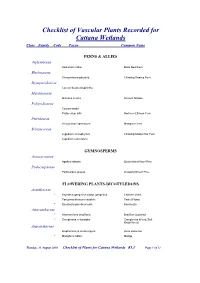
Checklist of Vascular Plants Recorded for Cattana Wetlands Class Family Code Taxon Common Name FERNS & ALLIES Aspleniaceae Asplenium nidus Birds Nest Fern Blechnaceae Stenochlaena palustris Climbing Swamp Fern Dryopteridaceae Coveniella poecilophlebia Marsileaceae Marsilea mutica Smooth Nardoo Polypodiaceae Colysis ampla Platycerium hillii Northern Elkhorn Fern Pteridaceae Acrostichum speciosum Mangrove Fern Schizaeaceae Lygodium microphyllum Climbing Maidenhair Fern Lygodium reticulatum GYMNOSPERMS Araucariaceae Agathis robusta Queensland Kauri Pine Podocarpaceae Podocarpus grayae Weeping Brown Pine FLOWERING PLANTS-DICOTYLEDONS Acanthaceae * Asystasia gangetica subsp. gangetica Chinese Violet Pseuderanthemum variabile Pastel Flower * Sanchezia parvibracteata Sanchezia Amaranthaceae * Alternanthera brasiliana Brasilian Joyweed * Gomphrena celosioides Gomphrena Weed; Soft Khaki Weed Anacardiaceae Blepharocarya involucrigera Rose Butternut * Mangifera indica Mango Tuesday, 31 August 2010 Checklist of Plants for Cattana Wetlands RLJ Page 1 of 12 Class Family Code Taxon Common Name Semecarpus australiensis Tar Tree Annonaceae Cananga odorata Woolly Pine Melodorum leichhardtii Acid Drop Vine Melodorum uhrii Miliusa brahei Raspberry Jelly Tree Polyalthia nitidissima Canary Beech Uvaria concava Calabao Xylopia maccreae Orange Jacket Apocynaceae Alstonia scholaris Milky Pine Alyxia ruscifolia Chain Fruit Hoya pottsii Native Hoya Ichnocarpus frutescens Melodinus acutiflorus Yappa Yappa Tylophora benthamii Wrightia laevis subsp. millgar Millgar -

HARDY FERN FOUNDATION QUARTERLY the HARDY FERN FOUNDATION QUARTERLY Volume 15 • No
THE HARDY FERN FOUNDATION P.O. Box 166 Medina, WA 98039-0166 Web site: www.hardyfems.org The Hardy Fern Foundation was founded in 1989 to establish a comprehen¬ sive collection of the world’s hardy ferns for display, testing, evaluation, public education and introduction to the gardening and horticultural community. Many rare and unusual species, hybrids and varieties are being propagated from spores and tested in selected environments for their different degrees of hardiness and ornamental garden value. The primary fern display and test garden is located at, and in conjunction with, The Rhododendron Species Botanical Garden at the Weyerhaeuser Corpo¬ rate Headquarters, in Federal Way, Washington. Satellite fern gardens are at the Stephen Austin Arboretum, Nacogdoches, Texas, Birmingham Botanical Gardens, Birmingham, Alabama, California State University at Sacramento, Sacramento, California, Coastal Maine Botanical Garden, Boothbay, Maine, Dallas Arboretum, Dallas, Texas, Denver Botanic Gardens. Denver, Colorado, Georgeson Botanical Garden, University of Alaska, Fairbanks, Alaska, Harry P. Leu Garden, Orlando, Florida, Inniswood Metro Gardens, Columbus, Ohio, Lewis Ginter Botanical Garden, Richmond, Virginia, New York Botanical Garden, Bronx, New York, and Strybing Arboretum, San Francisco, California. The fern display gardens are at Bainbridge Island Library, Bainbridge Island, WA, Lakewold, Tacoma, Washington, Les Jardins de Metis, Quebec, Canada, University of Northern Colorado, Greeley, Colorado, and Whitehall Historic Home and Garden, Louisville, KY. Hardy Fern Foundation members participate in a spore exchange, receive a quarterly newsletter and have first access to ferns as they are ready for distribution. Cover Design by Willanna Bradner HARDY FERN FOUNDATION QUARTERLY THE HARDY FERN FOUNDATION QUARTERLY Volume 15 • No. -
Field Instructions for The
FIELD INSTRUCTIONS FOR THE INVENTORY OF THE PACIFIC ISLANDS 2013 Hawaii Edition Forest Inventory and Analysis Program Pacific Northwest Research Station USDA Forest Service THIS MANUAL IS BASED ON: FOREST INVENTORY AND ANALYSIS NATIONAL CORE FIELD GUIDE FIELD DATA COLLECTION PROCEDURES FOR PHASE 2 PLOTS VERSION 5.1 TABLE OF CONTENTS 1 INTRODUCTION ........................................................................................................................................................................ 1 1.1 PURPOSES OF THIS MANUAL ................................................................................................................................................... 1 1.2 ORGANIZATION OF THIS MANUAL .......................................................................................................................................... 1 1.2.1 UNITS OF MEASURE ................................................................................................................................................................. 2 1.2.2 GENERAL DESCRIPTION ............................................................................................................................................................ 2 1.2.3 PLOT SETUP .............................................................................................................................................................................. 3 1.2.4 PLOT INTEGRITY ...................................................................................................................................................................... -

EPBC Protected Matters Database Search Results
FLORA AND FAUNA TECHNICAL REPORT Gold Coast Quarry EIS ATTACHMENT A – EPBC Protected Matters Database Search Results April 2013 Cardno Chenoweth 71 EPBC Act Protected Matters Report This report provides general guidance on matters of national environmental significance and other matters protected by the EPBC Act in the area you have selected. Information on the coverage of this report and qualifications on data supporting this report are contained in the caveat at the end of the report. Information about the EPBC Act including significance guidelines, forms and application process details can be found at http://www.environment.gov.au/epbc/assessmentsapprovals/index.html Report created: 01/06/12 14:33:07 Summary Details Matters of NES Other Matters Protected by the EPBC Act Extra Information Caveat Acknowledgements This map may contain data which are ©Commonwealth of Australia (Geoscience Australia), ©PSMA 2010 Coordinates Buffer: 6.0Km Summary Matters of National Environment Significance This part of the report summarises the matters of national environmental significance that may occur in, or may relate to, the area you nominated. Further information is available in the detail part of the report, which can be accessed by scrolling or following the links below. If you are proposing to undertake an activity that may have a significant impact on one or more matters of national environmental significance then you should consider the Administrative Guidelines on Significance - see http://www.environment.gov.au/epbc/assessmentsapprovals/guidelines/index.html World Heritage Properties: None National Heritage Places: None Wetlands of International 1 Great Barrier Reef Marine Park: None Commonwealth Marine Areas: None Threatened Ecological Communities: 1 Threatened Species: 57 Migratory Species: 27 Other Matters Protected by the EPBC Act This part of the report summarises other matters protected under the Act that may relate to the area you nominated. -

Attachment E - Desktop Searches
Attachment E - Desktop searches EPBC Act Protected Matters Report This report provides general guidance on matters of national environmental significance and other matters protected by the EPBC Act in the area you have selected. Information on the coverage of this report and qualifications on data supporting this report are contained in the caveat at the end of the report. Information is available about Environment Assessments and the EPBC Act including significance guidelines, forms and application process details. Report created: 11/06/20 13:02:49 Summary Details Matters of NES Other Matters Protected by the EPBC Act Extra Information Caveat Acknowledgements This map may contain data which are ©Commonwealth of Australia (Geoscience Australia), ©PSMA 2010 Coordinates Buffer: 20.0Km Summary Matters of National Environmental Significance This part of the report summarises the matters of national environmental significance that may occur in, or may relate to, the area you nominated. Further information is available in the detail part of the report, which can be accessed by scrolling or following the links below. If you are proposing to undertake an activity that may have a significant impact on one or more matters of national environmental significance then you should consider the Administrative Guidelines on Significance. World Heritage Properties: None National Heritage Places: None Wetlands of International Importance: None Great Barrier Reef Marine Park: None Commonwealth Marine Area: None Listed Threatened Ecological Communities: 4 Listed Threatened Species: 26 Listed Migratory Species: 16 Other Matters Protected by the EPBC Act This part of the report summarises other matters protected under the Act that may relate to the area you nominated. -

SGAP Cairns Newsletter
SGAP Cairns Newsletter May 2018 Newsletter 179 Editor’s Note Society for Growing Australian Plants, Inc. Cairns Branch. www.sgapcairns.org.au You may have noticed this month’s newsletter is not as secretary@sgapcairns.org.au “flashy” or to the standard we have come to expect each month from our newsletter editor, Stuart, that is because 2018 -2019 Committee he is taking a well earned holiday! However, what we President: Tony Roberts lack in pizzazz we have made up in content! Don has Vice President: Pauline Lawie kindly put together a report on our trip to Ella Bay (which Secretary: Sandy Perkins (secretary@sgapcairns.org.au) was a great day out, btw) and the plant of the month Treasurer: Val Carnie Newsletter: including an interesting google translation. And of Stuart Worboys course, there are the details on our next excursion to (worboys1968@yahoo.com.au) Emerald Creek Falls. Looking forward to seeing you all Webmaster: Tony Roberts in May. Sandy Perkins Excursion Report ELLA BAY (HEATH POINT ) Sunday 15 April 2018 By Don Lawie The beach and dune walk planned for 11 March was cancelled due to heavy rain, local flooding and road washouts. Indeed, damage to Ella Bay Road was so bad that it was closed at Heath Point, the southern arm of Ella Bay, when we arrived on 15 April. Nothing daunted, we set off along the beach but were soon blocked by sharp volcanic rocks so diverted to the road and walked up a steep hill then returned to the beach beyond the rock barrier. The aim of the day was to discover what plants – trees, shrubs, vines etc.- grew in the area with fruits that would conceivably be eaten by shipwrecked mariners who were not knowledgeable about their edibility or otherwise. -

Southern Gulf, Queensland
Biodiversity Summary for NRM Regions Species List What is the summary for and where does it come from? This list has been produced by the Department of Sustainability, Environment, Water, Population and Communities (SEWPC) for the Natural Resource Management Spatial Information System. The list was produced using the AustralianAustralian Natural Natural Heritage Heritage Assessment Assessment Tool Tool (ANHAT), which analyses data from a range of plant and animal surveys and collections from across Australia to automatically generate a report for each NRM region. Data sources (Appendix 2) include national and state herbaria, museums, state governments, CSIRO, Birds Australia and a range of surveys conducted by or for DEWHA. For each family of plant and animal covered by ANHAT (Appendix 1), this document gives the number of species in the country and how many of them are found in the region. It also identifies species listed as Vulnerable, Critically Endangered, Endangered or Conservation Dependent under the EPBC Act. A biodiversity summary for this region is also available. For more information please see: www.environment.gov.au/heritage/anhat/index.html Limitations • ANHAT currently contains information on the distribution of over 30,000 Australian taxa. This includes all mammals, birds, reptiles, frogs and fish, 137 families of vascular plants (over 15,000 species) and a range of invertebrate groups. Groups notnot yet yet covered covered in inANHAT ANHAT are notnot included included in in the the list. list. • The data used come from authoritative sources, but they are not perfect. All species names have been confirmed as valid species names, but it is not possible to confirm all species locations. -

Human-Environment Dynamics During the Holocene in the Australian Wet Tropics of NE Queensland: a Starch and Phytolith Study
This is a pre-copyedited, author-produced PDF of an article accepted for publication in J. Anthropol. Archaeol. following peer review. The version of record Field, J.H., et al. Human-environment dynamics during the Holocene in the Australian Wet Tropics of NE Queensland: A starch and phytolith study. J. Anthropol. Archaeol. (2016), http://dx.doi.org/10.1016/j.jaa.2016.07.007 is available online at: http://www.sciencedirect.com/science/article/pii/S0278416516300721 Human-environment dynamics during the Holocene in the Australian Wet Tropics of NE Queensland: A starch and phytolith study Judith H. Field a, Lisa Kealhofer b, Richard Cosgrove c, Adelle C.F. Coster d a School of Biological, Earth and Environmental Sciences, The University of New South Wales, 2052 NSW, Australia, Corresponding author. E-mail address: judith.field@unsw.edu.au b Dept of Anthropology and Environmental Studies and Sciences, Santa Clara University, 500 El Camino Real, Santa Clara, CA 95053, USA c Archaeology Program, School of Humanities, La Trobe University, Melbourne, Victoria 3086, Australia d School of Mathematics & Statistics, The University of New South Wales, 2052 NSW, Australia Keywords: Australia Rainforest Archaeology Holocene Phytoliths Ancient starch Niche construction Abstract The timing and nature of hunter-gather exploitation of tropical rainforests is a topic of ongoing debate. In contrast to most other tropical regions, permanent settlement in Australian rainforests developed much later, and in the absence of adjacent agricultural economies. Here we explore how the tropical rainforests of northern Queensland were exploited during the late Holocene through an ancient starch and phytolith record spanning the last 2000 years. -

Fossil Fruit of the Macadamieae (Proteaceae) in the Tertiary of Eastern Australia: Eureka Gen
Memoirs of the Queensland Museum | Nature 55(1) © The State of Queensland (Queensland Museum) 2010 PO Box 3300, South Brisbane 4101, Australia Phone 06 7 3840 7555 Fax 06 7 3846 1226 Email qmlib@qm.qld.gov.au Website www.qm.qld.gov.au National Library of Australia card number ISSN 0079-8835 NOTE Papers published in this volume and in all previous volumes of the Memoirs of the Queensland Museum may be reproduced for scientific research, individual study or other educational purposes. Properly acknowledged quotations may be made but queries regarding the republication of any papers should be addressed to the Editor in Chief. Copies of the journal can be purchased from the Queensland Museum Shop. A Guide to Authors is displayed at the Queensland Museum web site http://www.qm.qld.gov.au/About+Us/Publications/Memoirs+of+the+Queensland+Museum A Queensland Government Project Typeset at the Queensland Museum Fossil fruit of the Macadamieae (Proteaceae) in the Tertiary of eastern Australia: Eureka gen. nov. Mary E. DETTMANN H. Trevor CLIFFORD Queensland Museum, Geosciences, Hendra Facility, 122 Gerler Rd, Hendra, Qld 4011, Australia. Email: mary.dettmann@qm.qld.gov.au Citation: Dettmann, M.E. & Clifford, H.T. 2010 03 15. Fossil fruit of the Macadamieae (Proteaceae) in the Tertiary of eastern Australia: Eureka gen. nov.. Memoirs of the Queensland Museum — Nature 55(1): 147-166. Brisbane. ISSN 0079-8835. Accepted: 13 October 2009. ABSTRACT Eureka gen. nov. is proposed to accommodate fossil fruits recovered from several mid- Tertiary (early Oligocene-Miocene) sites in eastern Australia. The type (E.