Future Fisheries the Welsh Fishing Industry
Total Page:16
File Type:pdf, Size:1020Kb
Load more
Recommended publications
-

Recreational Fishing
12 Recreational Fishing 12.1 Introduction There are numerous recreational activities that utilise the waters around Guernsey, but due to it being and island nation recreational fishing is an especially large use of the resource. As such it has been decided to dedicate a chapter to recreational fishing to run alongside the commercial fisheries chapter. Most, if not all, of the waters in the Study area are at some time fished recreationally, however some specific points are fished to greater extent than others. The effects on both the target species, and the recreational fishers are discussed in this chapter. 12.2 Baseline Environment 12.2.1 Identification of Recreational Fishers This is a large but disparate group of individuals consisting of leisure and sport anglers, hand-liners, snorkel and scuba divers, amateur potters, trotters, netters and long-liners, operating both from the shore and afloat, and shore-gatherers. In many cases the same individuals will fall into more than one or even many of these groups, and as a result it is very difficult to quantify the numbers of people actively involved in these traditional activities. Nevertheless it is fair to say that, taken as a group, these individuals represent a significant area of economic activity, directly and indirectly supporting many aspects of the Island’s retail and service industries, and contributing to public funds. For example, there are an estimated 5000 plus small craft based in Guernsey alone, ranging from kayaks to cruisers, RIBs to racing yachts, dinghies today cruisers. Many of these will at some time or other engage in recreational fishing activities, even if only towing a set of mackerel feathers whilst in transit to the next port. -

FAO Fisheries & Aquaculture
Food and Agriculture Organization of the United Nations Fisheries and for a world without hunger Aquaculture Department Fishing Techniques Midwater Pair Trawling Main Components Aquatic species Target Species Semi-pelagic/demersal species Atlantic herring European pilchard(=Sardine) Seabream Hake Seabass European sprat Target Species Pelagic species Gear types: Midwater pair trawls Midwater pair trawls It has similar characteristics as midwater trawls used with otter boards. Vessel types: Pair trawlers In the wet-fish trawler the fish is kept in the hold in the fresh/"wet" condition. Characteristics Midwater pair trawling Species Environment Midwater pair trawling can be effective in different situations: when fish are aggregated into large dense shoals and when (at another season or time of the day or according to physiological status) fishes are regularly distributed within a given water layer. In addition to the difference it makes whether the FAO Fisheries and Aquaculture Department fish are aggregated in a small volume or spread within a large one, fish may swim (and avoid the net) at different speeds according to its own physiological status and/or other external conditions. As a result, in addition to the fish which is targeted, other different conditions will affect the design and size of the midwater trawl, as well as the towing speed. Fishing Gear A midwater pair trawl has roughly similar design as other midwater trawls. Midwater pair trawls might, however, be designed to have a more rectangular opening than ordinary midwater otter trawls. Midwater pair trawls might be rigged with two towing warps from each vessel or alternatively with one towing warp from each vessel and a bridle arrangement. -

Consultancy Report an Overview )F Vessels, Gearand Fishingtechniques Practicedin the Fisheriesof Peru
Consultancy Report An Overview )f Vessels, Gearand FishingTechniques Practicedin the Fisheriesof Peru Peru: Export Trade and Development Program 527-0349-A-00-1275-00 Prepared by: W. Douglas Souter Prepared for: Agricultural Cooperative Development International 50 F Street, NW, Suite 900 Washington, DC 20001 Phone: 202/638-4661 Fax: 202/626-8726 December 7, 1993 AN OVERVIEW OF VESSELS, GEAR AND FISHING TECHNIQUES PRACTICED IN THE FISHERIES OF PERU Submitted to: Asociaci6n de Exportadores (ADEX) Avenida Santo Toribio 151 San Isidro Lima, PERU By: W. Douglas Souter San Diego, California For: Agricultural Cooperative Development International Washington, D.C. December 7, 1993 CONTENTS I. PREFACE .............................................. 1 II. PROJECT OBJECTIVES ................................... 2 III. EXECUTIVE SUMMARY ................................. 3 IV. BACKGROUND ............................................. 7 V. PURSE SEINE VESSELS ENGAGED IN THE ANCHOVETA/ SARDINA/JUREL/CABELLA FISHERY .................. 8 Background 8 Discussion and Recommendations 9 VI. BOTTOM-TRAWL VESSELS ENGAGED IN THE MERLUSA FISHERY.. 11 Background 11 Operating and On-Board Handling Practices 12 Discussion end Recommendations 12 VII. BOTTOM PAIR TRAWLING FOR MERLUSA ..................... 14 Background 14 Vessels 15 Trawl Nets 15 Discussion and Recommendations 16 VIII. MID-WATER TRAWLING .............................. 18 IX. SINGLE VESSEL MID-WATER TRAWLING FOR JUREL AND CABELLA .................. ....... o.............o........ 19 Background 19 Vessels 19 Trawl Nets 20 Discussion and Recommendations 20 X. MID-WATER PAIR TRAWLING FOR JUREL AND CABALLA........ 21 Background 21 Vessels 21 Trawl Nets 21 Discussion and Recommendations 22 XI. VESSEL REFRIGERATION ....................... ........ 23 Refrigerated Sea Water 23 Pumping System 23 Fish Hold 23 Refrigeration Systems 24 Chilled Sea Water 26 Icing of Fish 29 XII. VESSEL SANITATION .............. ...................... 30 Discussion and Recommendations 30 CONTENTS Page XIII. -

Some Recent Examples of Fishing Gear Technology Development Or
MFR PAPER 1235 The resul t of the program and the interest in quid by the Southern New E ngland fi shing industry is illustrated Som e Recent Examples of Fishing in Table 1 which compares the spring Gear Technology Development or landi ngs of 1975 with those of 1976. Transfer in New England HERRING Pelagic pair-trawli ng fo r herring wa adopted by the New England ROBERT E. TABER industry through the effort of the University of Rh ode Island (URI ) Sea Fishing gear development or techno Robert E Taber is with the Uni Grant Program about 5 years ago. logy transfer supported by a variety versity of Rhode Island Marine Since that time the method has been offunding sources is currently being Advisory Service, Kingston, RI adopted by vessels from Cape May, conducted in New England by universi 02881 . .J., to Boothbay Harbor , Maine, with ties. state fisheries agencies. or non because of the manner in which the interest also developing on the possi profit fis heries corporations. The fund quid reacted to light from May to bility of bottom pair-trawling. Funding ing sources for these efforts have. for ovember of 1974. It was demonstrat from the Southern New England the most part. been through the New ed that the squid could be conce ntrated Development Program has enabled the England Fisheries Development Pro in approximately a 200 -foot diameter URI Marine Advisory Service to gram. local Sea Grant programs. or the area around a vessel to a depth of 5 succes fu ll y introduce this technique to Southern New England Fisheries De fathoms. -

Fisheries Bill Explanatory Notes
FISHERIES BILL EXPLANATORY NOTES What these notes do These Explanatory Notes relate to the Fisheries Bill as introduced in the House of Commons on 25 October 2018 (Bill 278). • These Explanatory Notes have been prepared by the Department for Environment, Farming and Rural Affairs in order to assist the reader of the Bill and to help inform debate on it. They do not form part of the Bill and have not been endorsed by Parliament. • These Explanatory Notes explain what each part of the Bill will mean in practice; provide background information on the development of policy; and provide additional information on how the Bill will affect existing legislation in this area. • These Explanatory Notes might best be read alongside the Bill. They are not, and are not intended to be, a comprehensive description of the Bill. Bill 278–EN 57/1 Table of Contents Subject Page of these Notes Overview of the Bill 4 Policy background 6 Exiting the EU 6 The Common Fisheries Policy (CFP) 6 Access 6 The management of fishing opportunities 7 Coastal State negotiations 7 December Fisheries Council 7 National quotas 7 Management regime 7 European Maritime Fisheries Fund 8 Fisheries management in the UK 8 Quota distribution 8 Producer Organisations 8 Fisheries Management in England 9 Devolution 9 Sustainable fisheries for future generations 9 Legal background 9 Legal background to the Common Fisheries Policy 9 London Fisheries Convention 10 UK law relating to fisheries 11 Legal background to the devolution of fisheries 12 International law: the United Nations Convention -

Industry Survey Turbot and Brill in the North Sea
Industry survey turbot and brill in the North Sea Set up and results of a fisheries-independent survey using commercial fishing vessels 2018-2020 Authors: Edward Schrama, Niels Hintzena, Jurgen Batsleera, Tony Wilkesa, Katinka Bleekera, Wageningen University & Morgane Amelota, Wouter van Broekhovenb, David Rasb, Emma de Boerc, Brita Trapmanc, Research report C037/21 Nathalie A. Steinsa Industry survey turbot and brill in the North Sea Set up and results of a fisheries-independent survey using commercial fishing vessels 2018-2020 Authors: Edward Schrama, Niels Hintzena, Jurgen Batsleera, Tony Wilkesa, Katinka Bleekera, Morgane Amelota, Wouter van Broekhovenb, David Rasb, Emma de Boerc, Brita Trapmanc, Nathalie A. Steinsa a Wageningen Marine Research b Cooperatie Kottervisserij Nederland U.A. (VisNed) c Nederlandse Vissersbond Wageningen Marine Research IJmuiden, April 2021 Wageningen Marine Research report C037/21 Keywords: Industry survey, turbot, brill, stock assessment European Union, European Maritime and Fisheries Fund (EMFF) Client: Rijksdienst voor Ondernemend Nederland Attn.: A.P.M. Vaessen Postbus 93144 2509 AC, Den Haag This report can be downloaded for free from https://doi.org/10.18174/544588 Wageningen Marine Research provides no printed copies of reports Wageningen Marine Research is ISO 9001:2015 certified. Photo cover: Edward Schram © Wageningen Marine Research Wageningen Marine Research, an institute Wageningen Marine Research accepts no liability for consequential damage, nor within the legal entity Stichting for damage resulting from applications of the results of work or other data Wageningen Research (a foundation under obtained from Wageningen Marine Research. Client indemnifies Wageningen Dutch private law) represented by Marine Research from claims of third parties in connection with this application. -

04-Bailly 669.Indd
Scophthalmus Rafinesque, 1810: The valid generic name for the turbot, S. maximus (Linnaeus, 1758) [Pleuronectiformes: Scophthalmidae] by Nicolas BAILLY* (1) & Bruno CHANET (2) ABSTRACT. - In the past 50 years, the turbot is referred to either as Scophthalmus maximus (Linnaeus, 1758) or Psetta maxima (Linnaeus, 1758) in the literature. Norman (1931) had argued that the valid name for the turbot was Scophthalmus maximus. However, his recommendation was never universally accepted, and today the confusing situation exists where two generic names are still being used for this species. We address this issue by analysing findings from recently published works on the anatomy, molecular and morphological phylogenetic systematics, and ecology of scophthalmid fishes. The preponderance of evidence supports the strong recommendation to use Scophthalmus as the valid generic name for the tur- bot. Acceptance of this generic name conveys the best information available concerning the systematic relationships of this species, and also serves to simplify the nomenclature of scophthalmid flatfishes in publications on systematics, fisheries and aquaculture, fishery statistics, ichthyofaunal and field guides for the general public, and in various legal and conserva- tion-related documents. This paper reinforces the conclusions of Chanet (2003) with more arguments. RÉSUMÉ. - Scophthalmus Rafinesque, 1810: le nom de genre valide du turbot,S. maximus (Linnaeus, 1758) (Pleuronecti- formes: Scophthalmidae). Depuis 50 ans, le turbot est dénommé dans la littérature soit Scophthalmus maximus (Linnaeus, 1758), soit Psetta maxima (Linnaeus, 1758). Norman (1931) avait montré que le nom valide pour le turbot était Scophthalmus maximus. Cependant, sa recommandation ne fut jamais universellement appliquée, et aujourd’hui la situation reste confuse avec deux noms génériques en usage pour cette espèce. -

Statoil-Chapter 14 Commercial Fisheries
Commercial fisheries Table of Contents 14 COMMERCIAL FISHERIES 14-1 14.1 Introduction 14-1 14.2 Legislative context and relevant guidance 14-2 14.3 Scoping and consultation 14-2 14.4 Baseline description 14-3 14.4.1 Introduction 14-3 14.4.2 Data gaps and uncertainties 14-3 14.4.3 Fishing activity overview 14-4 14.4.4 Description of individual fisheries 14-9 14.4.5 Key ports and vessel numbers 14-23 14.4.6 Salmon and sea trout fishery 14-23 14.4.7 Aquaculture 14-25 14.5 Impact assessment 14-25 14.5.1 Overview 14-25 14.5.2 Assessment criteria 14-25 14.5.3 Design Envelope 14-26 14.5.4 Data gaps and uncertainties 14-27 14.6 Impacts during construction and installation 14-27 14.6.1 Loss of access to fishing grounds 14-27 14.7 Impacts during operation and maintenance 14-29 14.7.1 Loss of access to fishing grounds 14-29 14.8 Potential variances in environmental impacts (based on Design Envelope) 14-29 14.9 Cumulative and in-combination impacts 14-29 14.9.1 Potential cumulative and in-combination impacts during construction and installation 14-30 14.9.2 Potential cumulative and in-combination impacts during operation and maintenance 14-30 14.9.3 Mitigation requirements for potential cumulative and in-combination impacts 14-30 14.10 Long term initiatives 14-30 14.11 References 14-30 Hywind Scotland Pilot Park Project – Environmental Statement Assignment Number: A100142-S35 Document Number: A-100142-S35-EIAS-001-008 iii 14 COMMERCIAL FISHERIES A desk based review of available data was undertaken supported by consultation with fishermen. -

Brill (Scophthalmus Rhombus) in Subarea 4 and Divisions 3.A and 7.D–E (North Sea, Skagerrak and Kattegat, English Channel)
ICES Advice on fishing opportunities, catch, and effort Celtic Seas and Greater North Sea ecoregions Published 30 June 2020 Brill (Scophthalmus rhombus) in Subarea 4 and divisions 3.a and 7.d–e (North Sea, Skagerrak and Kattegat, English Channel) ICES advice on fishing opportunities Please note: The present advice replaces the advice given in June 2019 for catches in 2021 ICES advises that when the precautionary approach is applied, catches in 2021 should be no more than 2047 tonnes. Management of brill and turbot under a combined species TAC prevents effective control of the single-species exploitation rates and could lead to the overexploitation of either species. ICES advises that management should be implemented at the species level in the entire stock distribution area (Subarea 4 and divisions 3.a and 7.d–e). Note: This advice sheet is abbreviated due to the COVID-19 disruption. The previous biennial advice issued for 2020 and 2021 is attached as Annex 1.The advice for brill is now issued annually. Stock development over time Figure 1 Brill in Subarea 4 and divisions 3.a and 7.d–e. Summary of the stock assessment. Biomass index is the standardized landings per unit effort (LPUE) from the Dutch beam-trawl fleet for vessels > 221 kW. The red horizontal lines show the mean stock indicators for 2018–2019 and 2015–2017. The landings below minimum conservation reference size (BMS) are those officially reported. Stock and exploitation status Table 1 Brill in Subarea 4 and divisions 3.a and 7.d–e. State of the stock and the fishery relative to proxy reference points. -

Study on Ownership and Exclusive Rights of Fisheries Means of Production
Study On Ownership and Exclusive Rights of Fisheries Means of Production Final Report Service Contract: EASME/EMFF/2016/1.3.2.1/SI2.766458 MRAG, AZTI & NEF February – 2019 Final Report EUROPEAN COMMISSION Executive Agency for Small and Medium-sized Enterprises (EASME) Unit A.3 — EMFF E-mail: EASME-EMFF@ec.europa.eu European Commission B-1049 Brussels EUROPEAN COMMISSION Study on ownership and exclusive rights of fisheries means of production Service Contract: EASME/EMFF/2016/1.3.2.1/SI2.766458 EASME/EMFF/2017/016 Executive Agency for Small and Medium-sized Enterprises (EASME) European Maritime and Fisheries Fund 2018 EN Final Report Europe Direct is a service to help you find answers to your questions about the European Union. Freephone number (*): 00 800 6 7 8 9 10 11 (*) The information given is free, as are most calls (though some operators, phone boxes or hotels may charge you). LEGAL NOTICE This document has been prepared for the European Commission however it reflects the views only of the authors, and the Commission cannot be held responsible for any use which may be made of the information contained therein. More information on the European Union is available on the Internet (http://www.europa.eu). Luxembourg: Publications Office of the European Union, 2019 ISBN: 978-92-9202-453-6 doi: 10.2826/246952 © European Union, 2019 Final Report TABLE OF CONTENTS TABLE OF CONTENTS ........................................................................................ I LIST OF ABBREVIATIONS ................................................................................ -

Parliamentary Debates House of Commons Official Report General Committees
PARLIAMENTARY DEBATES HOUSE OF COMMONS OFFICIAL REPORT GENERAL COMMITTEES Public Bill Committee FISHERIES BILL [LORDS] First Sitting Tuesday 8 September 2020 (Morning) CONTENTS Programme motion agreed to. CLAUSE 1 agreed to, with an amendment. Adjourned till this day at Two o’clock. PBC (Bill 153) 2019 - 2021 No proofs can be supplied. Corrections that Members suggest for the final version of the report should be clearly marked in a copy of the report—not telephoned—and must be received in the Editor’s Room, House of Commons, not later than Saturday 12 September 2020 © Parliamentary Copyright House of Commons 2020 This publication may be reproduced under the terms of the Open Parliament licence, which is published at www.parliament.uk/site-information/copyright/. 1 Public Bill Committee 8 SEPTEMBER 2020 Fisheries Bill [Lords] 2 The Committee consisted of the following Members: Chairs: †STEVE MCCABE,SIR CHARLES WALKER † Bonnar, Steven (Coatbridge, Chryston and Bellshill) † O’Hara, Brendan (Argyll and Bute) (SNP) (SNP) † Owatemi, Taiwo (Coventry North West) (Lab) † Bowie, Andrew (West Aberdeenshire and † Peacock, Stephanie (Barnsley East) (Lab) Kincardine) (Con) † Pollard, Luke (Plymouth, Sutton and Devonport) † Butler, Rob (Aylesbury) (Con) (Lab/Co-op) † Coutinho, Claire (East Surrey) (Con) † Prentis, Victoria (Parliamentary Under-Secretary of † Duffield, Rosie (Canterbury) (Lab) State for Environment, Food and Rural Affairs) † Smith, Cat (Lancaster and Fleetwood) (Lab) † Fletcher, Katherine (South Ribble) (Con) † Wild, James (North West -
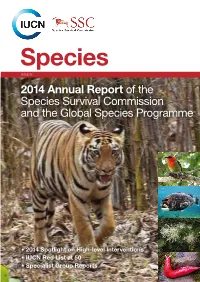
The IUCN Red List of Threatened Speciestm
Species 2014 Annual ReportSpecies the Species of 2014 Survival Commission and the Global Species Programme Species ISSUE 56 2014 Annual Report of the Species Survival Commission and the Global Species Programme • 2014 Spotlight on High-level Interventions IUCN SSC • IUCN Red List at 50 • Specialist Group Reports Ethiopian Wolf (Canis simensis), Endangered. © Martin Harvey Muhammad Yazid Muhammad © Amazing Species: Bleeding Toad The Bleeding Toad, Leptophryne cruentata, is listed as Critically Endangered on The IUCN Red List of Threatened SpeciesTM. It is endemic to West Java, Indonesia, specifically around Mount Gede, Mount Pangaro and south of Sukabumi. The Bleeding Toad’s scientific name, cruentata, is from the Latin word meaning “bleeding” because of the frog’s overall reddish-purple appearance and blood-red and yellow marbling on its back. Geographical range The population declined drastically after the eruption of Mount Galunggung in 1987. It is Knowledge believed that other declining factors may be habitat alteration, loss, and fragmentation. Experts Although the lethal chytrid fungus, responsible for devastating declines (and possible Get Involved extinctions) in amphibian populations globally, has not been recorded in this area, the sudden decline in a creekside population is reminiscent of declines in similar amphibian species due to the presence of this pathogen. Only one individual Bleeding Toad was sighted from 1990 to 2003. Part of the range of Bleeding Toad is located in Gunung Gede Pangrango National Park. Future conservation actions should include population surveys and possible captive breeding plans. The production of the IUCN Red List of Threatened Species™ is made possible through the IUCN Red List Partnership.