News Inbrief
Total Page:16
File Type:pdf, Size:1020Kb
Load more
Recommended publications
-

Trekking Trip in Armenia the Mysterious Mountainous Karabakh and the Highest Peak of the Country – Mount Aragats (4095 M)
Trekking trip in Armenia The mysterious Mountainous Karabakh and the highest peak of the country – Mount Aragats (4095 m). TRIP DESCRIPTION This trip is one of a kind. Not only will we conquer Armenia’s highest peak, namely Mount Aragats (4095 m), but also spend several days trekking in the most mysterious and inaccessible part of Armenia: in the Republic of Artsakh. Officially, the Mountainous Karabakh is a part emphasis on the mountains, which are wild of Azerbaijan. The inhabitants of the Moun- and untrampled by mass tourism, and simply tainous Karabakh consider it an independent breathtaking! During our stay in Armenia, we country. But despite the fact that the Moun- will also get to know its culture and tradition, tainous Karabakh has its own government, and visit the most beautiful and famous pla- army, flag and foreign representatives, its in- ces: Lake Sevan, the Temple of Garni, the dependence is not recognized by any country Geghard, Khop Virap and Tatev Monasteries, in the world. You can only enter the territory of and the capital of Armenia: Yerevan. During the Republic of Artsakh from Armenia, and the the whole trip, you will be accompanied by Armenians consider Artsakh (this is how they our team: a English-speaking trip leader and call the Mountainous Karabakh) as an insepa- an Armenian certified high mountain guide rable part of their country. The Republic of Art- (also trained in medical rescue in the moun- sakh is a peculiar place. In spite of the official tains), who will be responsible for your safety. ceasefire, the conflict between two nations is It is also important that we are going to help not settled. -

The Shifting Geopolitics of the Black Sea Region
The Shifting Geopolitics of the Black Sea Region Actors, Drivers and Challenges Geir Flikke (ed.), Einar Wigen, Helge Blakkisrud and Pål Kolstø Norwegian Institute of International Affairs International of Institute Norwegian Institutt Utenrikspolitisk Norsk NUPI Report Publisher: Norwegian Institute of International Affairs Copyright: © Norwegian Institute of International Affairs 2011 ISBN: 978-82-7002-303-5 Any views expressed in this publication are those of the authors. They should not be interpreted as reflecting the views of the Norwegian Institute of International Affairs. The text may not be printed in part or in full without the permission of the authors. Visiting address: C.J. Hambros plass 2d Address: P.O. Box 8159 Dep. NO-0033 Oslo, Norway Internet: www.nupi.no E-mail: info@nupi.no Fax: [+ 47] 22 36 21 82 Tel: [+ 47] 22 99 40 00 The Shifting Geopolitics of the Black Sea Region Actors, Drivers and Challenges Geir Flikke (ed.), Einar Wigen, Helge Blakkisrud and Pål Kolstø Introduction2 The Black Sea has long been a focal point for regionalization. Both the EU and NATO have had a proactive policy in the region, and various cooperative arrangements have been made to enhance multilateral mari- time governance in the Black Sea. Numerous regional mechanisms for interaction and cooperation among the littoral states have been set up, such as the Organization of the Black Sea Economic Cooperation (BSEC), the Black Sea Forum for Dialogue and Partnership (BSF) and the Black Sea Initiative of the EU (BSI). In January 2011, the European Parliament adopted a resolution on the Black Sea, reflecting the fact that since 2005 the region itself has entered a new modus operandi. -

Glendale Exhibits Explore Concept of Inherited Trauma of Armenian Genocide
MARCH 24, 2018 Mirror-SpeTHE ARMENIAN ctator Volume LXXXVIII, NO. 35, Issue 4530 $ 2.00 NEWS The First English Language Armenian Weekly in the United States Since 1932 INBRIEF Washington Armenian Aliyev Insists on Community Unites in ‘Historic Azeri Lands’ Support of Artsakh In Armenia BAKU (RFE/RL) — Azerbaijan’s President Ilham Aliyev has stood by his claims that much of By Aram Arkun modern-day Armenia lies in “historic Azerbaijani Mirror-Spectator Staff lands.” “I have repeatedly said and want to say once again that the territory of contemporary Armenia WASHINGTON — Upon the initiative of is historic Azerbaijani lands. There are numerous the representation of Artsakh in the United books and maps confirming that,” Aliyev said on States, the Armenian Assembly of America Monday, March 19, at the start of official celebra- and the Armenian National Committee of tions of Nowruz, the ancient Persian New Year America (ANCA) organized a reception and marked as a public holiday in Azerbaijan. banquet for the Armenian community on “The Azerbaijani youth must know this first and March 17 at the University Club in foremost. Let it know that most of modern-day Washington D. C. to honor the visiting del- Armenia is historic Azerbaijani lands. We will egation of the Republic of Artsakh led by never forget this,” he said. President Bako Sahakyan. Aliyev has repeatedly made such statements, The bilingual event was moderated by Annie Totah receives a medal from President Bako Sahakyan, while Aram Hamparian holds the medal he just got (photo: Aram Arkun) most recently on February 8. Speaking at a pre- Annie Simonian Totah, board member of election congress of his Yeni Azerbaycan party, he the Armenian Assembly, and Aram pledged to “return Azerbaijanis” to Yerevan, Hamparian, executive director of the two Armenian lobbying organizations of pointed out that the ANCA and the Syunik province and the area around Lake Sevan. -

Post-Conference Event 5 Days Tour – 790 EUR Per Person (April 28-May 2, 2019)
Post-Conference Event 5 Days tour – 790 EUR per person (April 28-May 2, 2019) Day1: Yerevan, Geghard, Garni, Sevan, Dilijan, Dzoraget ✓ Breakfast at the hotel • Geghard Geghard Monastery is 40km south-east from Yerevan. Geghard Monastery carved out of a huge monolithic rock. Geghard is an incredible ancient Armenian monastery, partly carved out of a mountain. It is said that the Holy Lance that pierced the body of Christ was kept here. The architectural forms and the decoration of Geghard’s rock premises show that Armenian builders could not only create superb works of architecture out of stone, but also hew them in solid rock. It is included in the list of UNESCO World Heritage Sites. • Garni From Geghard it is 11km to Garni Temple. Garni Pagan Temple, the only Hellenistic temple in the Caucasus. Gracing the hillside the temple was dedicated to the God of Sun, Mithra and comprises also royal palace ruins, Roman Baths with a well preserved mosaic. Lunch in Garni also Master class of traditional Armenian bread “lavash” being baked in tonir (ground oven). The preparation, meaning and appearance of traditional bread as an expression of culture in Armeniahas been inscribed on UNESCO’s Representative List of the Intangible Cultural Heritage of Humanity. • Sevan Visit to Sevan Lake which is 80 km from Garni temple. Sevan Lake is the largest lake in Armenia and the Caucasus region. With an altitude of 1,900 meters above sea level, it’s one of the highest lakes in the world. The name Sevan is of Urartian origin, and is derived of Siuna, meaning county of lakes. -

Nagorno-Karabakh's
Nagorno-Karabakh’s Gathering War Clouds Europe Report N°244 | 1 June 2017 Headquarters International Crisis Group Avenue Louise 149 • 1050 Brussels, Belgium Tel: +32 2 502 90 38 • Fax: +32 2 502 50 38 brussels@crisisgroup.org Preventing War. Shaping Peace. Table of Contents Executive Summary ................................................................................................................... i I. Introduction ..................................................................................................................... 1 II. Ongoing Risks of War ....................................................................................................... 2 A. Military Tactics .......................................................................................................... 4 B. Potential Humanitarian Implications ....................................................................... 6 III. Shifts in Public Moods and Policies ................................................................................. 8 A. Azerbaijan’s Society ................................................................................................... 8 1. Popular pressure on the government ................................................................... 8 2. A tougher stance ................................................................................................... 10 B. Armenia’s Society ....................................................................................................... 12 1. Public mobilisation and anger -

THE ARMENIAN Mirrorc SPECTATOR Since 1932
THE ARMENIAN MIRRORc SPECTATOR Since 1932 Volume LXXXXI, NO. 42, Issue 4684 MAY 8, 2021 $2.00 Rep. Kazarian Is Artsakh Toun Proposes Housing Solution Passionate about For 2020 Artsakh War Refugees Public Service By Harry Kezelian By Aram Arkun Mirror-Spectator Staff Mirror-Spectator Staff EAST PROVIDENCE, R.I. — BRUSSELS — One of the major results Katherine Kazarian was elected of the Artsakh War of 2020, along with the Majority Whip of the Rhode Island loss of territory in Artsakh, is the dislocation State House in January, but she’s no of tens of thousands of Armenians who have stranger to politics. The 30-year-old lost their homes. Their ability to remain in Rhode Island native was first elected Artsakh is in question and the time remain- to the legislative body 8 years ago ing to solve this problem is limited. Artsakh straight out of college at age 22. Toun is a project which offers a solution. Kazarian is a fighter for her home- The approach was developed by four peo- town of East Providence and her Ar- ple, architects and menian community in Rhode Island urban planners and around the world. And despite Movses Der Kev- the partisan rancor of the last several orkian and Sevag years, she still loves politics. Asryan, project “It’s awesome, it’s a lot of work, manager and co- but I do love the job. And we have ordinator Grego- a great new leadership team at the ry Guerguerian, in urban planning, architecture, renovation Khanumyan estimated that there are State House.” and businessman and construction site management in Arme- around 40,000 displaced people willing to Kazarian was unanimously elect- and philanthropist nia, Belgium and Lebanon. -

Critical Genocide Studies
Genocide Studies and Prevention: An International Journal Volume 7 Issue 1 Article 1 April 2012 Full Issue 7.1 Follow this and additional works at: https://scholarcommons.usf.edu/gsp Recommended Citation (2012) "Full Issue 7.1," Genocide Studies and Prevention: An International Journal: Vol. 7: Iss. 1: Article 1. Available at: https://scholarcommons.usf.edu/gsp/vol7/iss1/1 This Front Matter is brought to you for free and open access by the Open Access Journals at Scholar Commons. It has been accepted for inclusion in Genocide Studies and Prevention: An International Journal by an authorized editor of Scholar Commons. For more information, please contact scholarcommons@usf.edu. Editors’ Introduction Volume 7, issue 1 of Genocide Studies and Prevention continues the discussion of the state of the field of genocide studies that was initiated in volume 6, issue 3. Due to our (the editors’) keen desire to include as many different voices and perspectives as possi- ble, we reached out to old hands in the field, younger but well established scholars, and several scholars who recently completed their graduate studies but have already made an impact on the field. The sequence of the articles over the two issues began with comprehensive treat- ments and then moved into articles with more specific focuses, grouped thematically where applicable. Through the entire sequence across these two issues of GSP, we hope that readers will gain a solid sense of the history of the field and insight into some of the perdurable issues that have been at the heart of the field since its inception and that they have opportunities to reflect on the host of issues and concerns raised by authors coming from different disciplines (e.g., history, political science, sociology, psychology, philosophy) with vastly different perspectives. -

Nagorno Karabakh
NAGORNO KARABAKH SEPTEMBER - NOVEMBER BRIEFING 2018 Recent Developments Humanitarian Figures Azerbaijan is “playing with the Azerbaijan controls information released from Nagorno-Karabakh fate of people” and the global while preventing civil society organisations, journalists and political community remains silent in the figures from entering the disputed enclave. Important events and face of ‘caviar diplomacy,’ situations are kept out of the public eye, resulting in a lack of fact- according to the spokesperson for finding reports and humanitarian updates from the region. the president of Nagorno – Karabakh, Davit Babyan The Chairman of the Azerbaijani Key Developments Community of Nagorno Karabakh states Armenians living in the > The US representative to the OSCE has described the status quo as enclave “want to live according to “unacceptable”, underscoring the urgent need to find a resolution to ongoing hostilities over Nagorno Karabakh. Gregory Macris made the the laws of Azerbaijan”. Bayram remarks during an OSCE Permanent Council address, claiming the Safarov also claims that United States supports efforts to increase a “dialogue between Azerbaijan’s territorial integrity has Armenians and Azerbaijanis that can stabilise the security situation been recognised internationally by and make a more constructive atmosphere for negotiations”. countries such as Germany Tensions rise between Belarus > As Azerbaijani-Belarus relations strengthen, President Ilham Aliyev and Armenia: The Armenian Prime publicly thanks Alexander Lukashenko for Belarus’ stance on the Minister condemns the President settlement of conflict over Nagorno-Karabakh. The heads of state N of Belarus for questioning the role issued a joint statement in November which stressed the importance of Yerevan, the capital of Armenia, of resolution and declared that the territorial dispute must be resolved in the Collective Security Treaty within “the framework of territorial integrity and inviolability of the Organisation (CTSO) borders of Azerbaijan”. -

蛤蒂華頓垈隹寛埓滝咋瑕2015 Nagorno Karabakh in Figures
ȺèܲÚÆÜ Ô²ð²´²ÔÆ Ð²Üð²äºîàôÂÚ²Ü ²¼¶²ÚÆÜ ìÆֲβ¶ð²Î²Ü ̲è²ÚàôÂÚàôÜ NATIONAL STATISTICAL SERVICE OF THE NAGORNO KARABAKH REPUBLIC ȺèܲÚÆÜ Ô²ð²´²ÔÀ Âìºðàì 2015 NAGORNO KARABAKH IN FIGURES íÇ׳ϳ·ñ³Ï³Ý ·ñùáõÛÏ statistical booklet êîºö²Ü²Îºðî – 2015 – STEPANAKERT È»éݳÛÇÝ Ô³ñ³µ³ÕÁ Ãí»ñáí Nagorno Karabakh in figures î»Õ»Ï³ïíáõÃÛ³Ý µ³½Ù³½³Ýٳٵ ¨ In present day world which is characterized ï»Õ»Ï³ïí³Ï³Ý Ñáëù»ñÇ ÇÝï»ÝëÇ- by the information variety and intensity of í³óٳٵ µÝáõó·ñíáÕ ³ñ¹Ç ³ß˳ñ- informational flows, the possible ÑáõÙ ¿³å»ë ϳñ¨áñíáõÙ ¿ “combination” of three participants of official ¦íÇ׳ϳ·ñ³Ï³Ý »é³ÝÏÛáõÝáõ ³Ý- statistics such as respondents, users and ÏÛáõÝÝ»ñÁ ½µ³Õ»óÝáÕ§ ï³ñ³µ¨»é taxpayers, “occupying the angels of statistical ѳÏáõÙÝ»ñ áõÝ»óáÕ, å³ßïáÝ³Ï³Ý triangle” having different dispositions, is of íÇ׳ϳ·ñáõÃÛ³Ý »ñ»ù Ù³ëݳÏÇóÝ»ñǪ great importance, especially from viewpoint of é»ëåáݹ»ÝïÝ»ñÇ, ëå³éáÕÝ»ñÇ ¨ perception requirements “communication skills ѳñϳïáõÝ»ñÇ Ñݳñ³íáñÇÝ Ù»Ïï»ÕáõÙÁ leveling” by national and international levels. ѳïϳå»ëª ³½·³ÛÇÝ ¨ ÙÇç³½·³ÛÇÝ ã³÷³ÝÇßÝ»ñáí å»ñó»åódzÛÇ (ÏáÙáõÝÇϳóÇáÝ áõݳÏáõÃÛáõÝÝ»ñÇ Ñ³Ù³Ñ³ñûóÙ³Ý) å³Ñ³ÝçÝ»ñÇ The National Statistical Service of NKR ï»ë³ÝÏÛáõÝáí: would like to thank all the respondents who È»éݳÛÇÝ Ô³ñ³µ³ÕÇ Ð³Ýñ³- have supplied information for this statistical å»ïáõÃÛ³Ý ³½·³ÛÇÝ íÇ׳ϳ·ñ³Ï³Ý publication and from the above mentioned ͳé³ÛáõÃÛáõÝÁ ßÝáñѳϳÉáõÃÛáõÝ ¿ considerations welcomes any comments and ѳÛïÝáõÙ µáÉáñ é»ëåáݹ»ÝïÝ»ñÇÝ suggestions from the respondents and (ï»Õ»Ï³ïíáõÃÛáõÝ ïñ³Ù³¹ñáÕÝ»ñÇÝ), taxpayers, as statistical users, for the future áñáÝó ÏáÕÙÇó ïñ³Ù³¹ñí³Í developments of statistical publication. -
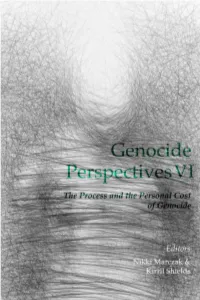
Genocide Perspectives VI Editors the Process and the Personal Cost of Genocide Marczak & Shields
Genocide Perspectives VI The Process and the Personal Cost of Genocide The Process and the Personal Cost of Genocide The Process Genocide Perspectives VI CONTRIBUTORS Alex J. Bellamy and Stephen Mark Tedeschi AM QC McLoughlin The 2017 Myall Creek Massacre Fateful Choices: Political Leadership and Commemoration Speech the Paths to and from Mass Atrocities Caroline Schneider and Hans-Lukas Melanie O’Brien Kieser Freedom of Religion in the Genocidal Long Shadows—The Great War, Process and Group Destruction in Australia and the Middle East: From the the Holocaust and Armenian and Armenian to the Yazidi Genocide Cambodian Genocides Armen Gakavian Katharine Gelber “It’s Happening Again”: Genocide, Denial, Post-memory and Artefacts: The Gelber/ Exile and Trauma Altschul Collection Amanda Tink “If You’re Different Are You the Same?”: The Nazi Genocide of Disabled People and Les Murray’s Fredy Neptune Linda Shields and Susan Benedict Nursing in Nazi Germany and the “Euthanasia” Programmes Marczak & Shields Marczak Colin Tatz Genocide and Suicide Editors Jacob G. Warren Apprehending the Slow Violence of Nuclear Colonialism: Art and Maralinga UTS EPRESS PUBLISHES PEER-REVIEWED, SCHOLARLY OPEN ACCESS BOOKS AND JOURNALS Genocide Perspectives VI The Process and the Personal Cost of Genocide Edited by Nikki Marczak and Kirril Shields Australian Institute for Holocaust and Genocide Studies Genocide Perspectives Series UTS ePRESS University of Technology Sydney Broadway NSW 2007 AUSTRALIA epress.lib.uts.edu.au Copyright Information This book is copyright. -
Understanding Genocide: Insights Gained Through Armenian Survivor Interviews
Understanding Genocide: Insights Gained through Armenian Survivor Interviews and Franz Werfel’s “The Forty Days of Musa Dagh” Kate Dwyer University of Minnesota Undergraduate Research Opportunities Program Senior Faculty Mentor: Joachim Savelsberg Introduction In 1933 Franz Werfel published what remains today the most famous literary depiction of the Armenian genocide – The Forty Days of Musa Dagh. The inspiration for the novel came to Werfel while he was touring Damascus fourteen years after genocide had wiped out over half the Armenian population in the region. It was the very sight of famished Armenian children working in a carpet factory that gave Werfel “the final impulse to snatch from the Hades of all that was, this incomprehensible destiny of the Armenian nation” (Werfel 1933). Thus, the very intent of the novel was not to tell a story, but to reveal the inconceivable truth of Armenian suffering. Werfel’s novel was quickly banned from Nazi Germany in 1934 at the request of the Turkish government. Yet, authoritarian leaders were not able to contain the influence of Werfel’s work. Along with other literary works, copies of The Forty Days of Musa Dagh circulated in Nazi ghettos, enhancing the spirit of fighters in the Warsaw ghetto rebellion (Toker 2019). It was read by the notation that like the Armenians on Musa Dagh, these fighters too refused to be massacred like ‘sheep’ (Gregorian 2019). There is no doubt as to why Werfel’s novel was banned; within it lie authentic truths about the Armenian genocide – truths which threatened to delegitimize the state which rose from Armenian ashes in 1923. -

The Transformation of Work and Citizenship in Turkey and the United States Under Neo-Liberalism1
Interns and Infidels: The Transformation of Work and Citizenship in Turkey and the United States under Neo-liberalism1 Kaan Agartan, Framingham State University, USA Cedric de Leon, Providence College, USA ABSTRACT How do the dispossessed remain governable under economic insecurity? What explains the persistence of work as a prerequisite to social rights in a time when fewer formal jobs exist? Drawing on a comparison of Turkey and the United States since 1980, we demonstrate that the neo-liberal state deploys different versions of the “work-citizenship nexus” to manage both the shrinking minority who enjoy the benefits of full citizenship and the rest who struggle to attain the rights and privileges of the formally employed. We find that neo-liberal state practices comprise a dual movement. On the one hand, the state in both countries reorients itself toward the market in welfare provision and the regulation of labour relations, capitalising on precarious work structures to bring their populations into the fold of neo-liberal governance. On the other hand, the state directly intervenes in disparate ways to manage those who cannot make it in the market. While the American state uses tactics of mass incarceration and deportation, the Turkish state opts for a blend of social conservatism and authoritarianism. This dual movement of reorientation and direct intervention results in what we call “tiered citizenship regimes” that facilitate the management of the population in each case. KEYWORDS neo-liberalism; work; social citizenship; governmentality; Turkey; United States Introduction Macro-historical accounts typically frame neo-liberalism as an economic doctrine that has exploded the Fordist mode of capital accumulation and in doing so deepened economic inequality.