Matters of Reception in Pastoral Amoebaean Contests
Total Page:16
File Type:pdf, Size:1020Kb
Load more
Recommended publications
-
THE MYTH of ORPHEUS and EURYDICE in WESTERN LITERATURE by MARK OWEN LEE, C.S.B. B.A., University of Toronto, 1953 M.A., Universi
THE MYTH OF ORPHEUS AND EURYDICE IN WESTERN LITERATURE by MARK OWEN LEE, C.S.B. B.A., University of Toronto, 1953 M.A., University of Toronto, 1957 A THESIS SUBMITTED IN PARTIAL FULFILMENT OF THE REQUIREMENTS FOR THE DEGREE OF DOCTOR OP PHILOSOPHY in the Department of- Classics We accept this thesis as conforming to the required standard THE UNIVERSITY OF BRITISH COLUMBIA September, i960 In presenting this thesis in partial fulfilment of the requirements for an advanced degree at the University of British Columbia, I agree that the Library shall make it freely available for reference and study. I further agree that permission for extensive copying of this thesis for scholarly purposes may be granted by the Head of my Department or by his representatives. It is understood that copying or publication of this thesis for financial gain shall not be allowed without my written permission. Department of The University of British Columbia Vancouver 8, Canada. ©he Pttttrerstt^ of ^riitsl} (Eolimtbta FACULTY OF GRADUATE STUDIES PROGRAMME OF THE FINAL ORAL EXAMINATION FOR THE DEGREE OF DOCTOR OF PHILOSOPHY of MARK OWEN LEE, C.S.B. B.A. University of Toronto, 1953 M.A. University of Toronto, 1957 S.T.B. University of Toronto, 1957 WEDNESDAY, SEPTEMBER 21, 1960 AT 3:00 P.M. IN ROOM 256, BUCHANAN BUILDING COMMITTEE IN CHARGE DEAN G. M. SHRUM, Chairman M. F. MCGREGOR G. B. RIDDEHOUGH W. L. GRANT P. C. F. GUTHRIE C. W. J. ELIOT B. SAVERY G. W. MARQUIS A. E. BIRNEY External Examiner: T. G. ROSENMEYER University of Washington THE MYTH OF ORPHEUS AND EURYDICE IN WESTERN Myth sometimes evolves art-forms in which to express itself: LITERATURE Politian's Orfeo, a secular subject, which used music to tell its story, is seen to be the forerunner of the opera (Chapter IV); later, the ABSTRACT myth of Orpheus and Eurydice evolved the opera, in the works of the Florentine Camerata and Monteverdi, and served as the pattern This dissertion traces the course of the myth of Orpheus and for its reform, in Gluck (Chapter V). -
Housman Lecture O'donoghue 2018 Final 02.Indd
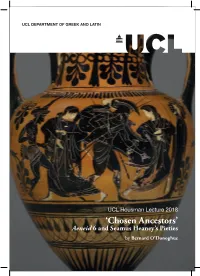
UCL DEPARTMENT OF GREEK AND LATIN UCL Housman Lecture 2018 ‘Chosen Ancestors’ Aeneid 6 and Seamus Heaney’s Pieties by Bernard O’Donoghue A.E. Housman (1859–1936) Born in Worcestershire in 1859, Alfred Edward Housman was a gifted classical scholar and poet. After studying in Oxford, Housman worked for ten years as a clerk, while publishing and writing scholarly articles on Horace, Propertius, Ovid, Aeschylus, Euripides and Sophocles. He gradually acquired such a high reputation that in 1892 he returned to the academic world as Professor of Classics at University College London (1892–1911) and then as Kennedy Professor of Latin at Trinity College, Cambridge (1911–1936). Housman Lectures at UCL The Department of Greek and Latin at University College London organizes regular Housman Lectures, named after its illustrious former colleague (with support from UCL Alumni). Housman Lectures, delivered by a scholar of international distinction, originally took place every second year and now happen every year, alternating between Greek and Roman topics (Greek lectures being funded by the A.G. Leventis Foundation). This is the tenth Housman Lecture, and it took place on 14 March 2018. Bernard O’Donoghue is a poet and an Emeritus Fellow of Wadham College, Oxford. Cover images: Attic black-figured amphora: Aeneas’ flight from Troy © The Trustees of the British Museum HOUSMAN LECTURE ‘Chosen Ancestors’ Aeneid 6 and Seamus Heaney’s Pieties Bernard O’Donoghue A complete translation by Seamus Heaney of Aeneid 6 had long been rumoured, so its posthumous appearance in 2016 was a major event. Heaney had said that he wanted to produce a ‘poetic remaking of Book VI’, by contrast with his more dutiful translation of Beowulf, which he said to begin with he did ‘not know or love enough’ to remake poetically. -

Epigraphic Bulletin for Greek Religion 1996
Kernos Revue internationale et pluridisciplinaire de religion grecque antique 12 | 1999 Varia Epigraphic Bulletin for Greek Religion 1996 Angelos Chaniotis, Joannis Mylonopoulos and Eftychia Stavrianopoulou Electronic version URL: http://journals.openedition.org/kernos/724 DOI: 10.4000/kernos.724 ISSN: 2034-7871 Publisher Centre international d'étude de la religion grecque antique Printed version Date of publication: 1 January 1999 Number of pages: 207-292 ISSN: 0776-3824 Electronic reference Angelos Chaniotis, Joannis Mylonopoulos and Eftychia Stavrianopoulou, « Epigraphic Bulletin for Greek Religion 1996 », Kernos [Online], 12 | 1999, Online since 13 April 2011, connection on 15 September 2020. URL : http://journals.openedition.org/kernos/724 Kernos Kemos, 12 (1999), p. 207-292. Epigtoaphic Bulletin for Greek Religion 1996 (EBGR 1996) The ninth issue of the BEGR contains only part of the epigraphie harvest of 1996; unforeseen circumstances have prevented me and my collaborators from covering all the publications of 1996, but we hope to close the gaps next year. We have also made several additions to previous issues. In the past years the BEGR had often summarized publications which were not primarily of epigraphie nature, thus tending to expand into an unavoidably incomplete bibliography of Greek religion. From this issue on we return to the original scope of this bulletin, whieh is to provide information on new epigraphie finds, new interpretations of inscriptions, epigraphieal corpora, and studies based p;imarily on the epigraphie material. Only if we focus on these types of books and articles, will we be able to present the newpublications without delays and, hopefully, without too many omissions. -

Silencing the Female Voice in Longus and Achilles Tatius
Silencing the female voice in Longus and Achilles Tatius Word Count: 12,904 Exam Number: B052116 Classical Studies MA (Hons) School of History, Classics and Archaeology University of Edinburgh B052116 Acknowledgments I am indebted to the brilliant Dr Calum Maciver, whose passion for these novels is continually inspiring. Thank you for your incredible supervision and patience. I’d also like to thank Dr Donncha O’Rourke for his advice and boundless encouragement. My warmest thanks to Sekheena and Emily for their assistance in proofreading this paper. To my fantastic circle of Classics girls, thank you for your companionship and humour. Thanks to my parents for their love and support. To Ben, for giving me strength and light. And finally, to the Edinburgh University Classics Department, for a truly rewarding four years. 1 B052116 Table of Contents Acknowledgments………………………………………………………………………….1 List of Abbreviations………………………………………………………………………3 Introduction ……………………………………………………………………………….4 Chapter 1: Through the Male Lens………………………………………………………6 The Aftertaste of Sophrosune……………………………………………………………….6 Male Viewers and Voyeuristic Fantasy.…………………………………………………....8 Narratorial Manipulation of Perspective………………………………………………….11 Chapter 2: The Mythic Hush…………………………………………………………….15 Echoing Violence in Longus……………………………………………………………….16 Making a myth out of Chloe………………………………………………………………..19 Leucippe and Europa: introducing the mythic parallel……………………………………21 Andromeda, Philomela and Procne: shifting perspectives………………………………...22 Chapter 3: Rupturing the -

Title: Midas, the Golden Age Trope, and Hellenistic Kingship in Ovid's
Title: Midas, the Golden Age trope, and Hellenistic Kingship in Ovid’s Metamorphoses Abstract: This article proposes a sustained politicized reading of the myth of Midas in Ovid’s Metamorphoses. It argues that Midas stands, first, as the embodiment of failed, Hellenistic kingship, with its ostentatious display of wealth and heralding of a new Golden Age, and, second, as a warning against the infectious “love of gold”, to which Roman politicians are far from immune. While the capture of Silenus and the golden touch episode link Midas with the tropes of Hellenistic kingship, his involvement in the competition between Pan and Apollo raises questions about the tropes of Roman imperial power itself. 0 Midas, the Golden Age trope, and Hellenistic Kingship in Ovid’s Metamorphoses It might be heaven, this static Plenitude: apples gold on the bough, Goldfinch, goldfish, golden tiger cat stock - Still in one gigantic tapestry – Sylvia Plath, In Midas' Country Ovid provides the fullest and most elaborate account of the myth of Midas that has come down to us from Classical Antiquity. His version conflates what must have been three different myths involving the legendary Phrygian king: first, his encounter with or capture of Silenus, second, the gift of the golden touch, which turned into a curse, and third, his acquisition of ass’s ears –– in Ovid’s version as a punishment by Apollo for his musical preferences. Throughout the narrative (11.85-193) Midas emerges as a figure of ridicule, a man unable to learn from his mistakes1. Despite the amount of criticism that has focused on the Metamorphoses, this episode has attracted remarkably little attention. -
The Divinity of Hellenistic Rulers
OriginalverCORE öffentlichung in: A. Erskine (ed.), A Companion to the Hellenistic World,Metadata, Oxford: Blackwell citation 2003, and similar papers at core.ac.uk ProvidedS. 431-445 by Propylaeum-DOK CHAPTKR TWENTY-FIVE The Divinity of Hellenistic Rulers Anßdos Chaniotis 1 Introduction: the Paradox of Mortal Divinity When King Demetrios Poliorketes returned to Athens from Kerkyra in 291, the Athenians welcomed him with a processional song, the text of which has long been recognized as one of the most interesting sources for Hellenistic ruler cult: How the greatest and dearest of the gods have come to the city! For the hour has brought together Demeter and Demetrios; she comes to celebrate the solemn mysteries of the Kore, while he is here füll of joy, as befits the god, fair and laughing. His appearance is majestic, his friends all around him and he in their midst, as though they were stars and he the sun. Hail son of the most powerful god Poseidon and Aphrodite. (Douris FGrH76 Fl3, cf. Demochares FGrH75 F2, both at Athen. 6.253b-f; trans. as Austin 35) Had only the first lines of this ritual song survived, the modern reader would notice the assimilaüon of the adventus of a mortal king with that of a divinity, the etymo- logical association of his name with that of Demeter, the parentage of mighty gods, and the external features of a divine ruler (joy, beauty, majesty). Very often scholars reach their conclusions about aspects of ancient mentality on the basis of a fragment; and very often - unavoidably - they conceive only a fragment of reality. -

ENGLISH RENAISSANCE EPITHALAMIA Approvedi Major Professor
ENGLISH RENAISSANCE EPITHALAMIA APPROVEDi Major Professor : ~ Director of the ^Department of English si Deaf of the Graduate School \ ENGLISH RENAISSANCE EPJTHALAMIA THESIS Presented to the Graduate Council of the North Texas State University in Partial Fulfillment of the Requirements For the Degree of MASTER OF ARTS By Larry B. Corse, M. M, Denton, Texas August, 1970 TABLE OF CONTENTS Page Chapter I, THE CLASSICAL BACKGROUND 1 II. SIR PHILIP SIDNEY. 20 III. EDMUND SPENSER 31 IV. JOHN DONNE 48 V. BEN JONS ON AND ROBERT HERRICK. 78 VI. CONCLUSIONS 90 APPENDIX 97 BIBLIOGRAPHY ...... 108 ill CHAPTER I THE CLASSICAL BACKGROUND In the late sixteenth century, the classical genre of marriage songs called epithalamia-'- appeared In England. A few fine poems in this tradition were written by some of the major English poets: Sidney, Spenser, Donne, Jonson, and Herrick. The genre was important for only three decades in England before it fell into the hands of minor poets and literary hacks. When the English Renaissance poets took up the epithalamic genre, it had a two-thousand year old tradition behind it, a tradition which began in Greece, flourished for a time in Rome, then disappeared until the Renaissance, when epithalamla were written in Italian, French, Spanish, Latin, and English poetry. After the Renaissance, the classical tradition lost its influence on English epithalamia, and not until the twentieth century have major English poets written marriage songs patterned on the classical models. ^To avoid confusion which might arise from the several forms of this word ending in -urn, -a, -ie, -ies, -on, and -ons, the Latin forms, epithalamium and epithalamla, will be used throughout this thesis except in quotations and titles where the original spelling will be raaintained. -

The Seventh Eclogue of Calpurmus Siculus
I^A,US NERONIS: THE SEVENTH ECLOGUE OF CALPURMUS SICULUS Calpurnius Siculus has been served badly by posterity, being neglected to the point of near complete oblivion or, if noticed at all, dismissed con- temptuouslyl. However recently more favourable judgments of the poet's work, which see merit in both the content of Calpurnius' poetry and its technical dexterity, have been forthcoming2. While these offer a persuasive reassessment of Calpurnius' poetics, un- forrunately his supporters have felt the need to disassociate the poet from the apparent praise he showers on the emperor of the day, normally believed to have been the Emperor Nero3. Two factors seem to be at work here: one is the modern distaste for the notion of the "court" poet, the second probably a wish to distance Calpurnius from a "bad" emperor; a similar approach can be detected frequently in Virgilian criticism, where ttrere is a wish to absolve the poet from these sins4. Three recent major studies of Calpurnius, those of Leach, Davis, and Newlands, unite in seeing Calpurnius' final eclogue as indicative of the poet's doubts about Nero's ru1e5. The poem begins with Corydon being (1) E.C. J. Wight Dufl A Literary History of Rome in the Silver Age (1927) 330: "The funportance of the eclogues of T. Calpurnius Siculus rests Írs much on their testimo- ny to the continuance of one aspect of Virgil's influence as upon intrinsic poetic value". (2) E.g. R. W. Garson, The Eclogues of Calpurnius, a partial defence, "Latomus" 33, 1974,668ff.; R. Meyer, Calpurnius Siculus: technique and date, "J.R.S." 70,1980,17sff . -

Coills of the Bible Full Hasmonean Chronology Still a Mystery
From our Collection of Classical Marbles /lOman mnrbh' blls/ of(1 bearded illlelh'('/ lial as (l (;reel.: Romon /!I arble life-size bllSI of MCI1(1ndl'r, AIIIellhlll po"', philosopher. Second haifa/2nd Cewllry A.D. le(l(/iliS It'rilcr ojlhe Nt'", COIIIl'dy (ca . .142-293 B.C. ). 22-I/r (57.' em.} &1r1y /srCf'llI/uyA.D. 15~(3R.1 em.) A nno unc in g t h e publicatioll of 0 111' 50th A nni versary c at a log. 96 pages, over 470 ohjects ill fuJI color ....................................... .. ....... $10.00 We fcnt llrc over 3500 works o f art rnngi ng from S I 00 to $1 ,0000,OOO ONE THOUSAND YEARS OPGREE K VAS ES (1990), nnd more, Inking great pride in ollr expe nise, connoisseurship, and 52-pp .... ....... ............. .................. .. .. ................ ..... ................ S 4.00 competitive pricing. all in an open and friendly atmosphere. GODS & r-. I OI~TALS: Ancicm Bronzes (1989), 52 pp ... S 4.00 Sl'ucI for our NEW FREE fu ll-color 32-pagc hrochur,,! TIl E AG E OF Cl .rOPATRA ( 1988),32 pp .... ................... S 2.00 Tile following ful l-color publications arc ;Jlso nvnibb1c: ART or THE ANCIENT WOR LD (1985). 208 PI' ............ $15 .00 GREEK , ETKUSCAN, KOMAN, EGYPTIAN AN D NEA K EASTERN ANTIQUITIES EU ROPEAN SCU LPTUKE T IIROUGH 1800 • OLD MASTER DRA WINGS ISLAMIC, SOUTH EA ST AS IAN AND OR IENTAL WORKS OF A RT PRE·COLUM BIA N AN D T RIBAL A RT · GREE K, KOMAN AND BYZANTINE COINS royal-athena galleries new y ork - beverly hills -london Eslablished 19-1 2 .J erol11 e M. -

Daphnis & Chloe. with the English Translation of George Thornley, Rev
Digitized by the Internet Archive in 2008 with funding from IVIicrosoft Corporation http://www.archive.org/details/daphnischloewithOOIonguoft DAPHXIS & CHLOE BY LONG US WITH THE ENGLISH TRANSLATION OF GEORGE THORNLEY REVISED AND AUGMENTED BY J. M. EDMONDS FELLOW OF JESrS COLLEGE, CAMBRIDGE THE LOVE ROMANCES OF PARTHENIUS AND OTHER FRAGMENTS WITH AN ENGLISH TRANSLATION BY S. GASELEE KELLOW OF MAGDALENE COLLEGE. rAMBRIDi^E % / LONDON : WILLL\M HEINEMANN NEW YORK : G. P. PUTNAM'S SONS MCMXVI PA 4 7 ';, H 1.% THE LOEB CLASSICAL LIBRARY i EDITED BY CAPPS, Ph.D.,XL.D. T. E. page, Litt.D. W. H. D. ROUSK, Litt.D. LONGUS DAPHNIS AND CHLOE PARTHENIUS CONTENTS PACK LONG US (DAPHNIS AND CHLOE)— IXTRODUCTION vii BIBLIOGRAPHY Xxiii PROEM 7 BOOK I 11 BOOK II 63 BOOK III 125 BOOK IV 185 PARTHEXIUS— iXTBOurcTiox 251 THE LOVE KOMAXCES 257 [ FRAGMENTS 351 THE ALEXANDRIAN EROTIC FRAGMENT . 374 THE NINUS ROMANCE 382 APPENDIX ON THE GREEK NOVEL 401 INDEX TO DAPHNIS AND CHLOE 417 INDEX TO PARTHENIUS, THE ALEXANDRIAN EROTIC FRAGMENT, THE NINUS ROMANCE, AND APPENDIX ON THE GREEK NOVEL . 419 Tell me, thou whom mj- soul loveth, whore thou feedest, where thou makest tliy flock to rest at noon. Song of Solomon, 1. 7. INTRODUCTIOX I. LoNGUS Nothing is known of the author of the Pastoralia. He describes Mytilene as if he knew it well, and he mentions the peculiarities of the Lesbian vine. He may have been a Lesbian, but such local colouring need not have been gathered on the spot, nor if so, by a native. His style and language are Graeco- Roman rather .than Hellenistic ; he probably knew ^ Vergil's Bucolics ; like Strabo and Lucian he writes in Greek and yet bears a Roman name. -
Dryden's Translation of the Eclogues in a Comparative Light
Proceedings o f the Virgil Society 26 (2008) Copyright 2008 Dryden’s Translation of the Eclogues in a Comparative Light A paper given to the Virgil Society on 21 January 2006 n this paper I shall sample some passages from Dryden’s version of Virgil’s Eclogues and compare them with the renderings of other translators, both earlier and later. One of my purposes is to consider Ihow Dryden and others conceived Virgil: for example, the styles of sixteenth and seventeenth century translations of the Eclogues indicate with some clarity how the dominant idea of pastoral changed in this period. But my aim is also to study how Dryden faced the problems of translating a poet especially admired for his verbal art, partly by considering his own discussion of the matter and partly by examination of the translations themselves. Matthew Arnold declared that the heroic couplet could not adequately represent Homer; a nicer question is how well it can represent Virgil. In the ‘Discourse concerning the Original and Progress of Satire’ which he placed as a preface to his translation of Juvenal, Dryden himself declared that Virgil could have written sharper satires than either Horace or Juvenal if he had chosen to employ his talent that way.1 The lines that he took to support this contention are from the Eclogues (3.26-7): non tu in triviis, indocte, solebas, stridenti, miserum, stipula, disperdere, carmen? In the Loeb edition - by H. Rushton Fairclough, revised by G. P. Goold - the lines are rendered thus: ‘Wasn’t it you, you dunce, that at the crossroads used to murder a sorry tune on a scrannel pipe?’ ‘Scrannel’ is not part of modern vocabulary; this departure from the usual practice of the Loeb Classical Library is a matter to which I shall return. -

From Mythos to Logos. Progress of Erotic Customs in Longus’
FROM MYTHOS TO LOGOS. PROGRESS OF EROTIC CUSTOMS IN LONGUS’ POIMENIKÀ Abstract: My paper intends to demonstrate that ancient novels, though often employing mythical patterns, sought to mark a progression away from the ambiguous ethics that informed issues of eroticism in most of the mythical tradition by moving toward a more egalitarian conception of the relationship between the sexes. This progression is particularly evident in Longus’ Poimenikà. In the first three books of this novel we find three mythical excursus which describe virgins undergoing a process of metamorphosis in order to escape a god’s rape or other kinds of abuse. The god Pan is regarded as the emblem of eros, purely physical desire, which is something sterile and degrading. On the contrary, the last book offers a positive model of the relationship between men and women: Daphnis and Chloe’s love reaches marital union, the proper place to experience sex as a divertissement with the crucial goal being that of procreation. The dichotomy between mythos and logos is implied earlier in the novel. If the excursus are classified as myths and they conclude with the virgins losing their human status, Longus underlines that his story is a truthful logos, and he gives it a happy ending: Chloe gains a role in society. Against the trend of looking at mythos as a container of ideal behavioural schemes and at a mythical Golden Age, Longus celebrates the development of erotic customs in his time through the means of a recent mimetic literary genre consisting of human characters. Although the Poimenikà take place in an idealised past, they give account of a contemporary social reality that is more respectful of female volition and they evoke a yearning to substitute the primeval mythical erotic code with the hope of becoming the new paradigm for erotic literature.