Women's Perspectives of Peace & Security Vol.I
Total Page:16
File Type:pdf, Size:1020Kb
Load more
Recommended publications
-
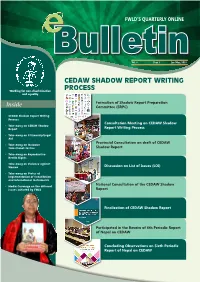
CEDAW Shadow Report Writing Process Consultation Meeting on CEDAW Shadow • Take Away on CEDAW Shadow Report Report Writing Process
FWLD’S QUARTERLY ONLINE BulletinVol. 8 Year 3 Jan-Mar, 2019 CEDAW SHADOW REPORT WRITING Working for non-discrimination PROCESS and equality Formation of Shadow Report Preparation Inside Committee (SRPC) • CEDAW Shadow Report Writing Process Consultation Meeting on CEDAW Shadow • Take away on CEDAW Shadow Report Report Writing Process • Take away on Citizenship/Legal Aid Provincial Consultation on draft of CEDAW • Take away on Inclusive Transitional Justice Shadow Report • Take away on Reproductive Health Rights • Take away on Violence against Women Discussion on List of Issues (LOI) • Take away on Status of Implementation of Constitution and International Instruments National Consultation of the CEDAW Shadow • Media Coverage on the different issues initiated by FWLD Report Finalization of CEDAW Shadow Report Participated in the Reveiw of 6th Periodic Report of Nepal on CEDAW Concluding Observations on Sixth Periodic Report of Nepal on CEDAW Take away on CEDAW SHADOW REPORT A productive two days consultative meeting on CEDAW obligations on 2nd and 3rd October 2018. Submission of CEDAW Press meet on CEDAW Shadow Report CEDAW Shadow Report Preparation Committee coordinated by FWLD has submitted the CEDAW Shadow Report and the A press meet was organized on 11th Oct. 2018 to report has been inform media about reporting process of Shadow uploaded in Report on Sixth Periodic Report of Nepal on CEDAW. The timeline of review of the report and its OHCHR’s website on outcome was also discussed. October 1st 2018. NGO Briefs and Informal Country meeting on the Lunch Meeting role of civil society in the 71st Session of CEDAW A country meeting was organized to discuss about the role of civil society in the 71st Session of CEDAW on 11th Oct, 2018. -

In the Name of 'Empowerment': Women and Development in Urban Nepal
In the name of ‘empowerment’: women and development in urban Nepal Margaret Becker Thesis submitted for the degree of Doctor in Philosophy Department of Anthropology School of Social Sciences, Faculty of Arts The University of Adelaide December 2016 Contents Abstract ...................................................................................................................... v Thesis declaration ...................................................................................................... vi Acknowledgements .................................................................................................. vii Transliteration ........................................................................................................... ix List of acronyms and abbreviations ........................................................................... x Introduction ...................................................................................................... 1 Ethnographic locations and methodology .................................................................. 3 Situating the organisations ......................................................................................... 5 Critical perspectives on development ........................................................................ 8 Critical perspectives on empowerment .................................................................... 12 Reflections on empowerment ................................................................................... 18 The structure -

Reimagining Peacemaking: Women's Roles in Peace Processes
JUNE 2015 Reimagining Peacemaking: Women’s Roles in Peace Processes MARIE O’REILLY, ANDREA Ó SÚILLEABHÁIN, AND THANIA PAFFENHOLZ Cover Photo: Signing ceremony of the ABOUT THE AUTHORS March 2014 peace pact between the government of the Philippines and the MARIE O’REILLY is Editor and Research Fellow at the Moro Islamic Liberation Front, Manila, International Peace Institute. March 27, 2014. © Romeo Ranoco/ Reuters/Corbis. Email: oreilly@ipinst.org Disclaimer: The views expressed in this ANDREA Ó SÚILLEABHÁIN is Senior Policy Analyst at the paper represent those of the authors International Peace Institute. and not necessarily those of the International Peace Institute. IPI welcomes consideration of a wide Email: osuilleabhain@ipinst.org range of perspectives in the pursuit of a well-informed debate on critical THANIA PAFFENHOLZ is Senior Researcher at the policies and issues in international Graduate Institute Geneva’s Centre on Conflict, affairs. Development and Peacebuilding. IPI Publications Email: thania.paffenholz@graduateinstitute.ch Adam Lupel, Director of Research and Publications Marie O’Reilly, Editor and Research Fellow ACKNOWLEDGEMENTS Marisa McCrone, Assistant Production This publication was made possible by generous funds Editor from the Permanent Mission of Thailand to the United Suggested Citation: Nations, the government of Norway, and the government Marie O’Reilly, Andrea Ó Súilleabháin, of Finland, for which IPI is very grateful. and Thania Paffenholz, “Reimagining Peacemaking: Women’s Roles in Peace The authors would like to thank Jacalyn Bennett, Steven Processes,” New York: International Dixon, Mary Anne Feeney, Anne Marie Goetz, Miki Jacevic, Peace Institute, June 2015 . Lone Jessen, Adam Lupel, Youssef Mahmoud, Shadia © by International Peace Institute, 2015 Marhaban, Sanam Naraghi-Anderlini, Jacqueline O’Neill, All Rights Reserved Maureen Quinn, Nick Ross, Irene Santiago, Elisabeth Scheper, Anita Schjølset, Laurel Stone, Nahla Valji, and www.ipinst.org Libby Wagner. -

Rebuilding Nepal: Women's Roles in Political Transition and Disaster
Rebuilding Nepal: Women’s Roles in Political Transition and Disaster Recovery BRIANA MAWBY AND ANNA APPLEBAUM Authors Briana Mawby (Hillary Rodham Clinton Research Fellow 2015–17, GIWPS) Anna Applebaum (Hillary Rodham Clinton Research Fellow 2015–17, GIWPS) Expert Advisers Ambassador Melanne Verveer (Executive Director, GIWPS) Roslyn Warren (Former Research Partnerships Manager, GIWPS) Acknowledgements The authors of this report are deeply grateful to the Georgetown Institute for Women, Peace and Security and to the many individuals who helped make this report possible. The authors would like to express their profound gratitude to Preeti Thapa (Asia Foundation and mediator/dialogue facilitator) and Margaret Ar- nold (World Bank) for serving as external reviewers of this report. They served in an individual capacity and not on behalf of their respective organizations. The authors would like to thank the following individuals for their advice and support: Ambassador Alaina B. Teplitz, Jasmine-Kim Westendorf, Jeni Klugman, Roslyn Warren, Mayesha Alam, Chloé White, Holly Fuhrman, Sarah Rutherford, Rebecca Turkington, Luis Mancilla, Andrew Walker, Andrea Welsh, Haydn Welch, Katherine Butler-Dines, Alexander Rohlwing, Kayla Elson, Tala Anchassi, Elizabeth Dana, Abigail Nichols, and Meredith Forsyth. The authors would also like to express deep gratitude to Reeti K. C. and Claire Naylor for their contributions and support. The Georgetown Institute for Women, Peace and Security Georgetown University’s Institute for Women, Peace and Security (GIWPS) seeks to promote a more stable, peaceful, and just world by focusing on the important role women play in preventing conflict and building peace, growing economies, and addressing global threats like climate change and violent extremism. -

Nepal COBP 2011-2013
Summary Report - Consultations with Stakeholders - 2009-2010 I. Introduction The Asian Development Bank (ADB), UK Department for International Development (DFID), and the World Bank (WB) held joint country consultations held in October- November 2008 with the aim to get insights from a wide range of stakeholders on what role they should play in supporting Nepal's development efforts. After the joint consultations, all the three agencies have developed their Country Business/Assistance Plans for their programs in Nepal. The three agencies decided to go back to the stakeholders and share these plans with them and seek their suggestions on how the proposed strategies could be effectively implemented. In this context, ADB contracted HURDEC (P). Ltd. to design and implement the consultation events. This report summarizes the findings and outcomes of the discussions and is organized as follows. The first part of the report summarizes the overall findings, and next part presents a summary of the recommendations from each event. The list of participants is annexed to this report. II. Locations and Process All the consultation events took place from December 2009 till April 2010. Consultations were held with the following stakeholders and locations: • Private Sector • Youth • Civil Society • Women and Excluded Groups • Nepalgunj • Pokhara • Biratnagar • GON Secretaries. In the locations outside Kathmandu, two events were held - one with community groups (CBOs, users' groups, women groups etc.); and second with district level political leaders, district line agencies, INGO/NGO representatives, project/program staff, youth and journalists. In each location, participants came from an average of 15 districts. Refer below for a map of Nepal showing districts from where participants attended the events. -

Women at the Indonesian Peace Table: Enhancing the Contributions of Women to Conflict Resolution
November 2010 Women at the Indonesian peace table: Enhancing the contributions of women to conflict resolution Report and policy recommendations with the Indonesian Institute of Sciences Women at the Peace Table Indonesia The Centre for Humanitarian Dialogue (HD Centre) “Mediation for peace” The Centre for Humanitarian Dialogue (HD Centre) is an independent mediation organisation dedicated to helping improve the global response to armed conflict. It attempts to achieve this by mediating between warring parties and providing support to the broader mediation community. The HD Centre is driven by humanitarian values and its ultimate goal to reduce the consequences of violent conflict, improve security, and contribute to the peaceful resolution of conflict. It maintains a neutral stance towards the warring parties that it mediates between and, in order to maintain its impartiality it is funded by a variety of governments, private foundations and philanthropists. Centre for Humanitarian Dialogue 114, rue de Lausanne Geneva 1202 Switzerland t + 41 22 908 11 30 f +41 22 908 11 40 e info@hdcentre.org w www.hdcentre.org © Centre for Humanitarian Dialogue, 2010 Images (front cover) An activist from West Papua protests against violence in front of the vice presidential palace in Jakarta, Indonesia, 16 October 2000. AP Photo/Dita Alangkara Globe showing Asia Pacific region. © iStockphoto Images (back cover) Internally displaced persons inside a refugee tent, Beto Timur, Timor-Leste, 3 July 2008. © UN Photo/Martine Perret A batik design from Indonesia. -

Cover Final.Indd
The Landmark Decisions of THE SUPREME COURT, NEPAL on GENDER JUSTICE NJA-Nepal Publisher: National Judicial Academy Hariharbhawan, Lalitpur Nepal The Landmark Decisions of the Supreme Court, Nepal on Gender Justice Editor Dr. Ananda Mohan Bhattarai NJA - Nepal National Judicial Academy Hariharbhawan, Lalitpur Nepal Advisor: Hon. Tope Bahadur Singh, Executive Director, NJA Translators: Hon. Dr. Haribansh Tripathi, Judge – CoA Mr. Shree Prasad Pandit, Advocate Mr. Sajjan Bar Singh Thapa, Advocate Management & Editorial Assistance Hon. Narishwar Bhandari, Faculty/Judge – DC, NJA Mr. Nripadhwoj Niroula, Registrar Mr. Shree Krishna Mulmi, Research Officer Mr. Paras Paudel, Statistical Officer Mr. Rajan Kumar KC, Finance Coordinator Assistants: Mr. Bishnu Bahadur Baruwal, Publication Assistant Ms. Poonam Lakhey, Office Secretary Ms. Sami Moktan, Administration Assistant Ms. Patrika Basnet, Personal Secretary Copy Rights: © National Judicial Academy/ UNIFEM, Nepal, 2010 Publishers: National Judicial Academy, Nepal Harihar Bhawan, Lalitpur & United Nations Fund for Women (UNIFEM) 401/42 Ramshah Path, Thapathali, Kathmandu Nepal Printing Copies: 500 Copies Financial Assistance: United Nations Fund for Women (UNIFEM) 401/42 Ramshah Path, Thapathali, Kathmandu Nepal Tel No: 977-1-425510/4254899 Fax No: 977-1-4247265 URL: www.unifem.org Printing: Format Printing Press, Hadigoan, Kathmandu Editor’s Note The decisions in this volume basically represent the second generation cases relating to gender justice in Nepal. I call them second generation because in the first generation (1990- 2005) the struggle was for securing women’s right to parental property, their rights against discrimination, their reproductive rights etc culminating in the parliamentary enactment 2005/6 which repealed many provisions of the National Code and other laws, found to be discriminatory on the basis of sex. -

Arria-Formula Meetings
Arria-Formula Meetings This table has been jointly compiled by Sam Daws and Loraine Sievers, as co-authors of The Procedure of the UN Security Council, and the staff of Security Council Report. The support extended by the Security Council Affairs Division in the compilation of the list is hereby recognised and greatly appreciated. ARRIA-FORMULA MEETINGS DATE SUBJECT/DOCUMENT IN WHICH INVITEE(S) ORGANISER(S) THE MEETING WAS MENTIONED March 1992 Bosnia and Herzegovina; S/1999/286; Fra Jozo Zovko (Bosnia and Herzegovina) Venezuela ST/PSCA/1/Add.12 18 December 1992 Persecution of Shiite ‘Marsh Arabs’ M.P. Emma Nicholson (UK) Venezuela, Hungary in Iraq 3 March 1993 Bosnia and Herzegovina Alija Izetbegović, President of Bosnia and Herzegovina 24 March 1993 Former Yugoslavia David Owen and Cyrus Vance, Co-Chairs of the International Conference on the Former Yugoslavia 15 April 1993 South Africa Richard Goldstone, Chair of the Commission of Inquiry regarding Venezuela the Prevention of Public Violence and Intimidation in South Africa 25 June 1993 Bosnia and Herzegovina Contact Group of the Organization of the Islamic Conference 12 August 1993 Bosnia and Herzegovina Organization of the Islamic Conference ministerial mission 6 September 1993 Bosnia and Herzegovina Alija Izetbegović, President of Bosnia and Herzegovina 28 September 1993 Croatia Permanent Representative of Croatia 2 March 1994 Georgia Eduard Shevardnadze, President of Georgia Czech Republic 18 March 1994 Croatia Franjo Tudjman, President of Croatia 11 April 1994 Bosnia and Herzegovina -

Landlessness, Exclusion, and Deprivation in Nepal
“LAND IS LIFE, LAND IS POWER”1: LANDLESSNESS, EXCLUSION, AND DEPRIVATION IN NEPAL Elisabeth Wickeri * INTRODUCTION ........................................................................ 932 I. LEGAL AND POLITICAL CONTEXT OF LAND RIGHTS IN NEPAL ............................................................ 937 A. Overview ....................................................................... 938 B. Nepal’s International Obligations .............................. 940 C. Codified Discrimination .............................................. 945 D. Land and Property in Nepali Law ............................... 949 1. The Traditional Legal Framework: State Landlordism ............................................................ 949 a. Overview of the Raikar System ......................... 949 b. Tenants Rights .................................................. 952 c. Bonded Labor ................................................... 953 2. Dismantling Raikar: Changes and Status Quo ...... 955 a. Overview ............................................................ 955 b. Emergence of Private Property Rights ............ 956 c. Land Ceilings .................................................... 959 d. Rights and Registration and “Invisible Landlessness” .................................................... 960 e. Tenure Security ................................................ 962 f. Indigenous Rights in Land ............................... 962 E. Land, Conflict, and the New Nepal ............................ 963 1. Overview ................................................................. -
Preventive Diplomacy: Skills and Tools Towards Effective Peacebuilding
ASEAN Regional Forum Workshop on Preventive Diplomacy: Skills and Tools Towards Effective Peacebuilding Co-Chairs Report (Myanmar, the United States of America, and New Zealand) 17-19 September 2018 Nay Pyi Taw, Myanmar Contents Executive Summary ....................................................................................................................................... 3 Background and Overview of Workshop ...................................................................................................... 5 DAY 1 – 17 September 2018 ..................................................................................................................... 6 DAY 2 – 18 September 2018 ..................................................................................................................... 7 DAY 3 – 19 September 2018 ..................................................................................................................... 9 Monitoring and Evaluation Tools ................................................................................................................ 11 Pre-Workshop and End-of-Workshop Surveys ....................................................................................... 11 Delayed Post-Workshop Survey .............................................................................................................. 13 Key Informant and Informal Scoping ...................................................................................................... 13 Guided Observation ............................................................................................................................... -

Gambling with Truth: Hopes and Challenges for Aceh’S Commission for Truth and Reconciliation
FLOWERS IN THE WALL Truth and Reconciliation in Timor-Leste, Indonesia, and Melanesia by David Webster ISBN 978-1-55238-955-3 THIS BOOK IS AN OPEN ACCESS E-BOOK. It is an electronic version of a book that can be purchased in physical form through any bookseller or on-line retailer, or from our distributors. Please support this open access publication by requesting that your university purchase a print copy of this book, or by purchasing a copy yourself. If you have any questions, please contact us at ucpress@ucalgary.ca Cover Art: The artwork on the cover of this book is not open access and falls under traditional copyright provisions; it cannot be reproduced in any way without written permission of the artists and their agents. The cover can be displayed as a complete cover image for the purposes of publicizing this work, but the artwork cannot be extracted from the context of the cover of this specific work without breaching the artist’s copyright. COPYRIGHT NOTICE: This open-access work is published under a Creative Commons licence. This means that you are free to copy, distribute, display or perform the work as long as you clearly attribute the work to its authors and publisher, that you do not use this work for any commercial gain in any form, and that you in no way alter, transform, or build on the work outside of its use in normal academic scholarship without our express permission. If you want to reuse or distribute the work, you must inform its new audience of the licence terms of this work. -

237 4 - 10 March 2005 16 Pages Rs 30
#237 4 - 10 March 2005 16 pages Rs 30 KUNDA DIXIT epal’s donors who have taken a strong line against NKing Gyanendra’s February First move will meet soon to decide on future aid to Nepal. My cell Despite the sharp rhetoric, they appear torn between using Lifeblood An alarm clock, camera, video the aid leverage to push the king game, palmtop, digital phone civil liberties. But they add taking directory, paperweight. The to roll back February First while hasty decisions may hurt those Donors want to use the aid only thing it isn't is a phone. maintaining humanitarian and in need. development assistance to Nepal’s “There are lots of poor and transfusion to push rollback on p 8-9 poorest and the army’s counter- excluded people…and nobody curbs, but are wary of hurting insurgency capability. wants to put them under greater The government is putting on pressure or reduce the poor a brave face. First deputy the impact on chairman of the council of poverty,” Robert J ministers, Tulsi Giri, told us: “If Smith of the they don’t understand, we’re not British aid going to go down on our hands group, DfID and knees to grovel.” told us. King Gyanendra hasn’t yet met Other key ambassadors who returned donors have after consultations in their suspended some capitals last week. But he did projects and say they will channel Weekly Internet Poll # 174 summon editors on 25 February money through civil society. Q. Does this internet poll generally reflect to signal donors they should prevalent public opinion about Nepali “We will not be signing any issues? choose between “terrorism and new project or program agreement democracy”.