Tarih Ve Günce ARMENIAN TERRORISM IN
Total Page:16
File Type:pdf, Size:1020Kb
Load more
Recommended publications
-
Reconstruction of Turkishness Among the Turkish Immigrants in Rochester
RECONSTRUCTION OF TURKISHNESS AMONG THE TURKISH IMMIGRANTS IN ROCHESTER A THESIS SUBMITTED TO THE GRADUATE SCHOOL OF SOCIAL SCIENCES OF MIDDLE EAST TECHNICAL UNIVERSITY BY BERKAY ORHANER IN PARTIAL FULFILLMENT OF THE REQUIREMENTS FOR THE DEGREE OF MASTER OF SCIENCE IN THE DEPARTMENT OF SOCIOLOGY JANUARY 2013 Approval of the Graduate School of Social Sciences Prof. Dr. Meliha Altunışık Director I certify that this thesis satisfies all the requirements as a thesis for the degree of Master of Science. Prof Dr. Ayşe Saktanber Head of Department This is to certify that we have read this thesis and that in our opinion it is fully adequate, in scope and quality, as a thesis for the degree of Master of Science. Assoc. Prof. Dr. Erdoğan Yıldırım Supervisor Examining Committee Members Prof. Dr. Recep Boztemur (METU, HIST) Assoc. Prof. Erdoğan Yıldırım (METU, SOC) Assoc. Prof. Ceylan Tokluoğlu (METU, SOC) I hereby declare that all information in this document has been obtained and presented in accordance with academic rules and ethical conduct. I also declare that, as required by these rules and conduct, I have fully cited and referenced all material and results that are not original to this work. Name, Last name: Berkay Orhaner Signature: iii ABSTRACT RECONSTRUCTION OF TURKISHNESS AMONG THE TURKISH IMMIGRANTS IN ROCHESTER Orhaner, Berkay M.S., Department of Sociology Supervisor: Assoc. Prof. Dr. Erdoğan Yıldırım January 2013, 103 pages This thesis examines the history of Turks migrated from Turkey to Rochester and their changing constructions of identities. In the early 1960’s, there was only a small group of Turkish immigrants in Rochester, who were well educated professionals. -

The Armenian Cause in America Today
THE ARMENIAN CAUSE IN AMERICA TODAY While meager Turkish American NGO assets are dedicated to cultural events and providing education on a wide range of political issues, approximately $40 million in Armenian American NGO assets are primarily dedicated to what is referred to in Armenian as Hai Tahd, ‘The Armenian Cause’. Hai Tahd includes three policy objectives: Recognition that the 1885-1919 Armenian tragedy constitutes genocide; Reparations from Turkey; and, Restitution of the eastern provinces of Turkey to Armenia. This paper examines the Armenian American strategy and the response of Turkish American via the Assembly of Turkish American Associations (ATAA). Günay Evinch Gunay Evinch (Övünç) practices international public law at Saltzman & Evinch and serves as Assembly of Turkish American Associations (ATAA) Vice-President for the Capital Region. He researched the Armenian case in Turkey as a U.S. Congressional Fulbright Scholar and Japan Sasakawa Peace Foundation Scholar in international law in 1991-93. To view media coverage and photographs associated with this article, please see, Günay Evinch, “The Armenian Cause Today,” The Turkish American, Vol. 2, No. 8 (Summer 2005), pp. 22-29. Also viewable at www.ATAA.org The Ottoman Armenian tragedy of 1880-1919 is a dark episode in the history of Turkish and Armenian relations. Over one million Muslims, mostly Kurds, Turks, and Arabs, and almost 600,000 Armenians perished in eastern Anatolia alone. WWI took the lives of 10 million combatants and 50 million civilians. While Russia suffered the greatest population deficit, the Ottoman Empire lost over five million, of which nearly 4 million were Muslims, 600,000 were Armenian, 300,000 were Greek, and 100,000 were Ottoman Jews.1 Moreover, the millennial Armenian presence in eastern Anatolia ended. -

State Immigration Laws, by State Enacted As of June 30, 2013 Bill
State Immigration Laws, by State Enacted as of June 30, 2013 Bill Name Title Governor's Action Summary Subject This resolution commends Trevor Warren on being one of the top three winners of the national 2013 StudentCam Documentary Competition for AL HR 346 Recognition Resolution 04/24/2013 - Enacted his video: "The Strangers: Illegal Immigration in America." Resolutions This resolution recognizes the efforts of the Volunteer Income Tax Assistance staff of Huntsville, Alabama who provides services without charge to legal immigrants, low and moderate income families, and the AL HR 408 Recognition Resolution 05/02/2013 - Enacted disabled. Resolutions This law creates the State Law Enforcement Agency to coordinate public safety in Alabama. The agency's Secretary shall, amongst other responsibilities, serve as the Homeland Security Advisor for the state with duties to include coordinating, designing and implementing AL S 108 Public Safety 03/19/2013 - Enacted Alabama's homeland security program, including immigration reform. Law_Enforcement This law amends the Code of Alabama 1975 to, among other changes related to firearm regulation, provide a process for the issuance of permits to applicants who are not U.S. citizens but who are lawfully AL S 286 Firearms 05/21/2013 - Enacted present in the state. Id_DriversLicense This resolution, which recognizes the important commerce, trade, and cultural relationship between the United States and the Republic of Poland and extends a warm welcome to Polish Ambassador Ryszard Schnepf during his visit to Birmingham in April 2013. The resolution also acknowledges the historical contributions of Polish immigrants and AL SJR 63 Recognition Resolution 04/25/2013 - Enacted Polish heritage that exists within Alabama. -

The Gordian Knot: American and British Policy Concerning the Cyprus Issue: 1952-1974
THE GORDIAN KNOT: AMERICAN AND BRITISH POLICY CONCERNING THE CYPRUS ISSUE: 1952-1974 Michael M. Carver A Thesis Submitted to the Graduate College of Bowling Green State University in partial fulfillment of The requirements for the degree of MASTER OF ARTS May 2006 Committee: Dr. Douglas J. Forsyth, Advisor Dr. Gary R. Hess ii ABSTRACT Douglas J. Forsyth, Advisor This study examines the role of both the United States and Great Britain during a series of crises that plagued Cyprus from the mid 1950s until the 1974 invasion by Turkey that led to the takeover of approximately one-third of the island and its partition. Initially an ancient Greek colony, Cyprus was conquered by the Ottoman Empire in the late 16th century, which allowed the native peoples to take part in the island’s governance. But the idea of Cyprus’ reunification with the Greek mainland, known as enosis, remained a significant tenet to most Greek-Cypriots. The movement to make enosis a reality gained strength following the island’s occupation in 1878 by Great Britain. Cyprus was integrated into the British imperialist agenda until the end of the Second World War when American and Soviet hegemony supplanted European colonialism. Beginning in 1955, Cyprus became a battleground between British officials and terrorists of the pro-enosis EOKA group until 1959 when the independence of Cyprus was negotiated between Britain and the governments of Greece and Turkey. The United States remained largely absent during this period, but during the 1960s and 1970s came to play an increasingly assertive role whenever intercommunal fighting between the Greek and Turkish-Cypriot populations threatened to spill over into Greece and Turkey, and endanger the southeastern flank of NATO. -

Publications 1427998433.Pdf
THE CHURCH OF ARMENIA HISTORIOGRAPHY THEOLOGY ECCLESIOLOGY HISTORY ETHNOGRAPHY By Father Zaven Arzoumanian, PhD Columbia University Publication of the Western Diocese of the Armenian Church 2014 Cover painting by Hakob Gasparian 2 During the Pontificate of HIS HOLINESS KAREKIN II Supreme Patriarch and Catholicos of All Armenians By the Order of His Eminence ARCHBISHOP HOVNAN DERDERIAN Primate of the Western Diocese Of the Armenian Church of North America 3 To The Mgrublians And The Arzoumanians With Gratitude This publication sponsored by funds from family and friends on the occasion of the author’s birthday Special thanks to Yeretsgin Joyce Arzoumanian for her valuable assistance 4 To Archpriest Fr. Dr. Zaven Arzoumanian A merited Armenian clergyman Beloved Der Hayr, Your selfless pastoral service has become a beacon in the life of the Armenian Apostolic Church. Blessed are you for your sacrificial spirit and enduring love that you have so willfully offered for the betterment of the faithful community. You have shared the sacred vision of our Church fathers through your masterful and captivating writings. Your newest book titled “The Church of Armenia” offers the reader a complete historiographical, theological, ecclesiological, historical and ethnographical overview of the Armenian Apostolic Church. We pray to the Almighty God to grant you a long and a healthy life in order that you may continue to enrich the lives of the flock of Christ with renewed zeal and dedication. Prayerfully, Archbishop Hovnan Derderian Primate March 5, 2014 Burbank 5 PREFACE Specialized and diversified studies are included in this book from historiography to theology, and from ecclesiology to ethno- graphy, most of them little known to the public. -

Turkish Community in North Texas
TURKISH COMMUNITY IN NORTH TEXAS QUICK OBSERVATIONS Country/region of origin Turkey Population (community leadership) 3,000 Population (census 2000) 788 Main reasons for migration Came to study and stayed Years in this region 10-20 years Primary areas of residence Scattered through the region General level of education Bachelor’s and graduate degrees Employment Muslim Languages Turkish, English Media (newspaper or radio) Community newsletter Cultural organizations 3 The cultural-humanitarian impact of the metroplex Turkish community surpasses its small numbers. For the past few years, the Turkish Festival has presented metroplex residents with turkey’s best folk dance troupe, the best Turkish pop band in the country and extraordinary traditional dishes. They have also raised large sums for relief for the victims of the August 1999 earthquake that devastated thousands of households in Turkey, and have supported local refugee projects. Many DFW Turkish Americans are active volunteers in civic, humanitarian and educational projects Many of the local Turkish-Americans came for higher education and decided to remain here as immigrants. They are highly educated professionals, Muslims, most of who work in engineering, communications and high tech positions. The community includes several university deans as well as many physicians. The Turkish American community in North Texas represents the crossroads of Western and Eastern culture. They reflect a hospitable culture that has assimilated with ease, although some remain concerned at the hesitation -

From Anatolia to the New World Life Stories of the First Turkish Immigrants to America LİBRA KİTAP: 65 HISTORY: 54 © Libra Kitapçılık Ve Yayıncılık
From Anatolia to the New World Life Stories of the First Turkish Immigrants to America LİBRA KİTAP: 65 HISTORY: 54 © Libra Kitapçılık ve Yayıncılık Page Layout: Merhaba Grafik Cover Design: Utku Lomlu Cover Photos: Front cover: Dr. Fuad Bey guest of Ottoman Welfare Association at a tea party given in his honour at Turkish Club in New York. Source: Fuad Mehmed [Umay], Amerika'da Türkler ve Gördüklerim, İstanbul, 1341, p.18. Back cover: Dr. Fuad Bey in New York with the officers of the assembly. Source: Fuad Mehmed [Umay], Amerika'da Türkler ve Gördüklerim, İstanbul, 1341, p.24. First edition: 2013 ISBN 978-605-4326-64-8 Printing and Binding Birlik Fotokopi Baskı Ozalit ve Büro Malzemeleri Sanayi ve Ticaret Ltd. Şti. Nispetiye Mah. Birlik Sokak No: 2 Nevin Arıcan Plaza 34340 Levent / İstanbul Tel: (212) 269 30 00 Certificate No: 20179 Libra Kitapçılık ve Yayıncılık Ticaret A.Ş. Ebekızı Sok. Günaydın Apt. No: 9/2 Osmanbey / İstanbul Certificate No: 15705 Tel: 90- 212-232 99 04/05 Fax: 90- 212-231 11 29 E-posta: info@librakitap.com.tr www.librakitap.com.tr © All rights reserved. No part of this publication may be transmitted in any form or by any means, electronic or mechanical, including photocopy, recording, or any information storage and retrieval system now known or to be invented, without permission in writing from the writer, except by a reviewer who wishes to quote brief passages for inclusion in a magazine, newspaper, or broadcast or academic publication. Rifat N. Balİ ~ From Anatolia to the New World Life Stories of the First Turkish Immigrants to America r Translated from the Turkish by Michael McGaha Biography Rifat N. -

Armenian Terrorism: a Reappraisal
Gunter 5/13/09 6:51 PM Page 109 The Journal of Conflict Studies Armenian Terrorism: A Reappraisal by Michael M. Gunter ABSTRACT This article reappraises the strategic impact of Armenian terrorism in the twentieth century. From 1973 to 1985, Armenian terrorists earned a deadly and infamous international reputation by murdering Turkish diplomats or members of their families, along with many other non-involved third parties killed in the crossfire, during 188 terrorist operations worldwide. By the mid-1980s, however, Armenian terrorists had fallen into mindless but deadly internal fighting that resulted in the deaths of several of their leading mem- bers. Yet even with the benefit of 20 years of hindsight, it remains dif- ficult to assess definitively the strategic influence exerted by Armenian terrorism. It was an excellent example of how one person’s terrorist can be viewed by some as another’s freedom fighter. In seek- ing revenge for past perceived wrongs and in pursuit of the goal of an independent state, Armenian terrorism also shared common characteristics with such other ethnic-based terrorist movements as the Irish and Palestinians. Although by practically all conventional standards of measurement its ultimate strategic impact was virtually nil, some might still argue that Armenian terrorism did help preserve the memory of what many call the twentieth-century’s first or forgot- ten genocide. INTRODUCTION Tacitly supported by many Armenians and others throughout the world as legitimate revenge for what most observers viewed as genocide1 in the First World War, Armenian terrorism in the twentieth century was an excellent exam- ple of how one person’s terrorist can be viewed by some as another’s freedom fighter. -

PROSPECTS for TURKISH-ARMENIAN RELATIONS Proceedings of the Symposium Organized by AVİM on 30 April 2015
AVİM Conference Book 15 PROSPECTS FOR TURKISH-ARMENIAN RELATIONS Proceedings of the Symposium Organized by AVİM on 30 April 2015 April 2015 PROSPECTS FOR TURKISH-ARMENIAN RELATIONS AVİM (Center for Eurasian Studies) Conference Book No: 15 April 2015 Ankara AVİM CONFERENCE BOOK No: 15 EDITOR Turgut Kerem Tuncel TRANSCRIPTION Cemre Dilay Boztepe Hazel Çağan Miguel Moreno Ali Murat Taşkent Mehmet Oğuzhan Tulun PHOTOGRAPHS Hazel Çağan Design Ruhi Alagöz PUBLICATION DATE July 2015 PRINTING Özyurt Matbaacılık Büyük San. 1. Cad. Süzgün Sok. No: 7 İskitler / ANKARA Tel: 0 312 384 15 36 - Faks: 0 312 384 15 37 Copyright © AVİM (Center for Eurasian Studies) All rights reserved. No part of this publication may be reproduced, stored in a retrieval system, transmitted or utilized in any form or by any means, electronic, mechanical, photocopying, recording or otherwise, without permission in writing from the Publishers. To get your own copy of this or any of AVİM publications please visit http://www.avim.org.tr/ Contents Foreword...................................................................................................................................................................................................................................5 OPENING SPEECH Ambassador (R) Alev KILIÇ.................................................................................................................................................6 PANEL I - CURRENT STATE OF TURKISH-ARMENIAN RELATIONS The Pain Favored Forever: The Young Turks and the End of the -
Contents Part I Turks As New Citizens of Europe
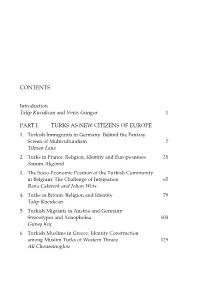
CONTENTS Introduction Talip Kucukcan and Veyis Gungor 1 PART I TURKS AS NEW CITIZENS OF EUROPE 1. Turkish Immigrants in Germany: Behind the Fantasy Screen of Multiculturalism 7 Tilman Lanz 2. Turks in France: Religion, Identity and Europeanness 35 Samim Akgönül 3. The Socio-Economic Position of the Turkish Community in Belgium: The Challenge of Integration 65 Rana Cakirerk and Johan Wets 4. Turks in Britain: Religion and Identity 79 Talip Kucukcan 5. Turkish Migrants in Austria and Germany: Stereotypes and Xenophobia 103 Günefl Koç 6. Turkish Muslims in Greece: Identity Construction among Muslim Turks of Western Thrace 129 Ali Chouseinoglou PART II YOUNG TURKS, IDENTITY PRACTICES AND INTEGRATION 7. Young Turks in England and Germany: an exploration of their identity formation and perceptions of Europe 155 Daniel Faas 8. Young Turkish-speaking People in UK: Early Employment Experiences and Dependency on Ethnic Enclave 185 Pinar Enneli and Tariq Modood 9. Identifying Ethnicity: “I’m Turkish”! 201 Lise Jönsson 10. The Musical Activities of the Young Turkish - Speaking Community in London: Identity and Nationalism 223 Paul Tkachenko 11. Integration of the Turks in Germany and the Netherlands 249 Gonul TOL 12. Immigration and Struggle for Integration: The Case of Turkish Americans 271 Ilhan Kaya PART III TURKISH WOMEN BETWEEN TRADITION AND MODERNITY 13. Starting a Family: a comparison of transition to parenthood for new parents with Swedish and Turkish background 289 Mona Franséhn and Margareta Bäck-Wiklund 14. Immigrant Women within Swedish Language Instruction Contradictions and Transgressions 313 Marie Carlson 15. Transition from the Traditional to the Modern: Islam and Turkish Women in Germany 333 Nezahat Altuntafl 16. -

Armenian Christmas at St. Vartan's Cathedral As It Kicks Off 50Th Year
JANUARY 20, 2018 Mirror-SpeTHE ARMENIAN ctator Volume LXXXVIII, NO. 26, Issue 4521 $ 2.00 NEWS The First English Language Armenian Weekly in the United States Since 1932 INBRIEF Armenian Organization Armenian Christmas at St. Vartan’s Attacked on Christmas Eve in Brussels Cathedral as it Kicks off 50th Year BRUSSELS, Belgium (Panorama.am) — Unidentified people opened fire at the Office “Sahakyan Union” of the Armenian community in NEW YORK — Temperatures in New Schaerbeek neighborhood of Brussels, York City approached zero degrees Ermenihaber reported, adding the incident took Fahrenheit on Saturday, January 6. But place the night of January 5. According to the inside the city’s St. Vartan Armenian source, nobody was injured during the attack, and Cathedral, worshippers were warmed by only the door and windows of the building were the celebration the Feast of the Nativity damaged. The organization does not operate cur- and Theophany of Our Lord Jesus Christ — rently. informally called “Armenian Christmas.” It is believed the attack in the mostly Turkish- Archbishop Khajag Barsamian, Primate populated district of the Belgian capital was moti- of the Diocese of the Armenian Church of vated by nationalism, with the source citing the America (Eastern), celebrated the Divine date of the assault conducted on the eve of the Liturgy and delivered a sermon that Christmas. touched on the theme of peace, as it relates The Istanbul-based Agos daily wrote that the to the story of Christ’s birth, to the spiritu- area was a scene of violence six years ago, when al atmosphere of the church, and to press- Armenian and Assyrian organizations in the dis- ing concerns of the world today. -

Merenics Éva / Éva Merenics Individuality, Collectivity, Locality
Merenics Éva / Éva Merenics Individuality, Collectivity, Locality and Transnationality in Armenian Genocide Processing Institute of International Relations /Nemzetközi Kapcsolatok Intézet Témavezet ő / Supervisor: Dr. Habil. Kardosné Kaponyi Erzsébet, egyetemi tanár / Dr. Habil. Elisabeth Kardos Kaponyi, university professor © Merenics Éva / Éva Merenics 2 Budapesti Corvinus Egyetem /Corvinus University of Budapest Nemzetközi Kapcsolatok Multidiszciplináris Doktori Iskola / International Relations Multidisciplinary Doctoral School INDIVIDUALITY, COLLECTIVITY, LOCALITY AND TRANSNATIONALITY IN ARMENIAN GENOCIDE PROCESSING Doktori értekezés / Doctoral dissertation Szerz ő / Author: Merenics Éva / Éva Merenics Anyanyelvi lektor/Proofreader: Frank Thomas Zsigo Ph.D. Budapest, 2015. 3 The research for the present dissertation between 2009 and 2011 was conducted within the frameworks of the Visegrad Scholarship Program in two institutes of the National Academy of Sciences of the Republic of Armenia: In the Museum-Institute of the Armenian Genocide in the academic year of 2009-2010 under the supervision of Hayk Demoyan D. Sc. (director) In the Institute of History in the academic year of 2010-2011 under the supervision of Armen Maruqyan C. Sc. (senior researcher, present head of the Department of Armenian Cause and Armenian Genocide) 4 Table of Contents List of Charts.....................................................................................................................6 1. Introduction...............................................................................................................7