2M8040 BSC V21 Cover
Total Page:16
File Type:pdf, Size:1020Kb
Load more
Recommended publications
-
Dissertação [ ] Tese
UNIVERSIDADE FEDERAL DE GOIÁS ESCOLA DE AGRONOMIA CARACTERIZAÇÃO E GERMINAÇÃO DE Dendrocalamus asper (SCHULTES F.) BACKER EX HEYNE (POACEAE: BAMBUSOIDEAE) CRISTHIAN LORRAINE PIRES ARAUJO Orientadora: Profa. Dra. Larissa Leandro Pires Setembro - 2017 TERMO DE CIÊNCIA E DE AUTORIZAÇÃO PARA DISPONIBILIZAR VERSÕES ELETRÔNICAS DE TESES E DISSERTAÇÕES NA BIBLIOTECA DIGITAL DA UFG Na qualidade de titular dos direitos de autor, autorizo a Universidade Federal de Goiás (UFG) a disponibilizar, gratuitamente, por meio da Biblioteca Digital de Te- ses e Dissertações (BDTD/UFG), regulamentada pela Resolução CEPEC nº 832/2007, sem ressarcimento dos direitos autorais, de acordo com a Lei nº 9610/98, o documento conforme permissões assinaladas abaixo, para fins de leitura, impres- são e/ou download, a título de divulgação da produção científica brasileira, a partir desta data. 1. Identificação do material bibliográfico: [ x ] Dissertação [ ] Tese 2. Identificação da Tese ou Dissertação: Nome completo do autor: Cristhian Lorraine Pires Araujo Título do trabalho: Caracterização e germinação de Dendrocalamus asper (Schultes f.) Backer ex Heyne (Poaceae: Bambusoideae) 3. Informações de acesso ao documento: Concorda com a liberação total do documento [ x ] SIM [ ] NÃO1 Havendo concordância com a disponibilização eletrônica, torna-se imprescin- dível o envio do(s) arquivo(s) em formato digital PDF da tese ou dissertação. Assinatura do(a) autor(a)2 Ciente e de acordo: Assinatura do(a) orientador(a)² Data: 26 / 06 / 2019 1 Neste caso o documento será embargado por até um ano a partir da data de defesa. A extensão deste prazo suscita justificativa junto à coordenação do curso. Os dados do documento não serão disponibilizados durante o período de embargo. -

Effect of Growth Regulators on the in Vitro Multiplication of Dendrocalamus Hamiltonii
Shatakshi Kapruwan et al. Int. Journal of Engineering Research and Applications www.ijera.com ISSN : 2248-9622, Vol. 4, Issue 11( Version 1),November 2014, pp.83-86 RESEARCH ARTICLE OPEN ACCESS Effect of growth regulators on the in vitro multiplication of Dendrocalamus Hamiltonii Shatakshi Kapruwan, Meena Bakshi, Manpreet Kaur* Department of Plant Physiology, Forest Research Institute Dehradun Abstract: Bamboos are versatile multipurpose forest product, which are important economically and are often referred to as ‘GREEN GOLD’. Dendrocalamus hamiltonii is one of the economically important species of Bamboo in India. Government of India is running National Bamboo Mission to encourage the production of Bamboos in India. The present work was undertaken to study the effect of Auxins and Cytokinins on the in vitro multiplication of nodal cuttings with axillary buds Dendrocalamus hamiltonii a bamboo species growing in North east region of India and north western Himalayas. The growth medium used was MS (1962) basal medium supplemented with BAP, Kn and NAA at varying concentrations. The multiplication rate of shoots increased with increasing the concentration of NAA and Kn. However the optimum results were obtained on MS medium supplemented with a combination of 0.5 mg/l NAA, 0.5 mg/l Kn and 1 mg/l BAP. Effect of TDZ concentration was also observed, and the results revealed that 0.25 mg/l TDZ, 0.25 mg/l PGH with 1 mg/l BAP were found to be most suitable for in vitro multiplication of Dendrocalamus hamiltonii. Key Words: Dendrocalamus hamiltonii, M S Medium, multiplication, TDZ. I. Introduction: forestry species, including bamboos. -

Bambusa Balcooa Roxb. and Dendrocalamus Stocksii Munro.) in Konkan Belt of Maharashtra, India
Journal of Bamboo & Rattan 37 J.Bamboo and Rattan,Vol. 17,Nos. 2, pp. 36 - 52 (2018) © KFRI (2018) Economic analysis of cultivation of bamboo (Bambusa balcooa Roxb. and Dendrocalamus stocksii Munro.) in Konkan belt of Maharashtra, India Sruthi Subbanna1 and SyamViswanath2* 1Institute of Wood Science and Technology, Malleswaram, Bangalore 2Kerala Forest Research Institute, Peechi, Kerala ABSTRACT :The past decade has seen an increasing impetus of growing bamboo in India. There has also been an increase in availability of micropropagated plantlets in substantial quantities. Both the reasons combined is making farmers explore bamboo cultivation as an alternative to traditional agriculture and horticulture crops. In this stusy, the economics associated with growing two bamboo species viz. Bambusa balcooa Roxb., a relatively new addition in the Konkan belt of Maharashtra and Dendrocalamus stocksii Munro., traditionally grown bamboo species in the region have been studied. The study projects that the potential of economic benefit from D. stocksii (₹ 2,28,473 or $3,147 ha-1 year-1) which is relatively greater than that of B. balcooa (₹ 1,99,715 or $2,752 annually ha-1year-1) and could primarily be attributed to greater number of new culms that emerge annually in D. stocksii (16.5±0.81) as compared to B. balcooa (7.2±0.58) for medium density block plantations. The input cost for growing the two bamboo species also varies considerably and better B/C ratio (6.02 and 5.70) was observed in D. stocksii as compared to B. balcooa (4.00 and 3.93). The study indicates that although both species are beneficial to the farmers, higher culm emergence and better culm and clump characteristics makes D. -

Download Bamboo Records (Public Information)
Status Date Accession Number Names::PlantName Names::CommonName Names::Synonym Names::Family No. Remaining Garden Area ###########2012.0256P Sirochloa parvifolia Poaceae 1 African Garden ###########1989.0217P Thamnocalamus tessellatus mountain BamBoo; "BergBamBoes" in South Africa Poaceae 1 African Garden ###########2000.0025P Aulonemia fulgor Poaceae BamBoo Garden ###########1983.0072P BamBusa Beecheyana Beechy BamBoo Sinocalamus Beechyana Poaceae 1 BamBoo Garden ###########2003.1070P BamBusa Burmanica Poaceae 1 BamBoo Garden ###########2013.0144P BamBusa chungii White BamBoo, Tropical Blue BamBoo Poaceae 1 BamBoo Garden ###########2007.0019P BamBusa chungii var. BarBelatta BarBie BamBoo Poaceae 1 BamBoo Garden ###########1981.0471P BamBusa dolichoclada 'Stripe' Poaceae 2 BamBoo Garden ###########2001.0163D BamBusa dolichoclada 'Stripe' Poaceae 1 BamBoo Garden ###########2012.0069P BamBusa dolichoclada 'Stripe' Poaceae 1 BamBoo Garden ###########1981.0079P BamBusa dolichomerithalla 'Green Stripe' Green Stripe Blowgun BamBoo Poaceae 1 BamBoo Garden ###########1981.0084P BamBusa dolichomerithalla 'Green Stripe' Green Stripe Blowgun BamBoo Poaceae 1 BamBoo Garden ###########2000.0297P BamBusa dolichomerithalla 'Silverstripe' Blowpipe BamBoo 'Silverstripe' Poaceae 1 BamBoo Garden ###########2013.0090P BamBusa emeiensis 'Flavidovirens' Poaceae 1 BamBoo Garden ###########2011.0124P BamBusa emeiensis 'Viridiflavus' Poaceae 1 BamBoo Garden ###########1997.0152P BamBusa eutuldoides Poaceae 1 BamBoo Garden ###########2003.0158P BamBusa eutuldoides -
Bamboos in Manual of Afforestation in Nepal
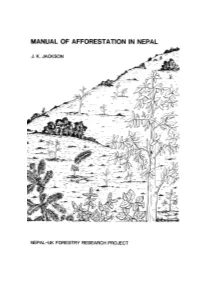
MANUAL OF AFFORESTATION IN NEPAL J. K. Jackson Silviculturist, Forestry Research Project with sections on Bamboos by C.M.A. Stapleton and Daphne by J.—P. Jeanrenaud Nepal-United Kingdom Forestry Research Project Forest Survey and Research Office Department of Forest Kathmandu, Nepal 1987 Bamboos Gramineae by C.M.A. Stapleton Occurrence and importance Until recently little was known about the identity, distribution, and uses in Nepal of the different species of bamboo. The standard reference, Gamble (1896), is not at all adequate for identification purposes in Nepal, and the herbarium specimens available are not well determined. This is understandab1e as Nepal has not been adequately covered by bamboo taxonomists in the past, and also as accurate identification of bamboo specimens requires both flowers and vegetative material. As most bamboos do not flower frequently and many species drop all their leaves and culm sheaths when they do flower, these are not usually available together, so that specimens are fragmentary. A few publications have named species from Nepal, but these have often been more guesswork than accurate identification. However, Seeland (1980) studied the names and uses of the seven bamboo species known near a village in east Nepal and successfully identified the five most important. Acharya (1975) wrote a sensible feasibility study of bamboo as the basis of cottage industry expansion in central Nepal without attempting specific identification. He used the three categories into which bamboo species are most commonly grouped in Nepali: bans, nigalo, and malingo. These three groups probably constituted a more rational taxonomy at that time than the official genera. -

Skripsi Karakteristik Morfologi Dan Sebaran
SKRIPSI KARAKTERISTIK MORFOLOGI DAN SEBARAN JENIS BAMBU DI KECAMATAN TIKALA KABUPATEN TORAJA UTARA Disusun dan diajukan oleh NITUS LAPU’ H41116009 DEPARTEMEN BIOLOGI FAKULTAS MATEMATIKA DAN ILMU PENGETAHUAN ALAM UNIVERSITAS HASANUDDIN MAKASSAR 2020 KARAKTERISTIK MORFOLOGI DAN SEBARAN JENIS BAMBU DI KECAMATAN TIKALA KABUPATEN TORAJA UTARA Skripsiinidiajukansebagaisalahsatusyaratuntukmencapaigelarsarjana padaprogramstudistratasatu (S1)padaDepartemenBiologi FakultasMatematikadanIlmuPengetahuanAlam UniversitasHasanuddin NITUS LAPU’ H41116009 DEPARTEMEN BIOLOGI FAKULTAS MATEMATIKA DAN ILMU PENGETAHUAN ALAM UNIVERSITAS HASANUDDIN MAKASSAR 2020 ii iii iv KATA PENGANTAR Segala puji syukur penulis panjatkan ke hadirat Tuhan Yang Maha Kuasa atas kasih dan pertolongan-Nya, sehingga penulis dapat menyelesaikan penyusunan skripsi yang berjudul Karakteristik Morfologi dan Sebaran Jenis Bambu di Kecamatan Tikala Kabupaten Toraja Utara, sebagai syarat kelulusan untuk memperoleh gelar sarjana. Penulis sangat bersyukur karena dapat menyelesaikan penyusunan skripsi ini, walaupun dalam menyelesaikannya penulis mengalami berbagai kesulitan dan hambatan, namun karena bantuan, bimbingan, nasehat, serta kerja sama berbagai pihak, khususnya pembimbing, sehingga kesulitan dan hambatan tersebut dapat diatasi. Terima kasih yang tak terhingga, terkhusus kepada kedua orang tuaku yakni, Ayahanda Markus Dualolo dan Ibunda terkasih Yuli Topayung, atas segala tetesan keringat dan jerih payahnya dalam membesarkan dan mengarahkan ananda sehingga dapat menyelesaikan pendidikan -
Bridging Livelihoods and Forest Conservation in Protected Areas: Exploring the Role and Scope of Non-Timber Forest Products
Bridging Livelihoods and Forest Conservation in Protected Areas: Exploring the role and scope of non-timber forest products Field experience from Satchari National Park, Habiganj, Bangladesh A dissertation paper submitted for the partial fulfillment of B.Sc. (Honors) in Forestry Submitted by Sharif Ahmed Mukul Registration no: 2001631031 Bridging Livelihoods and Forest Conservation in Protected Areas: Exploring the role and scope of non-timber forest products Field experience from Satchari National Park, Habiganj, Bangladesh Research Paper Prepared and Submitted by Sharif Ahmed Mukul Registration no. 2001631031 Department of Forestry School of Agriculture and Mineral Sciences Shahjalal University of Science and Technology May, 2007 ii Certification This is to certify that this paper entitled, ‘Bridging Livelihoods and Forest Conservation in Protected Areas: Exploring the role and scope for non-timber forest products’ is an original paper prepared by Registration no. 2001631031 (Session 2001- 02) based on his field study at Satchari National Park, Habiganj, Bangladesh for the partial fulfillment of his B.Sc. (Hons.) in Forestry degree at Shahjalal University of Science and Technology, Sylhet, Bangladesh. He has completed the work under my supervision and I do hereby approve the style and contents of this paper. A.Z.M. Manzoor Rashid Assistant Professor Department of Forestry iii Declaration This is to declare that, it is an original paper prepared by myself based on my one year field investigations at Satchari National Park, Habiganj, Bangladesh; to submit as a requirement for the partial fulfillment of B. Sc. (Hons.) degree in the Department of Forestry at School of Agriculture and Mineral Sciences of Shahjalal University of Science and Technology, Sylhet, Bangladesh. -

Pulp and Papermaking Properties of Bamboo Species Melocanna Baccifera
CELLULOSE CHEMISTRY AND TECHNOLOGY PULP AND PAPERMAKING PROPERTIES OF BAMBOO SPECIES MELOCANNA BACCIFERA SANDEEP KUMAR TRIPATHI, OM PRAKASH MISHRA, NISHI KANT BHARDWAJ and RAGHAVAN VARADHAN Avantha Centre for Industrial Research and Development, BILT Paper Mill Campus, Yamuna Nagar, Haryana, India ✉Corresponding author: S. Kumar Tripathi, sandeep@avantharesearch.com Received August, 17, 2016 Pulp and paper making properties of bamboo species Melocanna baccifera were studied with a focus on the physical properties and chemical composition of bamboo chips, on pulping behavior, bleaching response, fiber morphology, refining behavior and strength properties of the bleached pulp. Melocanna baccifera species was found to have 52.8% cellulose, 21.1% hemicelluloses and 25.2% lignin, i.e. similar to hardwood. The produced pulp could be bleached to 89 ± 1% ISO brightness. The bleached pulp refined to 25 °SR had 54.6 Nm/g tensile index, 10.7 mN.m 2/g tear index, 4.95 kN.m 2/g burst index and 328 double folds. Also, the bleached pulp had an average fiber length of 1.68 mm, which is higher than that of hardwood pulp (0.88-1.1 mm), but lower than that of softwood pulp (2.2-3.5 mm). Meanwhile, the pulp had an average fiber width of 17.1 µm, which is similar to that of hardwood fiber (16-20 µm), but lower than that of softwood fiber (28-35 µm). Keywords : bamboo, bleaching, extractives, papermaking properties, pulping INTRODUCTION dimensions has been reported among the species, Bamboo is one of the most versatile plants in but no significant differences in the chemical the world. -

Skripsi Daya Terima Organoleptik Dan Estimasi
SKRIPSI DAYA TERIMA ORGANOLEPTIK DAN ESTIMASI NILAI GIZI MI KERING REBUNG BETUNG (Dendrocalamus asper) DI SUSUN OLEH: AULIA WULAN PRAMITRI NIM: P05130216013 KEMENTERIAN KESEHATAN REPUBLIK INDONESIA POLITEKNIK KESEHATAN KEMENKES BENGKULU PROGRAM STUDI SARJANA TERAPAN GIZI DAN DIETETIKA TAHUN 2020 ii iii Program Studi Gizi Dan Dietetika Poltekkes Kemenkes Bengkulu Skripsi, Juni 2020 Aulia Wulan Pramitri DAYA TERIMA ORGANOLEPTIK DAN ESTIMASI NILAI GIZI MI KERINNG REBUNG BETUNG (Dendrocalamus asper) XIII + 71 halaman, 12 tabel, 6 gambar, 7 lampiran ABSTRAK Rebung merupakan kuncup bambu muda berasal dari akar bambu dengan sebutan lain bamboo shoot. Jenis rebung yang banyak dijumpai adalah rebung betung (D. asper) yang dimanfaatkan sebagai sayuran dan bahan makanan oleh masyarakat di pedesaan yang berada di kota Bengkulu tengah. Tujuan penelitian ini adalah untuk mengetahui daya terima organoleptik dan estimasi nilai gizi dari mi kering yang dimodifikasi dengan rebung betung. Penelitian ini merupakan penelitian Eksperimental Reaseach menggunakan rancangan acak lengkap (RAL). Uji daya terima organoleptik warna dilakukan terhadap 25 panelis terlatih. Data penelitian diperoleh melalui uji organoleptik dan estimasi nilai gizi. Data yang diperoleh dianalisis menggunakan uji Kruskall Wallis. Tidak ada perbedaan signifikan terhadap warna mi kering (p = 0,055). Uji estimasi nilai gizi diperoleh melalui Tabel Komposisi Pangan Indonesia, hasil estimasi nilai gizi pada mi kering rebung tertinggi diperoleh pada perlakuan F2 dengan total energi 410,19 kkal, protein 12,2 g, lemak 2,05 g, karbohidrat 76,23 g dan serat 0,48 g, serta menghasilkan rendemen sebesar 53,0%. Daya simpan mi kering dapat disimpan selama 4 bulan dengan menggunakan plastik polipropilen. Penelitian selanjutnya disarankan untuk melihat kandungan gizi lainnya yang terdapat pada mi kering dan dapat dijadikan sebagai makanan alternatif untuk mengurangi ketergantungan terhadap tepung terigu. -
Physical Properties
Physical Properties Chapter 3 Physical Properties of Calcutta Bamboo 3.1 Introduction Dendrocalamus strictus is commonly recognized as Calcutta bamboo [1], but also known as male bamboo [2], and solid bamboo [3]. Calcutta bamboo is the most widely used bamboo in India [4], especially for the paper industry. It is also used in house construction, basket making, mats, furniture, agriculture implement and tools handles. It is the most common species of bamboo cited in the Indian forest and is available in every state in India [5]. This species is also found in Burma, Bangladesh and Thailand, as well as being cultivated in Malaysia, Indonesia, Sri Langka and southern parts of the United States [1, 6]. The suitability of Calcutta bamboo for structural composite products will be dependent upon its physical properties. The physical properties investigated are relative density (specific gravity), equilibrium moisture content and dimensional stability. Relative density is the most important single physical characteristic of woody material. The influence of moisture content and its effects to dimensional stability are studied as a basic concern when using any forest product [7]. Dimensions start to change as the moisture content changes below the fiber saturation point. Wood-based materials are closely related to the amount of water present. Thus, in order to satisfactorily use bamboo as a raw material for composite products, the physical properties of relative density and dimensional stability, and their relation with equilibrium moisture content are studied. 53 Physical Properties Relative density (SG) is the weight of any given volume of a substance divided by the weight of an equal volume of water [9]. -
Ecological and Evolutionary Significance of Genomic GC Content
Ecological and evolutionary significance of genomic GC PNAS PLUS content diversity in monocots a,1 a a b c,d e a a Petr Smarda , Petr Bures , Lucie Horová , Ilia J. Leitch , Ladislav Mucina , Ettore Pacini , Lubomír Tichý , Vít Grulich , and Olga Rotreklováa aDepartment of Botany and Zoology, Masaryk University, CZ-61137 Brno, Czech Republic; bJodrell Laboratory, Royal Botanic Gardens, Kew, Surrey TW93DS, United Kingdom; cSchool of Plant Biology, University of Western Australia, Perth, WA 6009, Australia; dCentre for Geographic Analysis, Department of Geography and Environmental Studies, Stellenbosch University, Stellenbosch 7600, South Africa; and eDepartment of Life Sciences, Siena University, 53100 Siena, Italy Edited by T. Ryan Gregory, University of Guelph, Guelph, Canada, and accepted by the Editorial Board August 5, 2014 (received for review November 11, 2013) Genomic DNA base composition (GC content) is predicted to signifi- arises from the stronger stacking interaction between GC bases cantly affect genome functioning and species ecology. Although and the presence of a triple compared with a double hydrogen several hypotheses have been put forward to address the biological bond between the paired bases (19). In turn, these interactions impact of GC content variation in microbial and vertebrate organ- seem to be important in conferring stability to higher order isms, the biological significance of GC content diversity in plants structures of DNA and RNA transcripts (11, 20). In bacteria, for remains unclear because of a lack of sufficiently robust genomic example, an increase in GC content correlates with a higher data. Using flow cytometry, we report genomic GC contents for temperature optimum and a broader tolerance range for a spe- 239 species representing 70 of 78 monocot families and compare cies (21, 22). -

Dendrocalamus Hamiltonii
Harvesting method optimizing shoot and culm production in Dendrocalamus hamiltonii András Darabant, Prem B. Rai, Christina L. Staudhammer, Tshewang Dorji Background Poverty alleviation potential of NTFPs •NTFPs – great potential for poverty alleviation under optimal conditions •NTFP development one of the key strategies to alleviate poverty in Bhutan Problems •Lack of resource assessment methods •Lack of sustainable utilization standards/methods •Etc. Background Potential of bamboo Dendrocalamus hamiltonii •One the the priority species of NTFP development in Bhutan •Used for construction, fencing, baskets, containers, shoots eaten fresh or pickled Constraints •Lack of interest in intensive management (irrigation, fertilization) •Aim to harvest bamboo from wild stands with little input Solution •Proper bamboo silviculture Methods - Species Dendrocalamus hamiltonii •Central Himalayas to Northeast India up to 1800 m, also in the sub-tropical & warm-temperate zones of Bhutan •Sympodial bamboo with pachymorph rhizomes and culms up to 25 m height •Culms thin walled – suitable for weaving •Good fodder material •D. hamiltonii var. edulis is a variety with especially palatable shoots Methods - Study area •Eastern Himalayas, Bhutan •Southern-central part of the country with warm- temperate climate •Tshanglajong Community Forest established 2010 •Altitude 870 m •Precipitation 1800 mm •Mean annual maximum 26.2 °C •Mean annual minimum 15.2 °C •Open forests dominated by Castanopsis sp., Cinnamomum sp., Flueggea virosa, Mangifera sylvatica Methods –