Bangladesh Awami League Constitution in Bangla
Total Page:16
File Type:pdf, Size:1020Kb
Load more
Recommended publications
-

26Th March 2021 Golden Jubilee of Independence Bangladesh
6 BANGLADESH FRIDAY-SUNDAY, MARCH 26-28, 2021 26th March 2021 Golden Jubilee of Independence Bangladesh Our constitution was made on the basis of the spirit of the liberation war under his direction within just 10 months. In just three and a half years, he took war-torn Bangladesh to the list of least developed country. While Bangabandhu Sheikh Mujib was advancing to build an exploitation-deprivation-free non-communal democratic 'Sonar Bangla' overcoming all obstacles, the anti-liberation forces brutally killed him along with most of his family members on 15 August 1975. After the assassination of Bangabandhu Sheikh Mujib, the development and progress of Bangladesh came to a halt. The politics of killing, coup and conspiracy started in our beloved motherland. The assassins and their accomplices promulgated the 'Indemnity Ordinance' to block the trial of this heinous murder in the history. Getting the public mandate in 1996, Bangladesh Awami League formed the government after long 21 years. After assuming the office, we took the initiatives to establish H.E. Mr. Md. Abdul Hamid H.E. Sheikh Hasina Bangladesh as a self-respectful in the comity of Hon’ble President of Hon’ble Prime Minister of nations. Through the introduction of social Bangladesh Bangladesh safety-net programs, poor and marginalized people are brought under government allowances. We made the country self-sufficient Today is 26th March, our Independence and Today is the 26th March- our great in food production with special emphasis on National Day. This year we are celebrating the Independence Day. Bangladesh completes 50 agricultural production. The Ganges Water Sharing Treaty was signed with India in 1996. -
Predators 2021 8 7 6 5 4 3 2 1
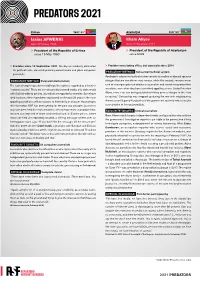
1 2 3 4 5 6 7 8 1 2 3 4 5 6 7 8 8 7 6 5 4 3 2 1 PREDATORS 2021 8 7 6 5 4 3 2 1 Azerbaijan 167/180* Eritrea 180/180* Isaias AFWERKI Ilham Aliyev Born 2 February 1946 Born 24 December 1961 > President of the Republic of Eritrea > President of the Republic of Azerbaijan since 19 May 1993 since 2003 > Predator since 18 September 2001, the day he suddenly eliminated > Predator since taking office, but especially since 2014 his political rivals, closed all privately-owned media and jailed outspoken PREDATORY METHOD: Subservient judicial system journalists Azerbaijan’s subservient judicial system convicts journalists on absurd, spurious PREDATORY METHOD: Paranoid totalitarianism charges that are sometimes very serious, while the security services never The least attempt to question or challenge the regime is regarded as a threat to rush to investigate physical attacks on journalists and sometimes protect their “national security.” There are no more privately-owned media, only state media assailants, even when they have committed appalling crimes. Under President with Stalinist editorial policies. Journalists are regarded as enemies. Some have Aliyev, news sites can be legally blocked if they pose a “danger to the state died in prison, others have been imprisoned for the past 20 years in the most or society.” Censorship was stepped up during the war with neighbouring appalling conditions, without access to their family or a lawyer. According to Armenia over Nagorno-Karabakh and the government routinely refuses to give the information RSF has been getting for the past two decades, journalists accreditation to foreign journalists. -

Bangladesh Beckons 2020
CONTENTS 1 Message from Honʼble President 2 Message from Honʼble Prime Minister 3 Message from Honʼble Foreign Minister 4 Message from Honʼble State Minister for Foreign Affairs 5 A Few Words from the High Commissioner 8 Bangabandhu in Timeline 12 Bangabandhu: The Making of a Great Leader 15 Bangabandhu: A Poet of Politics 18 The Greatest Speech of the Greatest Bangali 21 The Political Philosophy of Bangabandhu 25 Bangabandhu's Thoughts on Economic Development 28 Foreign Policy in Bangabandhu's Time 31 People-centric Education Policy of Bangabandhu Chief Editor Photos His Excellency External Publicity Wing, 34 Bangabandhu, Who Set the Tone of Md. Mustafizur Rahman Ministry of Foreign Affairs, Agricultural Revolution Dhaka Official website of Mujib Executive Editor Borsho Celebration Bangabandhu and his Policy of Health for All Committee 37 Md. Toufiq-ur-Rahman (https://mujib100.gov.bd/) Collections from Public 41 Bangabandhu: What the World Needs to Know Editorial Team Domain A.K.M. Azam Chowdhury Learnings from Bangabandhu's Writings Mohammad Ataur Rahman Portraits 45 Sabbir Ahmed Shahabuddin Ahmed Md. Rafiqul Islam Ahmed Shamsuddoha 47 What Lessons We Can Learn from Morioum Begum Shorna Moniruzzaman Monir Sheikh Mujibur Rahman Shahjahan Ahmed Bikash Cover Photo Kamaluddin Painting of Ahmed Samiran Chowdhury 50 Bangabandhu and Nelson Mandela: Samsuddoha Drawing a Parallel Courtesy of Hamid Group Design and Printing Kaleido Pte Ltd 53 Lee Kuan Yew and Sheikh Mujib: Article Sources 63 Ubi Avenue 1, #06-08B 63@Ubi, Singapore 408937 Titans of Tumultuous Times Collections from Public Domain M: 9025 7929 T: 6741 2966 www.kaleidomarketing.com Write ups by the High 55 Bangabandhu in the Eyes of World Leaders Commission 57 Tributes to Bangabandhu in Pictures Property of the High Commission of the People’s Republic of Bangladesh #04-00/ #10-00, Jit Poh Building, 19 Keppel Road, 58 Bangabandhu Corner in Pictures Singapore 089058, Tel. -

30 November 2011 Berlin, Dhaka Friends: Wulff
PRESSE REVIEW Official visit of German Federal President in Bangladesh 28 – 30 November 2011 Bangladesh News 24, Bangladesch Thursday, 29 November 2011 Berlin, Dhaka friends: Wulff Dhaka, Nov 29 (bdnews24.com) – Germany is a trusted friend of Bangladesh and there is ample scope of cooperation between the two countries, German president Christian Wulff has said. Speaking at a dinner party hosted by president Zillur Rahman in his honour at Bangabhaban on Tuesday, the German president underlined Bangladesh's valuable contribution to the peacekeeping force. "Bangladesh has been one of the biggest contributors to the peacekeeping force to make the world a better place." Prime minister Sheikh Hasina, speaker Abdul Hamid, deputy speaker Shawkat Ali Khan, ministers and high officials attended the dinner. Wulff said bilateral trade between the two countries is on the rise. On climate change, he said Bangladesh should bring its case before the world more forcefully. http://bdnews24.com/details.php?id=212479&cid=2 [02.12.2011] Bangladesh News 24, Bangladesch Thursday, 29 November 2011 'Bangladesh democracy a role model' Bangladesh can be a role model for democracy in the Arab world, feels German president. "You should not mix religion with power. Tunisia, Libya, Egypt and other countries are now facing the problem," Christian Wulff said at a programme at the Dhaka University. The voter turnout during polls in Bangladesh is also very 'impressive', according to him. The president came to Dhaka on a three-day trip on Monday. SECULAR BANGLADESH He said Bangladesh is a secular state, as minority communities are not pushed to the brink or out of the society here. -
Extensions of Remarks E305 EXTENSIONS of REMARKS
March 12, 2020 CONGRESSIONAL RECORD — Extensions of Remarks E305 EXTENSIONS OF REMARKS CELEBRATING AMERICA’S NEWEST of punishment, and assemble in peaceful pro- is a Brotherhood member of the Order of the CITIZENS test should they choose to do so. Arrow and holds the rank of Firebuilder in the Madam Speaker, I respectfully ask you and tribe of Mic-O-Say. Dillon has also contributed HON. PETER J. VISCLOSKY my other distinguished colleagues to join me to his community through his Eagle Scout OF INDIANA in congratulating these individuals who will be- project. Dillon constructed a butterfly garden, IN THE HOUSE OF REPRESENTATIVES come citizens of the United States of America bird feeder, and bird bath outside of Life Un- on March 13, 2020. They, too, will be Amer- limited in Liberty, Missouri. Thursday, March 12, 2020 ican citizens, guaranteed the inalienable rights Madam Speaker, I proudly ask you to join Mr. VISCLOSKY. Madam Speaker, it is with to life, liberty, and the pursuit of happiness. me in commending Dillon J. Carr for his ac- great pleasure and sincerity that I take this We, as a free and democratic nation, con- complishments with the Boy Scouts of Amer- time to congratulate fifty individuals who will gratulate them and welcome them. ica and for his efforts put forth in achieving the take their oaths of citizenship on March 13, f highest distinction of Eagle Scout. 2020. This memorable occasion will be held at f the United States Courthouse and Federal BIMBO BAKERIES USA ANNIVERSARY OF BIRTH OF Building in Hammond, Indiana. -

From Parastatals to Private Trade
5 Public Food Distribution System in Bangladesh: Successful Reforms and Remaining Challenges A. M. M. SHAWKAT ALI, ISHRAT JAHAN, AKHTER AHMED, AND SHAHIDUR RASHID Despite beginning its journey with a war-torn infrastructure in 1971, haunting experiences of a famine in 1974, and repeated bouts of floods and other natu• ral calamities, Bangladesh is now widely recognized for successfully trans• forming its grain market structures. Behind this success is a series of reforms, which included, among others, dismantling the food rationing system and eas• ing restrictions on both domestic and international trade of grain in the early 1990s. Available studies suggest that the policy reforms have produced all the desired outcomes—that is, increased private-sector participation, reduction in food subsidy bills, higher food availability, and increased stability of grain prices (Ahmed, Haggblade, and Chowdhury 2000). Furthermore, unlike many other developing countries, the reforms did not provoke popular protests. How did it all happen? Clearly, a host of factors contributed to the success, but the answer to the question in large part lies in the government's commitment to changing the old set of policies and redefining its role in the grain markets.1 By the late 1980s, evidence on the ineffective, or even counterproductive, nature of the old set of policies was mounting, and the government and its de• velopment partners were convinced that the country's food policies had to be changed. Both food rationing and public procurement were found ineffective; and none of the then-existing public distribution programs were reaching the poor. However, given the level of food insecurity, as well as vulnerability of the country to natural calamities, it was also clear that complete government with• drawal from the cereal markets was not a feasible reform option. -

South Asia @ LSE: an Indian and Bangladeshi Journey Page 1 of 3
South Asia @ LSE: An Indian and Bangladeshi Journey Page 1 of 3 An Indian and Bangladeshi Journey Having qualified in the UK during the late 1960s in General Agriculture and Animal Husbandry, I joined a Gandhi Peace Foundation village development programme in famine-affected Bihar (India) funded by OXFAM. I was based at Vinoba Bhave’s Samanvaya Ashram in Bodh Gaya, and worked with the ‘untouchable’ castes, named ‘Harijans’ (‘Children of God’) by Gandhi. Working with the extreme poor and helping set up an agriculture-based children’s school prepared me very well for my unexpected future life. Samanvaya Ashram, Bodh Gaya, Bihar (India), February 1970. Front row (L-R): Don Nuttall; Alan J Leather (in waistcoat; then Oxfam Assistant Field Director, Eastern India); Clive Bell; Julian Francis; Judith Hart (then Minister for Overseas Development, UK); Back row (L-R): Stephen Biggs; Richard Taylor (then Oxfam Field Director for Eastern India & East Pakistan) & Sally Taylor. © For copyright information, see below. In early 1971, I found myself thrown into a most demanding role for a young man of 26 years. I was asked to move quickly from Bihar to Calcutta (now Kolkata) to assist in an enormous refugee relief programme which cared for refugees fleeing in terror from Bangladesh. Eventually, I had the privilege and responsibility of administering OXFAM’s relief programme for about 600,000 of the 10 million refugees who had fled from East Pakistan (later Bangladesh) to India, and were staying in the over 900 refugee camps on the border area between India and East Pakistan. Date originally posted: 2021-03-15 Permalink: https://blogs.lse.ac.uk/southasia/2021/03/15/an-indian-and-bangladeshi-journey/ Blog homepage: https://blogs.lse.ac.uk/southasia/ South Asia @ LSE: An Indian and Bangladeshi Journey Page 2 of 3 Office of Frères des Hommes (“Brothers to all Men”), a French NGO involved in relief work, Buniyad Ganj, Gaya, Bihar (India), July 1968. -

India and Bangladesh Relationship Since 1971
26 April, 2021 India and Bangladesh relationship since 1971 (The Hindu Editorial) Introduction Bangladesh and India both celebrated the golden jubilee of Bangladesh’s Independence recently, alongside the birth centenary of ‘Banghabandu’ Sheikh Mujibur Rahman. The creation of Bangladesh — from the ashes of East Pakistan — is presumably India’s finest foreign policy triumph till date, and it defies imagination why India has been so reticent in acknowledging this fact. The architect, India’s stand A plausible reason put forward in certain quarters is that it possibly meant acknowledging the role of former Prime Minister Indira Gandhi in this seminal event, as she is widely acknowledged to be the real architect of this triumph, notwithstanding claims put forward by many a swashbuckling General and others in uniform. It would amount to ignoring historical facts, for without Prime Minister Indira Gandhi, it is difficult to conceive of India pulling off such a triumph. As for instance when it was communicated to her during a meeting of the War Cabinet, that the U.S. Seventh Fleet (which included the nuclear powered aircraft carrier, Enterprise) was steaming up the Bay of Bengal, will hardly dispute this fact. Displaying no signs of diffidence, she made it clear that it made little difference to the cause that they had embarked upon. Few nations across the world can possibly boast of an achievement of this nature. What is even more noteworthy is that while accomplishing this task, India did not claim any ‘spoils of victory’. After Pakistan’s defeat in East Pakistan, India voluntarily and unconditionally, handed over power to the elected representatives of the newly established nation. -

Armed Forces War Course-2013 the Ministers the Hon’Ble Ministers Presented Their Vision
National Defence College, Bangladesh PRODEEP 2013 A PICTORIAL YEAR BOOK NATIONAL DEFENCE COLLEGE MIRPUR CANTONMENT, DHAKA, BANGLADESH Editorial Board of Prodeep Governing Body Meeting Lt Gen Akbar Chief Patron 2 3 Col Shahnoor Lt Col Munir Editor in Chief Associate Editor Maj Mukim Lt Cdr Mahbuba CSO-3 Nazrul Assistant Editor Assistant Editor Assistant Editor Family Photo: Faculty Members-NDC Family Photo: Faculty Members-AFWC Lt Gen Mollah Fazle Akbar Brig Gen Muhammad Shams-ul Huda Commandant CI, AFWC Wg Maj Gen A K M Abdur Rahman R Adm Muhammad Anwarul Islam Col (Now Brig Gen) F M Zahid Hussain Col (Now Brig Gen) Abu Sayed Mohammad Ali 4 SDS (Army) - 1 SDS (Navy) DS (Army) - 1 DS (Army) - 2 5 AVM M Sanaul Huq Brig Gen Mesbah Ul Alam Chowdhury Capt Syed Misbah Uddin Ahmed Gp Capt Javed Tanveer Khan SDS (Air) SDS (Army) -2 (Now CI, AFWC Wg) DS (Navy) DS (Air) Jt Secy (Now Addl Secy) A F M Nurus Safa Chowdhury DG Saquib Ali Lt Col (Now Col) Md Faizur Rahman SDS (Civil) SDS (FA) DS (Army) - 3 Family Photo: Course Members - NDC 2013 Brig Gen Md Zafar Ullah Khan Brig Gen Md Ahsanul Huq Miah Brig Gen Md Shahidul Islam Brig Gen Md Shamsur Rahman Bangladesh Army Bangladesh Army Bangladesh Army Bangladesh Army Brig Gen Md Abdur Razzaque Brig Gen S M Farhad Brig Gen Md Tanveer Iqbal Brig Gen Md Nurul Momen Khan 6 Bangladesh Army Bangladesh Army Bangladesh Army Bangladesh Army 7 Brig Gen Ataul Hakim Sarwar Hasan Brig Gen Md Faruque-Ul-Haque Brig Gen Shah Sagirul Islam Brig Gen Shameem Ahmed Bangladesh Army Bangladesh Army Bangladesh Army Bangladesh -

Great Game to 9/11
Air Force Engaging the World Great Game to 9/11 A Concise History of Afghanistan’s International Relations Michael R. Rouland COVER Aerial view of a village in Farah Province, Afghanistan. Photo (2009) by MSst. Tracy L. DeMarco, USAF. Department of Defense. Great Game to 9/11 A Concise History of Afghanistan’s International Relations Michael R. Rouland Washington, D.C. 2014 ENGAGING THE WORLD The ENGAGING THE WORLD series focuses on U.S. involvement around the globe, primarily in the post-Cold War period. It includes peacekeeping and humanitarian missions as well as Operation Enduring Freedom and Operation Iraqi Freedom—all missions in which the U.S. Air Force has been integrally involved. It will also document developments within the Air Force and the Department of Defense. GREAT GAME TO 9/11 GREAT GAME TO 9/11 was initially begun as an introduction for a larger work on U.S./coalition involvement in Afghanistan. It provides essential information for an understanding of how this isolated country has, over centuries, become a battleground for world powers. Although an overview, this study draws on primary- source material to present a detailed examination of U.S.-Afghan relations prior to Operation Enduring Freedom. Opinions, conclusions, and recommendations expressed or implied within are solely those of the author and do not necessarily represent the views of the U.S. Air Force, the Department of Defense, or the U.S. government. Cleared for public release. Contents INTRODUCTION The Razor’s Edge 1 ONE Origins of the Afghan State, the Great Game, and Afghan Nationalism 5 TWO Stasis and Modernization 15 THREE Early Relations with the United States 27 FOUR Afghanistan’s Soviet Shift and the U.S. -
List of Trainees of Egp Training
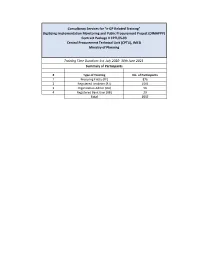
Consultancy Services for “e-GP Related Training” Digitizing Implementation Monitoring and Public Procurement Project (DIMAPPP) Contract Package # CPTU/S-03 Central Procurement Technical Unit (CPTU), IMED Ministry of Planning Training Time Duration: 1st July 2020- 30th June 2021 Summary of Participants # Type of Training No. of Participants 1 Procuring Entity (PE) 876 2 Registered Tenderer (RT) 1593 3 Organization Admin (OA) 59 4 Registered Bank User (RB) 29 Total 2557 Consultancy Services for “e-GP Related Training” Digitizing Implementation Monitoring and Public Procurement Project (DIMAPPP) Contract Package # CPTU/S-03 Central Procurement Technical Unit (CPTU), IMED Ministry of Planning Training Time Duration: 1st July 2020- 30th June 2021 Number of Procuring Entity (PE) Participants: 876 # Name Designation Organization Organization Address 1 Auliullah Sub-Technical Officer National University, Board Board Bazar, Gazipur 2 Md. Mominul Islam Director (ICT) National University Board Bazar, Gazipur 3 Md. Mizanoor Rahman Executive Engineer National University Board Bazar, Gazipur 4 Md. Zillur Rahman Assistant Maintenance Engineer National University Board Bazar, Gazipur 5 Md Rafiqul Islam Sub Assistant Engineer National University Board Bazar, Gazipur 6 Mohammad Noor Hossain System Analyst National University Board Bazar, Gazipur 7 Md. Anisur Rahman Programmer Ministry Of Land Bangladesh Secretariat Dhaka-999 8 Sanjib Kumar Debnath Deputy Director Ministry Of Land Bangladesh Secretariat Dhaka-1000 9 Mohammad Rashedul Alam Joint Director Bangladesh Rural Development Board 5,Kawranbazar, Palli Bhaban, Dhaka-1215 10 Md. Enamul Haque Assistant Director(Construction) Bangladesh Rural Development Board 5,Kawranbazar, Palli Bhaban, Dhaka-1215 11 Nazneen Khanam Deputy Director Bangladesh Rural Development Board 5,Kawranbazar, Palli Bhaban, Dhaka-1215 12 Md. -
Essays on the History of Sindh.Pdf
Essays On The History of Sindh Mubarak Ali Reproduced by Sani H. Panhwar (2019) CONTENTS Introduction .. .. .. .. .. .. .. .. .. 1 Historiography of Sindh .. .. .. .. .. .. .. .. 6 Nasir Al-Din Qubachah (1206-1228) .. .. .. .. .. .. 12 Lahribandar: A Historical Port of Sindh .. .. .. .. .. 22 The Portuguese in Sindh .. .. .. .. .. .. .. .. 29 Sayyid Ahmad Shahid In Sindh .. .. .. .. .. .. 35 Umarkot: A Historic City of Sindh .. .. .. .. .. .. 39 APPENDIX .. .. .. .. .. .. .. .. 49 Relations of Sindh with Central Asia .. .. .. .. .. .. 70 Reinterpretation of Arab Conquest of Sindh .. .. .. .. .. 79 Looters are 'great men' in History! .. .. .. .. .. .. 81 Index .. .. .. .. .. .. .. .. .. .. 85 INTRODUCTION The new history creates an image of the vanquished from its own angle and the defeated nation does not provide any opportunity to defend or to correct historical narrative that is not in its favour. As a result, the construction of the history made by the conquerors becomes valid without challenge. A change comes when nations fight wars of liberation and become independent after a long and arduous struggle. During this process, leaders of liberation movements are required to use history in order to fulfil their political ends. Therefore, attempts are made to glorify the past to counter the causes of their subjugation. A comprehensive plan is made to retrieve their lost past and reconstruct history to rediscover their traditions and values and strengthen their national identity. However, in some cases, subject nations are so much integrated to the culture of their conquerors that they lose their national identity and align themselves with foreign culture. They accept their version of history and recognize the aggressors as their heroes who had liberated them from their inefficient rulers and, after elimination of their out- dated traditions, introduced them to modern values and new ideas.