Baltic Country Holidays WILDLIFE TOURS
Total Page:16
File Type:pdf, Size:1020Kb
Load more
Recommended publications
-

Family Vault of the Dukes of Courland
FAMILY VAULT OF THE DUKES OF COURLAND The family vault of the Dukes of Courland is located on the basement-floor level of the south-east corner of Jelgava Palace, seemingly connecting Rastrelli’s building and the old Jelgava medieval castle. The first members of the Kettler family, the Duke Gotthard’s under aged sons, had died in Riga Castle, were buried in Kuldīga and only later brought to Jelgava. The Duke Wilhelm’s wife Sophie who died in 1610 also had been buried in Kuldīga castle church was completed; there was a cellar beneath it for the Dukes’ sarcophagi. The cellar premise was about 9 m wide, with a free passage in the middle and covered by a barrel vault. In 1587, the Duke Gotthard was the first to be buried there; 24 members of the Ket- tler family were buried until 1737. During the Northern War; in September 1705, the crypt was damaged for the first time when Swedish soldiers broke off several sarcophagi and stole jewellery. In 1737 when the castle was blown up, the church and crypt were destroyed as well. Sarcophagi were placed in the shed while the family vault premise was built on the basement floor of the new palace. The new crypt consisted of two rather small vaulted premises on the basement floor of the southern block, with a separate entrance from out- side that was walled up later. The Birons did not realize the idea of a separate family vault. In 1819, a call to the Courland society was announced to donate money for the reconstruction of the Dukes’ family vault. -
Protected Areas and Opportunities for Ecotourism in Latvia
Protected areas and opportunities for ecotourism in Latvia Valdis Pilâts Gauja National Park, Baznîcas iela 3, Sigulda, LV-2150, Latvia pilats@lanet.lv Introduction In Latvia similarly to elsewhere, nature based tourism and nature protection have clo- sely evolved. For instance, Gauja River valley with sandstone outcrops became a fa- mous destination place for travellers already at the beginning of the 19th century. German travellers who compared it to the Elba in Saxony and to the “Switzerland of Saxony” called it the “Switzerland of Livland”. In 1920s the first three areas of Gauja valley obtained the status of protected areas, and in 1930s a National Park of 375 ha was created there. During the first period of independence in the first half of 20th century Latvia had a powerful tourism industry. Income from tourism was almost twice the income from our main export product - bacon. Already in the 1930’s tourism was regar- ded as an essential component of regional development, which succeeded in stimula- ting economic development, maintaining the traditional rural landscape and also play- ing a role in public education about history and nature. Unfortunately, during the mid 1900’s Latvia was once again embroiled in war, and incorporated in the Soviet Union. As a result it was isolated behind the “iron curtain” and therefore still is a “blank spot “ on today’s European and World tourist maps. Nowadays Latvia similarly to other Eastern European States in post-communist transition period is looking for new ways to strengthen national economy. Tourism is one of the areas with greatest potential for development. -

Ainavu Arhitektūra Un Plānošana 20 Gadi = 20 Years of Landscape
AINAVU ARHITEKTŪRA UN PLĀNOŠANA 20 GADI 20 YEARS OF LANDSCAPE ARCHITECTURE AND PLANNING AINAVU ARHITEKTŪRA UN PLĀNOŠANA 20 GADI 20 YEARS OF LANDSCAPE ARCHITECTURE AND PLANNING Jelgava 2015 AINAVU ARHITEKTŪRA UN PLĀNOŠANA 20 GADI 20 YEARS OF LANDSCAPE ARCHITECTURE AND PLANNING Fotogrāfijas no fakultātes, katedras un rakstu autoru personīgiem arhīviem Izdevumu sastādīja: Natalija Ņitavska, Madara Markova www.llu.lv Drukāts SIA „Talsu tipogrāfija” ISBN 978-9984-48-184-5 Elektr.: ISBN 978-9984-48-185-2 Jelgava 2015 Ievads/ Introduction Līdz ar 20 gadu atzīmes sasniegšanu Latvijas By celebrating the reach of 20 years Landscape Lauksaimniecības universitātes Ainavu arhitektūras Architecture Specialty of Latvia University of Agriculture specialitāte ir ieguvusi jaunas mājas Valdekas pilī. Šobrīd has acquired new home in Valdekas Castle. Currently, we varam droši teikt, ka beidzot esam tā pa īstam ieskrējušies may say for sure that finally we are taking a run and being un gatavi jauniem izaicinājumiem. Ainavu arhitektūras ready for new challenges. Landscape Architecture specialitāte pēc studējošo skaita šobrīd ir otrā lielākā Specialty according to number of students is second Lauku inženieru fakultātē pēc Būvniecības specialitātes. largest in the Faculty of Rural Engineering right after Liels nopelns te ir vienmēr aktīvajiem pasniedzējiem, kas Building. Great merit for that goes to always active ir patiesi savas jomas patrioti. Jāsaka, ka arī mūsu studenti professors that are true patriots of their profession. Also it un absolventi vienmēr gatavi īstenot visdrosmīgākās must be said that our students and graduates are always idejas. Aizvien vairāk izejam starptautiskajā telpā. ready to implement the craziest ideas. Increasingly we are ERASMUS+ programmas un BOVA (Baltijas going out into international environment. -

Mushroom Tour at Vidzeme Region
www.countryholidays.lv Mushroom Tour at Vidzeme region Tallinn This is for people who enjoy forests, wildlife and has an interest in mushrooms – different species as well as their various ways of preparation. The tour is lead by the professional mycologist and combines the mysteri- ous world of mushrooms with local culinary traditions. The group is introduced with mushrooms growing at the forests, meadows, old parks and even yards. The mycologist will help to discover edible and poisonous mushrooms as well as rare and common ones . The tour passes through valuable nature and culture heritage Rīga sites and small villages on the way. During the tour you will see at least 100 different mushroom species and explore various forests with their typical flora and fauna. Everyone could try their hand at mushrooming and by the end of the day together with guide sort them out and cook in delicious meal. Vilnius (7 days) General Route: Rīga - Lielstraupe Day 3 - Cēsis - Zilais kalns - Strenči - Valka - Gauja National Park: Zvārte Cliff – Cēsis Āraiši - Sigulda - Mālpils - Rīga – Ungurmuiža We will walk the nature trail along the Day 1 Amata river that guarantees spectacular Arrival in Rīga views, including impressive sandstone Departure to the hotel in the city centre. Zvartes Cliff, and mushrooms typical Introductory meeting with the guide at for river banks and alluvial forests like the Latvian Nature Museum which can Chaga Inonotys obliquus that is used in be followed by the excursion to the Cen- medicine or Alder Bracket Inonotus radia- tus that changes its colour depending of Golden Chanterelle Cantharellus cibarius tral Market. -

Proposal for FOSS4G Europe 2020 Valmiera Th 30 September 2019
Proposal for FOSS4G Europe 2020 Valmiera th 30 September 2019 OVERVIEW In cooperation with Valmiera City council and Valmiera Development Agency we propose the FOSS4G Europe 2020 conference to take place in Valmiera, Latvia. We would like to propose the FOSS4G Europe 2020 conference to take place in Valmiera as the international nor european FOSS4G events have not yet been to this North-Eastern part of Europe. Latvia is democratic republic for almost 30 years and part of the European Union for the past 15 years the conference would be set in an environment that the FOSS4GE event has not been in before. As with Latvia’s setting in the zigzag of history the guiding motto behind the conference would be to remember the past but look and live for the future. Valmiera is a town situated in the historic Vidzeme region on the banks of the Gauja river. About 100 km North-East from the Latvian capital Rīga, and 50 km from the Estonian Southern border. The place dates back to the 13th century; Valmiera was founded in 1283 with city rights granted in 1323. Valmiera was a site of the Livonian Order (an autonomous branch of the Teutonic Order) stronghold - Valmiera castle. To this day the castle’s ruins lie in the city centre. Most of the old buildings dating back to the 18th-19th century were destroyed in the fires during the last war. Nevertheless we would like to urge the participants to discover the city and its historic surroundings as an extracurricular activity to the conference: hiking the Gauja National Park, kayaking on the Gauja river, bobsleighing in Sigulda, and a visit to the Turaida castle. -

Turaida. Turaida Ravines and Caves
6 km TURAIDA. TURAIDA RAVINES AND CAVES Gūtmaņala Cave Tracks in Gauja valley Photo: Baltic Pictures and the Archive of Sigulda TIC Turaida Castle Description Distance Starting point/ destination For travellers interested in the nature ~ 6 km. Parking lot at the Gūtmaņala Cave and culture monuments located on Visitor Centre. 24.84699, 57.17633 the banks of the old Gauja valley. The Route reason why fortified settlements by Gūtmaņala Cave Visitor Centre – Way marking Livs later followed by monolith stone Vikmeste Valley – Mounds Taurētāju None on site. castles erected by Germans were and Rata – Mound Kārļa – Turaida established here are the natural – Turaida Museum Reserve – Dainu Distance to Riga conditions and geologic processes kalns or the Hill of Folksongs – stairs 55 km. over the last 10,000–15,000 years and leading down from Dainu kalns to the consequences thereof — complicated River Gauja – Turaidas Street (Igauņu Public transportation terrain, steep ravines and rock Ravine) – Gūtmaņala Cave Visitor The train Riga-Sigulda operates 8-9 pillars on banks in the places of their Centre. times per day; Turaida is reached by interactions, onto which castles were bus (buses going to Krimulda or In- erected. Were the primeval valley not Duration ciems), bus stop “Turaida”, electric formed by the glacier, the nature and Half-day or a full day route. car, or on foot (5 km). culture landscape of Sigulda would be completely different! Difficulty level Worth knowing! Moderate. Some sections — banks Suitable trekking footwear and a Best time to go of the primeval valley of the River map of Turaida is needed. -

Promocijas Darba Kopsavilkums : Latvijas Vēsturiskie Dārzi Un Parki
Latvijas Lauksaimniecības universitāte Lauku inženieru fakultāte Arhitektūras un būvniecības katedra Latvia University of Agriculture Faculty of Rural Engineering Department of Architecture and Construction Mg. arch. Kristīne Dreija LATVIJAS VĒSTURISKIE DĀRZI UN PARKI MŪSDIENU LAUKU AINAVĀ HISTORIC GARDENS AND PARKS OF LATVIA IN PRESENT RURAL LANDSCAPE Promocijas darba KOPSAVILKUMS Arhitektūras doktora (Dr.arch.) zinātniskā grāda iegūšanai ainavu arhitektūras apakšnozarē SUMMARY of Doctoral thesis for the scientific degree Dr.arch. in landscape architecture ________________ (paraksts) Jelgava 2013 INFORMĀCIJA Promocijas darbs izstrādāts Latvijas Lauksaimniecības universitātes, Lauku inženieru fakultātes, Arhitektūras un būvniecības katedrā Doktora studiju programma – Ainavu arhitektūra Promocijas darba zinātniskā vadītāja – arhitektūras un būvniecības katedras profesore, Dr.phil. Māra Urtāne Promocijas darba zinātā aprobācija noslēguma posmā: 1. apspriests un aprobēts LLU LIF Arhitektūras un būvniecības katedras personāla pārstāvju sēdē 2012. gada 24. janvārī; 2. apspriests un aprobēts LLU LIF akadēmiskā personāla pārstāvju sēdē 2012. gada 19. jūnijā, un atzīts par sagatavotu iesniegšanai Promocijas padomei; 3. atzīts par pilnībā sagatavotu un pieņemts 2012. gada 8. novembrī. Oficiālie recenzenti: 1. Latvijas Lauksaimniecības universitātes docente, Dr.arch. Daiga Zigmunde 2. Valsts kultūras pieminekļu aizsardzības inspekcijas vadītājs, Dr.arch. Juris Dambis 3. Tartu universitātes profesors, Dr. phil. Simon Bell Promocijas darba aizstāvēšana notiks LLU, ainavu arhitektūras apakšnozares promocijas padomes atklātā sēdē 2013. gada 21. februārī Jelgavā, Lielā ielā 2, Jelgavas pils muzejā (183. telpā), plkst. 16:00 Ar promocijas darbu var iepazīties LLU Fundamentālajā bibliotēkā, Lielā ielā 2, Jelgavā un http://llufb.llu.lv/promoc_darbi.html Atsauksmes sūtīt Promocijas padomes sekretārei – Akadēmijas ielā 19, Jelgavā, LV – 3001, tālrunis 63028791; e-pasts: una.ile@llu.lv Atsauksmes vēlams sūtīt skanētā veidā ar parakstu. -
Challenges of Small and Medium-‐Sized Urban Areas (Smuas)
Challenges of Small and Medium-Sized Urban Areas (SMUAs), their economic growth potential and impact on territorial development in the European Union and Latvia Research report to support the Latvian EU Presidency 2015 This paper has been written by HESPI and EUKN and consulted by ESPON on behalf of the Latvian Presidency of the Council of the European Union (The Ministry of Environmental Protection and Regional Development). The research is financed by the Norwegian financial instrument programme 2009-2014 No. LV07 “Strengthening of capacity and institutional cooperation between Latvian and Norwegian institutions, local and regional institutions“ Project No 4.3.-24/NFI/INP-002. Final Report, 25 May, 2015 Social, Economic and Humanities Research Institute (HESPI) of Vidzeme University of Applied Sciences Cēsu iela 4, | Valmiera, LV-4201 | Latvia Tel. + 371 64207230 | www.va.lv/en/hespi Contact: Agita Līviņa, Director of HESPI European Urban Knowledge Network EGTC Koningin Julianaplein 10 | 2495 AA The Hague | Netherlands Tel. +31 703028484 | www.eukn.eu Contact: Mart Grisel, Director of EUKN EGTC 1 List of Authors Visvaldis Valtenbergs (HESPI), Alfons Fermin (EUKN), Mart Grisel (EUKN), Lorris Servillo (ESPON), Inga Vilka (University of Latvia, Faculty of Economics and Management), Agita Līviņa (HESPI), Līga Bērzkalne (HESPI). Table of Contents List of Abbreviations .............................................................................................. 3 List of Boxes, Figures Tables and Maps .................................................................. -

Historic Parks of Latvia Historic Parks Of
Historic Parks of Latvia Guide Book of the Trip to Latvian Historic Parks 2011 LEGEND: 1. Karla Manor park 2. Anna Manor park 3. Mezotne Manor park 4. Rundale Palace park 5. Eleja Manor park 6. Jelgava Palace park 7. Remte Manor park 8. Smuku Manor park Contents Route map 1. Historic parks of Latvia 1.1. How in Latvia is defined historic park 1.2. What are Latvian historic parks, answering according definition? 1.3. What is the Latvian nature and heritage protection policy? 2. Trip to Latvian Historic Parks 2.1. Karla Manor Park 2.2. Anna Manor Park 2.3. Mezotne Manor Park 2.4. Rundale Palace Park 2.5. Eleja Manor Park 2.6. Jelgava Palace Park 2.7. Remte Manor Park 2.8. Smuku Manor Park Material resources Appendix Program of the Trip to Latvian Historic Parks Historic Parks of Latvia Kristine Dreija Every landscape has its own story, which is given by architecture, stylistics, variety of plants, composition and other objects of environment. Finding us in this environment turns us back in time… But does it always happen? Is this the right time we should go back and is the concrete landscape telling us the most beautiful story of heritage? How in Latvia is defined historic park Riga Historical Centre Preservation and Protection Act "gives the following historical terminology explanation: it is a masterpiece of human creative spirit, demonstrating important interaction of human values over a given period or place in relation to the architecture or technology, monumental arts, town planning, landscape design, which directly or materialy related to events, live traditions, artistic or literary works, that have a special universal value and which is not under the age of 25. -

Map & Tourist Guide
LOCAL GOODS FOR GOURMETS HOTELS HOLIDAY HOUSES 1 | Valmiermuiža beer brewery Hotel "Dikļu pils" Holiday house "Mednieku namiņš" www.celotajs.lv/ The brewery offers both excursions and beer tastings, sells live Dzirnavu iela 2, Valmiermuiža Dikļi, Kocēni municipality ph. 64207480 www.diklupils.lv GPS: 57.5978, 25.1025 Mednieku, Sigulda ph. 26553922 medniekunamins GPS: 57.1618, 24.8255 beer, bath-house accessories and souvenirs. There is also a little phone: 20264269 Hotel "Aparjods" Holiday house "Pilskalni" “Pilskalni”, pub where you can enjoy beer foods and organize celebrations. www.valmiermuiza.lv Ventas iela 1a, Sigulda ph. 67972230 www.aparjods.lv GPS: 57.1414, 24.8446 Kocēni parish, Kocēni municipality ph. 29299268 www.pilskalni.lv GPS: 57.4615, 25.2684 Visitors are welcome to ride a horse or a pony and see the park of GPS: 57.5559, 25.4311 Hotel "Kārļamuiža" Holiday house "Ezerklabi" Valmiermuiža, or to get acquainted with the surroundings of “Kārļamuiža”, Kārļi, Amata municipality ph. 26165298 www.karlamuiza.lv GPS: 57.2406, 25.2121 “Jaun-Klabi”, Amata parish, Amata municipality ph. 29266445 www.ezerklabi.lv GPS: 57.1784, 25.2449 Valmiermuiža on horseback. SPA hotel "Ezeri" Holiday house "Jaunbrenguļi" “Ezeri”, Sigulda municipality ph. 67973009 www.hotelezeri.lv GPS: 57.1319, 24.8542 “Jaunbrenguļi”, Raiskums parish, "Jonathan Spa Estate" Pārgauja municipality ph. 26330479 www.jaunbrenguli.lv GPS: 57.3183, 25.1964 “Vējiņi”, 1 3 2 | Zilver house wines Amatciems, Amata municipality ph. 29222011 www.jonathanspahotel.com GPS: 57.2254, 25.3034 Holiday house "Vējiņi" The winery offers you to purchase Zilver house wines which have “Pīlādži”, Sigulda municipality Hotel "Sigulda" Straupe parish, Pārgauja municipality ph. -
Summary of the Development Vision 2030 for Tourism and Transport Corridor of the VIA Hanseatica Route
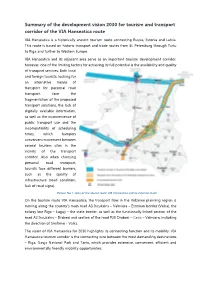
Summary of the development vision 2030 for tourism and transport corridor of the VIA Hanseatica route VIA Hanseatica is a historically ancient tourism route connecting Russia, Estonia and Latvia. This route is based on historic transport and trade routes from St. Petersburg through Tartu to Riga and further to Western Europe. VIA Hanseatica and its adjacent area serve as an important tourism development corridor, however, one of the limiting factors for achieving its full potential is the availability and quality of transport services. Both local and foreign tourists, looking for an alternative means of transport for personal road transport, face the fragmentation of the proposed transport solutions, the lack of digitally available information, as well as the inconvenience of public transport use and the incompatibility of scheduling times, which hampers convenient movement between several tourism sites in the vicinity of the transport corridor. Also when choosing personal road transport, tourists face different barriers, such as the quality of infrastructure (road condition, lack of road signs). Picture No 1: Area of the tourist route VIA Hanseatica and its external reach On the tourism route VIA Hanseatica, the transport flow in the Vidzeme planning region is moving along the country's main road A3 Incukalns – Valmiera – Estonian border (Valka), the railway line Riga – Lugaji – the state border, as well as the functionally linked section of the road A2 Incukalns – Drabesi and section of the road P20 Drabesi – Cesis – Valmiera, including the direction of Smiltene - Valka. The vision of VIA Hanseatica for 2030 highlights its connecting function and its mobility: VIA Hanseatica tourism corridor is the connecting wire between the most demanding destinations – Riga, Gauja National Park and Tartu, which provides extensive, convenient, efficient and environmentally friendly mobility opportunities. -

ENG Web Celvedis Arhitekturas Un Makslas Objekti Final Copy
ENG ARCHITECTURE AND ART IN VALMIERA GUIDEBOOK INTRODUCTION Valmiera is one of the oldest cities in Latvia. From 14th to 16th century it was a member of the Hanseatic League, from 18th to 20th century – a regional centre; and during the second half of the 20th century – a district centre. In 1702 the city was completely destroyed by the Russian army. During 1770s it was severely damaged by several res. At the dusk of the World War II, in September 1944, almost whole historical centre of Valmiera completely burnt down. Only few buildings remained intact – the Valmiera St. Simon’s Church, the medieval castle ruins and the building complex of the Valmiera Museum. Within the last 20 years a lot has been done to preserve the remaining historical heritage. The peculiar image of the city is also shaped by sculptures and environmental objects, particularly ones connected with the works of the famous sculptor and initiator of the stone sculpture symposium Andris Vārpa. This guidebook hopes to make the reader stop and have a look at the testimonies of their time, appreciate and evaluate ideas and opportunities, taste and aspirations of representation of the time, when all this was made. Source: Marburga photo archive SCULPTURES, MONUMENTS AND ENVIRONMENTAL OBJECTS 1. “A Gift to the New Millenium“ In 2001 in the Unity square the sculpture by Ginters Krūmholcs, resident of Valmiera and back then a student at the Art Academy of Latvia, was put up. For many years it served as the symbol of Valmiera, until a new logo was elaborated. In June 2015 it was moved next to the Vidzeme Olympic Centre, symbolizing gates to Valmiera and welcoming all arriving guests.