Konačna Rang Lista 2020/2021
Total Page:16
File Type:pdf, Size:1020Kb
Load more
Recommended publications
-
The Ruthenian Journey from the Carpathian Mountains to the Panonian Plain* M
182 2014, № 2 (36) UDC 94(497.1) THE RUTHENIAN JOURNEY FROM THE CARPATHIAN MOUNTAINS TO THE PANONIAN PLAIN* M. Fejsa Faculty of Philosophy, Department of Ruthenian Studies University of Novi Sad (Serbia) e-mail: fejsam@gmail.com Scopus Author ID: 56031169500 Abstract Although the Ruthenians / Rusyns in Serbia (less than 15 000 members of the Ruthenian (Rusyn national community today) were cut off from their brethren in the Carpathian area they have managed to survive on the Panonian Plain. Comparing to the Ruthenians in all other countries the Ruthenians in Serbia have the highest level of minority rights. The Serbian / Vojvodinian authorities do their best to implement international conventions and there is a hope for the Ruthenians in Serbia / Vojvodina to preserve their culture, language and national identity in the future. Keywords: Ruthenians in Serbia / Vojvodina, Carpathian homeland, ethnocultural development, Ruthenian language, national minorities For centuries Ruthenians / Rusyns lived within the borders of Hungarian Kingdom. They lived in the northeast Hungarian counties, namely, in Zemplen, Saros, Abauj-Torna, Borsod, Szabolcs, Ung, Ugocsa, Maramaros and Gemer. Some 260 years ago, groups of Ruthenians began migrating south from their homeland in the Carpathian mountains to the Srem and Bačka regions of what is now Vojvodina in Serbia and Eastern Slavonia in Croatia (Фејса, 2010: 112-113). After the defeat and retreat of the Ottoman Empire from Bačka, Srem and Banat in 1699, the Austro-Hungarian authorities needed more population in the south of their state and supported colonization of Germans, Hungarians, Slovaks and others, among them Ruthenians as well (Gavrilović, 1977: 153). -

Lokalni Energetski Plan Čoka
ELE K TROTE H N I ČKI INSTITUT "NIKOLA TESLA" Centar z a elektr o energet s k e sisteme Beograd PROJEKAT TEHNI Č KE USLUGE MIN I STAR S TVU RUDARSTVA I ENER G ET I KE ZA IMPLEMENTACIJU ALTERENERGY PROJEKTA (RADNI PAKET 4) L O KANI ENERGETSKI PLAN OP Š T INE Č OKA 2014. god i na ELE K TROTE H N I ČKI INSTITUT "NIKOLA TESLA" Centar z a elektr o energet s k e sisteme Beograd, Koste Glavin i ć a 8a Projekat br. 114013/4 TEHNI Č KA USLUGE M I NISTAR S TVU RUDAR S TVA I ENERGET I KE ZA IMPLEMENTACIJU ALTERENERGY PROJEKTA (RADNI PAKET 4) L O KALNI ENER G ET S KI PLAN O P Š TINE Č OKA Korisnik: Ministarstvo rudarstva i energetike Ur a đeno prema: Ugovor u br . 1 1 9 - 01 - 0 0 311/ 2 013 - 0 4 o d 5 . 6. 20 1 4, Ugovor o us l ugama br. STR/00 01 /0/T - 01 (M i n i starstvo rudarstva i energetike) Ugovoru br. 01 / 2454 od 4. 6. 2014. (Institut “Nikola Tesla”) Broj strana: 31 I z veštaj isp o ručen: 27. 1 1 . 2 01 4 . Ključni eks p ert 1: Saša Minić, dipl. el. ing. Ključni eks p ert 2: Gordana Radović, d ipl i n g. Saradnici: Branislav Ć up ić, dipl. el. i ng. Dragan Đ o r đ ević, m ast. el. ing. Jelena Per i ć, mast. el. ing. Miloš A nđ elković, m a st. -

Prethodna Studija Izvodljivosti Izgradnje RVS Dubovac-Zrenjanin-Kikinda-Knjiga 2
Prethodna Studija izvodljivosti izgradnje RVS Dubovac-Zrenjanin-Kikinda-Knjiga 2 1. Uvod Brz razvoj privrede i društva i urbanizacija naselja u proteklom periodu na području Vojvodine nije uporedo pratila izgradnja infrastrukturnih objekata koji obezbeđuju stabilno i kvalitetno vodosnabdevanje. Neadekvatno rešenje vodosnabdevanja ogleda se pre svega u nestašici vode pri čemu posebno treba istaći neadekvatan kvalitet isporučene vode, koji u pojedinim regionima Vojvodine predstavlja osnovni problem vodovodnih sistema. Javno snabdevanje vodom u Vojvodini je orijentisano isključivo na korišćenje podzemnih voda iz različitih vodonosnih sredina: aluvijalnih sedimenata u priobalju Save i Dunava - "prva" izdan (dubine bunara do 50 m), osnovnog vodonosnog kompleksa - osnovna izdan (dubine bunara od 50-250m) i subarteske i arteske izdani - duboka izdan (dubine bunara od 250m do 350m) Problemi koji se javljaju u vodosnabdevanju prema svojoj prirodi mogu se generalno svrstati u dve grupe: 1. problemi vezani za resurs podzemnih voda 2. problemi vezani za vodovodne sisteme Problemi vezani za resurs podzemnih voda se mogu svrstati u dve kategorije: problemi nedovoljnih količina podzemnih voda i problemi neodgovarajućeg kvaliteta. Period od početka organizovanog vodosnabdevanja 60-tih godina prošlog veka do danas karakteriše se izrazitim porastom eksploatacije podzemnih voda na području cele Vojvodine (Zahvaćene količine podzemnih voda iz izdani koje se sporo obnavljaju (osnovne i duboke izdani) su znatno veće (4600 l/s) od količina zahvaćenih iz relativno brzo obnovljive izdani ("prve" izdani) - oko 1900 l/s. S obzirom na činjenicu da su izvorišta formirana u naseljima ili u njihovoj neposrednoj blizini, eksploatacija podzemnih voda se vrši na malom prostoru što je dovelo do sniženja nivoa podzemnih voda, kako lokalno tako i na širem području. -

The Small Religious Communities of Yugoslavia
Occasional Papers on Religion in Eastern Europe Volume 3 Issue 6 Article 2 9-1983 The Small Religious Communities of Yugoslavia Rudolf Grulich Follow this and additional works at: https://digitalcommons.georgefox.edu/ree Part of the Christianity Commons, and the Eastern European Studies Commons Recommended Citation Grulich, Rudolf (1983) "The Small Religious Communities of Yugoslavia," Occasional Papers on Religion in Eastern Europe: Vol. 3 : Iss. 6 , Article 2. Available at: https://digitalcommons.georgefox.edu/ree/vol3/iss6/2 This Article, Exploration, or Report is brought to you for free and open access by Digital Commons @ George Fox University. It has been accepted for inclusion in Occasional Papers on Religion in Eastern Europe by an authorized editor of Digital Commons @ George Fox University. For more information, please contact arolfe@georgefox.edu. l THE SMALL RELIGIOUS COMMUNITIES OF YUGOSLAVIA by Rudolf Grulich Th e Old Catholics Th e Croatian bishop Josip Jura j Stro ssmay er of Djakovo was th e most outspo ken oppon ent of th e dogma of papal infallibility at th e First Vatican Council , and also th e last bi shop to accept th e council 's decre es in 18 73, thr ee years aft er th e meet ing . Th ere was , how ever, no Old Catholic mov ement in th e Croatian dioc es es at that tim e, although th e situation was diff erent in th e German-sp eaking ar eas of middl e Europ e. This was becaus e the imp erial gov ernment in Vi enna was against th e Old Catholic mov ement . -

Potentials of Renewable Energy Sources in the Republic of Serbia
POTENTIALS OF RENEWABLE ENERGY SOURCES IN THE REPUBLIC OF SERBIA WITH A DETAILED REVIEW OF THE EXPLOITATION OF GEOTHERMAL RESOURCES IN THE AUTONOMOUS PROVINCE OF VOJVODINA Zoran Stipi ć City of Subotica Urban Planning Institute, Trg Republike 16, Subotica, Serbia szoran01@gmail.com Slobodan Vidovi ć Tehnoproing , Gogoljeva 13,Novi Sad, Serbia, slo.vidovic@gmail.com Mom čilo Spasojevi ć Faculty of Technical Sciences, Trg D.Obradovi ća 6, Novi Sad, Serbia, momcilo.spasojevic@open.telekom.rs Abstract: Energy supply is one of the basic issues in the contemporary world’s sustainable development. By adopting the Kyoto Protocol and implementing its mechanisms, it is expected that the use of conventional energy sources shall stabilise and decrease on global level. The European Union’s legal framework, through its appropriate directives, sets very clear objectives for the use of renewable energy sources for member states. Serbia is a country with significant potentials in renewable energy sources, which are, regretfully, underused. Renewable energy source potentials are featured by very favourable indicators in matters of both capacity and distribution. The status is especially favourable in the field of geothermal energy potentials in the Autonomous Province of Vojvodina, situated in the Pannonian Basin, where there are significant sources of this fuel. The paper presents the basic forms and characteristics of renewable energy sources in Serbia and provides an overview of the possibilities for their use. Key words: Renewable energy sources, potentials, capacities, resources, geothermal energy, Serbia, Vojvodina. 1. INTRODUCTION Solving global energy problems implies an interdisciplinary approach and considering the issues from different perspectives. Decreasing overall energy consumption, increasing energy efficiency, modernising the installation, using alternative energy sources and adopting and implementing a number of legal regulations and international covenants are the points of departure in solving this exceptionally complex issue. -

Serbia in 2001 Under the Spotlight
1 Human Rights in Transition – Serbia 2001 Introduction The situation of human rights in Serbia was largely influenced by the foregoing circumstances. Although the severe repression characteristic especially of the last two years of Milosevic’s rule was gone, there were no conditions in place for dealing with the problems accumulated during the previous decade. All the mechanisms necessary to ensure the exercise of human rights - from the judiciary to the police, remained unchanged. However, the major concern of citizens is the mere existential survival and personal security. Furthermore, the general atmosphere in the society was just as xenophobic and intolerant as before. The identity crisis of the Serb people and of all minorities living in Serbia continued. If anything, it deepened and the relationship between the state and its citizens became seriously jeopardized by the problem of Serbia’s undefined borders. The crisis was manifest with regard to certain minorities such as Vlachs who were believed to have been successfully assimilated. This false belief was partly due to the fact that neighbouring Romania had been in a far worse situation than Yugoslavia during the past fifty years. In considerably changed situation in Romania and Serbia Vlachs are now undergoing the process of self identification though still unclear whether they would choose to call themselves Vlachs or Romanians-Vlachs. Considering that the international factor has become the main generator of change in Serbia, the Helsinki Committee for Human Rights in Serbia believes that an accurate picture of the situation in Serbia is absolutely necessary. It is essential to establish the differences between Belgrade and the rest of Serbia, taking into account its internal diversities. -

Jedinica Lokalne Samouprave Grad/Mesto Naziv Marketa Adresa Ada Ada TSV DISKONT Lenjinova 44A Ada Ada TSV Diskont Lenjinova 24 A
Jedinica lokalne samouprave Grad/Mesto Naziv marketa Adresa Ada Ada TSV DISKONT Lenjinova 44a Ada Ada TSV Diskont Lenjinova 24 Ada Ada Univerexport SABO SEPEŠI LASLA 88 Ada Ada Trgopromet LENJINOVA 44A Ada Ada DUDI CO D.O.O. Lenjinova 15 Ada Ada DTL - AD Senta Promet TP Bakoš Kalmana 1 Ada Ada DTL - AD Senta Promet TP Žarka Zrenjanina 12 Ada Ada DTL - AD Senta Promet TP Karadjordjeva br 61 Ada Ada DTL - AD Senta Promet TP Ul. Save Kovačevića 1 Ada Ada Gomex Lenjinova 2 Ada Mol TSV Diskont Maršala Tita 75 Ada Mol DTL - AD Senta Promet TP Ul Đure Daničića 24 Ada Mol Gomex Maršala Tita 50 Aleksandrovac Aleksandrovac TSV DISKONT 29. Novembra 48 Aleksandrovac Aleksandrovac TR Lukić ITS Gornje Rateje BB Aleksandrovac Aleksandrovac STR Popović 29. Novembar 105/2 Aleksandrovac Aleksandrovac STR Popović Kruševačka BB Aleksandrovac Aleksandrovac Str Mira Dobroljupci BB Aleksandrovac Aleksandrovac Mesara Glidžić 29 Novembra bb Aleksandrovac Aleksandrovac IM Biftek Niš 29.novembar br.86 Aleksandrovac Aleksandrovac DIS 10. Avgusta bb, 37230 Aleksandrovac Aleksandrovac Garevina STUR TOŠA GAREVINA Garevina Aleksinac Aleksinac PD SUPERMARKETI AS DOO KNJAZA MILOSA 40 Aleksinac Aleksinac PD SUPERMARKETI AS DOO KNJAZA MILOSA 138-144 Aleksinac Aleksinac PD SUPERMARKETI AS DOO MOMČILA POPOVIĆA 128 Aleksinac Aleksinac SL Market Knjaza Milosa 77 Aleksinac Aleksinac IM Biftek Niš Majora Tepića br.11 Aleksinac Aleksinac IM Biftek Niš Momčila Popovića br. 19 Aleksinac Aleksinac Kneza Miloša 80 Aleksinac Aleksinac Apoteka Arnika Momčila Popovića 23 Aleksinac Aleksinac -
Spatial, Cultural and Historical Entities in Bačka Ings Around It Mainly Date from the End of About When Mentioning Building of This City
GEOGRAPHICA ANNONICA No8; p 47-52 ence entities, cultural and ambience values of Lake Palić, Jodna banja (health resort) in Spatial, Cultural and Novi Sad and medieval fort in Bač Old City Centers Historical Entities in Bačka Old city centers are favorite staying plac- es for tourists, trade centers, cultural plac- es, places to meet people and entertain. In Bačka there is a significant number of inter- esting and preserved old city centers such as those in Bečej, Sombor, Novi Sad and Subotica. They were formed at the end of Besermenji, S.* 18th and the beginning of 19th century and are composed of institutions and buildings that belonged to rich people and officials. Abstract Spatial cultural-historical entities ultural values in Bačka are prod- are urban or rural settlements of their ucts of material and spiritual cul- Novi Sad parts. It is space with unmovable cultural Cture of different ethnic groups; fact Novi Sad is a relatively young city whose goods with distinct cultural and historical that makes them even more attractive. Di- existence goes back to the end of 17th cen- values. This group of cultural goods is very versity of cultural heritage in Bačka repre- tury when in 1748 it obtained the status numerous in this area of Bačka, and it is sents a tangible tourist product. This kind of of a Royal Borough by the decree of Maria very convenient to tourist presentation and diversity in Bačka and Vojvodina is unique Theresa. Today’s name of the city goes back valorization. In Bačka these are old town in whole Europe and that should be used as to that period and it means “new vineyard”. -

Serbia 2Nd Periodical Report
Strasbourg, 23 September 2010 MIN-LANG/PR (2010) 7 EUROPEAN CHARTER FOR REGIONAL OR MINORITY LANGUAGES Second periodical report presented to the Secretary General of the Council of Europe in accordance with Article 15 of the Charter SERBIA The Republic of Serbia The European Charter for Regional or Minority Languages The Second Periodical Report Submitted to the Secretary General of the Council of Europe Pursuant to Article 15 of the Charter Belgrade, September 2010 2 C O N T E N T S 1. INTRODUCTION ……………………………………………………………………6 2. Part I …………………………………………………………………………………12 2.1. Legislative and institutional changes after the first cycle of monitoring of the implementation of the Charter …………………………………………………….12 2.1.1. Legislative changes ……………………………………………………….12 2.1.2. The National Strategy for the Improvement of the Status of Roma ……..17 2.1.3. Judicial Reform …………………………………………………………...17 2.1.4. Establishment of the Ministry of Human and Minority Rights …………..23 2.2. Novelties expected during the next monitoring cycle of the implementation of the Charter …………………………………………………………………………….24 2.2.1. The Census ………………………………………………………………..24 2.2.2. Election of the national councils of the national minorities ……………...26 2.3. Implementation of the recommendations of the Committee of Ministers of the Council of Europe (RecChL(2009)2) 28) …………………………………………29 2.4. Activities for the implementation of the box-recommendation of the Committee of Experts with regard to the implementation of the Charter ………………………...33 3. PART II Implementation of Article 7 of the Charter ……………………………..38 3.1. Information on the policy, legislation and practice in the implementation of Part II - Article 7 of the Charter ……………………………………………………………..38 3.1.1. -

The Distribution of Microorganisms in Different Types of Agricultural Soils in the Vojvodina Province
Research Journal of Agricultural Science, 44 (3), 2012 THE DISTRIBUTION OF MICROORGANISMS IN DIFFERENT TYPES OF AGRICULTURAL SOILS IN THE VOJVODINA PROVINCE Jelena MARINKOVIĆ, Dragana BJELIĆ, Jovica VASIN, Branislava TINTOR, Jordana NINKOV Institute of Field and Vegetable Crops, Maksim Gorki St., 30, 21000 Novi Sad, Serbia; E-mail: jelena.marinkovic@ifvcns.ns.ac.rs Abstract: The soil fertility is determined by its All investigated microbial groups were found in all composition and properties. Soil properties have a locations. Number of the microorganisms was strong impact on a range of processes influencing uneven by type of soil. Studies have shown that the crop yield, including microbial diversity. The highest total number of bacteria was obtained on distribution of microorganisms in soil is influenced humogley and chernozem, in the locations of Bečej, by numerous abiotic and biotic factors, primarily Begejci and Kula. The highest distribution was by soil type, plant species, soil usage and tillage, recorded on chernozem, at the locations where the use of organic and mineral fertilizers, irrigation, plough-field and harvest residues of maize were pesticide application, etc. Therephore, the objective found, as well as on fluvisol and humogley. The of this study was to examine the distribution of highest number of ammonium-fixing bacteria was microorganisms in different types of agricultural recorded in Zrenjanin, on chernozem. N-fixing soils in the Vojvodina Province. The distribution of bacteria were the most abundant on cambisol, in soil microbes was assessed on the basis of indirect the locations of Petrovaradin and Vršac, as well as dilution method on appropriate nutritive media. -

PAYS SECTION Serbie Établissements De Taxidermie
En vigueur depuis le: PAYS Serbie 10/08/2007 00038 SECTION Établissements de taxidermie Date de publication 09/01/2020 Liste en vigueur Numéro Nom Ville Régions Activités Remarque Date de la demande d'agrément RS-47-001 JP „Vojvodinašume" Klenak Sremski okrug CAT3 RS-47-002 JP „Vojvodinašume“ Apatin Zapadno-bački okrug CAT3 RS-47-003 JP „Vojvodinašume“ Subotica Severno-bački okrug CAT3 RS-47-004 Vojna Ustanova “Morović” Morović Sremski okrug CAT 2, CAT3 RS-47-006 JP „Vojvodinašume“ Bač Južnobački okrug CAT 2, CAT3 RS-47-007 PVS ”Profivet”d.o.o. Trešnjevac Severno-banatski okrug CAT3 RS-47-008 Lovačko Udruženje „Perjanica” Mokrin Severno-banatski okrug CAT 2, CAT3 RS-47-009 JP „Srbijašume“ Beograd (Novi Beograd) Grad Beograd CAT3 RS-47-010 Lovačko Udruženje „Emil Talijan“ Novi Kneževac Severno-banatski okrug CAT3 RS-47-011 D.O.O. „Hubertus“ Ada Severno-banatski okrug CAT3 RS-47-012 Lovačko Udruženje “Novi Bečej” Novi Bečej Srednje-banatski okrug CAT3 RS-47-013 Lovačko Udruženje „Padej“ Padej Severno-banatski okrug CAT3 RS470138 SRDAN VUČKOVIĆ PR IZRADA RAZNOVRSNIH PREDMETA Beograd (Novi Beograd) Grad Beograd CAT 2, CAT3 08/01/2020 BG HUNTING BEOGRAD RS-47-015 Lovačko Udruženje “Kikinda” Kikinda Severno-banatski okrug CAT3 RS-47-016 VOJVODINASUME Dubovac Južno-banatski okrug CAT3 23/07/2013 1 / 3 Liste en vigueur Numéro Nom Ville Régions Activités Remarque Date de la demande d'agrément RS-47-017 DOO „Beli Lovac“ Sremski Karlovci Južnobački okrug CAT 2, CAT3 RS-47-018 Lovačko Udruženje „Senta“ Gornji Breg Severno-banatski okrug CAT3 RS-47-019 -
Executive Summary
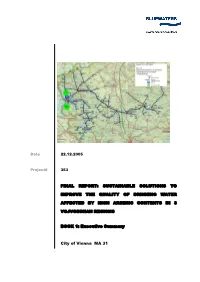
Date 22.12.2005 Project# 353 FINAL REPORT: SUSTAINABLE SOLUTIONS TO IMPROVE THE QUALITY OF DRINKING WATER AFFECTED BY HIGH ARSENIC CONTENTS IN 3 VOJVODINIAN REGIONS BOOK 1: Executive Summary City of Vienna MA 31 i. TABLE OF CONTENTS BOOK I 1 EXECUTIVE SUMMARY...................................................................................................... 1.12 1.1 INTRODUCTION ................................................................................................................... 1.12 1.2 SCOPE AND OBJECTIVES..................................................................................................... 1.12 1.2.1 Scope .............................................................................................................................. 1.12 1.2.2 Objectives ....................................................................................................................... 1.13 1.3 METHODOLOGY.................................................................................................................. 1.14 1.4 LEGAL FEASIBILITY............................................................................................................ 1.18 1.5 REGULATIONS AND DIRECTIVES ........................................................................................ 1.18 1.5.1 European Drinking Water Directive .............................................................................. 1.18 1.5.2 Regulations for Groundwater Protection....................................................................... 1.19